 Physical activity (PA) is defined as ‘any bodily
movement produced by skeletal muscles that
results in energy expenditure above resting
(basal) levels.
 Exercise is a subcategory of PA ‘that is planned,
structured and repetitive and [that] has, as a final
or intermediate objective, the improvement or
maintenance of one or more dimensions of
physical fitness’
Garber CE et al (2011)
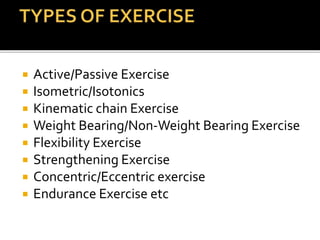
 Active/Passive Exercise
 Isometric/Isotonics
 Kinematic chain Exercise
 Weight Bearing/Non-Weight Bearing Exercise
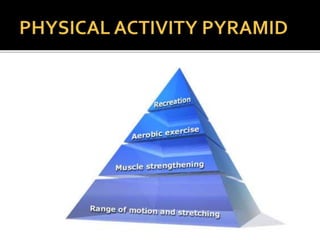
 Flexibility Exercise
 Strengthening Exercise
 Concentric/Eccentric exercise
 Endurance Exercise etc
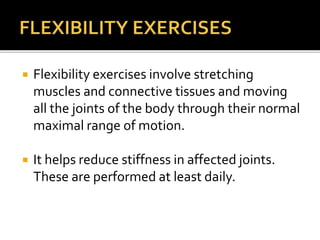
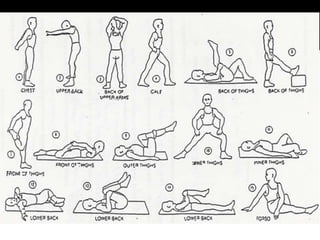
 Flexibility exercises involve stretching
muscles and connective tissues and moving
all the joints of the body through their normal
maximal range of motion.
 It helps reduce stiffness in affected joints.
These are performed at least daily.
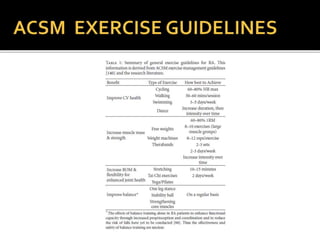
• Resistance exercise can increase strength and enhance the
capability of muscles to support the joints of the body.
• Start relatively low amount of weight to start, about 10%
of maximum, and progresses about 10% per week as
tolerated.
• Frequency should be 2 to 3 days per week with one or
more sets of 10 to 15 repetitions per exercise per session.
• Progressive resistance exercises can be performed using
machines, handheld weights (e.g., dumbbells), or
resistance bands.
• Aerobic or cardiovascular exercise helps improve the
overall level of fitness.
• Aerobic exercise involves non- or lowimpact
activities (e.g., walking, water aerobics, swimming,
indoor or outdoor cycling, elliptical training).
• Start with several brief (i.e., a few minutes) bouts of
aerobic exercise as tolerated to reach 20 to 30
minutes daily.
• 150 minutes of moderate-intensity activity per week
accumulated for 3 to 5 days or 75 minutes of
vigorous-intensity per week is the recommended
goal.
• A joint and its surrounding muscles are often
affected by surgery or the disease itself,
resulting in impaired balance and
coordination.
• Exercises to improve posture, balance, joint
position, coordination, and relaxation should
be included in a comprehensive treatment
plan.
 Cold packs
 Relaxation techniques
 Joint protection techniques
 Energy Conservation techniques
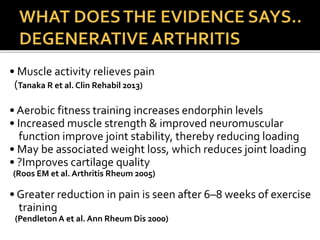
• Muscle activity relieves pain
(Tanaka R et al. Clin Rehabil 2013)
• Aerobic fitness training increases endorphin levels
• Increased muscle strength & improved neuromuscular
function improve joint stability, thereby reducing loading
• May be associated weight loss, which reduces joint loading
• ?Improves cartilage quality
(Roos EM et al. Arthritis Rheum 2005)
• Greater reduction in pain is seen after 6–8 weeks of exercise
training
(Pendleton A et al. Ann Rheum Dis 2000)
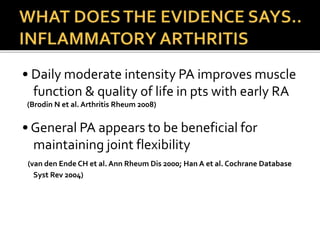
• Daily moderate intensity PA improves muscle
function & quality of life in pts with early RA
(Brodin N et al. Arthritis Rheum 2008)
• General PA appears to be beneficial for
maintaining joint flexibility
(van den Ende CH et al. Ann Rheum Dis 2000; Han A et al. Cochrane Database
Syst Rev 2004)
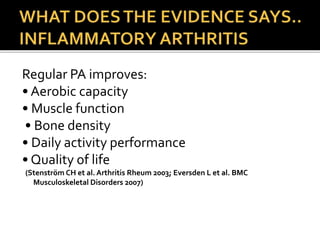
Regular PA improves:
• Aerobic capacity
• Muscle function
• Bone density
• Daily activity performance
• Quality of life
(Stenström CH et al. Arthritis Rheum 2003; Eversden L et al. BMC
Musculoskeletal Disorders 2007)
THANKYOU

Exercise and Arthritis

  • 2.
     Physical activity(PA) is defined as ‘any bodily movement produced by skeletal muscles that results in energy expenditure above resting (basal) levels.  Exercise is a subcategory of PA ‘that is planned, structured and repetitive and [that] has, as a final or intermediate objective, the improvement or maintenance of one or more dimensions of physical fitness’ Garber CE et al (2011)
  • 4.
     Active/Passive Exercise Isometric/Isotonics  Kinematic chain Exercise  Weight Bearing/Non-Weight Bearing Exercise  Flexibility Exercise  Strengthening Exercise  Concentric/Eccentric exercise  Endurance Exercise etc
  • 5.
     Flexibility exercisesinvolve stretching muscles and connective tissues and moving all the joints of the body through their normal maximal range of motion.  It helps reduce stiffness in affected joints. These are performed at least daily.
  • 7.
    • Resistance exercisecan increase strength and enhance the capability of muscles to support the joints of the body. • Start relatively low amount of weight to start, about 10% of maximum, and progresses about 10% per week as tolerated. • Frequency should be 2 to 3 days per week with one or more sets of 10 to 15 repetitions per exercise per session. • Progressive resistance exercises can be performed using machines, handheld weights (e.g., dumbbells), or resistance bands.
  • 8.
    • Aerobic orcardiovascular exercise helps improve the overall level of fitness. • Aerobic exercise involves non- or lowimpact activities (e.g., walking, water aerobics, swimming, indoor or outdoor cycling, elliptical training). • Start with several brief (i.e., a few minutes) bouts of aerobic exercise as tolerated to reach 20 to 30 minutes daily. • 150 minutes of moderate-intensity activity per week accumulated for 3 to 5 days or 75 minutes of vigorous-intensity per week is the recommended goal.
  • 9.
    • A jointand its surrounding muscles are often affected by surgery or the disease itself, resulting in impaired balance and coordination. • Exercises to improve posture, balance, joint position, coordination, and relaxation should be included in a comprehensive treatment plan.
  • 12.
     Cold packs Relaxation techniques  Joint protection techniques  Energy Conservation techniques
  • 13.
    • Muscle activityrelieves pain (Tanaka R et al. Clin Rehabil 2013) • Aerobic fitness training increases endorphin levels • Increased muscle strength & improved neuromuscular function improve joint stability, thereby reducing loading • May be associated weight loss, which reduces joint loading • ?Improves cartilage quality (Roos EM et al. Arthritis Rheum 2005) • Greater reduction in pain is seen after 6–8 weeks of exercise training (Pendleton A et al. Ann Rheum Dis 2000)
  • 14.
    • Daily moderateintensity PA improves muscle function & quality of life in pts with early RA (Brodin N et al. Arthritis Rheum 2008) • General PA appears to be beneficial for maintaining joint flexibility (van den Ende CH et al. Ann Rheum Dis 2000; Han A et al. Cochrane Database Syst Rev 2004)
  • 15.
    Regular PA improves: •Aerobic capacity • Muscle function • Bone density • Daily activity performance • Quality of life (Stenström CH et al. Arthritis Rheum 2003; Eversden L et al. BMC Musculoskeletal Disorders 2007)
  • 18.