Exercise in rheumatic disease
Aims of physical therapy in arthritis - restoration of optimal function using non-pharmacological modalities. Heat/cold, electrotherapy, mobilisations & manipulations - decrease pain, swelling, muscle spasm, joint stiffness, increase ROM.
The efficacy and mode of action of these modalities are poorly evaluated - controlled clinical trials essential. Placebo effects - very powerful, useful adjunct to therapy. Passive treatment modalities - therapist in control, when the treatment is stopped the patient cannot help themselves.
The role of muscle in arthritis Research has focused on immunology, biochemistry, bone and cartilage, paucity of research on the role of muscle. Synovial joint is a  functional unit  comprised of intra- and extra-articular structures. If any component of this unit is dysfunctional the joint will be dysfunctional. Muscle dysfunction  (weakness, fatigue, joint instability) is a frequent and early clinical feature, which is assumed to adversely affect functional performance.
Muscle function Motor -  Contraction Functional stability Shock absorption Sensory -  Proprioceptive acuity  -  muscles spindles Motor and sensory functions of muscle intimately related, may be inappropriate to consider them separately.
Joint-muscle interrelationship 1. Consequences of articular dysfunction on muscle activity: Joint pain, effusion, structural damage, psychological factors alter muscle activity;  -motorneurone excitability - reducing motor control and output resulting in weakness  -motorneurone excitability - desensitising the muscle spindles thus reducing sensory input.
2. Consequences of muscle dysfunction on articular function: De-conditioned muscles (age-related, injury, reduced activity, psychosocial influences) become weak and poorly controlled, this compromise the  neuromuscular protective mechanisms  that attenuate harmful impulsive heel strike transients, resulting in; excessive, rapid joint loading and jarring, abnormal movement, laxity/instability, stress innervated tissues causing pain, gait alterations, increased risk of joint damage.
2. Consequences of muscle dysfunction: Micro trauma to cartilage and subchrondral bone results in; fissuring and attrition of articular cartilage, subchrondral bone heals with callus formation to become sclerotic which is less resilience and dissipates forces acting across the joint poorly. The ebonated subchrondral bone becomes the anvil upon which the articular cartilage is pounded during each cycle of gait.
Which occurs first - muscle weakness, joint damage, pain or disability - is unknown. For OA an argument can be constructed suggesting that muscle dysfunction is the  cause  rather than the result of the pathology (circumstantial, tenuous, difficult to prove, specific to sub-sets and site)
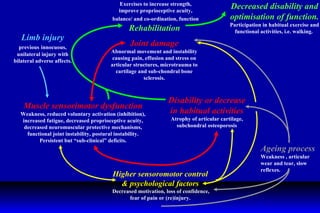
Higher sensoromotor control & psychological factors Decreased motivation, loss of confidence, fear of pain or (re)injury. Muscle sensorimotor dysfunction Weakness, reduced voluntary activation (inhibition), increased fatigue, decreased proprioceptive acuity, decreased neuromuscular protective mechanisms, functional joint instability, postural instability. Persistent but “sub-clinical” deficits. Ageing process Weakness , articular wear and tear, slow reflexes.   Decreased disability and optimisation of function. Participation in habitual exercise and functional activities, i.e. walking.  Limb injury   previous   innocuous, unilateral injury with bilateral adverse affects. Joint damage Abnormal movement and instability causing pain, effusion and stress on articular structures, microtrauma to cartilage and sub-chondral bone sclerosis. Disability or decrease in habitual activities  Atrophy of articular cartilage, subchondral osteoporosis Exercises to increase strength, improve proprioceptive acuity, balance/ and co-ordination, function   Rehabilitation
Summary Muscle is vital for joint health and function Muscle sensorimotor dysfunction maybe very important in the pathogenesis of joint damage  Whether the cause or consequence, maintenance of physical activity and adequate rehabilitation following damage it is essential in maintenance of musculoskeletal health
The good news Muscle is an extremely plastic tissue, motor (strength, endurance) and sensory (skill acquisition) can be improved - even in the elderly (nonagenarians). If joint damage is due to muscle dysfunction maintaining well-conditioned muscles may Delay the onset of OA Ameliorate the effects of OA, Retard, halt or even reverse progression of OA
Exercise therapy - Decreases pain, swelling, muscle spasm, joint stiffness. Increases muscle strength and endurance, ROM, joint stability, function and mobility. Movement is good for health of articular cartilage, bone and general health of patients. Active treatment modality - management of the condition returned to the patient.
Systematic reviews are confirming that exercise increases muscle strength and function, without   exacerbating disease and they are being recommended by professional bodies; Osteoarthritis van Baar et al,  Arth & Rheum, 1999 Rheumatoid Arthritis van den Ende et al Brit J Rheum, 1998 Low back pain Van Tulder et al Spine 2000 Anklosing Spondilityis Juvenile Idiopathic Arthritis
Rehabilitation regimen. A clinically practicable rehabilitation regimen (10 x 30 minutes exercise sessions – strength, function, balance and co-ordination exs.) effected a large increase in quadriceps strength and for the first time improved proprioceptive acuity. Accompanying these increases were concurrent improvements in objective and subjective functional   performance. The improvements maintained 6 months after rehabilitation.
But, regime is; Hospital-based + supervised + indiv. therapy = cost-inefficient  To be effective must be performed regularly (twice a week) over a long time (forever!). Size of patient population and resources preclude long-term hospital management So patients must exercise in the community to maintain benefits of rehab. Patients need to understand the condition, how to manage it, and enable them to manage it.
Patient education programmes  dispel fallacies about arthritis, encourage self-management and improves adherence with these lifestyle changes, i.e. weight loss and simple exercise. Psychosocial factors are strong predictors of functional impairment and pain. Cognitive behavioural therapy  often incorporate exercise to improve physical function, feelings of self-confidence and self-esteem, and social interaction.
Perceived self-efficacy (for exercise)  is an individuals belief they can perform a specific health behaviour (exercise) that will improve their health. Major influence on compliance with exercise regimes. Enhanced by patients believing in the benefits of exercise, and their ability to exercise. Achieved by patients experiencing the benefits a simple and practicable exercise regime.
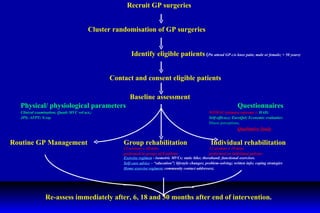
Recruit GP surgeries     Cluster randomisation of GP surgeries     Identify eligible patients  ( Pts attend GP c/o knee pain; male or female; > 50 years)    Contact and consent eligible patients   Baseline assessment Physical/ physiological parameters  Questionnaires Clinical examination; Quads MVC vol act,; WOMAC (primary outcome );  HAD; JPS; AFPT; X-ray Self-efficacy; EuroQol; Economic evaluatio n Illness perceptions, Qualitative Study Routine GP Management  Group rehabilitation   Individual rehabilitation 12 sessions x 30 mins 12 sessions x 30 mins  performed in groups of 8 patients  performed on individual patients  Exercise regimen  - isometric MVCs; static bike; theraband; functional exercises. Self-care advice  – “education”; lifestyle changes; problem-solving; written info; coping strategies Home exercise regimen ; community contact addresses). Re-assess immediately after, 6, 18 and 30 months after end of intervention .
Facilitating habitual exercise in the community   Home-based rehab.  is probably the easiest, and therefore best, place to exercise. May not be effective - evaluate efficacy. Problems with compliance - reinforcement and positive feedback, regular follow-up.
Community-based rehab.  may be effective but provision is poor. Co-operation between local health and social services may enable expansion of community-base rehab. facilitates, where exercise, adoption of healthier lifestyles and coping strategies can be encouraged.
Management of arthritis: The Golden Scenario. Positive attitude - relentless joint degeneration is not inevitable, good prognosis, effects can be limited. Education - ourselves, patients and public about aetiology, course, prognosis. Correct advice - re-inforced by all health professions. Early diagnosis - implement therapy as soon as possible.
Modify life-style - loose weight, footwear, exercise gently but regularly - movement is not detrimental, inactivity is. Rehabilitation -  establish  what/when modalities are most effective, develop cost-effective regimes - group classes, home exercises. Follow-up. Self-management - get the patient to take responsibility for the management of their condition.
Arthritis is an enormous problem, which is incurable but treatable. Rehab. (exercise, education, etc.) can alleviate the problems, but not enough patients are benefiting from effective regimes. Long term participation in habitual exercise, in the community is essential.
To be enhance habitual exercise explain; the aims of exercising to the patients and involve family/carers - reinforce regularly. the exercise regime - make it functional, practicable and pleasurable, arthritis has a unpredictable and variable course - if experiencing pain, rest the joint, but  resume  exercising when the pain settles.

Exercise In Rhuematology Lecture

  • 1.
  • 2.
    Aims of physicaltherapy in arthritis - restoration of optimal function using non-pharmacological modalities. Heat/cold, electrotherapy, mobilisations & manipulations - decrease pain, swelling, muscle spasm, joint stiffness, increase ROM.
  • 3.
    The efficacy andmode of action of these modalities are poorly evaluated - controlled clinical trials essential. Placebo effects - very powerful, useful adjunct to therapy. Passive treatment modalities - therapist in control, when the treatment is stopped the patient cannot help themselves.
  • 4.
    The role ofmuscle in arthritis Research has focused on immunology, biochemistry, bone and cartilage, paucity of research on the role of muscle. Synovial joint is a functional unit comprised of intra- and extra-articular structures. If any component of this unit is dysfunctional the joint will be dysfunctional. Muscle dysfunction (weakness, fatigue, joint instability) is a frequent and early clinical feature, which is assumed to adversely affect functional performance.
  • 5.
    Muscle function Motor- Contraction Functional stability Shock absorption Sensory - Proprioceptive acuity - muscles spindles Motor and sensory functions of muscle intimately related, may be inappropriate to consider them separately.
  • 6.
    Joint-muscle interrelationship 1.Consequences of articular dysfunction on muscle activity: Joint pain, effusion, structural damage, psychological factors alter muscle activity;  -motorneurone excitability - reducing motor control and output resulting in weakness  -motorneurone excitability - desensitising the muscle spindles thus reducing sensory input.
  • 7.
    2. Consequences ofmuscle dysfunction on articular function: De-conditioned muscles (age-related, injury, reduced activity, psychosocial influences) become weak and poorly controlled, this compromise the neuromuscular protective mechanisms that attenuate harmful impulsive heel strike transients, resulting in; excessive, rapid joint loading and jarring, abnormal movement, laxity/instability, stress innervated tissues causing pain, gait alterations, increased risk of joint damage.
  • 8.
    2. Consequences ofmuscle dysfunction: Micro trauma to cartilage and subchrondral bone results in; fissuring and attrition of articular cartilage, subchrondral bone heals with callus formation to become sclerotic which is less resilience and dissipates forces acting across the joint poorly. The ebonated subchrondral bone becomes the anvil upon which the articular cartilage is pounded during each cycle of gait.
  • 9.
    Which occurs first- muscle weakness, joint damage, pain or disability - is unknown. For OA an argument can be constructed suggesting that muscle dysfunction is the cause rather than the result of the pathology (circumstantial, tenuous, difficult to prove, specific to sub-sets and site)
  • 10.
    Higher sensoromotor control& psychological factors Decreased motivation, loss of confidence, fear of pain or (re)injury. Muscle sensorimotor dysfunction Weakness, reduced voluntary activation (inhibition), increased fatigue, decreased proprioceptive acuity, decreased neuromuscular protective mechanisms, functional joint instability, postural instability. Persistent but “sub-clinical” deficits. Ageing process Weakness , articular wear and tear, slow reflexes. Decreased disability and optimisation of function. Participation in habitual exercise and functional activities, i.e. walking. Limb injury previous innocuous, unilateral injury with bilateral adverse affects. Joint damage Abnormal movement and instability causing pain, effusion and stress on articular structures, microtrauma to cartilage and sub-chondral bone sclerosis. Disability or decrease in habitual activities Atrophy of articular cartilage, subchondral osteoporosis Exercises to increase strength, improve proprioceptive acuity, balance/ and co-ordination, function Rehabilitation
  • 11.
    Summary Muscle isvital for joint health and function Muscle sensorimotor dysfunction maybe very important in the pathogenesis of joint damage Whether the cause or consequence, maintenance of physical activity and adequate rehabilitation following damage it is essential in maintenance of musculoskeletal health
  • 12.
    The good newsMuscle is an extremely plastic tissue, motor (strength, endurance) and sensory (skill acquisition) can be improved - even in the elderly (nonagenarians). If joint damage is due to muscle dysfunction maintaining well-conditioned muscles may Delay the onset of OA Ameliorate the effects of OA, Retard, halt or even reverse progression of OA
  • 13.
    Exercise therapy -Decreases pain, swelling, muscle spasm, joint stiffness. Increases muscle strength and endurance, ROM, joint stability, function and mobility. Movement is good for health of articular cartilage, bone and general health of patients. Active treatment modality - management of the condition returned to the patient.
  • 14.
    Systematic reviews areconfirming that exercise increases muscle strength and function, without exacerbating disease and they are being recommended by professional bodies; Osteoarthritis van Baar et al, Arth & Rheum, 1999 Rheumatoid Arthritis van den Ende et al Brit J Rheum, 1998 Low back pain Van Tulder et al Spine 2000 Anklosing Spondilityis Juvenile Idiopathic Arthritis
  • 15.
    Rehabilitation regimen. Aclinically practicable rehabilitation regimen (10 x 30 minutes exercise sessions – strength, function, balance and co-ordination exs.) effected a large increase in quadriceps strength and for the first time improved proprioceptive acuity. Accompanying these increases were concurrent improvements in objective and subjective functional performance. The improvements maintained 6 months after rehabilitation.
  • 16.
    But, regime is;Hospital-based + supervised + indiv. therapy = cost-inefficient To be effective must be performed regularly (twice a week) over a long time (forever!). Size of patient population and resources preclude long-term hospital management So patients must exercise in the community to maintain benefits of rehab. Patients need to understand the condition, how to manage it, and enable them to manage it.
  • 17.
    Patient education programmes dispel fallacies about arthritis, encourage self-management and improves adherence with these lifestyle changes, i.e. weight loss and simple exercise. Psychosocial factors are strong predictors of functional impairment and pain. Cognitive behavioural therapy often incorporate exercise to improve physical function, feelings of self-confidence and self-esteem, and social interaction.
  • 18.
    Perceived self-efficacy (forexercise) is an individuals belief they can perform a specific health behaviour (exercise) that will improve their health. Major influence on compliance with exercise regimes. Enhanced by patients believing in the benefits of exercise, and their ability to exercise. Achieved by patients experiencing the benefits a simple and practicable exercise regime.
  • 19.
    Recruit GP surgeries   Cluster randomisation of GP surgeries Identify eligible patients ( Pts attend GP c/o knee pain; male or female; > 50 years)    Contact and consent eligible patients   Baseline assessment Physical/ physiological parameters Questionnaires Clinical examination; Quads MVC vol act,; WOMAC (primary outcome ); HAD; JPS; AFPT; X-ray Self-efficacy; EuroQol; Economic evaluatio n Illness perceptions, Qualitative Study Routine GP Management Group rehabilitation Individual rehabilitation 12 sessions x 30 mins 12 sessions x 30 mins performed in groups of 8 patients performed on individual patients Exercise regimen - isometric MVCs; static bike; theraband; functional exercises. Self-care advice – “education”; lifestyle changes; problem-solving; written info; coping strategies Home exercise regimen ; community contact addresses). Re-assess immediately after, 6, 18 and 30 months after end of intervention .
  • 20.
    Facilitating habitual exercisein the community Home-based rehab. is probably the easiest, and therefore best, place to exercise. May not be effective - evaluate efficacy. Problems with compliance - reinforcement and positive feedback, regular follow-up.
  • 21.
    Community-based rehab. may be effective but provision is poor. Co-operation between local health and social services may enable expansion of community-base rehab. facilitates, where exercise, adoption of healthier lifestyles and coping strategies can be encouraged.
  • 22.
    Management of arthritis:The Golden Scenario. Positive attitude - relentless joint degeneration is not inevitable, good prognosis, effects can be limited. Education - ourselves, patients and public about aetiology, course, prognosis. Correct advice - re-inforced by all health professions. Early diagnosis - implement therapy as soon as possible.
  • 23.
    Modify life-style -loose weight, footwear, exercise gently but regularly - movement is not detrimental, inactivity is. Rehabilitation - establish what/when modalities are most effective, develop cost-effective regimes - group classes, home exercises. Follow-up. Self-management - get the patient to take responsibility for the management of their condition.
  • 24.
    Arthritis is anenormous problem, which is incurable but treatable. Rehab. (exercise, education, etc.) can alleviate the problems, but not enough patients are benefiting from effective regimes. Long term participation in habitual exercise, in the community is essential.
  • 25.
    To be enhancehabitual exercise explain; the aims of exercising to the patients and involve family/carers - reinforce regularly. the exercise regime - make it functional, practicable and pleasurable, arthritis has a unpredictable and variable course - if experiencing pain, rest the joint, but resume exercising when the pain settles.