Pre-Participation Physical ExaminationsPre-Participation Physical Examinations
Dr.RAJAT JANGIRDr.RAJAT JANGIR
Consultant Arthroscopy and Orthopedic SurgeonConsultant Arthroscopy and Orthopedic Surgeon
Saket Hospital, MansarovarSaket Hospital, Mansarovar
Assistant ProfessorAssistant Professor
Mahatma Gandhi Medical College, JaipurMahatma Gandhi Medical College, Jaipur
Fellowship In Arthroscopy(South Korea)
International Olympic Committee Diploma Sports Medicine(UK)
Sports Physician RIO Olympic 2016
IPC Medical Code
Fitness to practice a
sport
46. Prior to engaging in
competitive sport, and
preferably with regular
intervals throughout their
athletic career, athletes
should undergo pre-
participation evaluation....
The International Olympic Committee (IOC)
Consensus Statement on Periodic Health
Evaluation of Elite Athletes
http://www.olympic.org/assets/importednews/documents/en_r
eport_1448.pdf
Br J Sports Med. 2009 Sep;43(9):631-643.
PPEPPE
 Goals of the PPEGoals of the PPE
 Preparation for the PPEPreparation for the PPE
 Medical historyMedical history
 Components of the PPEComponents of the PPE
 Clearance for participationClearance for participation
Goals of the PPEGoals of the PPE
 Determine general health and current immunizationDetermine general health and current immunization
statusstatus
 Establish rapport with participantEstablish rapport with participant
 Detect medical conditions that can predispose one toDetect medical conditions that can predispose one to
injury/illness so treatment can be continued/initiatedinjury/illness so treatment can be continued/initiated
 Identify health risk behaviors that can be addressed withIdentify health risk behaviors that can be addressed with
counselingcounseling
Goals of the PPEGoals of the PPE
 Establish baseline parameters for return to playEstablish baseline parameters for return to play
decisionsdecisions
 Assess physical maturityAssess physical maturity
 Evaluate physical fitnessEvaluate physical fitness
 Make recommendations regarding participation/exerciseMake recommendations regarding participation/exercise
 Meet legal requirements to athletic participationMeet legal requirements to athletic participation
Goals of the PPEGoals of the PPE
 Specific focus of PPE varies amongstSpecific focus of PPE varies amongst
populationspopulations
 Pre-pubescentPre-pubescent
 Undiagnosed congenital abnormalitiesUndiagnosed congenital abnormalities
 PubescentPubescent
 Maturation level, establishing healthy behaviorsMaturation level, establishing healthy behaviors
 Young adultYoung adult
 History of previous injury, sport-specific examHistory of previous injury, sport-specific exam
 AdultAdult
 Overuse conditions predominateOveruse conditions predominate
SUDDEN DEATHSUDDEN DEATH
• Sudden death in athletics can occur fromSudden death in athletics can occur from
direct or indirect causesdirect or indirect causes
• direct - traumaticdirect - traumatic
• indirect - atraumaticindirect - atraumatic
SUDDEN DEATHSUDDEN DEATH
• Most indirect causes are cardiac in origin.Most indirect causes are cardiac in origin.
• A very small number of indirect causes ofA very small number of indirect causes of
sudden death are noncardiacsudden death are noncardiac
• heat strokeheat stroke
• CVACVA
• pulmonary emboluspulmonary embolus
• drug abusedrug abuse
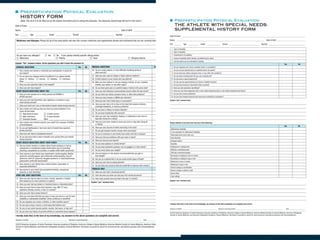
PPE: The HistoryPPE: The History
History forms are very helpfulHistory forms are very helpful
 athletes and parents should jointly complete a history formathletes and parents should jointly complete a history form
prior to the PPEprior to the PPE
 Review form: 75% of issues detected through Hx aloneReview form: 75% of issues detected through Hx alone
Web based history forms may be more convenient forWeb based history forms may be more convenient for
the athletes (ePPE)the athletes (ePPE)
Preparticipation form recommended by the AAFP,Preparticipation form recommended by the AAFP,
AAP, AMSSM, and AOSSM is available in theAAP, AMSSM, and AOSSM is available in the
Preparticipation Physical Evaluation, 4Preparticipation Physical Evaluation, 4thth
ed. 2010.ed. 2010.
Preparation for the PPEPreparation for the PPE
 No one best/right way to do PPENo one best/right way to do PPE
 Influenced by several factorsInfluenced by several factors
 Level of competitionLevel of competition
 Availability of personnel and facilitiesAvailability of personnel and facilities
 Number of PPE being conductedNumber of PPE being conducted
 Personal preference/historyPersonal preference/history
Preparation for the PPEPreparation for the PPE
 FormatFormat
 TimingTiming
 FrequencyFrequency
PPE FormatPPE Format
 Primary care physician modelPrimary care physician model
 Enhanced knowledge of medical history,Enhanced knowledge of medical history,
immunization status and prior injuries thatimmunization status and prior injuries that
could limit participationcould limit participation
 Generally a more thorough examGenerally a more thorough exam
 Affords best privacy and better environmentAffords best privacy and better environment
for counselingfor counseling
 Cost is expensive – insurance?Cost is expensive – insurance?
PPE FormatPPE Format
 Group/station modelGroup/station model
 Good for large number of PPE in given periodGood for large number of PPE in given period
of timeof time
 Individual personnel responsible for givenIndividual personnel responsible for given
element of PPE atelement of PPE at ““stationstation””
 Clearance verified by team MD at end of PPEClearance verified by team MD at end of PPE
 Typically free of chargeTypically free of charge
PPE TimingPPE Timing
 Ideally completed several weeks prior to initialIdeally completed several weeks prior to initial
practicepractice
 Allows ability to address any problems identifiedAllows ability to address any problems identified
on PPE (labs, tests, records) without impedingon PPE (labs, tests, records) without impeding
participation statusparticipation status
 Typically done within 1 week prior to firstTypically done within 1 week prior to first
scheduled activity – high schools often overscheduled activity – high schools often over
summersummer
PPE FrequencyPPE Frequency
 Entry-level PPE (complete) at outset ofEntry-level PPE (complete) at outset of
participation for school/organizationparticipation for school/organization
 Recommended annual re-evaluationRecommended annual re-evaluation
without complete PPE unless warrantedwithout complete PPE unless warranted
Medical HistoryMedical History
 Generally accomplished ahead of time inGenerally accomplished ahead of time in
yes/no formatyes/no format
 Often a supplemental form for femalesOften a supplemental form for females
 For station model, qualified evaluator mustFor station model, qualified evaluator must
review history and red flag potentialreview history and red flag potential
concerns for further scrutiny/evaluationconcerns for further scrutiny/evaluation
Components of the PPEComponents of the PPE
 Vital signsVital signs
 General medicalGeneral medical
problemsproblems
 CardiovascularCardiovascular
 PulmonaryPulmonary
 MusculoskeletalMusculoskeletal
 NeurologicNeurologic
 EyesEyes
 DentalDental
 GastrointestinalGastrointestinal
 GenitourinaryGenitourinary
 DermatologicDermatologic
 Examination for heatExamination for heat
disordersdisorders
 Laboratory testsLaboratory tests
Vital SignsVital Signs
 Establishes individualEstablishes individual’’s baseline parameterss baseline parameters
 Height/weightHeight/weight
 Comparison to normative dataComparison to normative data
 Pulse/respiratory rate (60-100/12-16)Pulse/respiratory rate (60-100/12-16)
 Observe quantity and qualityObserve quantity and quality
 Blood pressure (120/80)Blood pressure (120/80)
 Cuff size very importantCuff size very important
 Body temperature (98.6/37.0)Body temperature (98.6/37.0)
 Oral vs. tympanic vs. axillary (rectal)Oral vs. tympanic vs. axillary (rectal)
General Medical ProblemsGeneral Medical Problems
 Questions asked regardingQuestions asked regarding
 Currently being treated for illness/injuryCurrently being treated for illness/injury
 History of hospitalization or surgeryHistory of hospitalization or surgery
 History of progressive disease (MS, MD,History of progressive disease (MS, MD,
cancer)cancer)
 Current use of OTC/Rx medsCurrent use of OTC/Rx meds
 Allergies to meds, food, environmentAllergies to meds, food, environment
Cardiovascular ExaminationCardiovascular Examination
 Done in quiet area to maximize validityDone in quiet area to maximize validity
 Auscultation of heart soundsAuscultation of heart sounds
 Questions asked regardingQuestions asked regarding
 Fainting (syncope), dizziness, SOB, chest pain with exertionFainting (syncope), dizziness, SOB, chest pain with exertion
 Heart palpitations, tachycardia, dysrhythmia, known murmurHeart palpitations, tachycardia, dysrhythmia, known murmur
 Family member with sudden, early cardiac deathFamily member with sudden, early cardiac death
 Positive responses to any necessitate referral toPositive responses to any necessitate referral to
cardiologist for further evaluationcardiologist for further evaluation
Pulmonary ExaminationPulmonary Examination
 Done in quiet area to maximize validityDone in quiet area to maximize validity
 Auscultation of breath sounds in all lung lobes –Auscultation of breath sounds in all lung lobes –
look for symmetrical movement of diaphragmlook for symmetrical movement of diaphragm
 Questions asked regardingQuestions asked regarding
 Excessive coughing during/after activityExcessive coughing during/after activity
 History of asthma, bronchitis, allergiesHistory of asthma, bronchitis, allergies
 SOB, unusual breath sounds during/after activitySOB, unusual breath sounds during/after activity
 History of collapsed lung (pneumothorax)History of collapsed lung (pneumothorax)
Musculoskeletal ExaminationMusculoskeletal Examination
 Basic exam consists of observation forBasic exam consists of observation for
symmetry, ROM, strength tests for majorsymmetry, ROM, strength tests for major
muscles and specific tests for previously injuredmuscles and specific tests for previously injured
areasareas
 Questions asked regardingQuestions asked regarding
 Focus on history of injury, time frame, evaluation,Focus on history of injury, time frame, evaluation,
treatment and rehabilitationtreatment and rehabilitation
 Use of protective devicesUse of protective devices
Neurologic ExaminationNeurologic Examination
 Evaluation consists of cranial nerve testsEvaluation consists of cranial nerve tests
including pupil function, sensory/motor tests ofincluding pupil function, sensory/motor tests of
UE/LE, deep tendon reflexesUE/LE, deep tendon reflexes
 Questions asked regardingQuestions asked regarding
 History of head injuriesHistory of head injuries
 Any previous loss of consciousnessAny previous loss of consciousness
 Numbness/tingling, loss of motor function in bodyNumbness/tingling, loss of motor function in body
 History of seizures, burners/stingersHistory of seizures, burners/stingers
Eye ExaminationEye Examination
 Visual acuity assessed via Snellen chart, bothVisual acuity assessed via Snellen chart, both
monocularly and binocularly (use corrective lenses)monocularly and binocularly (use corrective lenses)
 Emmetropia (20/20 vision)Emmetropia (20/20 vision)
 Myopia (nearsightedness)Myopia (nearsightedness)
 Hypermetropia (farsightedness)Hypermetropia (farsightedness)
 Questions asked regardingQuestions asked regarding
 Use of corrective lenses/typeUse of corrective lenses/type
 Blurring or double visionBlurring or double vision
 Color blindness, peripheral vision lossColor blindness, peripheral vision loss
 History of eye trauma, retinal detachmentHistory of eye trauma, retinal detachment
Dental ExaminationDental Examination
 Typically done by dentist – not meant toTypically done by dentist – not meant to
perform preventative care but to establishperform preventative care but to establish
pre-existing conditions for liability reasonspre-existing conditions for liability reasons
in case of dental injuryin case of dental injury
 Allows opportunity for dental molds to beAllows opportunity for dental molds to be
made for crafting of custom mouthguardmade for crafting of custom mouthguard
Gastrointestinal ExaminationGastrointestinal Examination
 Evaluation of digestive system, eating habits andEvaluation of digestive system, eating habits and
nutritionnutrition
 Concerns for athletes where image is important to activityConcerns for athletes where image is important to activity
 Evaluation done supine with palpation for masses orEvaluation done supine with palpation for masses or
organomegalyorganomegaly
 Questions regardingQuestions regarding
 History of heartburn, indigestion, diarrhea or constipationHistory of heartburn, indigestion, diarrhea or constipation
 Prior history of organ injury (spleen, liver, kidney)Prior history of organ injury (spleen, liver, kidney)
Genitourinary ExaminationGenitourinary Examination
 For males, questions asked regardingFor males, questions asked regarding
 Hernias, testicular torsion, absent or undescended testicleHernias, testicular torsion, absent or undescended testicle
 For females, questions asked regardingFor females, questions asked regarding
 Menstrual cycle, pregnancyMenstrual cycle, pregnancy
 General questions asked regardingGeneral questions asked regarding
 History of bladder/urinary tract infections, STDsHistory of bladder/urinary tract infections, STDs
 Absence of one kidneyAbsence of one kidney
 Can include urinalysis to look for proteins, blood, sugarCan include urinalysis to look for proteins, blood, sugar
and hemoglobin in urineand hemoglobin in urine
Dermatologic ExaminationDermatologic Examination
 Skin evaluated for rashes, lesions, infectionsSkin evaluated for rashes, lesions, infections
that can be contagious to othersthat can be contagious to others
 Herpes, fungal infections (tinea), impetigo, STDs,Herpes, fungal infections (tinea), impetigo, STDs,
acne/treatmentacne/treatment
 Also look at existing blemishes (warts, moles,Also look at existing blemishes (warts, moles,
etc.)etc.)
 Change in appearance (size, color, border, etc.) inChange in appearance (size, color, border, etc.) in
recent pastrecent past
Examination for Heat DisordersExamination for Heat Disorders
 Especially important for activities taking placeEspecially important for activities taking place
under conditions of high temperature, highunder conditions of high temperature, high
humidity or a combination of the twohumidity or a combination of the two
 Questions asked regardingQuestions asked regarding
 History of heat illness (cramping, syncope,History of heat illness (cramping, syncope,
exhaustion, stroke)exhaustion, stroke)
 Current meds (diuretics, antihistamines)Current meds (diuretics, antihistamines)
 Use of caffeinated/alcoholic beveragesUse of caffeinated/alcoholic beverages
 Nutritional and hydration habitsNutritional and hydration habits
Laboratory TestsLaboratory Tests
 Not typical associated with PPE – usuallyNot typical associated with PPE – usually
due to cost of testing proceduresdue to cost of testing procedures
 Often used when/if red flags appearOften used when/if red flags appear
during PPEduring PPE
 UrinalysisUrinalysis
 Blood workBlood work
 ECGECG
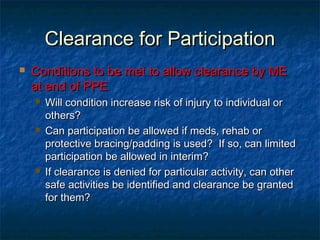
Clearance for ParticipationClearance for Participation
 Conditions to be met to allow clearance by MEConditions to be met to allow clearance by ME
at end of PPEat end of PPE
 Will condition increase risk of injury to individual orWill condition increase risk of injury to individual or
others?others?
 Can participation be allowed if meds, rehab orCan participation be allowed if meds, rehab or
protective bracing/padding is used? If so, can limitedprotective bracing/padding is used? If so, can limited
participation be allowed in interim?participation be allowed in interim?
 If clearance is denied for particular activity, can otherIf clearance is denied for particular activity, can other
safe activities be identified and clearance be grantedsafe activities be identified and clearance be granted
for them?for them?
Clearance for ParticipationClearance for Participation
 Individuals have right to participate in anyIndividuals have right to participate in any
activity regardless of pre-existing medicalactivity regardless of pre-existing medical
condition/scondition/s
 PhysicianPhysician’’s cannot exclude individual froms cannot exclude individual from
participation – can only recommend againstparticipation – can only recommend against
participationparticipation
Conditions that ContraindicateConditions that Contraindicate
Sports ParticipationSports Participation
 Active myocarditis or pericarditisActive myocarditis or pericarditis
Hypertrophic cardiomyopathyHypertrophic cardiomyopathy
 Severe hypertension untilSevere hypertension until
 Poorly controlled convulsive disorderPoorly controlled convulsive disorder
 no archery, riflery, swimming, weight lifting or powerno archery, riflery, swimming, weight lifting or power
lifting, strength training or sports involving heights)lifting, strength training or sports involving heights)
 Recurrent episodes of burning upper-extremityRecurrent episodes of burning upper-extremity
pain or weakness, or episodes of transientpain or weakness, or episodes of transient
quadriplegia until stability of cervical spine canquadriplegia until stability of cervical spine can
be assured (no contact or collision sports)be assured (no contact or collision sports)
Conditions that ContraindicateConditions that Contraindicate
Sports ParticipationSports Participation
 Sickle cell disease (no high-exertion,Sickle cell disease (no high-exertion,
contact or collision sports)contact or collision sports)
 Eating disorder where athlete is notEating disorder where athlete is not
compliant with therapy and follow-up, orcompliant with therapy and follow-up, or
where there is evidence of diminishedwhere there is evidence of diminished
performance or potential injury because ofperformance or potential injury because of
eating disordereating disorder
 Acute enlargement of spleen or liverAcute enlargement of spleen or liver
PRE PARTICIPATION EXAMINATION  I Dr.RAJAT JANGIR JAIPUR

PRE PARTICIPATION EXAMINATION I Dr.RAJAT JANGIR JAIPUR

  • 1.
    Pre-Participation Physical ExaminationsPre-ParticipationPhysical Examinations Dr.RAJAT JANGIRDr.RAJAT JANGIR Consultant Arthroscopy and Orthopedic SurgeonConsultant Arthroscopy and Orthopedic Surgeon Saket Hospital, MansarovarSaket Hospital, Mansarovar Assistant ProfessorAssistant Professor Mahatma Gandhi Medical College, JaipurMahatma Gandhi Medical College, Jaipur Fellowship In Arthroscopy(South Korea) International Olympic Committee Diploma Sports Medicine(UK) Sports Physician RIO Olympic 2016
  • 2.
    IPC Medical Code Fitnessto practice a sport 46. Prior to engaging in competitive sport, and preferably with regular intervals throughout their athletic career, athletes should undergo pre- participation evaluation....
  • 3.
    The International OlympicCommittee (IOC) Consensus Statement on Periodic Health Evaluation of Elite Athletes http://www.olympic.org/assets/importednews/documents/en_r eport_1448.pdf Br J Sports Med. 2009 Sep;43(9):631-643.
  • 4.
    PPEPPE  Goals ofthe PPEGoals of the PPE  Preparation for the PPEPreparation for the PPE  Medical historyMedical history  Components of the PPEComponents of the PPE  Clearance for participationClearance for participation
  • 5.
    Goals of thePPEGoals of the PPE  Determine general health and current immunizationDetermine general health and current immunization statusstatus  Establish rapport with participantEstablish rapport with participant  Detect medical conditions that can predispose one toDetect medical conditions that can predispose one to injury/illness so treatment can be continued/initiatedinjury/illness so treatment can be continued/initiated  Identify health risk behaviors that can be addressed withIdentify health risk behaviors that can be addressed with counselingcounseling
  • 6.
    Goals of thePPEGoals of the PPE  Establish baseline parameters for return to playEstablish baseline parameters for return to play decisionsdecisions  Assess physical maturityAssess physical maturity  Evaluate physical fitnessEvaluate physical fitness  Make recommendations regarding participation/exerciseMake recommendations regarding participation/exercise  Meet legal requirements to athletic participationMeet legal requirements to athletic participation
  • 7.
    Goals of thePPEGoals of the PPE  Specific focus of PPE varies amongstSpecific focus of PPE varies amongst populationspopulations  Pre-pubescentPre-pubescent  Undiagnosed congenital abnormalitiesUndiagnosed congenital abnormalities  PubescentPubescent  Maturation level, establishing healthy behaviorsMaturation level, establishing healthy behaviors  Young adultYoung adult  History of previous injury, sport-specific examHistory of previous injury, sport-specific exam  AdultAdult  Overuse conditions predominateOveruse conditions predominate
  • 8.
    SUDDEN DEATHSUDDEN DEATH •Sudden death in athletics can occur fromSudden death in athletics can occur from direct or indirect causesdirect or indirect causes • direct - traumaticdirect - traumatic • indirect - atraumaticindirect - atraumatic
  • 9.
    SUDDEN DEATHSUDDEN DEATH •Most indirect causes are cardiac in origin.Most indirect causes are cardiac in origin. • A very small number of indirect causes ofA very small number of indirect causes of sudden death are noncardiacsudden death are noncardiac • heat strokeheat stroke • CVACVA • pulmonary emboluspulmonary embolus • drug abusedrug abuse
  • 10.
    PPE: The HistoryPPE:The History History forms are very helpfulHistory forms are very helpful  athletes and parents should jointly complete a history formathletes and parents should jointly complete a history form prior to the PPEprior to the PPE  Review form: 75% of issues detected through Hx aloneReview form: 75% of issues detected through Hx alone Web based history forms may be more convenient forWeb based history forms may be more convenient for the athletes (ePPE)the athletes (ePPE) Preparticipation form recommended by the AAFP,Preparticipation form recommended by the AAFP, AAP, AMSSM, and AOSSM is available in theAAP, AMSSM, and AOSSM is available in the Preparticipation Physical Evaluation, 4Preparticipation Physical Evaluation, 4thth ed. 2010.ed. 2010.
  • 12.
    Preparation for thePPEPreparation for the PPE  No one best/right way to do PPENo one best/right way to do PPE  Influenced by several factorsInfluenced by several factors  Level of competitionLevel of competition  Availability of personnel and facilitiesAvailability of personnel and facilities  Number of PPE being conductedNumber of PPE being conducted  Personal preference/historyPersonal preference/history
  • 13.
    Preparation for thePPEPreparation for the PPE  FormatFormat  TimingTiming  FrequencyFrequency
  • 14.
    PPE FormatPPE Format Primary care physician modelPrimary care physician model  Enhanced knowledge of medical history,Enhanced knowledge of medical history, immunization status and prior injuries thatimmunization status and prior injuries that could limit participationcould limit participation  Generally a more thorough examGenerally a more thorough exam  Affords best privacy and better environmentAffords best privacy and better environment for counselingfor counseling  Cost is expensive – insurance?Cost is expensive – insurance?
  • 15.
    PPE FormatPPE Format Group/station modelGroup/station model  Good for large number of PPE in given periodGood for large number of PPE in given period of timeof time  Individual personnel responsible for givenIndividual personnel responsible for given element of PPE atelement of PPE at ““stationstation””  Clearance verified by team MD at end of PPEClearance verified by team MD at end of PPE  Typically free of chargeTypically free of charge
  • 16.
    PPE TimingPPE Timing Ideally completed several weeks prior to initialIdeally completed several weeks prior to initial practicepractice  Allows ability to address any problems identifiedAllows ability to address any problems identified on PPE (labs, tests, records) without impedingon PPE (labs, tests, records) without impeding participation statusparticipation status  Typically done within 1 week prior to firstTypically done within 1 week prior to first scheduled activity – high schools often overscheduled activity – high schools often over summersummer
  • 17.
    PPE FrequencyPPE Frequency Entry-level PPE (complete) at outset ofEntry-level PPE (complete) at outset of participation for school/organizationparticipation for school/organization  Recommended annual re-evaluationRecommended annual re-evaluation without complete PPE unless warrantedwithout complete PPE unless warranted
  • 18.
    Medical HistoryMedical History Generally accomplished ahead of time inGenerally accomplished ahead of time in yes/no formatyes/no format  Often a supplemental form for femalesOften a supplemental form for females  For station model, qualified evaluator mustFor station model, qualified evaluator must review history and red flag potentialreview history and red flag potential concerns for further scrutiny/evaluationconcerns for further scrutiny/evaluation
  • 19.
    Components of thePPEComponents of the PPE  Vital signsVital signs  General medicalGeneral medical problemsproblems  CardiovascularCardiovascular  PulmonaryPulmonary  MusculoskeletalMusculoskeletal  NeurologicNeurologic  EyesEyes  DentalDental  GastrointestinalGastrointestinal  GenitourinaryGenitourinary  DermatologicDermatologic  Examination for heatExamination for heat disordersdisorders  Laboratory testsLaboratory tests
  • 20.
    Vital SignsVital Signs Establishes individualEstablishes individual’’s baseline parameterss baseline parameters  Height/weightHeight/weight  Comparison to normative dataComparison to normative data  Pulse/respiratory rate (60-100/12-16)Pulse/respiratory rate (60-100/12-16)  Observe quantity and qualityObserve quantity and quality  Blood pressure (120/80)Blood pressure (120/80)  Cuff size very importantCuff size very important  Body temperature (98.6/37.0)Body temperature (98.6/37.0)  Oral vs. tympanic vs. axillary (rectal)Oral vs. tympanic vs. axillary (rectal)
  • 21.
    General Medical ProblemsGeneralMedical Problems  Questions asked regardingQuestions asked regarding  Currently being treated for illness/injuryCurrently being treated for illness/injury  History of hospitalization or surgeryHistory of hospitalization or surgery  History of progressive disease (MS, MD,History of progressive disease (MS, MD, cancer)cancer)  Current use of OTC/Rx medsCurrent use of OTC/Rx meds  Allergies to meds, food, environmentAllergies to meds, food, environment
  • 22.
    Cardiovascular ExaminationCardiovascular Examination Done in quiet area to maximize validityDone in quiet area to maximize validity  Auscultation of heart soundsAuscultation of heart sounds  Questions asked regardingQuestions asked regarding  Fainting (syncope), dizziness, SOB, chest pain with exertionFainting (syncope), dizziness, SOB, chest pain with exertion  Heart palpitations, tachycardia, dysrhythmia, known murmurHeart palpitations, tachycardia, dysrhythmia, known murmur  Family member with sudden, early cardiac deathFamily member with sudden, early cardiac death  Positive responses to any necessitate referral toPositive responses to any necessitate referral to cardiologist for further evaluationcardiologist for further evaluation
  • 23.
    Pulmonary ExaminationPulmonary Examination Done in quiet area to maximize validityDone in quiet area to maximize validity  Auscultation of breath sounds in all lung lobes –Auscultation of breath sounds in all lung lobes – look for symmetrical movement of diaphragmlook for symmetrical movement of diaphragm  Questions asked regardingQuestions asked regarding  Excessive coughing during/after activityExcessive coughing during/after activity  History of asthma, bronchitis, allergiesHistory of asthma, bronchitis, allergies  SOB, unusual breath sounds during/after activitySOB, unusual breath sounds during/after activity  History of collapsed lung (pneumothorax)History of collapsed lung (pneumothorax)
  • 24.
    Musculoskeletal ExaminationMusculoskeletal Examination Basic exam consists of observation forBasic exam consists of observation for symmetry, ROM, strength tests for majorsymmetry, ROM, strength tests for major muscles and specific tests for previously injuredmuscles and specific tests for previously injured areasareas  Questions asked regardingQuestions asked regarding  Focus on history of injury, time frame, evaluation,Focus on history of injury, time frame, evaluation, treatment and rehabilitationtreatment and rehabilitation  Use of protective devicesUse of protective devices
  • 26.
    Neurologic ExaminationNeurologic Examination Evaluation consists of cranial nerve testsEvaluation consists of cranial nerve tests including pupil function, sensory/motor tests ofincluding pupil function, sensory/motor tests of UE/LE, deep tendon reflexesUE/LE, deep tendon reflexes  Questions asked regardingQuestions asked regarding  History of head injuriesHistory of head injuries  Any previous loss of consciousnessAny previous loss of consciousness  Numbness/tingling, loss of motor function in bodyNumbness/tingling, loss of motor function in body  History of seizures, burners/stingersHistory of seizures, burners/stingers
  • 27.
    Eye ExaminationEye Examination Visual acuity assessed via Snellen chart, bothVisual acuity assessed via Snellen chart, both monocularly and binocularly (use corrective lenses)monocularly and binocularly (use corrective lenses)  Emmetropia (20/20 vision)Emmetropia (20/20 vision)  Myopia (nearsightedness)Myopia (nearsightedness)  Hypermetropia (farsightedness)Hypermetropia (farsightedness)  Questions asked regardingQuestions asked regarding  Use of corrective lenses/typeUse of corrective lenses/type  Blurring or double visionBlurring or double vision  Color blindness, peripheral vision lossColor blindness, peripheral vision loss  History of eye trauma, retinal detachmentHistory of eye trauma, retinal detachment
  • 28.
    Dental ExaminationDental Examination Typically done by dentist – not meant toTypically done by dentist – not meant to perform preventative care but to establishperform preventative care but to establish pre-existing conditions for liability reasonspre-existing conditions for liability reasons in case of dental injuryin case of dental injury  Allows opportunity for dental molds to beAllows opportunity for dental molds to be made for crafting of custom mouthguardmade for crafting of custom mouthguard
  • 29.
    Gastrointestinal ExaminationGastrointestinal Examination Evaluation of digestive system, eating habits andEvaluation of digestive system, eating habits and nutritionnutrition  Concerns for athletes where image is important to activityConcerns for athletes where image is important to activity  Evaluation done supine with palpation for masses orEvaluation done supine with palpation for masses or organomegalyorganomegaly  Questions regardingQuestions regarding  History of heartburn, indigestion, diarrhea or constipationHistory of heartburn, indigestion, diarrhea or constipation  Prior history of organ injury (spleen, liver, kidney)Prior history of organ injury (spleen, liver, kidney)
  • 30.
    Genitourinary ExaminationGenitourinary Examination For males, questions asked regardingFor males, questions asked regarding  Hernias, testicular torsion, absent or undescended testicleHernias, testicular torsion, absent or undescended testicle  For females, questions asked regardingFor females, questions asked regarding  Menstrual cycle, pregnancyMenstrual cycle, pregnancy  General questions asked regardingGeneral questions asked regarding  History of bladder/urinary tract infections, STDsHistory of bladder/urinary tract infections, STDs  Absence of one kidneyAbsence of one kidney  Can include urinalysis to look for proteins, blood, sugarCan include urinalysis to look for proteins, blood, sugar and hemoglobin in urineand hemoglobin in urine
  • 31.
    Dermatologic ExaminationDermatologic Examination Skin evaluated for rashes, lesions, infectionsSkin evaluated for rashes, lesions, infections that can be contagious to othersthat can be contagious to others  Herpes, fungal infections (tinea), impetigo, STDs,Herpes, fungal infections (tinea), impetigo, STDs, acne/treatmentacne/treatment  Also look at existing blemishes (warts, moles,Also look at existing blemishes (warts, moles, etc.)etc.)  Change in appearance (size, color, border, etc.) inChange in appearance (size, color, border, etc.) in recent pastrecent past
  • 32.
    Examination for HeatDisordersExamination for Heat Disorders  Especially important for activities taking placeEspecially important for activities taking place under conditions of high temperature, highunder conditions of high temperature, high humidity or a combination of the twohumidity or a combination of the two  Questions asked regardingQuestions asked regarding  History of heat illness (cramping, syncope,History of heat illness (cramping, syncope, exhaustion, stroke)exhaustion, stroke)  Current meds (diuretics, antihistamines)Current meds (diuretics, antihistamines)  Use of caffeinated/alcoholic beveragesUse of caffeinated/alcoholic beverages  Nutritional and hydration habitsNutritional and hydration habits
  • 33.
    Laboratory TestsLaboratory Tests Not typical associated with PPE – usuallyNot typical associated with PPE – usually due to cost of testing proceduresdue to cost of testing procedures  Often used when/if red flags appearOften used when/if red flags appear during PPEduring PPE  UrinalysisUrinalysis  Blood workBlood work  ECGECG
  • 34.
    Clearance for ParticipationClearancefor Participation  Conditions to be met to allow clearance by MEConditions to be met to allow clearance by ME at end of PPEat end of PPE  Will condition increase risk of injury to individual orWill condition increase risk of injury to individual or others?others?  Can participation be allowed if meds, rehab orCan participation be allowed if meds, rehab or protective bracing/padding is used? If so, can limitedprotective bracing/padding is used? If so, can limited participation be allowed in interim?participation be allowed in interim?  If clearance is denied for particular activity, can otherIf clearance is denied for particular activity, can other safe activities be identified and clearance be grantedsafe activities be identified and clearance be granted for them?for them?
  • 35.
    Clearance for ParticipationClearancefor Participation  Individuals have right to participate in anyIndividuals have right to participate in any activity regardless of pre-existing medicalactivity regardless of pre-existing medical condition/scondition/s  PhysicianPhysician’’s cannot exclude individual froms cannot exclude individual from participation – can only recommend againstparticipation – can only recommend against participationparticipation
  • 36.
    Conditions that ContraindicateConditionsthat Contraindicate Sports ParticipationSports Participation  Active myocarditis or pericarditisActive myocarditis or pericarditis Hypertrophic cardiomyopathyHypertrophic cardiomyopathy  Severe hypertension untilSevere hypertension until  Poorly controlled convulsive disorderPoorly controlled convulsive disorder  no archery, riflery, swimming, weight lifting or powerno archery, riflery, swimming, weight lifting or power lifting, strength training or sports involving heights)lifting, strength training or sports involving heights)  Recurrent episodes of burning upper-extremityRecurrent episodes of burning upper-extremity pain or weakness, or episodes of transientpain or weakness, or episodes of transient quadriplegia until stability of cervical spine canquadriplegia until stability of cervical spine can be assured (no contact or collision sports)be assured (no contact or collision sports)
  • 37.
    Conditions that ContraindicateConditionsthat Contraindicate Sports ParticipationSports Participation  Sickle cell disease (no high-exertion,Sickle cell disease (no high-exertion, contact or collision sports)contact or collision sports)  Eating disorder where athlete is notEating disorder where athlete is not compliant with therapy and follow-up, orcompliant with therapy and follow-up, or where there is evidence of diminishedwhere there is evidence of diminished performance or potential injury because ofperformance or potential injury because of eating disordereating disorder  Acute enlargement of spleen or liverAcute enlargement of spleen or liver