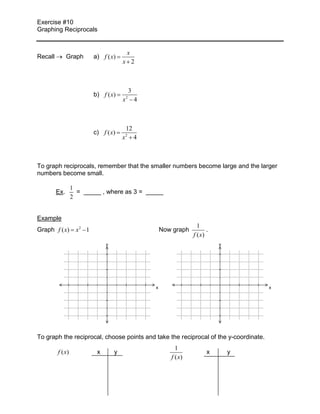
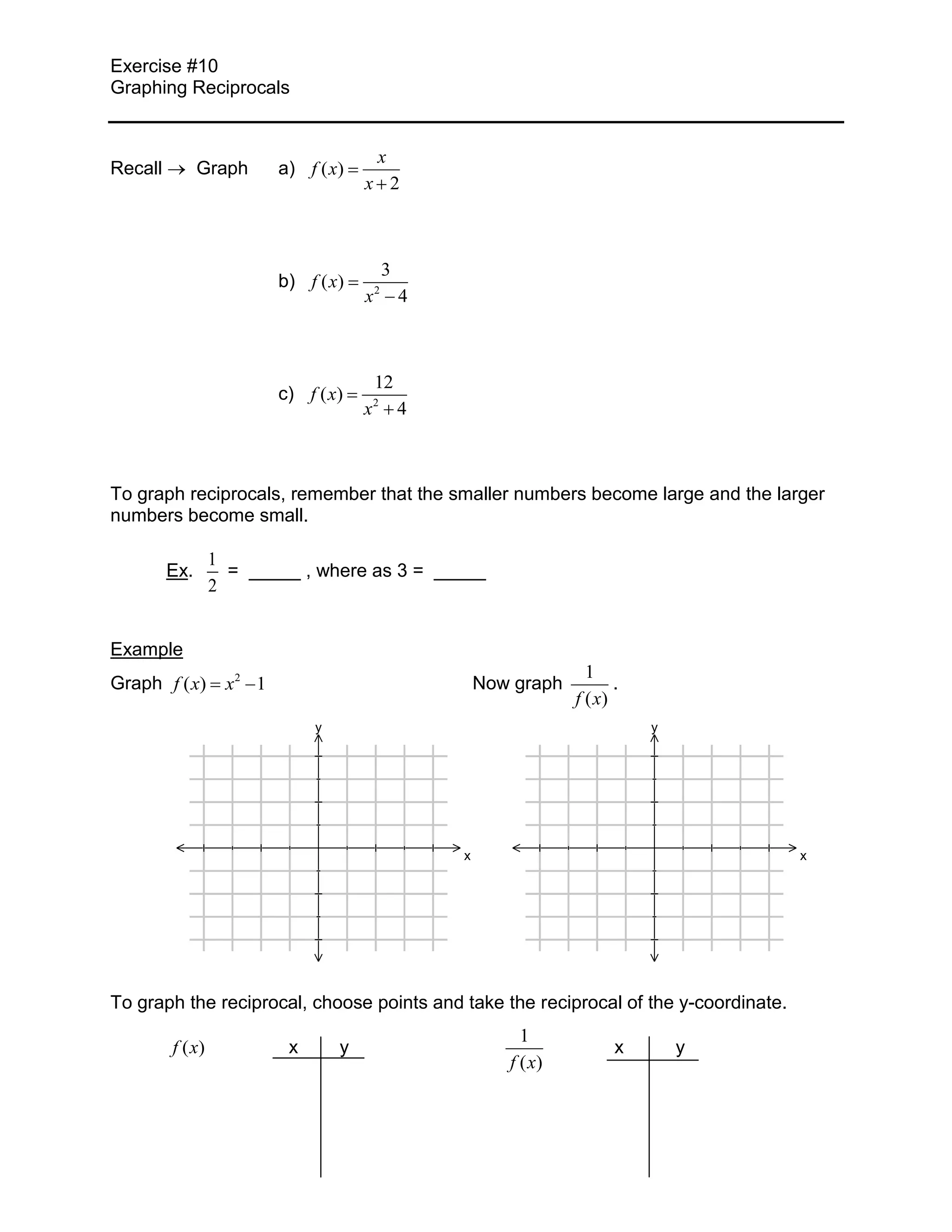
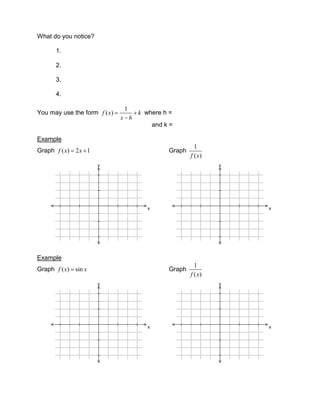
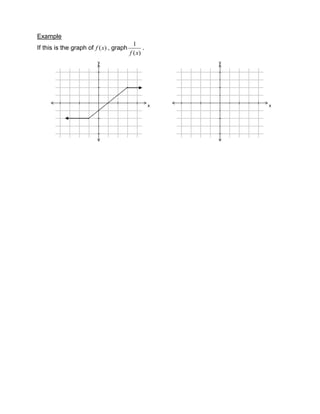
This document provides examples for graphing reciprocals of functions. It explains that for reciprocals, smaller numbers on the x-axis become larger on the y-axis, and vice versa. An example graphs the reciprocal of f(x)=1/x^2. It notes that reciprocals can be written in the form f(x)=k/x+h, where k and h are determined from the original function. Further examples graph the reciprocals of f(x)=2/x+4 and f(x)=sin(x).