Exploring Conic Sections


     Any conic section from ellipse and circle to parabola and hyperbola
may be described by the implicit relation:

                      Ax2 + Bxy + Cy2 + Dx + Ey + F = 0.

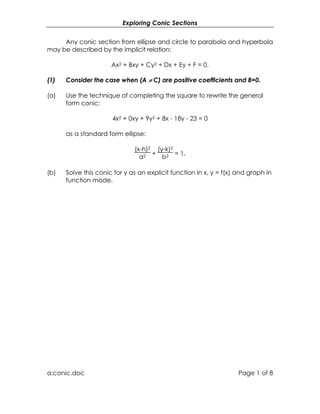
(1)   Consider the case when (A ≠ C) are positive coefficients and B=0.

(a)   Use the technique of completing the square to rewrite the general
      form conic:

                      4x2 + 0xy + 9y2 + 8x - 18y - 23 = 0

      as a standard form ellipse:

                              (x-h)2 (y-k)2
                                    +       = 1.
                                a2     b2

(b)   Solve this conic for y as an explicit function in x, y = f(x) and graph in
      function mode.


a:conic.doc                                                         Page 1 of 8
Exploring Conic Sections


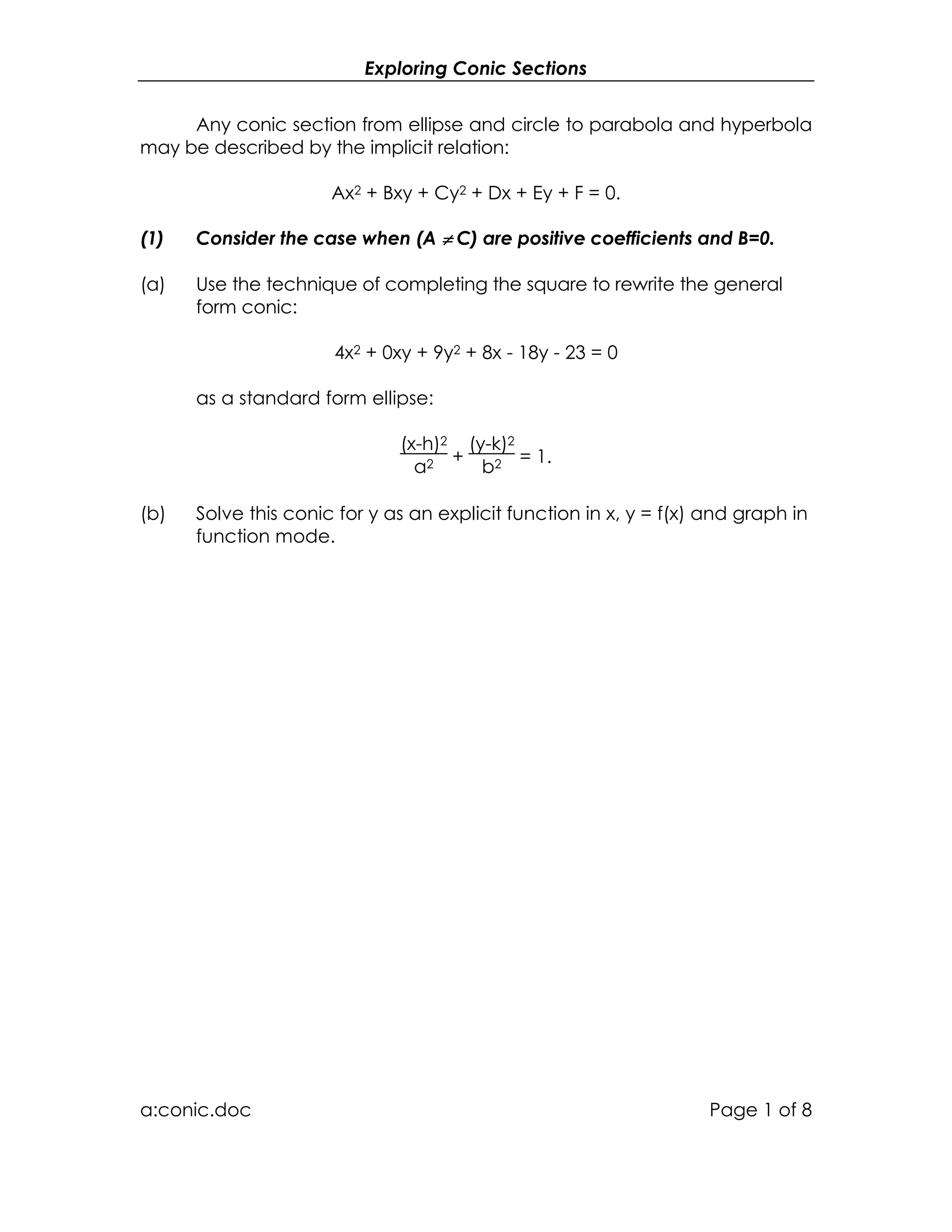
(2)  Consider the case when (A ≠ C) are coefficients with opposite signs
and B=0.

(a)   Use the technique of completing the square to rewrite the general
      form conic:

                       2x2 + 0xy - 8y2 - 8x + 16y - 16 = 0

      as a standard form hyperbola:

                               (x-h)2 (y-k)2
                                     -       = 1.
                                 a2     b2

(b)   Solve this conic for y as an explicit function in x, y = f(x) and graph in
      function mode.


a:conic.doc                                                         Page 2 of 8
Exploring Conic Sections


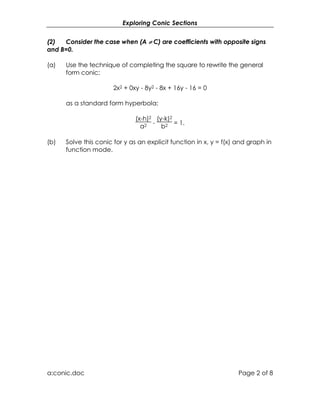
(3)   Consider the case when (A = C) and B=0.

(a)   Use the technique of completing the square to rewrite the general
      form conic:

                       2x2 + 0xy + 2y2 + 8x + 4y + 2 = 0

      as a standard form circle:

                             (x - h)2 + (y - k)2 = r2

(b)   Solve this conic for y as an explicit function in x, y = f(x) and graph in
      function mode.


a:conic.doc                                                         Page 3 of 8
Exploring Conic Sections


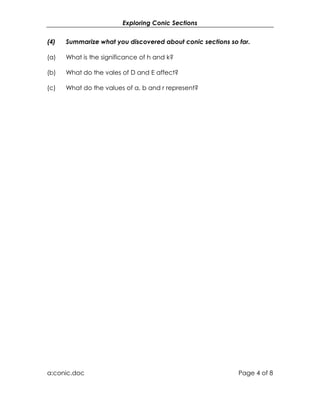
(4)   Summarize what you discovered about conic sections so far.

(a)   What is the significance of h and k?

(b)   What do the vales of D and E affect?

(c)   What do the values of a, b and r represent?


a:conic.doc                                                 Page 4 of 8
Exploring Conic Sections


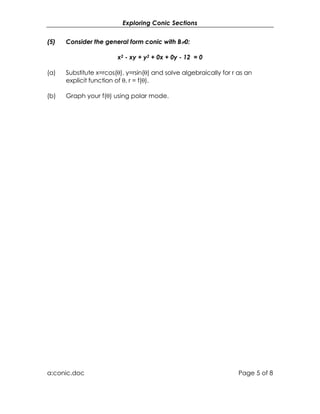
(5)   Consider the general form conic with B≠0:

                        x2 - xy + y2 + 0x + 0y - 12 = 0

(a)   Substitute x=rcos(θ), y=rsin(θ) and solve algebraically for r as an
      explicit function of θ, r = f(θ).

(b)   Graph your f(θ) using polar mode.


a:conic.doc                                                         Page 5 of 8
Exploring Conic Sections


(6)   Consider the general form conic with B≠0:

                       x2 + 2xy + y2 + 0x + 0y - 12 = 0

(a)   Substitute x=rcos(θ), y=rsin(θ) and solve algebraically for r as an
      explicit function of θ, r = f(θ).

(b)   Graph your f(θ) using polar mode.


a:conic.doc                                                         Page 6 of 8
Exploring Conic Sections


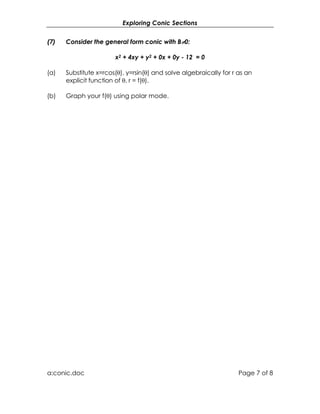
(7)   Consider the general form conic with B≠0:

                       x2 + 4xy + y2 + 0x + 0y - 12 = 0

(a)   Substitute x=rcos(θ), y=rsin(θ) and solve algebraically for r as an
      explicit function of θ, r = f(θ).

(b)   Graph your f(θ) using polar mode.


a:conic.doc                                                         Page 7 of 8
Exploring Conic Sections


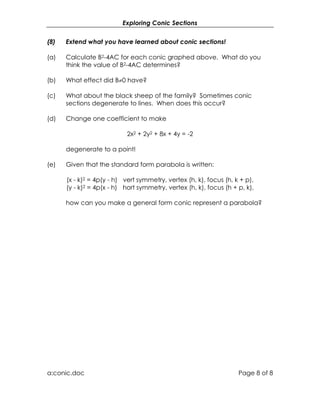
(8)   Extend what you have learned about conic sections!

(a)   Calculate B2-4AC for each conic graphed above. What do you
      think the value of B2-4AC determines?

(b)   What effect did B≠0 have?

(c)   What about the black sheep of the family? Sometimes conic
      sections degenerate to lines. When does this occur?

(d)   Change one coefficient to make

                            2x2 + 2y2 + 8x + 4y = -2

      degenerate to a point!

(e)   Given that the standard form parabola is written:

      (x - k)2 = 4p(y - h) vert symmetry, vertex (h, k), focus (h, k + p),
      (y - k)2 = 4p(x - h) hort symmetry, vertex (h, k), focus (h + p, k),

      how can you make a general form conic represent a parabola?


a:conic.doc                                                         Page 8 of 8

5HBC2012 Conic Worksheet

  • 1.
    Exploring Conic Sections Any conic section from ellipse and circle to parabola and hyperbola may be described by the implicit relation: Ax2 + Bxy + Cy2 + Dx + Ey + F = 0. (1) Consider the case when (A ≠ C) are positive coefficients and B=0. (a) Use the technique of completing the square to rewrite the general form conic: 4x2 + 0xy + 9y2 + 8x - 18y - 23 = 0 as a standard form ellipse: (x-h)2 (y-k)2 + = 1. a2 b2 (b) Solve this conic for y as an explicit function in x, y = f(x) and graph in function mode. a:conic.doc Page 1 of 8
  • 2.
    Exploring Conic Sections (2) Consider the case when (A ≠ C) are coefficients with opposite signs and B=0. (a) Use the technique of completing the square to rewrite the general form conic: 2x2 + 0xy - 8y2 - 8x + 16y - 16 = 0 as a standard form hyperbola: (x-h)2 (y-k)2 - = 1. a2 b2 (b) Solve this conic for y as an explicit function in x, y = f(x) and graph in function mode. a:conic.doc Page 2 of 8
  • 3.
    Exploring Conic Sections (3) Consider the case when (A = C) and B=0. (a) Use the technique of completing the square to rewrite the general form conic: 2x2 + 0xy + 2y2 + 8x + 4y + 2 = 0 as a standard form circle: (x - h)2 + (y - k)2 = r2 (b) Solve this conic for y as an explicit function in x, y = f(x) and graph in function mode. a:conic.doc Page 3 of 8
  • 4.
    Exploring Conic Sections (4) Summarize what you discovered about conic sections so far. (a) What is the significance of h and k? (b) What do the vales of D and E affect? (c) What do the values of a, b and r represent? a:conic.doc Page 4 of 8
  • 5.
    Exploring Conic Sections (5) Consider the general form conic with B≠0: x2 - xy + y2 + 0x + 0y - 12 = 0 (a) Substitute x=rcos(θ), y=rsin(θ) and solve algebraically for r as an explicit function of θ, r = f(θ). (b) Graph your f(θ) using polar mode. a:conic.doc Page 5 of 8
  • 6.
    Exploring Conic Sections (6) Consider the general form conic with B≠0: x2 + 2xy + y2 + 0x + 0y - 12 = 0 (a) Substitute x=rcos(θ), y=rsin(θ) and solve algebraically for r as an explicit function of θ, r = f(θ). (b) Graph your f(θ) using polar mode. a:conic.doc Page 6 of 8
  • 7.
    Exploring Conic Sections (7) Consider the general form conic with B≠0: x2 + 4xy + y2 + 0x + 0y - 12 = 0 (a) Substitute x=rcos(θ), y=rsin(θ) and solve algebraically for r as an explicit function of θ, r = f(θ). (b) Graph your f(θ) using polar mode. a:conic.doc Page 7 of 8
  • 8.
    Exploring Conic Sections (8) Extend what you have learned about conic sections! (a) Calculate B2-4AC for each conic graphed above. What do you think the value of B2-4AC determines? (b) What effect did B≠0 have? (c) What about the black sheep of the family? Sometimes conic sections degenerate to lines. When does this occur? (d) Change one coefficient to make 2x2 + 2y2 + 8x + 4y = -2 degenerate to a point! (e) Given that the standard form parabola is written: (x - k)2 = 4p(y - h) vert symmetry, vertex (h, k), focus (h, k + p), (y - k)2 = 4p(x - h) hort symmetry, vertex (h, k), focus (h + p, k), how can you make a general form conic represent a parabola? a:conic.doc Page 8 of 8