Lesson 41 & 42
                         Budgeting
          Text Reference: Chapter 1, Section 8

$ Budgeting can be defined as a PLAN for spending your money. It is used
  to help people or business manage their expenses relative to their total
  earnings.

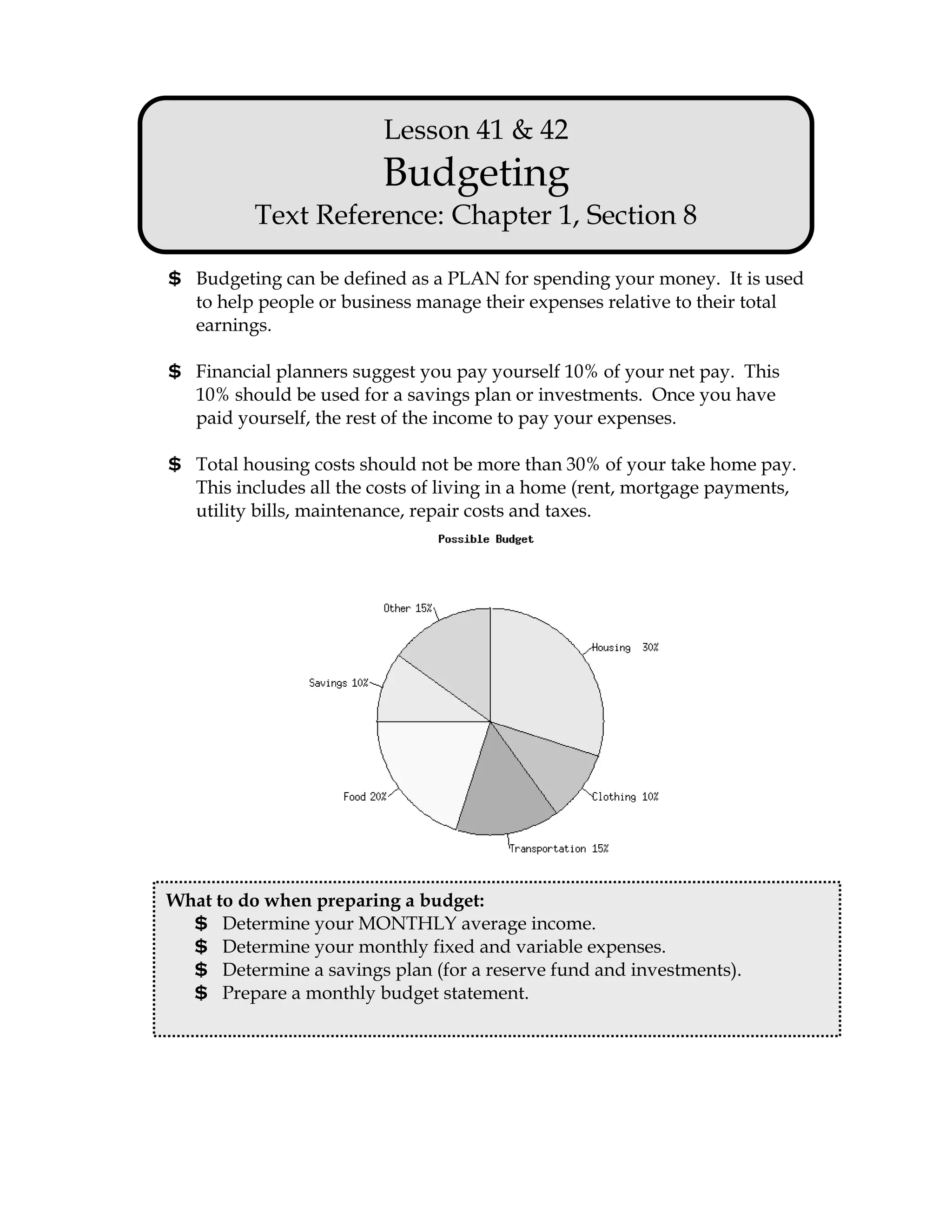
$ Financial planners suggest you pay yourself 10% of your net pay. This
  10% should be used for a savings plan or investments. Once you have
  paid yourself, the rest of the income to pay your expenses.

$ Total housing costs should not be more than 30% of your take home pay.
  This includes all the costs of living in a home (rent, mortgage payments,
  utility bills, maintenance, repair costs and taxes.


What to do when preparing a budget:
  $ Determine your MONTHLY average income.
  $ Determine your monthly fixed and variable expenses.
  $ Determine a savings plan (for a reserve fund and investments).
  $ Prepare a monthly budget statement.
$ To set up a budget you first must estimate your income. It is
     important that you do not overestimate. If you are unsure, then
     underestimate.
         Income includes:
                Regular income (net pay)
                Other Income
                         Bonuses
                         Tips
                         Overtime payments
                         Tax refund
                Additional income
                         Child tax benefits
                         Pensions
                         Insurance benefits
                         Interest payments

   $ Analyze your current regular spending habits to estimate your
     expenses.
         Fixed Expenses – definite expenses that must be paid at regular
           intervals.
                Mortgage or rent
                Personal Loan
                Telephone
                Hydro
                Car Insurance, taxes that are paid yearly but need to be
                  budgeted for monthly.

          Variable Expenses – expenses that vary from month to month
               Food
               Clothing
               Recreation
               Vehicle maintenance

$ Reserve Fund - It is a good idea to have a reserve of two to three month’s
  pay to meet unexpected expenses that may occur. If your expenses exceed
  your income, you will use the money from the reserve fund to cover the
  extra expenses.

$ Budgets – can be set up based on any time period you wish but budgets
  usually coincide with your pay periods. For these lessons budgets are set
  up on a monthly basis.

           Assignment: Exercise 41 – Q 1 to 13
                       Exercise 42 – Q 1 to 13

Lesson 41

  • 1.
    Lesson 41 &42 Budgeting Text Reference: Chapter 1, Section 8 $ Budgeting can be defined as a PLAN for spending your money. It is used to help people or business manage their expenses relative to their total earnings. $ Financial planners suggest you pay yourself 10% of your net pay. This 10% should be used for a savings plan or investments. Once you have paid yourself, the rest of the income to pay your expenses. $ Total housing costs should not be more than 30% of your take home pay. This includes all the costs of living in a home (rent, mortgage payments, utility bills, maintenance, repair costs and taxes. What to do when preparing a budget: $ Determine your MONTHLY average income. $ Determine your monthly fixed and variable expenses. $ Determine a savings plan (for a reserve fund and investments). $ Prepare a monthly budget statement.
  • 2.
    $ To setup a budget you first must estimate your income. It is important that you do not overestimate. If you are unsure, then underestimate.  Income includes:  Regular income (net pay)  Other Income Bonuses Tips Overtime payments Tax refund  Additional income Child tax benefits Pensions Insurance benefits Interest payments $ Analyze your current regular spending habits to estimate your expenses.  Fixed Expenses – definite expenses that must be paid at regular intervals.  Mortgage or rent  Personal Loan  Telephone  Hydro  Car Insurance, taxes that are paid yearly but need to be budgeted for monthly.  Variable Expenses – expenses that vary from month to month  Food  Clothing  Recreation  Vehicle maintenance $ Reserve Fund - It is a good idea to have a reserve of two to three month’s pay to meet unexpected expenses that may occur. If your expenses exceed your income, you will use the money from the reserve fund to cover the extra expenses. $ Budgets – can be set up based on any time period you wish but budgets usually coincide with your pay periods. For these lessons budgets are set up on a monthly basis. Assignment: Exercise 41 – Q 1 to 13 Exercise 42 – Q 1 to 13