Exemplification/Illustration
One of the expository modes or
strategies of writing (writing
intended to explain, inform, or teach)
Definitions:
– an item or incident that is representative of a rule,
a type, or an abstraction
Definitions:
– an item or incident that is representative of a rule,
a type, or an abstraction
– A parallel or closely similar case serving as a
representative or model
Definitions:
– an item or incident that is representative of a rule,
a type, or an abstraction
– an item or incident that is representative of a rule,
a type, or an abstraction
– an instance serving to illustrate a rule or precept
4 reasons to use examples
• We use them to persuade, explain, or engage
4 Reasons to use examples
• We use them to persuade, explain, or engage
– they validate your argument or position, giving
you credibility (persuade)
4 Reasons to use examples
We use them to persuade, to explain, or to
engage
• they validate your argument or position,
giving you credibility
• they carify the meaning of a general
statement or abstract idea (explain)
4 Reasons to use examples
We use them to persuade, to explain, or to
engage
• they validate your argument or position,
giving you credibility
• they clarify meaning that is otherwise unclear
• they eliminate unintended ambiguity (explain)
4 Reasons to use examples
We use them to persuade, explain or engage
• they validate your argument or position,
giving you credibility
• they clarify meaning that is otherwise unclear
• they eliminate unintended ambiguity
• they make the writing interesting and
applicable to the real world of experience
(engage the reader)
Examples should be
– relevant
Examples should be
– relevant
– meaningful, graphic, engaging
Examples should be
– relevant
– meaningful, graphic, engaging
– accurate
Examples should be
– relevant
– meaningful, graphic, engaging
– accurate
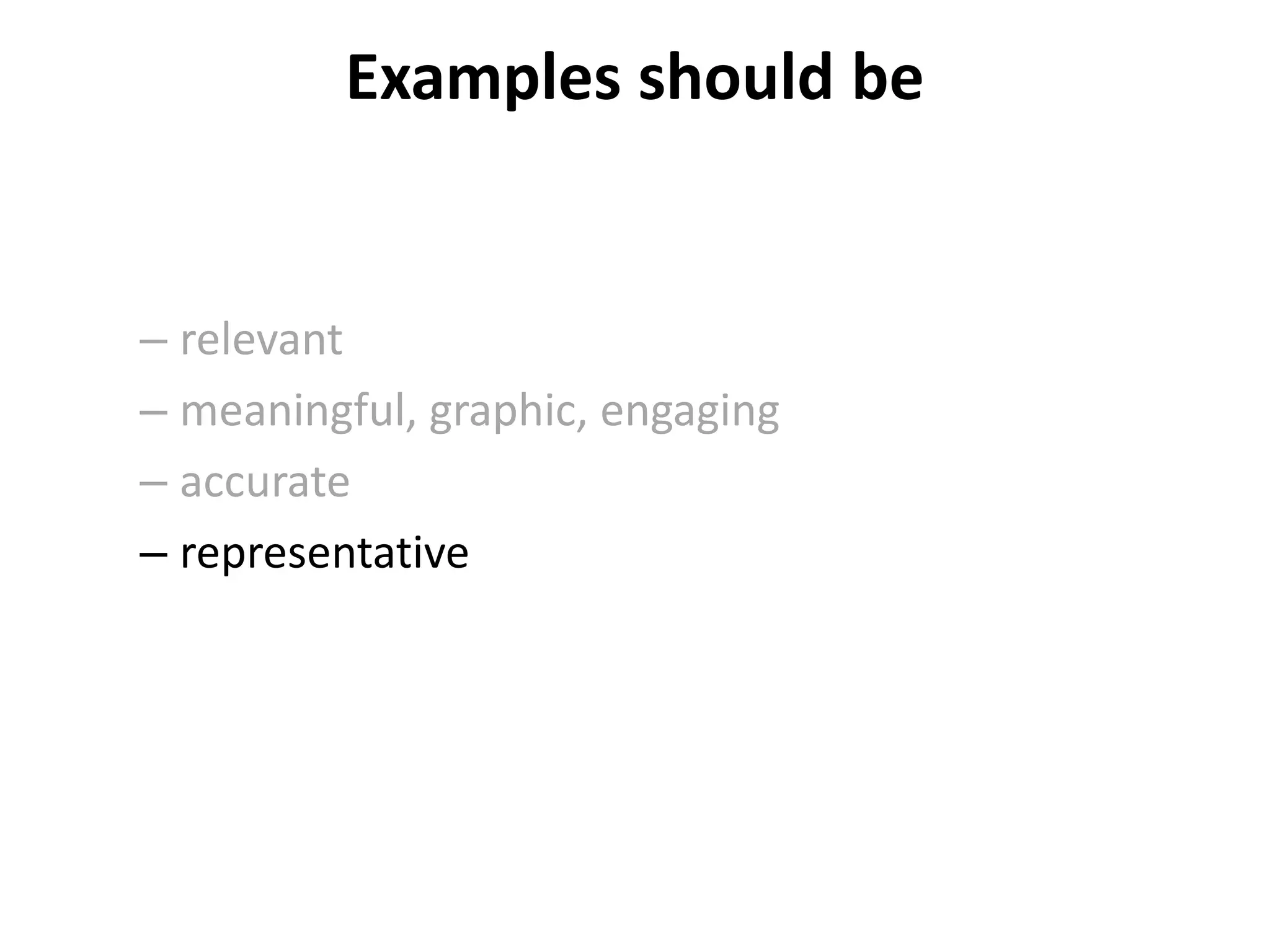
– representative
Examples should be
– relevant
– meaningful, graphic, engaging
– accurate
– representative
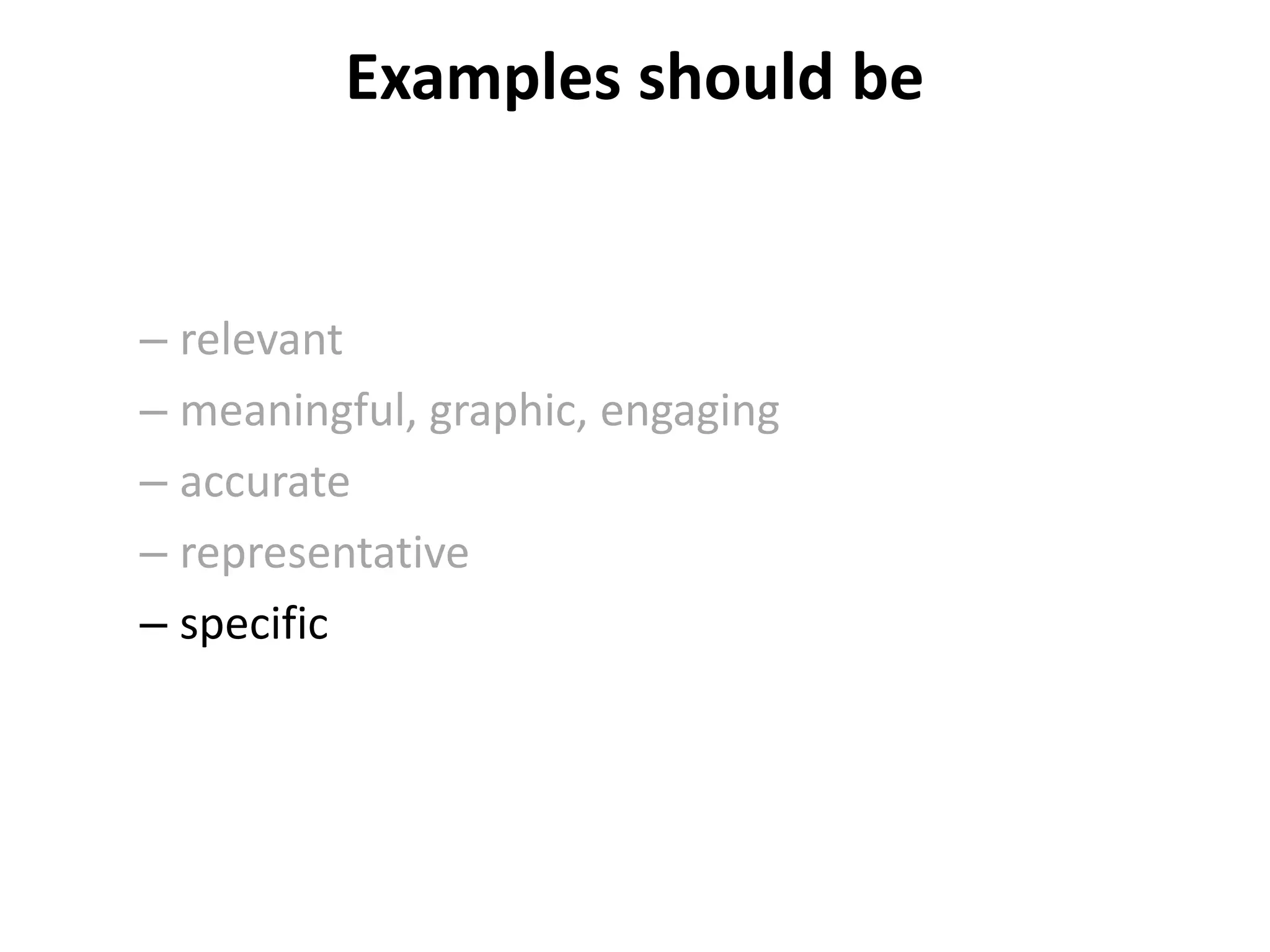
– specific
Examples should be
– relevant
– meaningful, graphic, engaging
– accurate
– representative
– specific
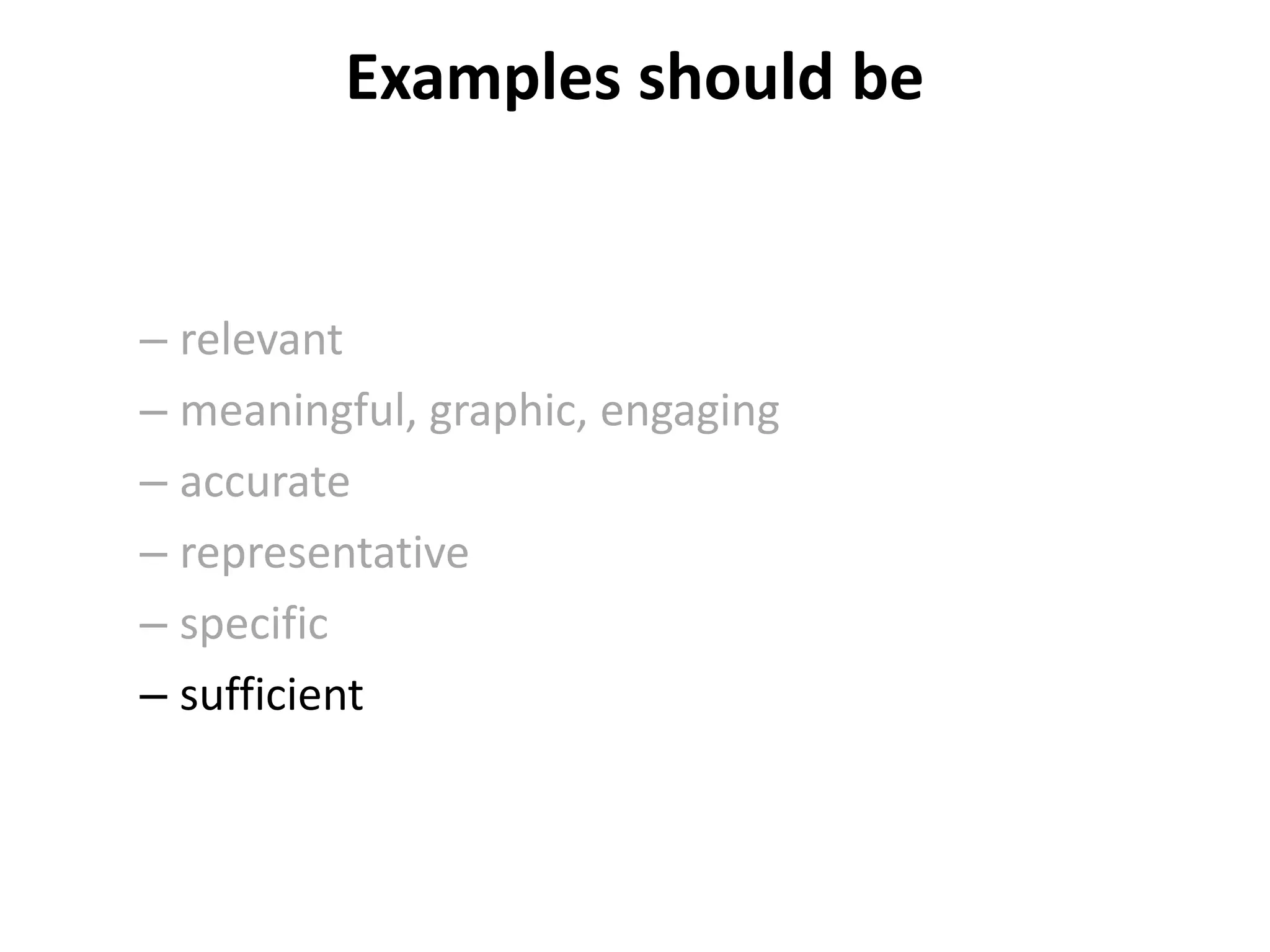
– sufficient
We can classify examples in two
ways:
• By length/development
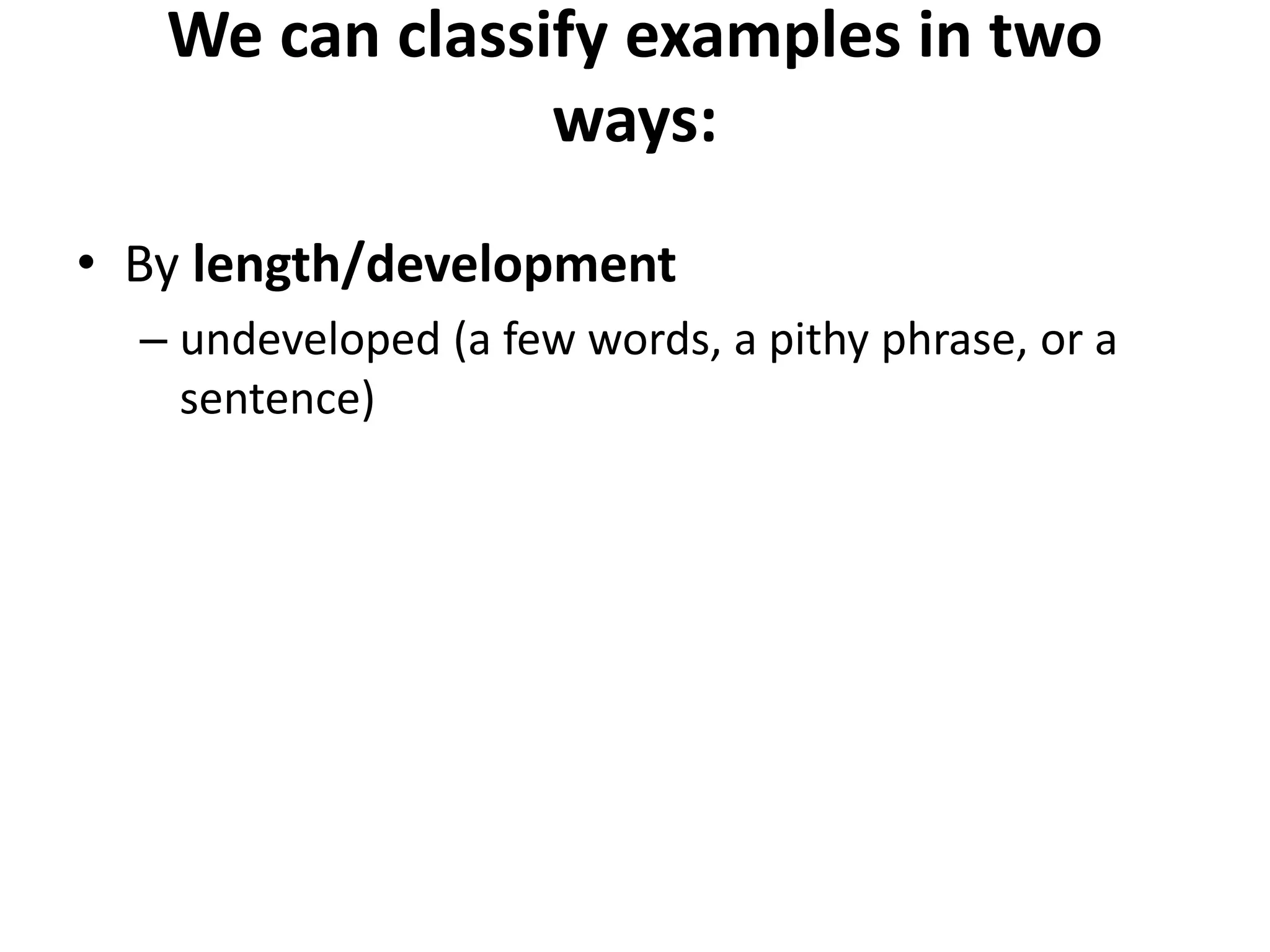
– undeveloped (a few words, a pithy phrase, or a
sentence)
We can classify examples in two
ways:
• By length/development
– undeveloped (a few words, a pithy phrase, or a
sentence)
– developed (multisentence passage)
We can classify examples in two
ways:
• By length/development
– undeveloped (a few words, a pithy phrase, or a
sentence)
– developed (multisentence passage)
– extended (working through a whole essay or a
long multiparagraph passage
We can classify examples in two
ways:
• By source
– personal experience (nonfiction)
We can classify examples in two
ways:
• By source
– personal experience (nonfiction)
– typical case (nonfiction)
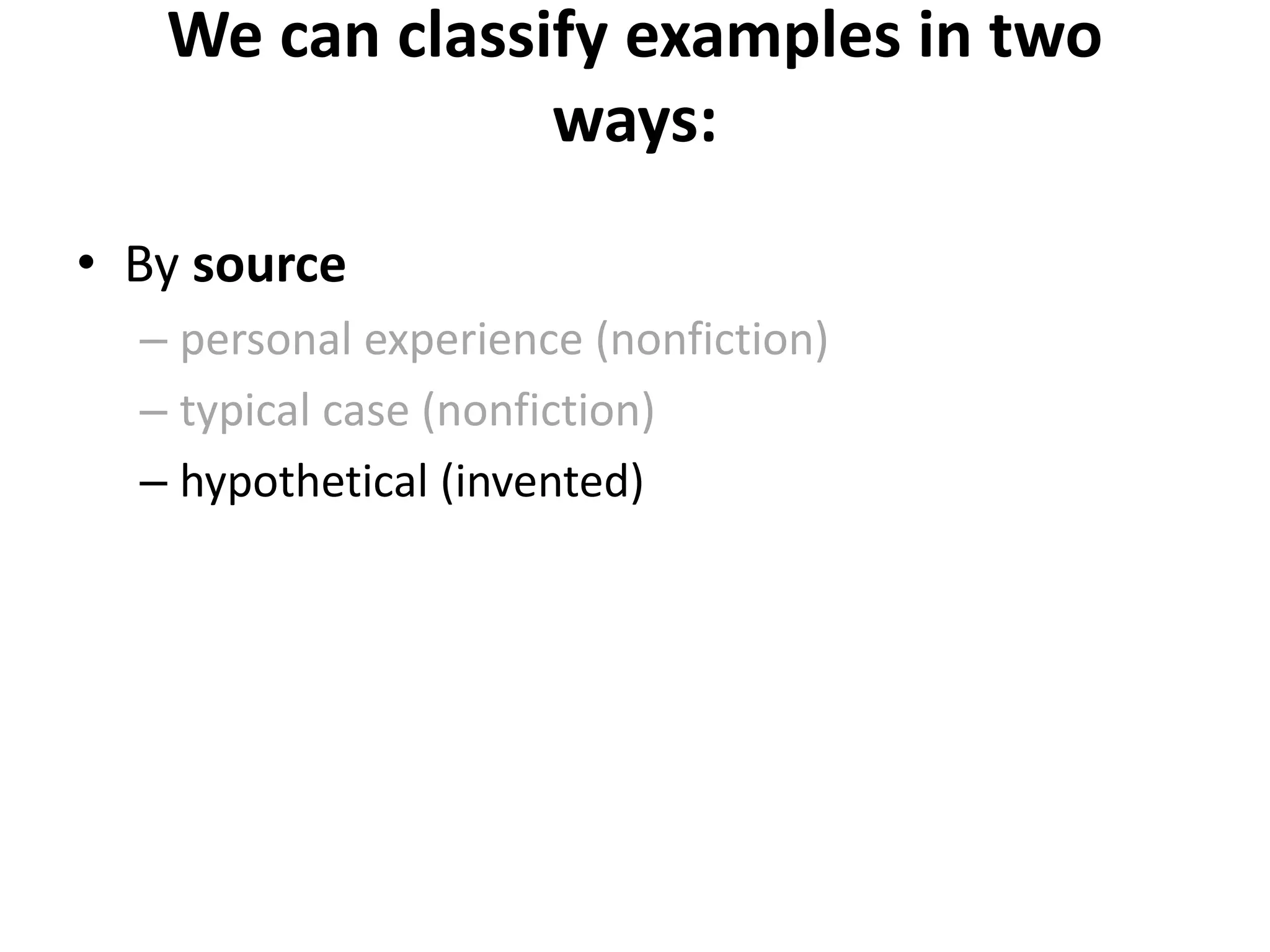
We can classify examples in two
ways:
• By source
– personal experience (nonfiction)
– typical case (nonfiction)
– hypothetical (invented)

Exemplification powerpoint presentation

  • 1.
    Exemplification/Illustration One of theexpository modes or strategies of writing (writing intended to explain, inform, or teach)
  • 2.
    Definitions: – an itemor incident that is representative of a rule, a type, or an abstraction
  • 3.
    Definitions: – an itemor incident that is representative of a rule, a type, or an abstraction – A parallel or closely similar case serving as a representative or model
  • 4.
    Definitions: – an itemor incident that is representative of a rule, a type, or an abstraction – an item or incident that is representative of a rule, a type, or an abstraction – an instance serving to illustrate a rule or precept
  • 5.
    4 reasons touse examples • We use them to persuade, explain, or engage
  • 6.
    4 Reasons touse examples • We use them to persuade, explain, or engage – they validate your argument or position, giving you credibility (persuade)
  • 7.
    4 Reasons touse examples We use them to persuade, to explain, or to engage • they validate your argument or position, giving you credibility • they carify the meaning of a general statement or abstract idea (explain)
  • 8.
    4 Reasons touse examples We use them to persuade, to explain, or to engage • they validate your argument or position, giving you credibility • they clarify meaning that is otherwise unclear • they eliminate unintended ambiguity (explain)
  • 9.
    4 Reasons touse examples We use them to persuade, explain or engage • they validate your argument or position, giving you credibility • they clarify meaning that is otherwise unclear • they eliminate unintended ambiguity • they make the writing interesting and applicable to the real world of experience (engage the reader)
  • 10.
  • 11.
    Examples should be –relevant – meaningful, graphic, engaging
  • 12.
    Examples should be –relevant – meaningful, graphic, engaging – accurate
  • 13.
    Examples should be –relevant – meaningful, graphic, engaging – accurate – representative
  • 14.
    Examples should be –relevant – meaningful, graphic, engaging – accurate – representative – specific
  • 15.
    Examples should be –relevant – meaningful, graphic, engaging – accurate – representative – specific – sufficient
  • 16.
    We can classifyexamples in two ways: • By length/development – undeveloped (a few words, a pithy phrase, or a sentence)
  • 17.
    We can classifyexamples in two ways: • By length/development – undeveloped (a few words, a pithy phrase, or a sentence) – developed (multisentence passage)
  • 18.
    We can classifyexamples in two ways: • By length/development – undeveloped (a few words, a pithy phrase, or a sentence) – developed (multisentence passage) – extended (working through a whole essay or a long multiparagraph passage
  • 19.
    We can classifyexamples in two ways: • By source – personal experience (nonfiction)
  • 20.
    We can classifyexamples in two ways: • By source – personal experience (nonfiction) – typical case (nonfiction)
  • 21.
    We can classifyexamples in two ways: • By source – personal experience (nonfiction) – typical case (nonfiction) – hypothetical (invented)