Substantive Change
Considerations for Monitoring
Overview
Applies to the Principles of Accreditation 14.2:
“The institution has a policy and procedure to ensure that all
substantive changes are reported in accordance with SACSCOC’s
policy.”
Overview
Substantive change, according to SACSCOC, is :
“a significant modification or expansion in the nature and scope of an
institution”
(this can actually encompass some situations that do not seem like a
significant change)
The US Department of Education has identified a
set of expectations for accreditation agencies.
The commission needs to be aware of, and be prepared to report on,
an institution’s evolution and growth. SACSCOC does so by
• Reviewing proposed changes in terms of mission
• Considering impact of change on existing programs
• Determining whether the institution has sufficient resources to implement the change
• Evaluating the soundness of the proposed change”
SACS COC passes the federal pressure on to its member institutions.
All SACSCOC-accredited institutions are
expected to report Substantive
Changes. This is not a new policy, but
SACSCOC has placed increased
emphasis on monitoring this policy in
the last 10 years.
SACS COC’s expectations of us
• Notification occurs prior to implementation (we can’t overemphasize that)
• Ongoing notification is expected (not just during 5th year and 10 year
reaffirmation)
• Some notifications required for SACSCOC “acceptance” (must be
approved)
• Others are to maintain accurate snapshot of institution
• Failure to comply with the substantive change procedures of the Commission can
result in serious consequences that include
• suspending the activity until SACSCOC approval is received
• denying approval of the activity, causing the college to cease implementation
• requiring the college to pay back financial aid dispersed to students
• placing the college on sanctions, or removing the college’s accreditation entirely
Types of substantive change (quite a few of
them altogether)
• initiating programs or courses through contractual
agreements or consortium
• entering into a contract with an entity that is not
certified to participate in USDOE
• initiating a degree completion program
Types of substantive change (continued)
• adding programs at the current credential level
• initiating courses or programs at a different
credential level
• substantially altering program length
• changing from clock hours to credit hours
Types of substantive change (continued)
•terminating or inactivating a program
•significant changes to Gen Ed
•relocating an off-campus site, main campus or
center
•initiating a branch campus*
Types of substantive change (continued)
• significantly altering the mission of the institution
• changing governance, ownership, control or legal
status
• Commencing program offerings at off-campus sites
or initiating distance learning
Types of substantive change (continued)
• initiating joint or dual degrees (modification of
previous version of Substantive Change policy)
• adding a combination degree program that
reduces the hours needed to complete the
combined degrees
• acquiring another site or program from another
institution
Types of substantive change (continued)
•adding a permanent location at a site where
the institution is conducting a teach-out for
students from another institution that is
closing
•direct assessment competency-based
educational programs
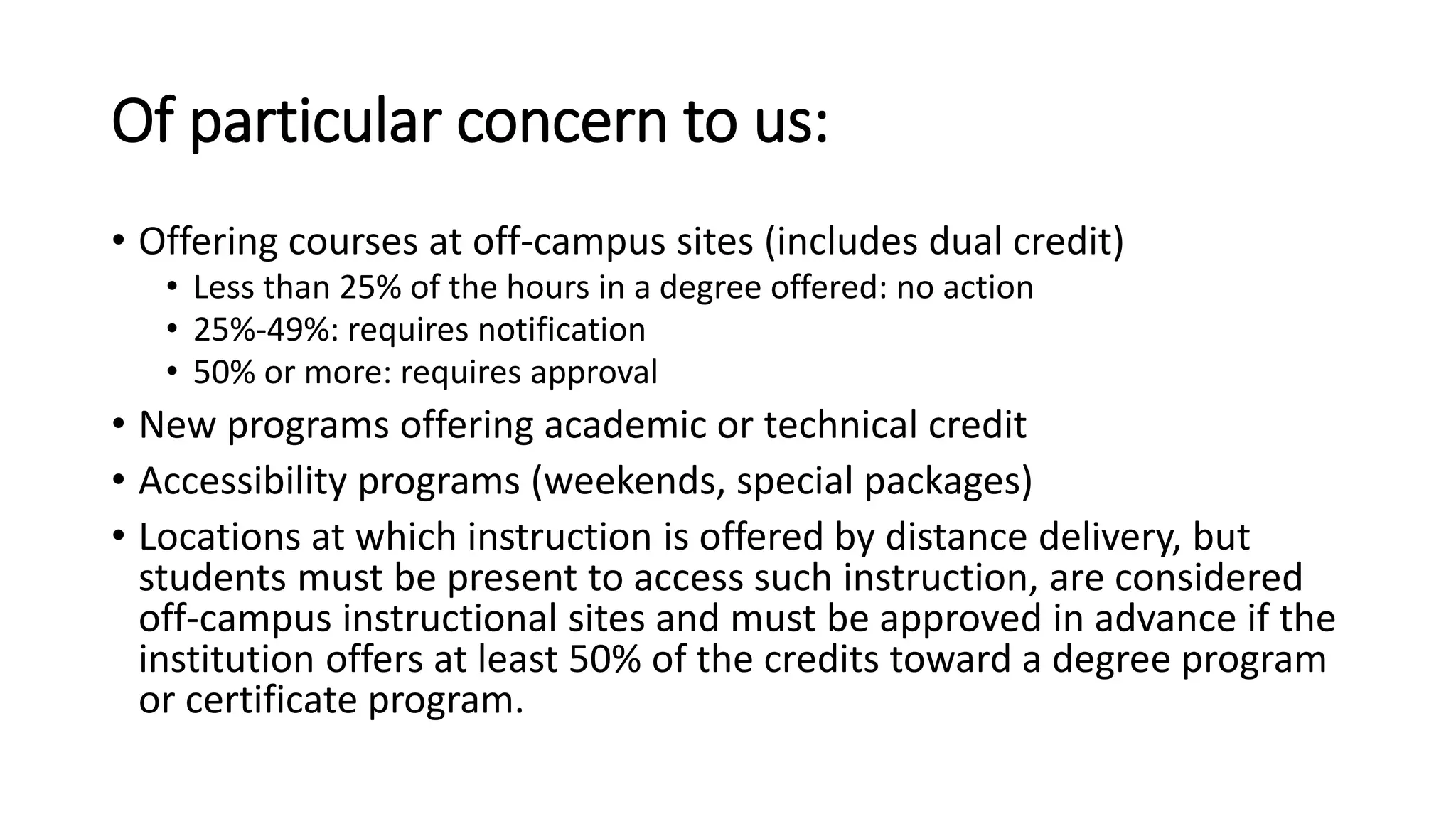
Of particular concern to us:
• Offering courses at off-campus sites (includes dual credit)
• Less than 25% of the hours in a degree offered: no action
• 25%-49%: requires notification
• 50% or more: requires approval
• New programs offering academic or technical credit
• Accessibility programs (weekends, special packages)
• Locations at which instruction is offered by distance delivery, but
students must be present to access such instruction, are considered
off-campus instructional sites and must be approved in advance if the
institution offers at least 50% of the credits toward a degree program
or certificate program.
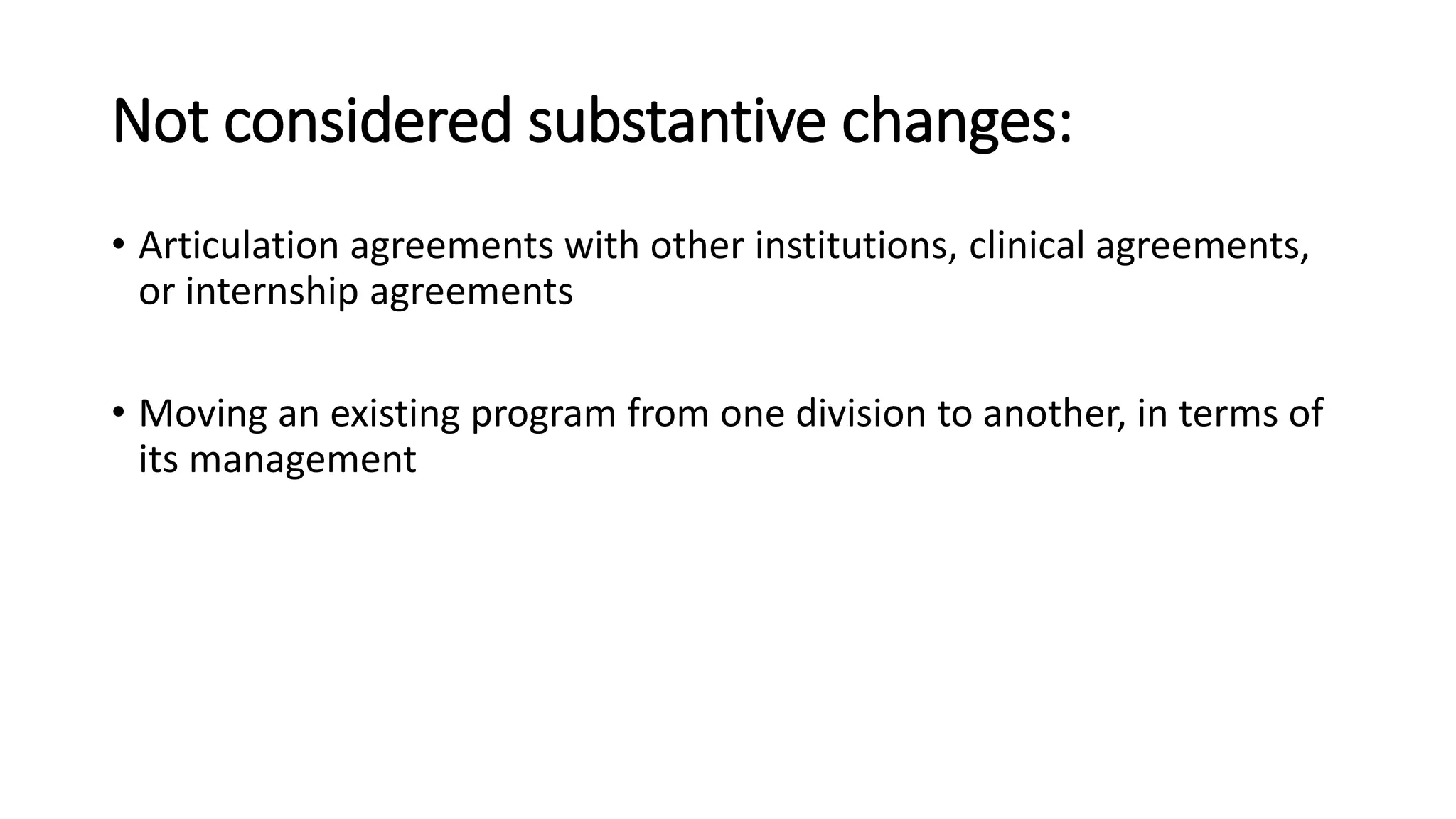
Not considered substantive changes:
• Articulation agreements with other institutions, clinical agreements,
or internship agreements
• Moving an existing program from one division to another, in terms of
its management
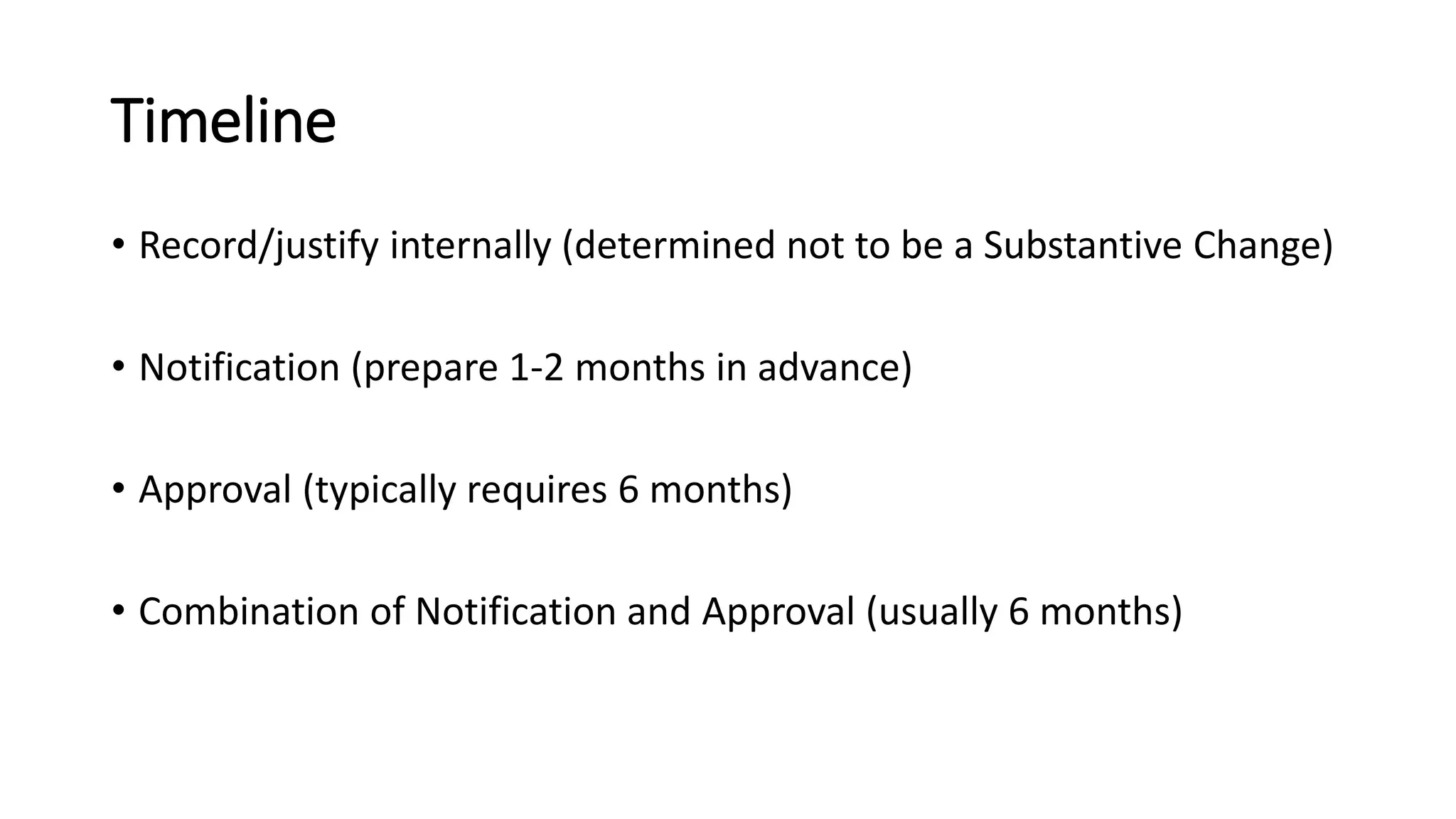
Timeline
• Record/justify internally (determined not to be a Substantive Change)
• Notification (prepare 1-2 months in advance)
• Approval (typically requires 6 months)
• Combination of Notification and Approval (usually 6 months)
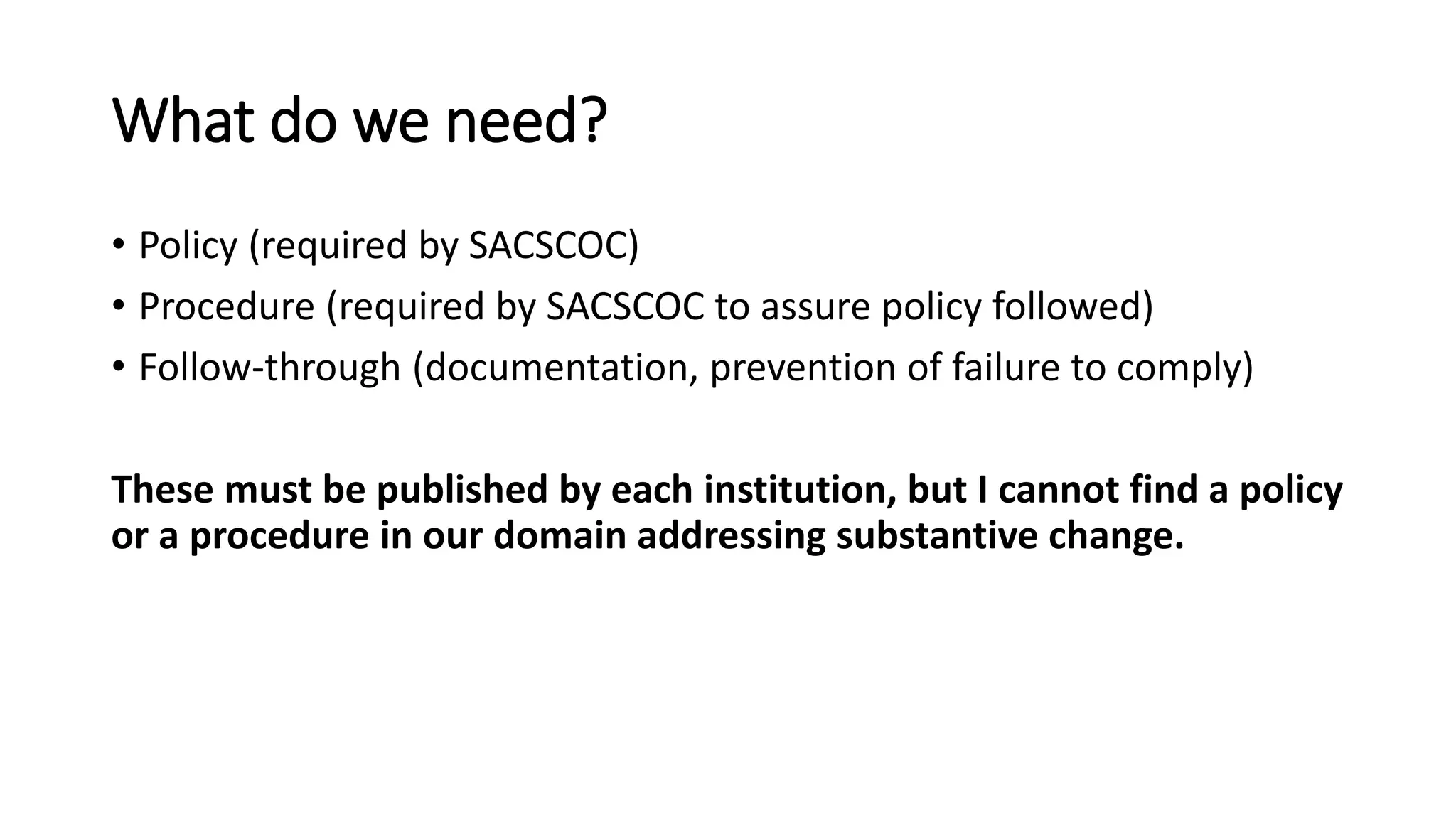
What do we need?
• Policy (required by SACSCOC)
• Procedure (required by SACSCOC to assure policy followed)
• Follow-through (documentation, prevention of failure to comply)
These must be published by each institution, but I cannot find a policy
or a procedure in our domain addressing substantive change.
Recommended policy statement
Policy Statement
LSCO adheres to accreditation standards and complies with the
principles of the Southern Association of Colleges and Schools
Commission on Colleges.
Procedures?
Recommended procedure
I recommend that the deans, program directors, and service unit
directors adapt the curriculum committee approval process for
program changes and new programs to include submission to the
SACSCOC liaison of an intake form before or concurrently with
submission of new program/program change proposals to the
curriculum committee.
The form will ask a series of questions and the information gathered
will be used to determine if submission of a substantial change
prospectus or notification is required.
These forms would also be entered into a substantial change log to be
updated at least once per semester.
Recommended procedure
I further recommend that the new program/program change proposal
form itself be modified to permit gathering of information on the
location at which the new program will be offered, and the modality of
delivery.
questions?
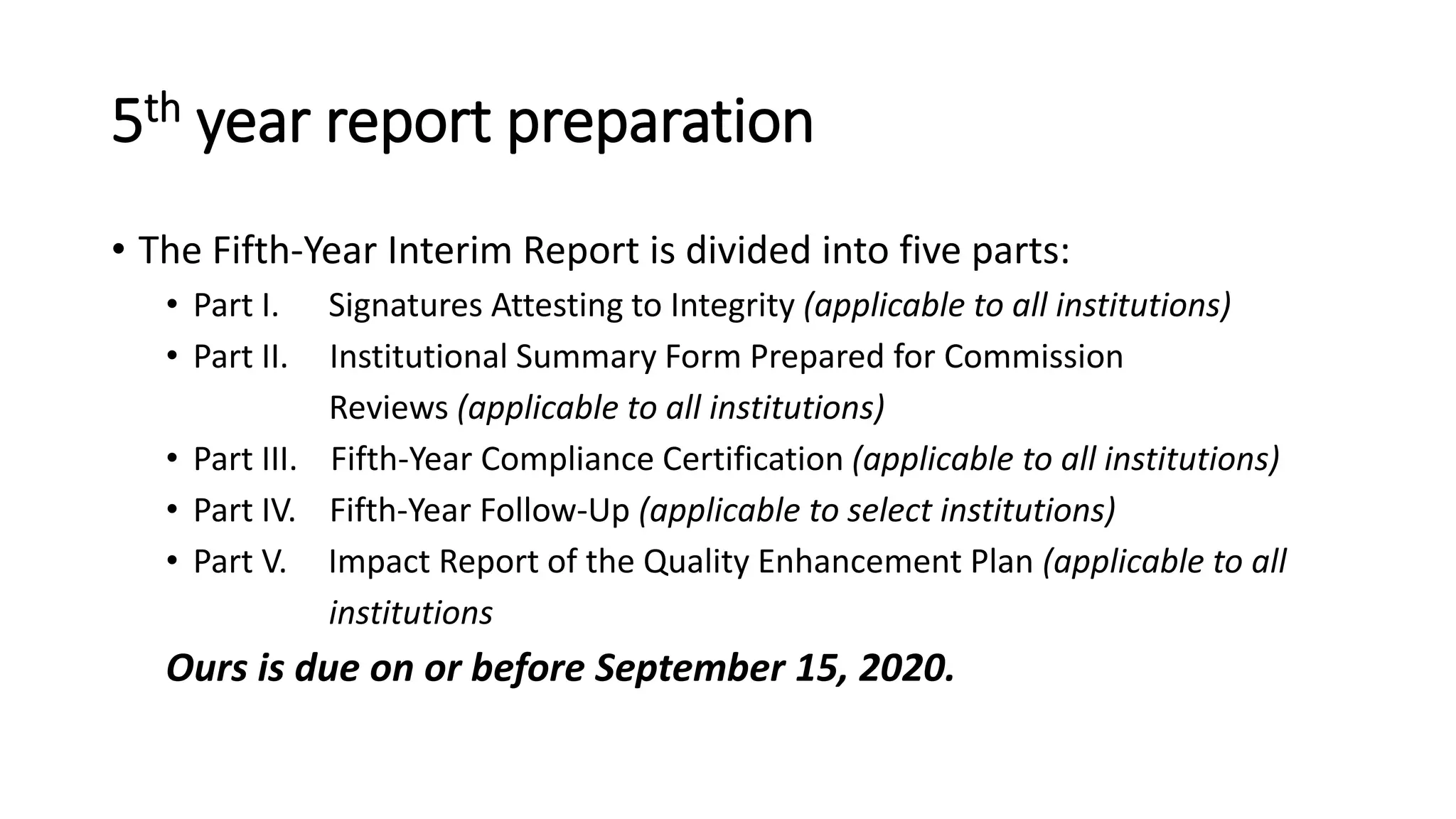
5th year report preparation
• The Fifth-Year Interim Report is divided into five parts:
• Part I. Signatures Attesting to Integrity (applicable to all institutions)
• Part II. Institutional Summary Form Prepared for Commission
Reviews (applicable to all institutions)
• Part III. Fifth-Year Compliance Certification (applicable to all institutions)
• Part IV. Fifth-Year Follow-Up (applicable to select institutions)
• Part V. Impact Report of the Quality Enhancement Plan (applicable to all
institutions
Ours is due on or before September 15, 2020.
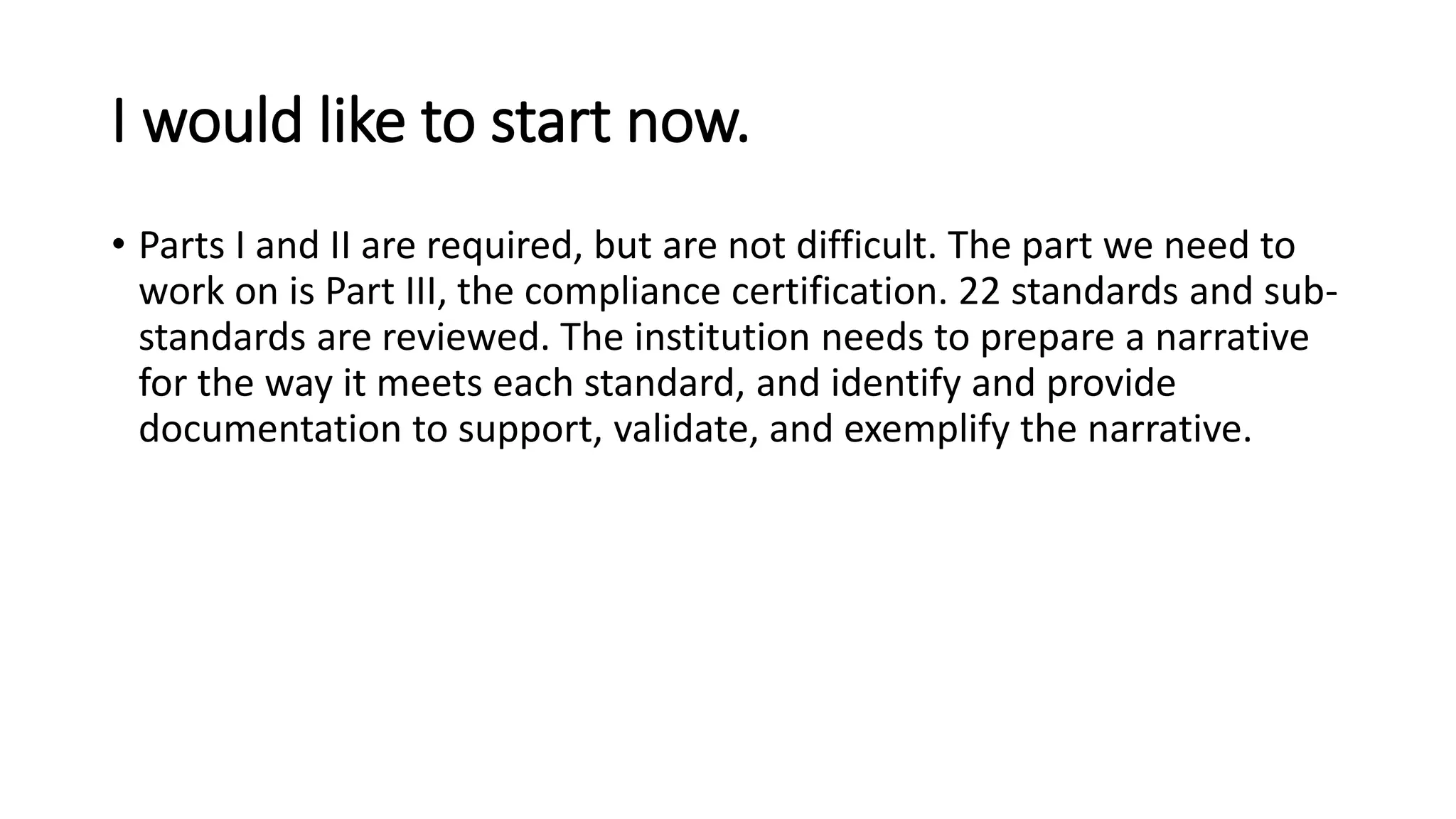
I would like to start now.
• Parts I and II are required, but are not difficult. The part we need to
work on is Part III, the compliance certification. 22 standards and sub-
standards are reviewed. The institution needs to prepare a narrative
for the way it meets each standard, and identify and provide
documentation to support, validate, and exemplify the narrative.
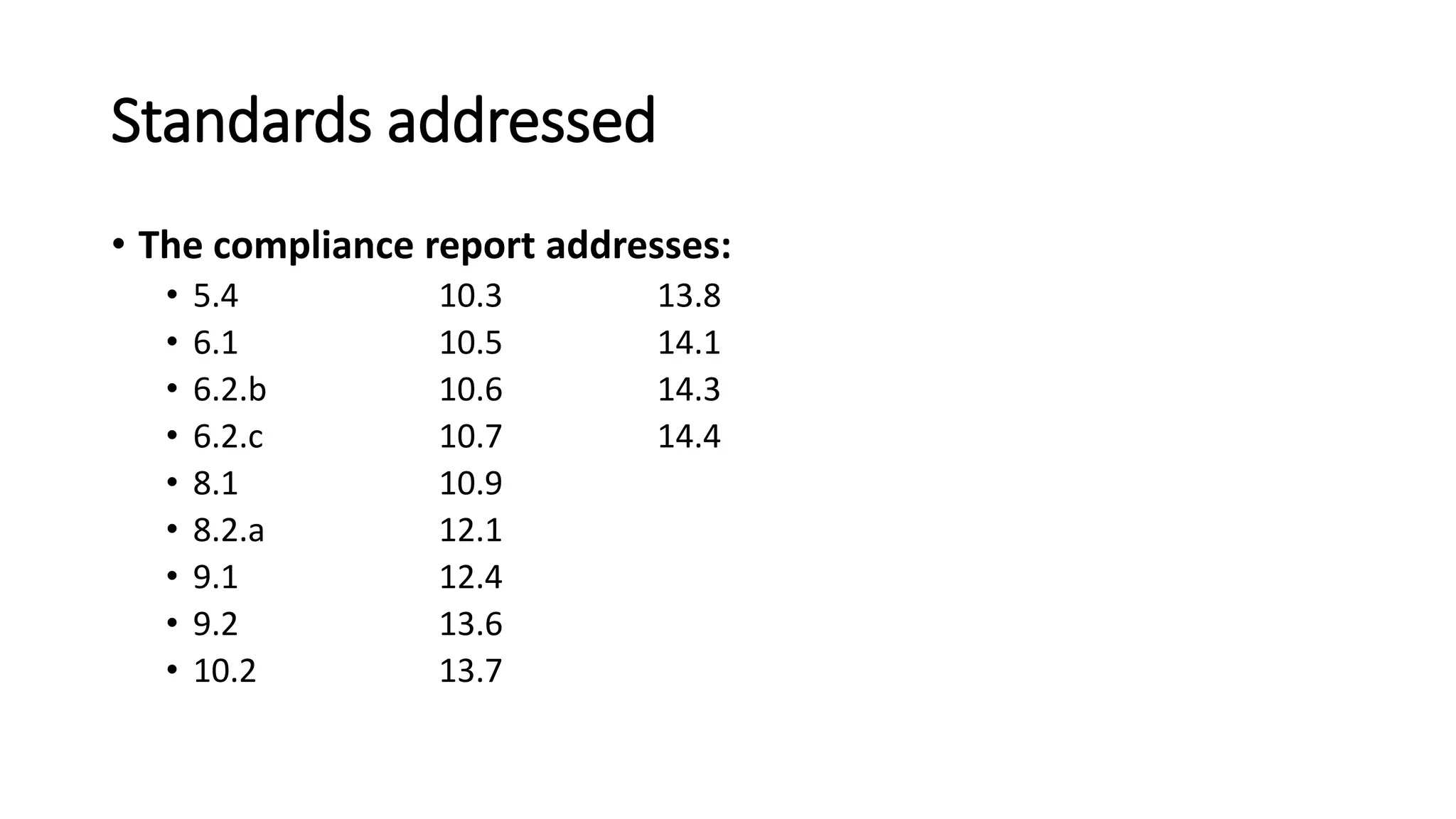
Standards addressed
• The compliance report addresses:
• 5.4 10.3 13.8
• 6.1 10.5 14.1
• 6.2.b 10.6 14.3
• 6.2.c 10.7 14.4
• 8.1 10.9
• 8.2.a 12.1
• 9.1 12.4
• 9.2 13.6
• 10.2 13.7
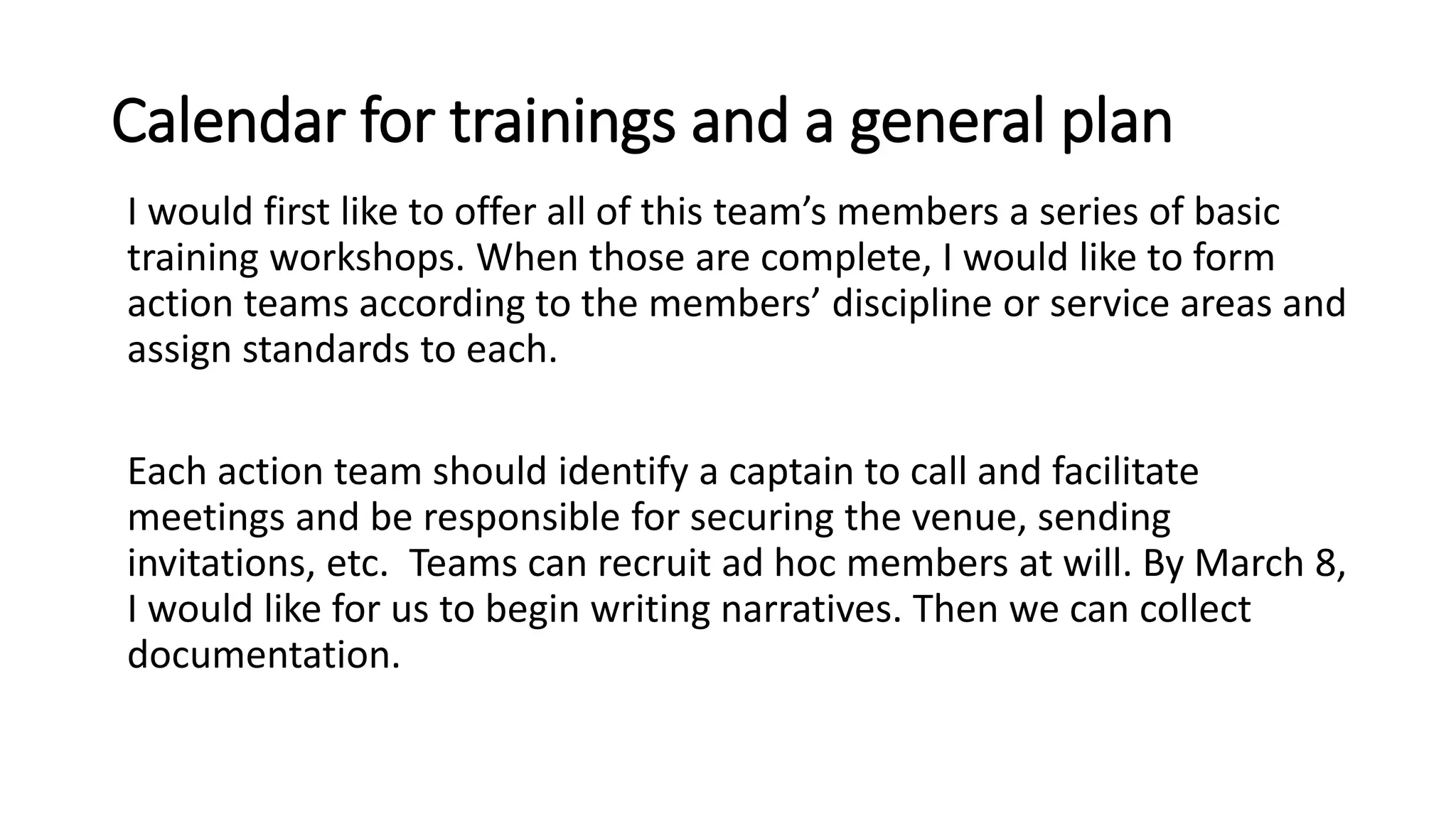
Calendar for trainings and a general plan
I would first like to offer all of this team’s members a series of basic
training workshops. When those are complete, I would like to form
action teams according to the members’ discipline or service areas and
assign standards to each.
Each action team should identify a captain to call and facilitate
meetings and be responsible for securing the venue, sending
invitations, etc. Teams can recruit ad hoc members at will. By March 8,
I would like for us to begin writing narratives. Then we can collect
documentation.
Calendar for trainings and a general plan
I would also recommend that each action team should meet biweekly
(or more often as you like), either in person or via Bb Collaborate.
The entire team (everyone here today) should meet monthly, to exhort
one another. If we can, let’s have a rough draft for review by the whole
team by May 1 (send materials to me for collating and redistribution by
April 29), and let’s try to be finished with a good draft by the beginning
of FY20.
Why so early?
In Fall of 2019, I want us to double check everything, revising and
updating what we need to. We should have plenty of time to be
thorough.
In Spring of 2020, I would like for our action teams to present their
reports to the faculty, staff, and administration.
questions?
Substantive change and 5th year report presentation

Substantive change and 5th year report presentation

  • 1.
  • 2.
    Overview Applies to thePrinciples of Accreditation 14.2: “The institution has a policy and procedure to ensure that all substantive changes are reported in accordance with SACSCOC’s policy.”
  • 3.
    Overview Substantive change, accordingto SACSCOC, is : “a significant modification or expansion in the nature and scope of an institution” (this can actually encompass some situations that do not seem like a significant change)
  • 4.
    The US Departmentof Education has identified a set of expectations for accreditation agencies. The commission needs to be aware of, and be prepared to report on, an institution’s evolution and growth. SACSCOC does so by • Reviewing proposed changes in terms of mission • Considering impact of change on existing programs • Determining whether the institution has sufficient resources to implement the change • Evaluating the soundness of the proposed change” SACS COC passes the federal pressure on to its member institutions.
  • 5.
    All SACSCOC-accredited institutionsare expected to report Substantive Changes. This is not a new policy, but SACSCOC has placed increased emphasis on monitoring this policy in the last 10 years.
  • 6.
    SACS COC’s expectationsof us • Notification occurs prior to implementation (we can’t overemphasize that) • Ongoing notification is expected (not just during 5th year and 10 year reaffirmation) • Some notifications required for SACSCOC “acceptance” (must be approved) • Others are to maintain accurate snapshot of institution • Failure to comply with the substantive change procedures of the Commission can result in serious consequences that include • suspending the activity until SACSCOC approval is received • denying approval of the activity, causing the college to cease implementation • requiring the college to pay back financial aid dispersed to students • placing the college on sanctions, or removing the college’s accreditation entirely
  • 7.
    Types of substantivechange (quite a few of them altogether) • initiating programs or courses through contractual agreements or consortium • entering into a contract with an entity that is not certified to participate in USDOE • initiating a degree completion program
  • 8.
    Types of substantivechange (continued) • adding programs at the current credential level • initiating courses or programs at a different credential level • substantially altering program length • changing from clock hours to credit hours
  • 9.
    Types of substantivechange (continued) •terminating or inactivating a program •significant changes to Gen Ed •relocating an off-campus site, main campus or center •initiating a branch campus*
  • 10.
    Types of substantivechange (continued) • significantly altering the mission of the institution • changing governance, ownership, control or legal status • Commencing program offerings at off-campus sites or initiating distance learning
  • 11.
    Types of substantivechange (continued) • initiating joint or dual degrees (modification of previous version of Substantive Change policy) • adding a combination degree program that reduces the hours needed to complete the combined degrees • acquiring another site or program from another institution
  • 12.
    Types of substantivechange (continued) •adding a permanent location at a site where the institution is conducting a teach-out for students from another institution that is closing •direct assessment competency-based educational programs
  • 13.
    Of particular concernto us: • Offering courses at off-campus sites (includes dual credit) • Less than 25% of the hours in a degree offered: no action • 25%-49%: requires notification • 50% or more: requires approval • New programs offering academic or technical credit • Accessibility programs (weekends, special packages) • Locations at which instruction is offered by distance delivery, but students must be present to access such instruction, are considered off-campus instructional sites and must be approved in advance if the institution offers at least 50% of the credits toward a degree program or certificate program.
  • 14.
    Not considered substantivechanges: • Articulation agreements with other institutions, clinical agreements, or internship agreements • Moving an existing program from one division to another, in terms of its management
  • 15.
    Timeline • Record/justify internally(determined not to be a Substantive Change) • Notification (prepare 1-2 months in advance) • Approval (typically requires 6 months) • Combination of Notification and Approval (usually 6 months)
  • 16.
    What do weneed? • Policy (required by SACSCOC) • Procedure (required by SACSCOC to assure policy followed) • Follow-through (documentation, prevention of failure to comply) These must be published by each institution, but I cannot find a policy or a procedure in our domain addressing substantive change.
  • 17.
    Recommended policy statement PolicyStatement LSCO adheres to accreditation standards and complies with the principles of the Southern Association of Colleges and Schools Commission on Colleges. Procedures?
  • 18.
    Recommended procedure I recommendthat the deans, program directors, and service unit directors adapt the curriculum committee approval process for program changes and new programs to include submission to the SACSCOC liaison of an intake form before or concurrently with submission of new program/program change proposals to the curriculum committee. The form will ask a series of questions and the information gathered will be used to determine if submission of a substantial change prospectus or notification is required. These forms would also be entered into a substantial change log to be updated at least once per semester.
  • 19.
    Recommended procedure I furtherrecommend that the new program/program change proposal form itself be modified to permit gathering of information on the location at which the new program will be offered, and the modality of delivery.
  • 20.
  • 21.
    5th year reportpreparation • The Fifth-Year Interim Report is divided into five parts: • Part I. Signatures Attesting to Integrity (applicable to all institutions) • Part II. Institutional Summary Form Prepared for Commission Reviews (applicable to all institutions) • Part III. Fifth-Year Compliance Certification (applicable to all institutions) • Part IV. Fifth-Year Follow-Up (applicable to select institutions) • Part V. Impact Report of the Quality Enhancement Plan (applicable to all institutions Ours is due on or before September 15, 2020.
  • 22.
    I would liketo start now. • Parts I and II are required, but are not difficult. The part we need to work on is Part III, the compliance certification. 22 standards and sub- standards are reviewed. The institution needs to prepare a narrative for the way it meets each standard, and identify and provide documentation to support, validate, and exemplify the narrative.
  • 23.
    Standards addressed • Thecompliance report addresses: • 5.4 10.3 13.8 • 6.1 10.5 14.1 • 6.2.b 10.6 14.3 • 6.2.c 10.7 14.4 • 8.1 10.9 • 8.2.a 12.1 • 9.1 12.4 • 9.2 13.6 • 10.2 13.7
  • 24.
    Calendar for trainingsand a general plan I would first like to offer all of this team’s members a series of basic training workshops. When those are complete, I would like to form action teams according to the members’ discipline or service areas and assign standards to each. Each action team should identify a captain to call and facilitate meetings and be responsible for securing the venue, sending invitations, etc. Teams can recruit ad hoc members at will. By March 8, I would like for us to begin writing narratives. Then we can collect documentation.
  • 25.
    Calendar for trainingsand a general plan I would also recommend that each action team should meet biweekly (or more often as you like), either in person or via Bb Collaborate. The entire team (everyone here today) should meet monthly, to exhort one another. If we can, let’s have a rough draft for review by the whole team by May 1 (send materials to me for collating and redistribution by April 29), and let’s try to be finished with a good draft by the beginning of FY20.
  • 26.
    Why so early? InFall of 2019, I want us to double check everything, revising and updating what we need to. We should have plenty of time to be thorough. In Spring of 2020, I would like for our action teams to present their reports to the faculty, staff, and administration.
  • 27.