Writing Matters
by Rebecca Moore Howard
Thinking and
Reading Critically7
©2010, The McGraw-Hill Companies, Inc. All Rights Reserved. 1
©2010, The McGraw-Hill Companies, Inc. All Rights Reserved. 2
Comprehending
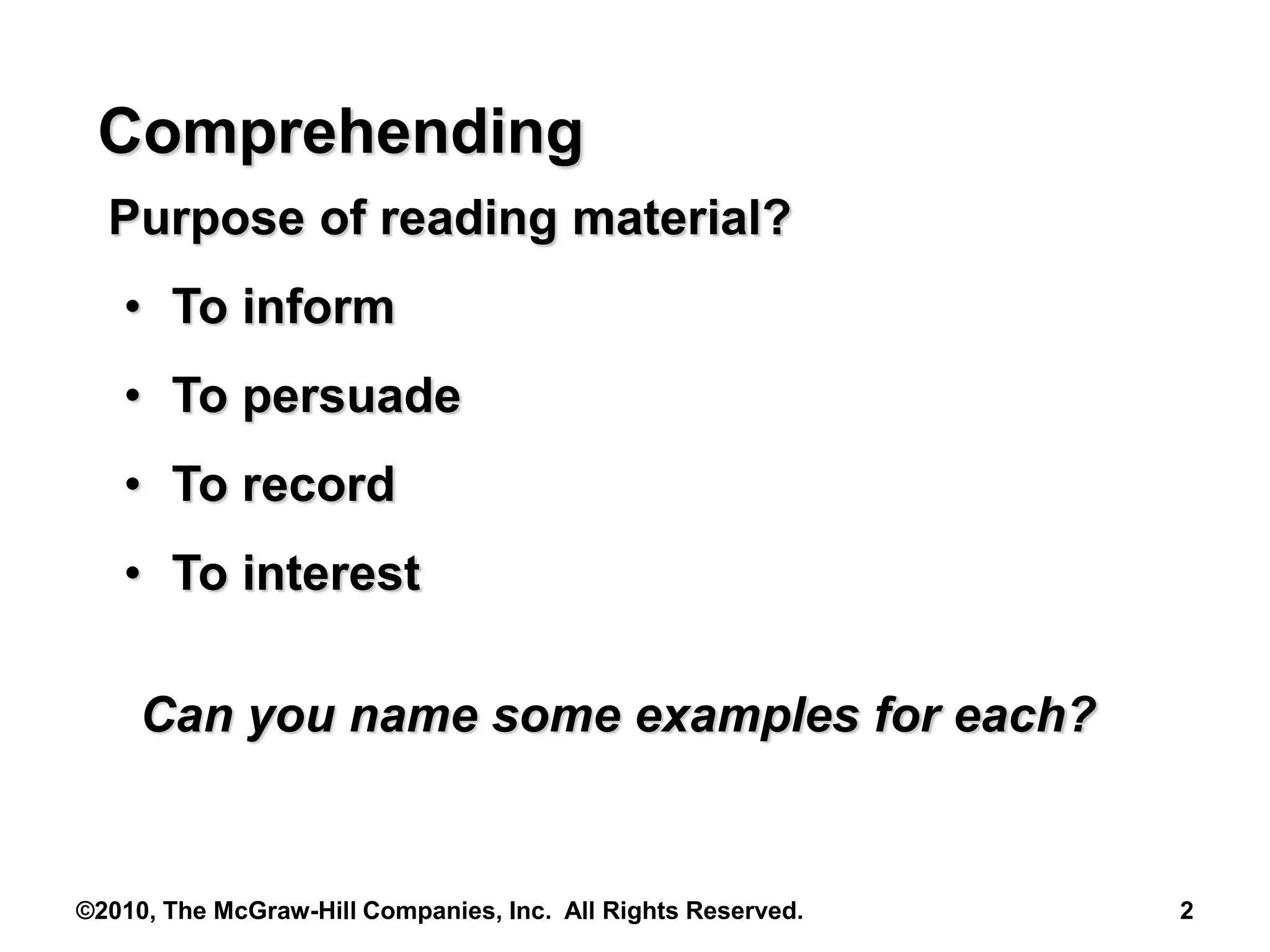
Purpose of reading material?
• To inform
• To persuade
• To record
• To interest
Can you name some examples for each?
©2010, The McGraw-Hill Companies, Inc. All Rights Reserved. 3
Comprehending
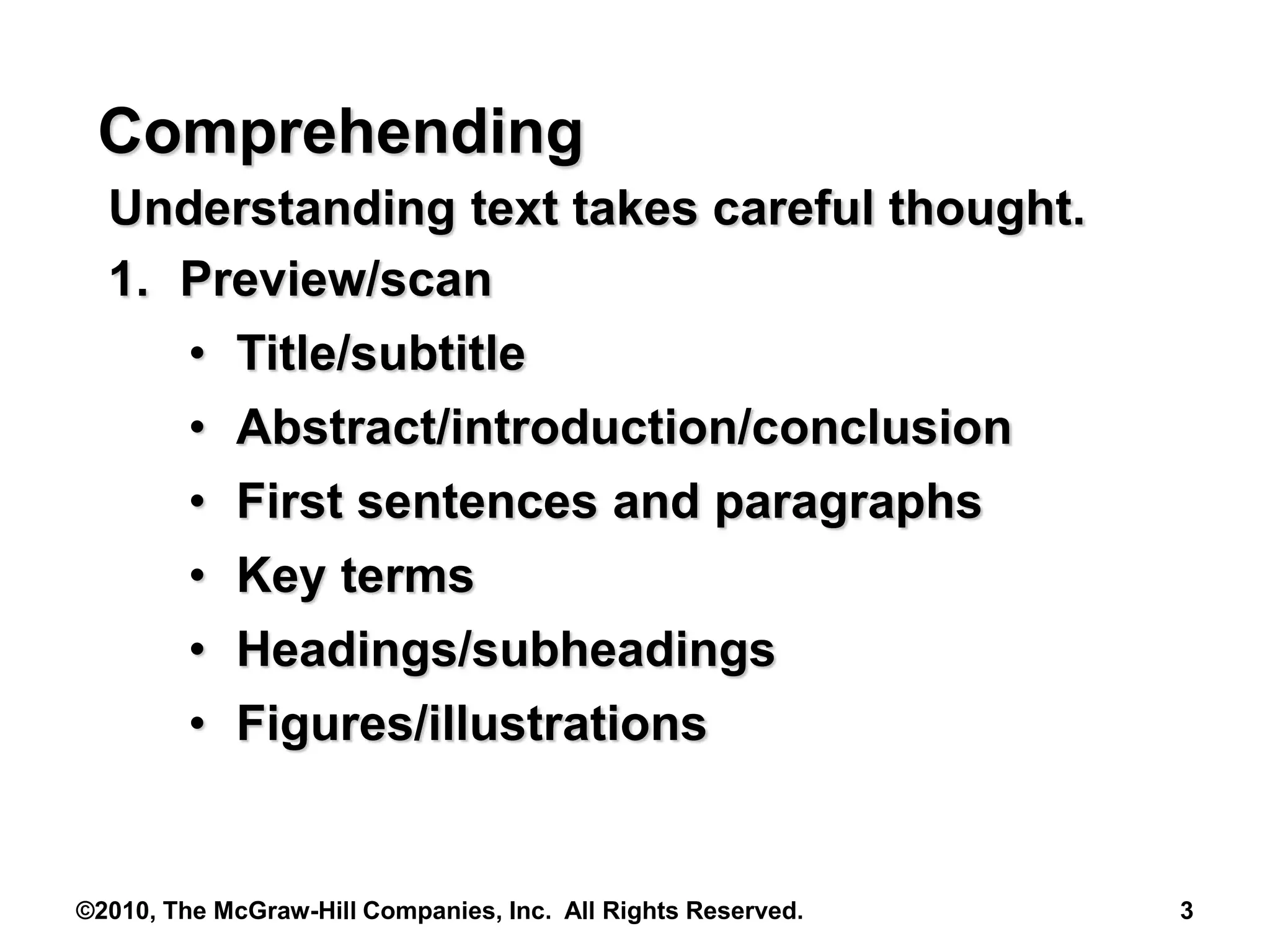
Understanding text takes careful thought.
1. Preview/scan
• Title/subtitle
• Abstract/introduction/conclusion
• First sentences and paragraphs
• Key terms
• Headings/subheadings
• Figures/illustrations
©2010, The McGraw-Hill Companies, Inc. All Rights Reserved. 4
Comprehending
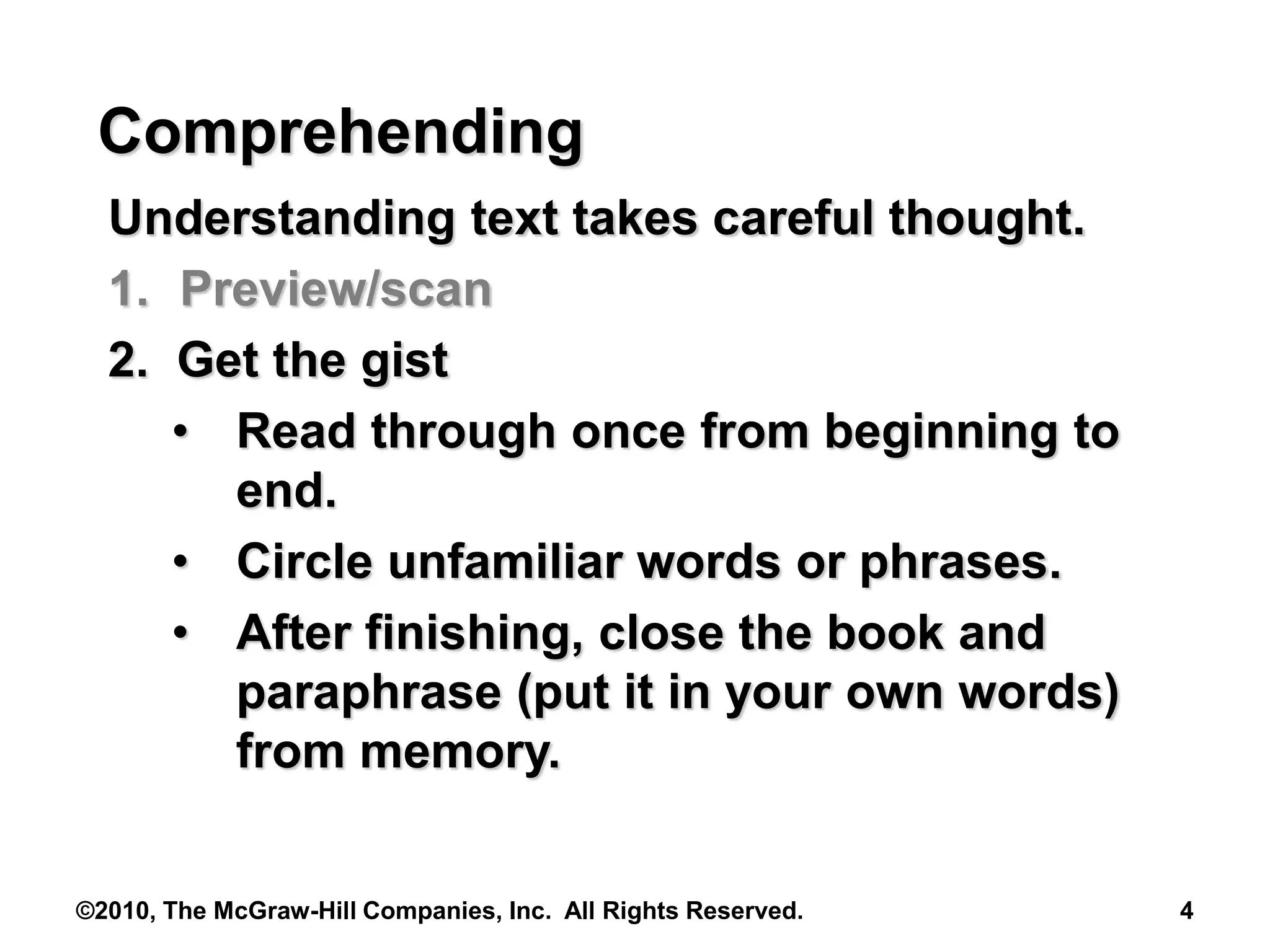
Understanding text takes careful thought.
1. Preview/scan
2. Get the gist
• Read through once from beginning to
end.
• Circle unfamiliar words or phrases.
• After finishing, close the book and
paraphrase (put it in your own words)
from memory.
©2010, The McGraw-Hill Companies, Inc. All Rights Reserved. 5
Comprehending
Understanding text takes careful thought.
1. Preview/scan
2. Get the gist/paraphrase
3. Summarize in your own words
• Restate main idea and key support.
• 10% to 50% as long as original.
• Helps you remember.
• Provides a helpful reference for later
writing.
©2010, The McGraw-Hill Companies, Inc. All Rights Reserved. 6
Comprehending
Understanding text takes careful thought.
1. Preview/scan
2. Get the gist/paraphrase
3. Summarize
4. Enjoy
• Think as you read.
• Consider details.
• Note words and phrases.
• Connect to your life.
©2010, The McGraw-Hill Companies, Inc. All Rights Reserved. 7
Reflecting
Connects reading the text to
understanding it.
©2010, The McGraw-Hill Companies, Inc. All Rights Reserved. 8
Reflecting
1. Annotate
• Definitions
• Look up words.
©2010, The McGraw-Hill Companies, Inc. All Rights Reserved. 9
Reflecting
1. Annotate
• Definitions
• Concepts
• Underline all that is interesting,
important, or difficult.
©2010, The McGraw-Hill Companies, Inc. All Rights Reserved. 10
Reflecting
1. Annotate
• Definitions
• Concepts
• Tone
• Is the writer sincere? Sarcastic?
Witty?
©2010, The McGraw-Hill Companies, Inc. All Rights Reserved. 11
Reflecting
1. Annotate
• Definitions
• Concepts
• Tone
• Biases
• What is the writer’s opinion?
• What is your opinion?
©2010, The McGraw-Hill Companies, Inc. All Rights Reserved. 12
Reflecting
1. Annotate
• Definitions
• Concepts
• Tone
• Biases
• Fallacies
• Errors in logic?
• Misleading?
©2010, The McGraw-Hill Companies, Inc. All Rights Reserved. 13
Reflecting
1. Annotate
• Definitions
• Concepts
• Tone
• Biases
• Fallacies
• Responses
• Ask questions.
• Note your reactions.
©2010, The McGraw-Hill Companies, Inc. All Rights Reserved. 14
Reflecting
1. Annotate
• Definitions
• Concepts
• Tone
• Biases
• Fallacies
• Responses
• Connections
• Relate to experience or other texts
©2010, The McGraw-Hill Companies, Inc. All Rights Reserved. 15
Reflecting
1. Annotate
Don’t forget footnotes or parenthetical
text.
©2010, The McGraw-Hill Companies, Inc. All Rights Reserved. 16
Reflecting
1. Annotate
When annotating an image rather than a
text, follow the steps outlined in the Self-
Assessment checklist on p. 115 to focus
your efforts.
©2010, The McGraw-Hill Companies, Inc. All Rights Reserved. 17
Reflecting
1. Annotate
2. Journal
• Analyze the writer’s purpose.
• Freewrite your reactions.
• Brainstorm related ideas.
• Outline the text.
• Connect the material to your own
ideas.
©2010, The McGraw-Hill Companies, Inc. All Rights Reserved. 18
Reflecting
1. Annotate
2. Journal
A double-entry journal will help you
avoid plagiarism by keeping your
own ideas separate from the ideas
you have found in the text.
©2010, The McGraw-Hill Companies, Inc. All Rights Reserved. 19
Preparing to Write
1. Analyze
To analyze means to break down—to
tear apart and consider components.
• What do the parts mean?
• How do the parts work together as a
whole?
©2010, The McGraw-Hill Companies, Inc. All Rights Reserved. 20
Preparing to Write
1. Analyze
• Consider the major claims.
• Evidence?
©2010, The McGraw-Hill Companies, Inc. All Rights Reserved. 21
Preparing to Write
1. Analyze
• Consider the major claims.
• Consider the development.
• Counterevidence?
• Sources?
©2010, The McGraw-Hill Companies, Inc. All Rights Reserved. 22
Preparing to Write
1. Analyze
• Consider the major claims.
• Consider the development.
• Consider the organization.
• Patterns?
• Classical
• Rogerian
• Toulmin
©2010, The McGraw-Hill Companies, Inc. All Rights Reserved. 23
Preparing to Write
1. Analyze
• Consider the major claims.
• Consider the development.
• Consider the organization.
• Consider the rhetorical appeals.
• Logos?
• Ethos?
• Pathos?
©2010, The McGraw-Hill Companies, Inc. All Rights Reserved. 24
Preparing to Write
1. Analyze
• Consider the major claims.
• Consider the development.
• Consider the organization.
• Consider the rhetorical appeals.
• Consider the tone and style.
• What do they indicate about
purpose? Audience?
©2010, The McGraw-Hill Companies, Inc. All Rights Reserved. 25
Preparing to Write
1. Analyze
• Consider the major claims.
• Consider the development.
• Consider the organization.
• Consider the rhetorical appeals.
• Consider the tone and style.
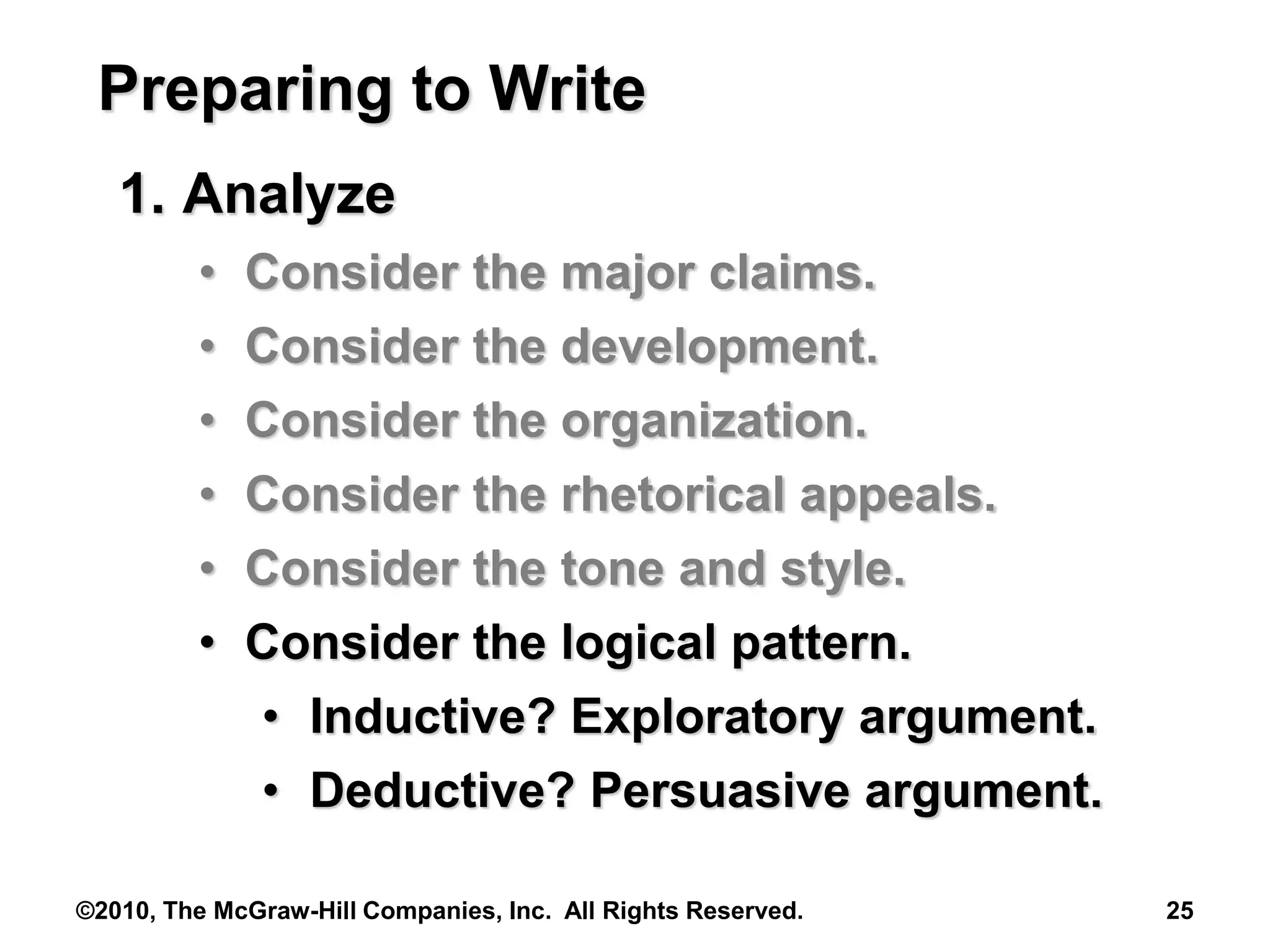
• Consider the logical pattern.
• Inductive? Exploratory argument.
• Deductive? Persuasive argument.
©2010, The McGraw-Hill Companies, Inc. All Rights Reserved. 26
Preparing to Write
1. Analyze
2. Interpret
What is the significance?
©2010, The McGraw-Hill Companies, Inc. All Rights Reserved. 27
Preparing to Write
1. Analyze
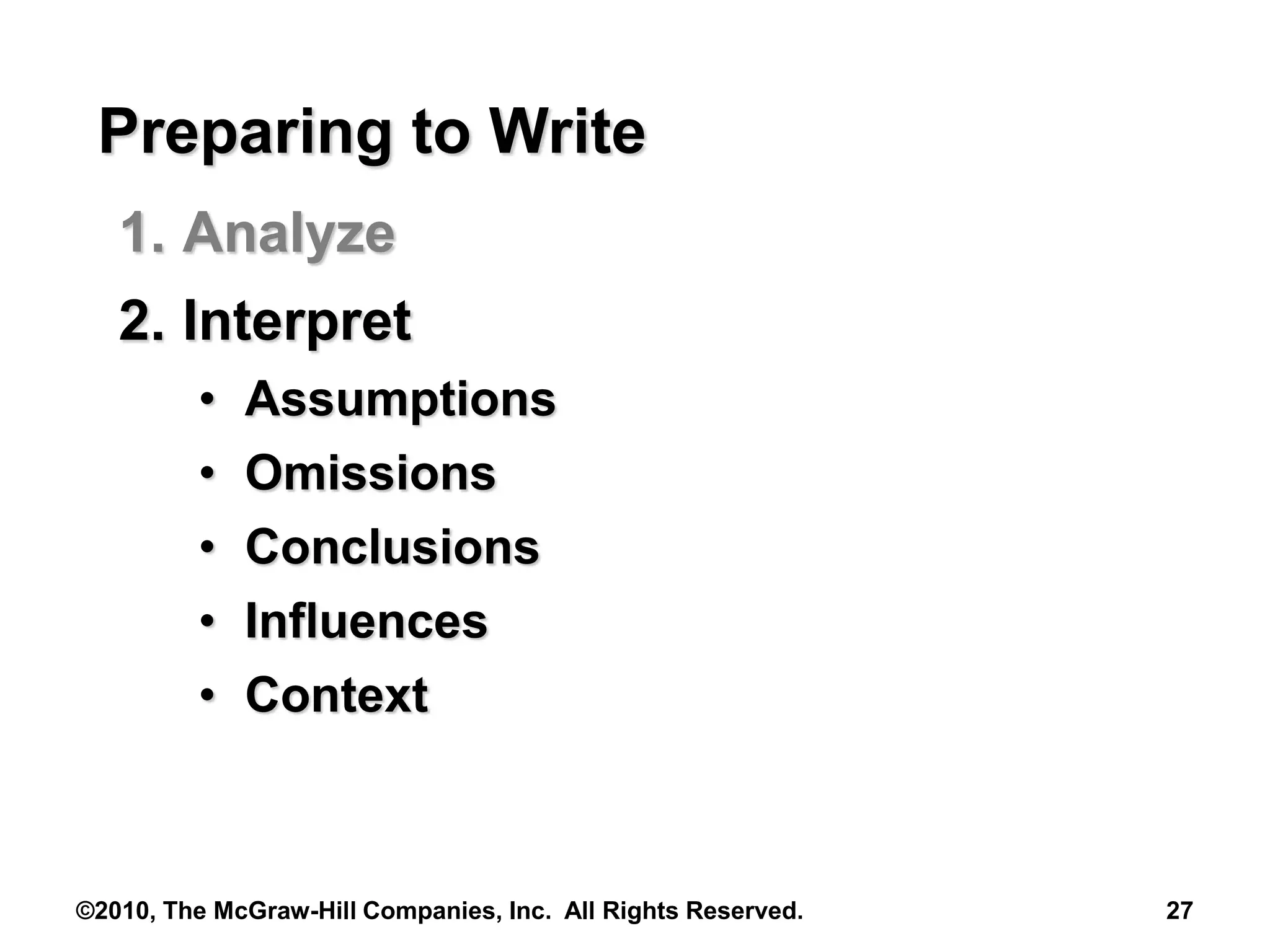
2. Interpret
• Assumptions
• Omissions
• Conclusions
• Influences
• Context
©2010, The McGraw-Hill Companies, Inc. All Rights Reserved. 28
Preparing to Write
1. Analyze
2. Interpret
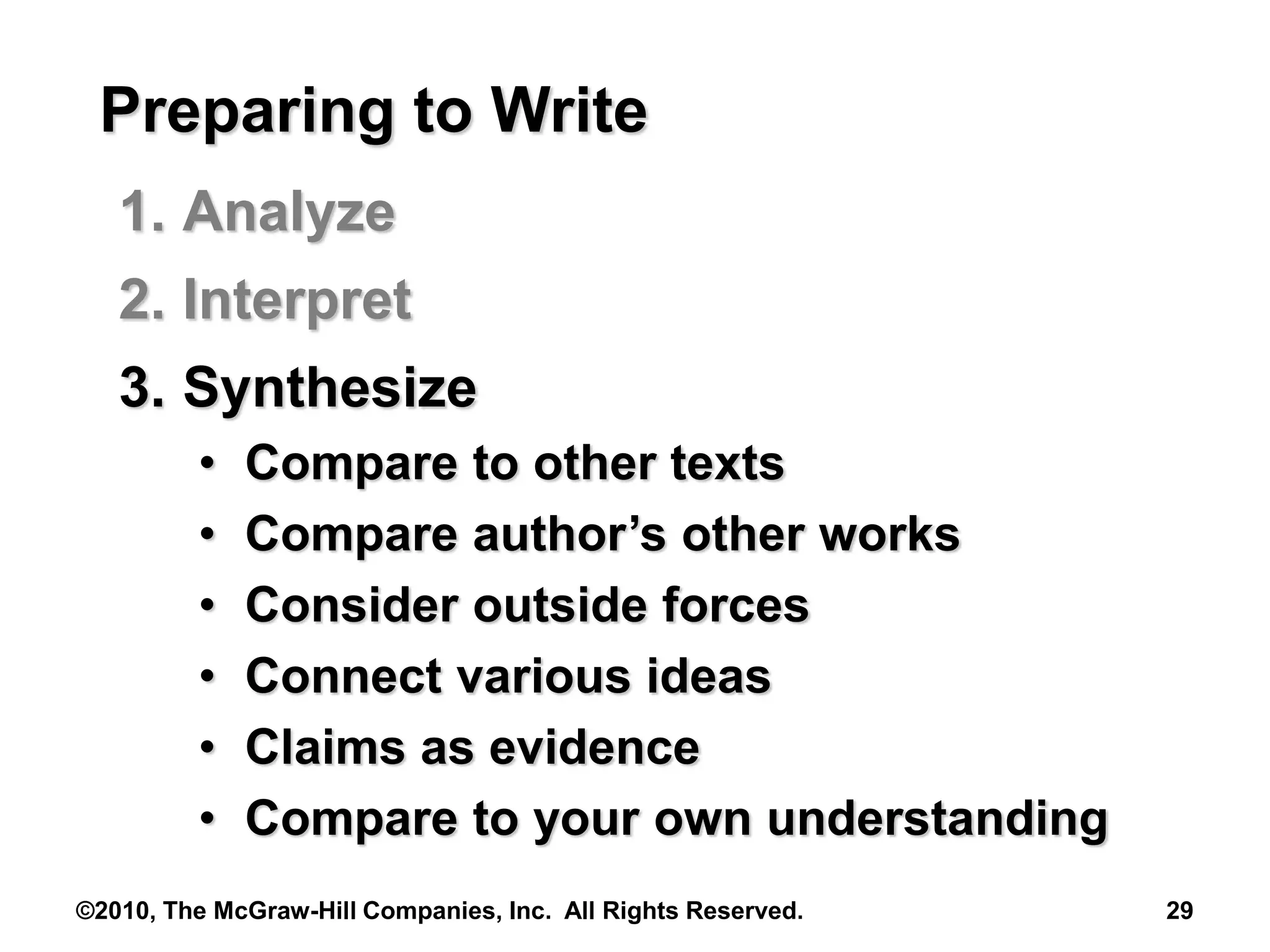
3. Synthesize
Connect material to the “real world.”
©2010, The McGraw-Hill Companies, Inc. All Rights Reserved. 29
Preparing to Write
1. Analyze
2. Interpret
3. Synthesize
• Compare to other texts
• Compare author’s other works
• Consider outside forces
• Connect various ideas
• Claims as evidence
• Compare to your own understanding
©2010, The McGraw-Hill Companies, Inc. All Rights Reserved. 30
Preparing to Write
1. Analyze
2. Interpret
3. Synthesize
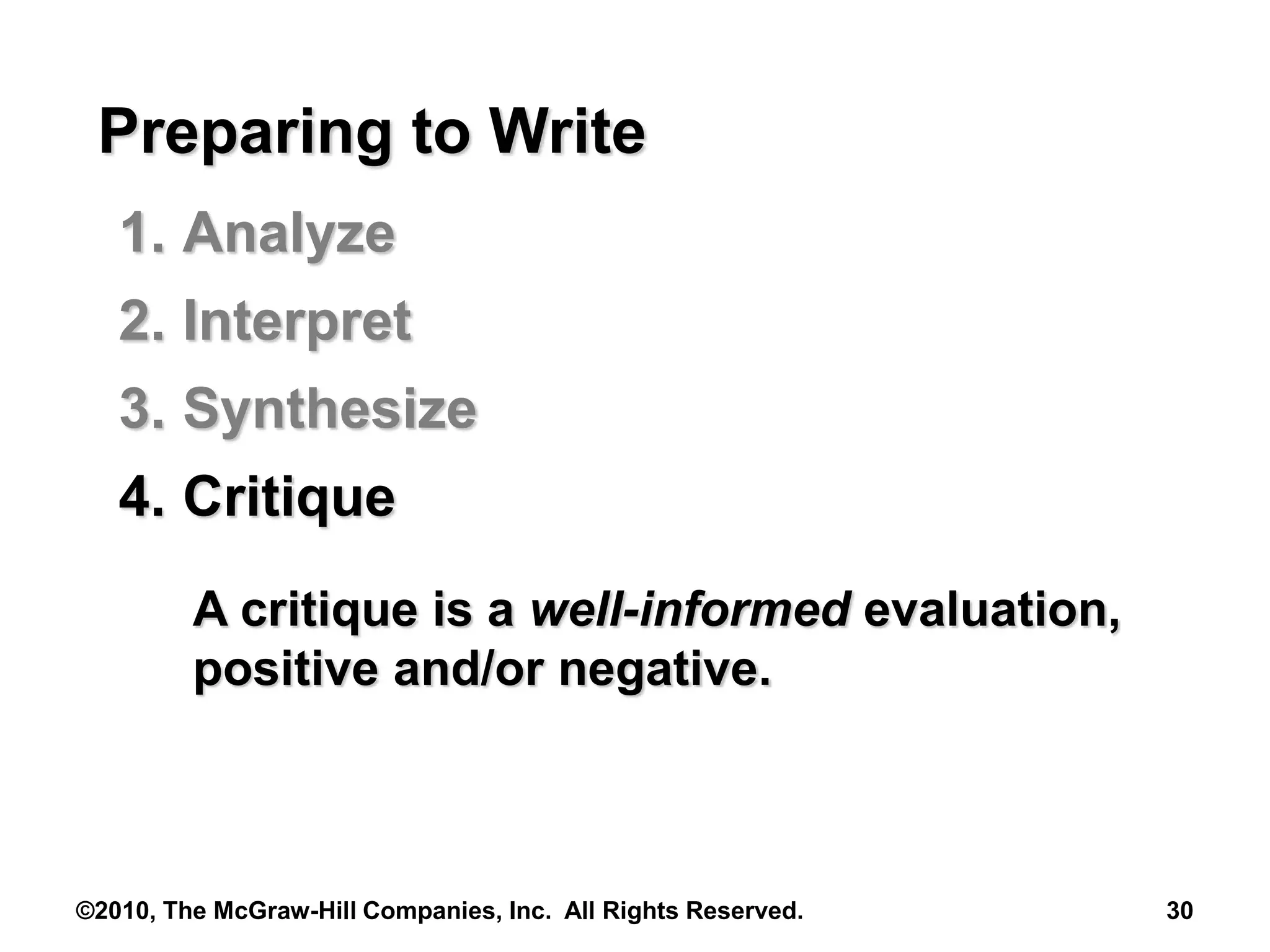
4. Critique
A critique is a well-informed evaluation,
positive and/or negative.
©2010, The McGraw-Hill Companies, Inc. All Rights Reserved. 31
Preparing to Write
1. Analyze
2. Interpret
3. Synthesize
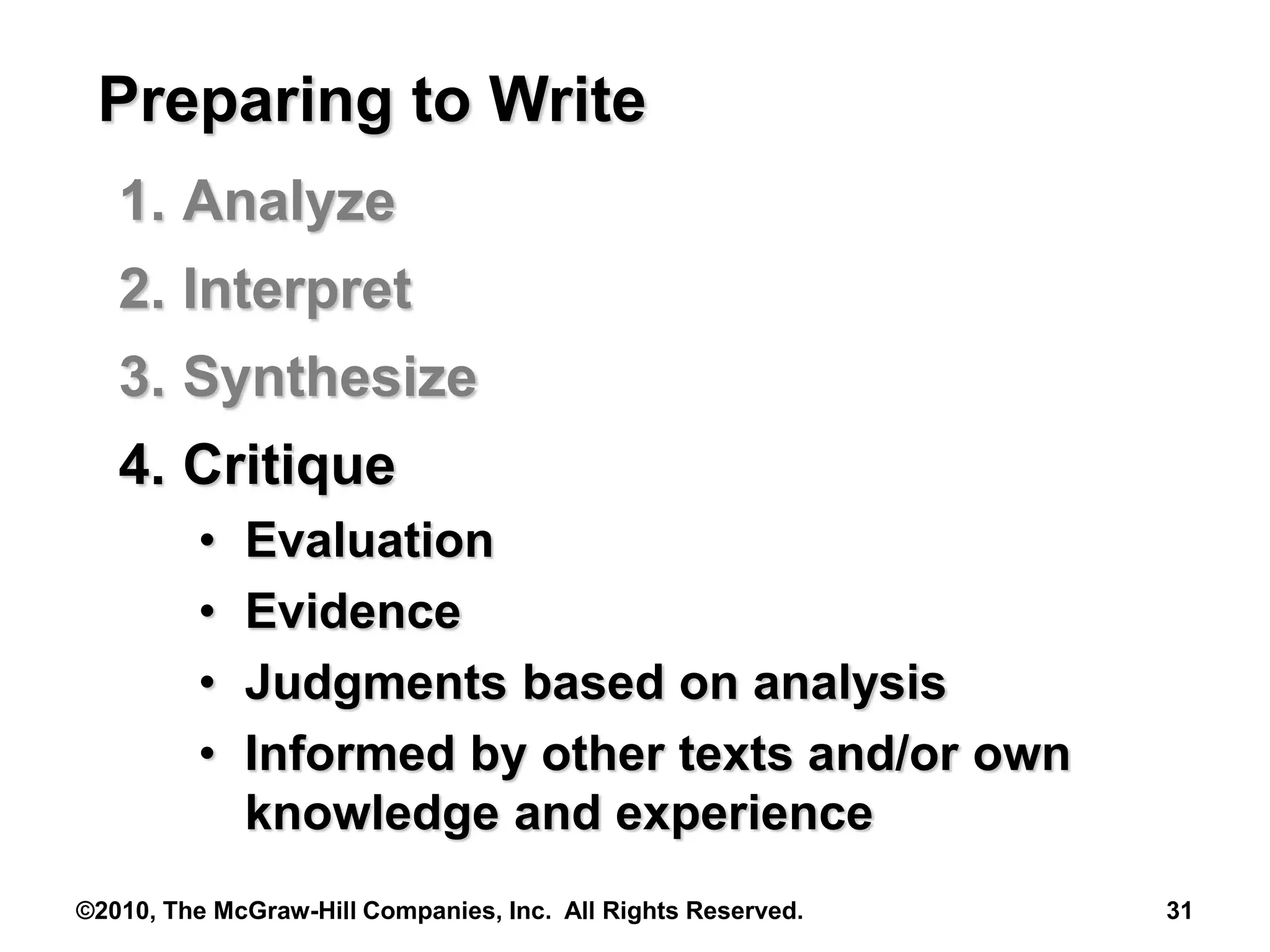
4. Critique
• Evaluation
• Evidence
• Judgments based on analysis
• Informed by other texts and/or own
knowledge and experience
©2010, The McGraw-Hill Companies, Inc. All Rights Reserved. 32
Preparing to Write
1. Analyze
2. Interpret
3. Synthesize
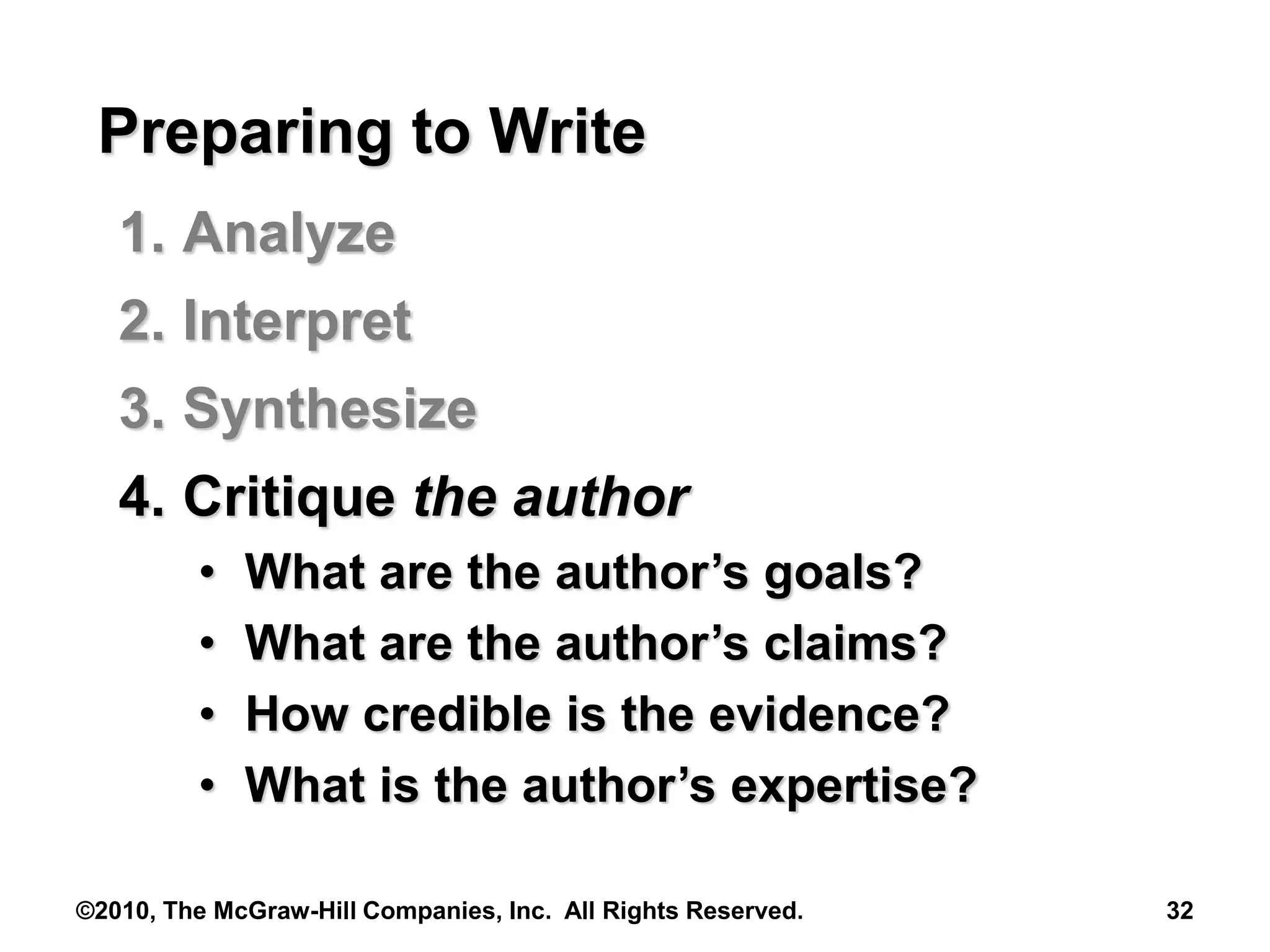
4. Critique the author
• What are the author’s goals?
• What are the author’s claims?
• How credible is the evidence?
• What is the author’s expertise?
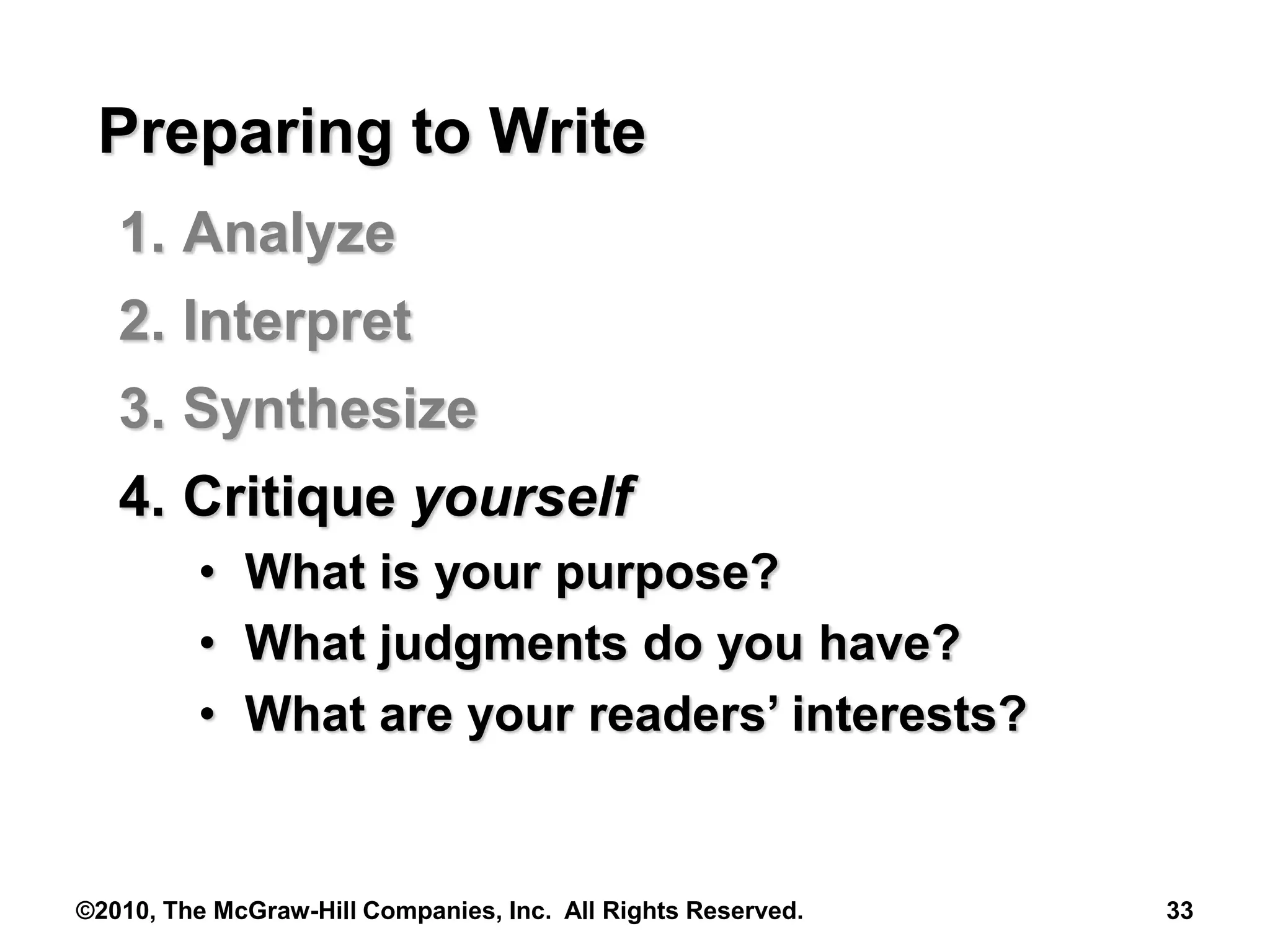
©2010, The McGraw-Hill Companies, Inc. All Rights Reserved. 33
Preparing to Write
1. Analyze
2. Interpret
3. Synthesize
4. Critique yourself
• What is your purpose?
• What judgments do you have?
• What are your readers’ interests?
Writing Matters
by Rebecca Moore Howard
Thinking and
Reading Critically7
©2010, The McGraw-Hill Companies, Inc. All Rights Reserved. 34

Howard wm2ec ppt-ch07 (1)

  • 1.
    Writing Matters by RebeccaMoore Howard Thinking and Reading Critically7 ©2010, The McGraw-Hill Companies, Inc. All Rights Reserved. 1
  • 2.
    ©2010, The McGraw-HillCompanies, Inc. All Rights Reserved. 2 Comprehending Purpose of reading material? • To inform • To persuade • To record • To interest Can you name some examples for each?
  • 3.
    ©2010, The McGraw-HillCompanies, Inc. All Rights Reserved. 3 Comprehending Understanding text takes careful thought. 1. Preview/scan • Title/subtitle • Abstract/introduction/conclusion • First sentences and paragraphs • Key terms • Headings/subheadings • Figures/illustrations
  • 4.
    ©2010, The McGraw-HillCompanies, Inc. All Rights Reserved. 4 Comprehending Understanding text takes careful thought. 1. Preview/scan 2. Get the gist • Read through once from beginning to end. • Circle unfamiliar words or phrases. • After finishing, close the book and paraphrase (put it in your own words) from memory.
  • 5.
    ©2010, The McGraw-HillCompanies, Inc. All Rights Reserved. 5 Comprehending Understanding text takes careful thought. 1. Preview/scan 2. Get the gist/paraphrase 3. Summarize in your own words • Restate main idea and key support. • 10% to 50% as long as original. • Helps you remember. • Provides a helpful reference for later writing.
  • 6.
    ©2010, The McGraw-HillCompanies, Inc. All Rights Reserved. 6 Comprehending Understanding text takes careful thought. 1. Preview/scan 2. Get the gist/paraphrase 3. Summarize 4. Enjoy • Think as you read. • Consider details. • Note words and phrases. • Connect to your life.
  • 7.
    ©2010, The McGraw-HillCompanies, Inc. All Rights Reserved. 7 Reflecting Connects reading the text to understanding it.
  • 8.
    ©2010, The McGraw-HillCompanies, Inc. All Rights Reserved. 8 Reflecting 1. Annotate • Definitions • Look up words.
  • 9.
    ©2010, The McGraw-HillCompanies, Inc. All Rights Reserved. 9 Reflecting 1. Annotate • Definitions • Concepts • Underline all that is interesting, important, or difficult.
  • 10.
    ©2010, The McGraw-HillCompanies, Inc. All Rights Reserved. 10 Reflecting 1. Annotate • Definitions • Concepts • Tone • Is the writer sincere? Sarcastic? Witty?
  • 11.
    ©2010, The McGraw-HillCompanies, Inc. All Rights Reserved. 11 Reflecting 1. Annotate • Definitions • Concepts • Tone • Biases • What is the writer’s opinion? • What is your opinion?
  • 12.
    ©2010, The McGraw-HillCompanies, Inc. All Rights Reserved. 12 Reflecting 1. Annotate • Definitions • Concepts • Tone • Biases • Fallacies • Errors in logic? • Misleading?
  • 13.
    ©2010, The McGraw-HillCompanies, Inc. All Rights Reserved. 13 Reflecting 1. Annotate • Definitions • Concepts • Tone • Biases • Fallacies • Responses • Ask questions. • Note your reactions.
  • 14.
    ©2010, The McGraw-HillCompanies, Inc. All Rights Reserved. 14 Reflecting 1. Annotate • Definitions • Concepts • Tone • Biases • Fallacies • Responses • Connections • Relate to experience or other texts
  • 15.
    ©2010, The McGraw-HillCompanies, Inc. All Rights Reserved. 15 Reflecting 1. Annotate Don’t forget footnotes or parenthetical text.
  • 16.
    ©2010, The McGraw-HillCompanies, Inc. All Rights Reserved. 16 Reflecting 1. Annotate When annotating an image rather than a text, follow the steps outlined in the Self- Assessment checklist on p. 115 to focus your efforts.
  • 17.
    ©2010, The McGraw-HillCompanies, Inc. All Rights Reserved. 17 Reflecting 1. Annotate 2. Journal • Analyze the writer’s purpose. • Freewrite your reactions. • Brainstorm related ideas. • Outline the text. • Connect the material to your own ideas.
  • 18.
    ©2010, The McGraw-HillCompanies, Inc. All Rights Reserved. 18 Reflecting 1. Annotate 2. Journal A double-entry journal will help you avoid plagiarism by keeping your own ideas separate from the ideas you have found in the text.
  • 19.
    ©2010, The McGraw-HillCompanies, Inc. All Rights Reserved. 19 Preparing to Write 1. Analyze To analyze means to break down—to tear apart and consider components. • What do the parts mean? • How do the parts work together as a whole?
  • 20.
    ©2010, The McGraw-HillCompanies, Inc. All Rights Reserved. 20 Preparing to Write 1. Analyze • Consider the major claims. • Evidence?
  • 21.
    ©2010, The McGraw-HillCompanies, Inc. All Rights Reserved. 21 Preparing to Write 1. Analyze • Consider the major claims. • Consider the development. • Counterevidence? • Sources?
  • 22.
    ©2010, The McGraw-HillCompanies, Inc. All Rights Reserved. 22 Preparing to Write 1. Analyze • Consider the major claims. • Consider the development. • Consider the organization. • Patterns? • Classical • Rogerian • Toulmin
  • 23.
    ©2010, The McGraw-HillCompanies, Inc. All Rights Reserved. 23 Preparing to Write 1. Analyze • Consider the major claims. • Consider the development. • Consider the organization. • Consider the rhetorical appeals. • Logos? • Ethos? • Pathos?
  • 24.
    ©2010, The McGraw-HillCompanies, Inc. All Rights Reserved. 24 Preparing to Write 1. Analyze • Consider the major claims. • Consider the development. • Consider the organization. • Consider the rhetorical appeals. • Consider the tone and style. • What do they indicate about purpose? Audience?
  • 25.
    ©2010, The McGraw-HillCompanies, Inc. All Rights Reserved. 25 Preparing to Write 1. Analyze • Consider the major claims. • Consider the development. • Consider the organization. • Consider the rhetorical appeals. • Consider the tone and style. • Consider the logical pattern. • Inductive? Exploratory argument. • Deductive? Persuasive argument.
  • 26.
    ©2010, The McGraw-HillCompanies, Inc. All Rights Reserved. 26 Preparing to Write 1. Analyze 2. Interpret What is the significance?
  • 27.
    ©2010, The McGraw-HillCompanies, Inc. All Rights Reserved. 27 Preparing to Write 1. Analyze 2. Interpret • Assumptions • Omissions • Conclusions • Influences • Context
  • 28.
    ©2010, The McGraw-HillCompanies, Inc. All Rights Reserved. 28 Preparing to Write 1. Analyze 2. Interpret 3. Synthesize Connect material to the “real world.”
  • 29.
    ©2010, The McGraw-HillCompanies, Inc. All Rights Reserved. 29 Preparing to Write 1. Analyze 2. Interpret 3. Synthesize • Compare to other texts • Compare author’s other works • Consider outside forces • Connect various ideas • Claims as evidence • Compare to your own understanding
  • 30.
    ©2010, The McGraw-HillCompanies, Inc. All Rights Reserved. 30 Preparing to Write 1. Analyze 2. Interpret 3. Synthesize 4. Critique A critique is a well-informed evaluation, positive and/or negative.
  • 31.
    ©2010, The McGraw-HillCompanies, Inc. All Rights Reserved. 31 Preparing to Write 1. Analyze 2. Interpret 3. Synthesize 4. Critique • Evaluation • Evidence • Judgments based on analysis • Informed by other texts and/or own knowledge and experience
  • 32.
    ©2010, The McGraw-HillCompanies, Inc. All Rights Reserved. 32 Preparing to Write 1. Analyze 2. Interpret 3. Synthesize 4. Critique the author • What are the author’s goals? • What are the author’s claims? • How credible is the evidence? • What is the author’s expertise?
  • 33.
    ©2010, The McGraw-HillCompanies, Inc. All Rights Reserved. 33 Preparing to Write 1. Analyze 2. Interpret 3. Synthesize 4. Critique yourself • What is your purpose? • What judgments do you have? • What are your readers’ interests?
  • 34.
    Writing Matters by RebeccaMoore Howard Thinking and Reading Critically7 ©2010, The McGraw-Hill Companies, Inc. All Rights Reserved. 34