Types of Evidence
How can I build an argument?
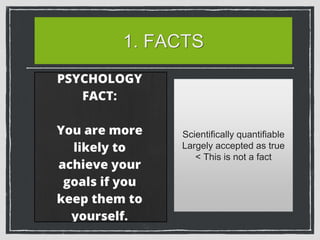
1. FACTS
Scientifically quantifiable
Largely accepted as true
< This is not a fact
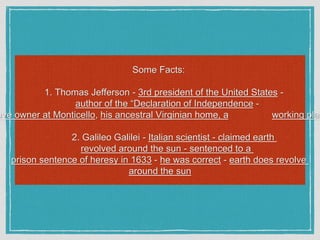
Some Facts:
1. Thomas Jefferson - 3rd president of the United States -
author of the “Declaration of Independence -
ave owner at Monticello, his ancestral Virginian home, a working plan
2. Galileo Galilei - Italian scientist - claimed earth
revolved around the sun - sentenced to a
prison sentence of heresy in 1633 - he was correct - earth does revolve
around the sun
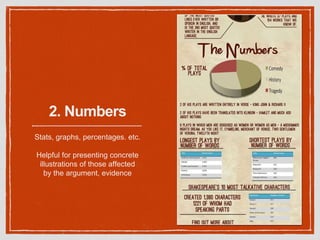
2. Numbers
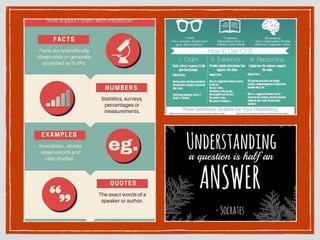
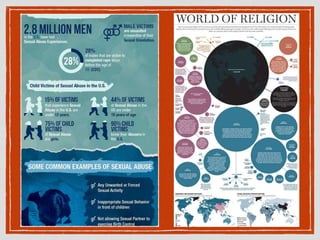
Stats, graphs, percentages. etc.
Helpful for presenting concrete
illustrations of those affected
by the argument, evidence
3. Examples: Anecdotes, Case Studies, Hypotheticals &
Analogies
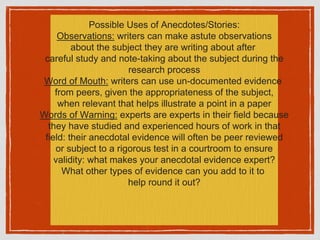
Possible Uses of Anecdotes/Stories:
Observations: writers can make astute observations
about the subject they are writing about after
careful study and note-taking about the subject during the
research process
Word of Mouth: writers can use un-documented evidence
from peers, given the appropriateness of the subject,
when relevant that helps illustrate a point in a paper
Words of Warning: experts are experts in their field because
they have studied and experienced hours of work in that
field: their anecdotal evidence will often be peer reviewed
or subject to a rigorous test in a courtroom to ensure
validity: what makes your anecdotal evidence expert?
What other types of evidence can you add to it to
help round it out?
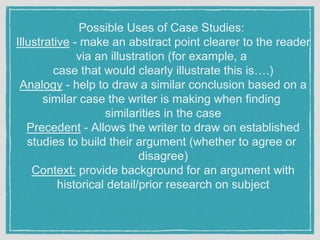
Possible Uses of Case Studies:
Illustrative - make an abstract point clearer to the reader
via an illustration (for example, a
case that would clearly illustrate this is….)
Analogy - help to draw a similar conclusion based on a
similar case the writer is making when finding
similarities in the case
Precedent - Allows the writer to draw on established
studies to build their argument (whether to agree or
disagree)
Context: provide background for an argument with
historical detail/prior research on subject
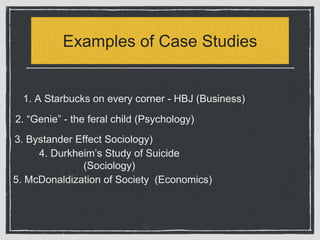
Examples of Case Studies
1. A Starbucks on every corner - HBJ (Business)
2. “Genie” - the feral child (Psychology)
3. Bystander Effect Sociology)
4. Durkheim’s Study of Suicide
(Sociology)
5. McDonaldization of Society (Economics)
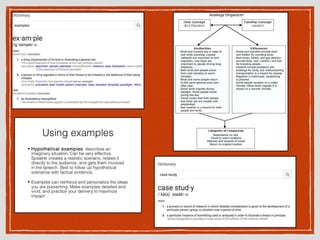
Hypotheticals & Analogies
Sometimes, we have an idea that we know is good,
but we don’t quite have traditional evidence, like a case
study or a quote to help prove it for our supporting detail.
Sometimes, we have to make our out illustration, create it.
That is called a hypothetical.
The Hypothetical:
A young boy went into the bush to hunt with his bow and
arrow. He saw a monkey on the branch of a tree and aimed
his arrow. The monkey spoke to him, “Stop. You must think
before you shoot me. If you kill me, your mother will die
and if you do not kill me, your father will die.”
What can this illustrate in an argument? What other evidence
does it need to be combined with?
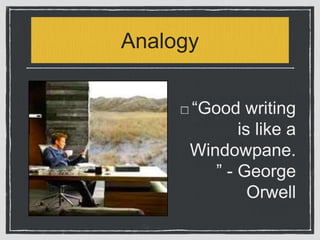
Analogy
“Good writing
is like a
Windowpane.
” - George
Orwell
We can make an argument by comparing two things and creating
an analogy for the reader.
Example: look at the image on the previous slide—how does the
image suggest a connection between good writing and the glass of
a windowpane?
How Do Analogies Work?
4. Citations
Quotes and Paraphrases
–Sir Isaac Newton
“If I have seen further it is by standing on
the shoulders of Giants.”
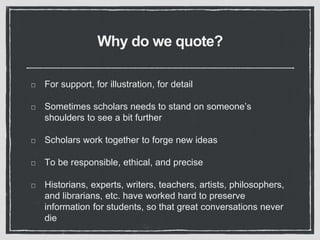
Why do we quote?
For support, for illustration, for detail
Sometimes scholars needs to stand on someone’s
shoulders to see a bit further
Scholars work together to forge new ideas
To be responsible, ethical, and precise
Historians, experts, writers, teachers, artists, philosophers,
and librarians, etc. have worked hard to preserve
information for students, so that great conversations never
die
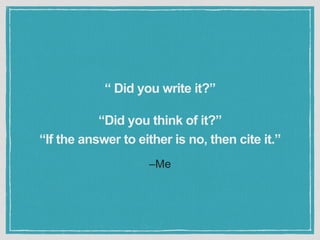
–Me
“ Did you write it?”
“Did you think of it?”
“If the answer to either is no, then cite it.”

Using evidence101

  • 1.
    Types of Evidence Howcan I build an argument?
  • 3.
    1. FACTS Scientifically quantifiable Largelyaccepted as true < This is not a fact
  • 4.
    Some Facts: 1. ThomasJefferson - 3rd president of the United States - author of the “Declaration of Independence - ave owner at Monticello, his ancestral Virginian home, a working plan 2. Galileo Galilei - Italian scientist - claimed earth revolved around the sun - sentenced to a prison sentence of heresy in 1633 - he was correct - earth does revolve around the sun
  • 5.
    2. Numbers Stats, graphs,percentages. etc. Helpful for presenting concrete illustrations of those affected by the argument, evidence
  • 7.
    3. Examples: Anecdotes,Case Studies, Hypotheticals & Analogies
  • 9.
    Possible Uses ofAnecdotes/Stories: Observations: writers can make astute observations about the subject they are writing about after careful study and note-taking about the subject during the research process Word of Mouth: writers can use un-documented evidence from peers, given the appropriateness of the subject, when relevant that helps illustrate a point in a paper Words of Warning: experts are experts in their field because they have studied and experienced hours of work in that field: their anecdotal evidence will often be peer reviewed or subject to a rigorous test in a courtroom to ensure validity: what makes your anecdotal evidence expert? What other types of evidence can you add to it to help round it out?
  • 10.
    Possible Uses ofCase Studies: Illustrative - make an abstract point clearer to the reader via an illustration (for example, a case that would clearly illustrate this is….) Analogy - help to draw a similar conclusion based on a similar case the writer is making when finding similarities in the case Precedent - Allows the writer to draw on established studies to build their argument (whether to agree or disagree) Context: provide background for an argument with historical detail/prior research on subject
  • 11.
    Examples of CaseStudies 1. A Starbucks on every corner - HBJ (Business) 2. “Genie” - the feral child (Psychology) 3. Bystander Effect Sociology) 4. Durkheim’s Study of Suicide (Sociology) 5. McDonaldization of Society (Economics)
  • 12.
    Hypotheticals & Analogies Sometimes,we have an idea that we know is good, but we don’t quite have traditional evidence, like a case study or a quote to help prove it for our supporting detail. Sometimes, we have to make our out illustration, create it. That is called a hypothetical.
  • 13.
    The Hypothetical: A youngboy went into the bush to hunt with his bow and arrow. He saw a monkey on the branch of a tree and aimed his arrow. The monkey spoke to him, “Stop. You must think before you shoot me. If you kill me, your mother will die and if you do not kill me, your father will die.” What can this illustrate in an argument? What other evidence does it need to be combined with?
  • 14.
    Analogy “Good writing is likea Windowpane. ” - George Orwell
  • 15.
    We can makean argument by comparing two things and creating an analogy for the reader. Example: look at the image on the previous slide—how does the image suggest a connection between good writing and the glass of a windowpane? How Do Analogies Work?
  • 16.
  • 17.
    –Sir Isaac Newton “IfI have seen further it is by standing on the shoulders of Giants.”
  • 18.
    Why do wequote? For support, for illustration, for detail Sometimes scholars needs to stand on someone’s shoulders to see a bit further Scholars work together to forge new ideas To be responsible, ethical, and precise Historians, experts, writers, teachers, artists, philosophers, and librarians, etc. have worked hard to preserve information for students, so that great conversations never die
  • 20.
    –Me “ Did youwrite it?” “Did you think of it?” “If the answer to either is no, then cite it.”