EMPLOYEE MANAGEMENT SYSTEM


CHAPTER 1
                                         INTRODUCTION
The employee record system is very simple and for very beginner mini project. It is based on
the menu-driven program for elementary database management. It employ all the basic
technique of file handling in C. It consists of following features

       Writing the data in binary file

       Reading the data from binary file

       Modify the record

       Delete the record

This project is a learning milestone for beginners who want to step into the database
management project in C.

Employee database management system is consistent of crucial work-related and important
personal information about an employee. In a nutshell, it is an online inventory of all
employees of an organization.

Listed below are a few reasons why employee database management system is important for
startups and small businesses:

1.1 Availability

It performs as a readily available source of information between the organization and the
employee. Contact information, salary information, posts, work schedule, education
information etc. is what most database systems consist of.

1.2 Efficiency

Employee database management systems are highly efficient. A member of the organization
can easily retrieve information about his/her colleague whenever required, and that too on
short notice. One can avoid making calls to the employee out on vacation just to retrieve an
address to send an important letter.


Dept of CS&E                                                                         Page 1
EMPLOYEE MANAGEMENT SYSTEM


1.3 Accuracy

Since the information is mostly fed in by the employees themselves you can be sure the
information is accurate since it’s straight from the source. Moreover, an employee can access
their information at any time. Therefore, he/she can keep it updated and correct mistakes, if
any.

1.4 Updates on time-bound

The information added to the employee database management system can be available for as
long as an employee is working in a firm or if needed, longer than that. Also if at any point in
time, the employee data changes, the employee themselves can make the alterations. As a
result, obsolete data is a rare find on such systems.

1.5 Confidentiality

Specific information about the employee can not only be set to be kept private from public
viewing but can also be set to be kept private from anyone.It can insure availability,
efficiency, accuracy, updates on time-bound information, confidentiality etc. You can worry
less about managing a bulky dilapidated file or calling up your employees at inconvenient
times or even be stranded without crucial information with the employee database
management system.


Dept of CS&E                                                                            Page 2
EMPLOYEE MANAGEMENT SYSTEM


CHAPTER 2
                            LITERATURE SURVEY
2.1 Existing system
      Existing system is based on standalone systems.

      It is developed under Windows 95 that is why it is not compatible with new operating
      system.

      The human resource administrator falls short of controlling the employee’s activities
      in analyzing his/her strengths and weakness.

      Existing employee management system is not much user friendly.

2.1.1 Disadvantages
      Need of extra manual effort.

      As current system is stand alone, normal employees cannot track their employee
      status.

      It used to take much time to find any employee.

      Not very much accurate.

      Compatible up to windows XP.

      Danger of losing files.

2.2 Proposed system
      The proposed system is intranet based system. So employee can also participate in
      this system and can track their status.

      The proposed system provides detailed general information about the employee along
      the educational, skill and project details.


Dept of CS&E                                                                        Page 3
EMPLOYEE MANAGEMENT SYSTEM


      It enhances the human resource management in adding, viewing and updating
      employee’s details and generates various reports regarding employee’s skill and
      experience.

      The proposed system of human resource module is the right software to be
      incorporated into the automation of human resource software for helping the
      organization needs with respect to skillful human resource.

2.2.1 Advantages
      As it is intranet application it can be accessed by multiple users at a time.

      Proposed system provides domain login facility so no need to remember user id and
      password.

      Very fast and accurate.

      No need of extra manual effort.

      Just need a little knowledge to operate the system.

      Doesn’t require any extra hardware device.


Dept of CS&E                                                                          Page 4
EMPLOYEE MANAGEMENT SYSTEM


CHAPTER 3
                          SYSTEM REQUIREMENTS
HARDWARE REQUIREMENTS
Processor:   Intel core2 duo processor,2.00 GHz

Hard   disk drive: 297.2 GB

RAM:    3 GB


SOFTWARE REQUIREMENTS
Software:Turbo    C

gcc   compiler


Dept of CS&E                                        Page 5
EMPLOYEE MANAGEMENT SYSTEM


CHAPTER 4
                                 SYSTEM DESIGN
Design the physical system.Specify input and output media.Design the database and specify
backup procedures. Design physical information flow through the system and a physical
design Walkthrough.Plan system implementation.Prepare a conversion schedule and target
date.Determine training procedures, courses and timetable.Devise a test and implementation
plan and specify any new hardware/software.Update benefits,costs,and conversion date and
system constraints. Feasibility study.Requirements engineering.Architectural design module
design.


4.1 Analysis
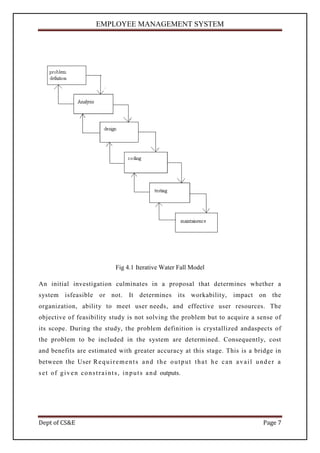
Software development life cycle process specifies a method of developing the
software. Eachsoftwaredevelopment projects starts with some needs and ends with some
software that satisfiesthose needs. A software development life cycle specifies the
set of activities that should be performed to go from user needs to final
products.Depending on the nature of project, a suitable model is chosen and the entire process
of softwarerequirement analysis, design, coding, testing and maintenance is performed
accordingly.


Dept of CS&E                                                                           Page 6
EMPLOYEE MANAGEMENT SYSTEM


                                     Fig 4.1 Iterative Water Fall Model

An initial investigation culminates in a proposal that determines whether a
system isfeasible or not.                   It determines its workability,         impact on the
organization, ability to meet user needs, and effective user resources. The
objective of feasibility study is not solving the problem but to acquire a sense of
its scope. During the study, the problem definition is crystallized andaspects of
the problem to be included in the system are determined. Consequently, cost
and benefits are estimated with greater accuracy at this stage. This is a bridge in
between the User R e q u i r e m e n t s a n d t h e o u t p u t t h a t h e c a n a v a i l u n d e r a
s e t o f g i v e n c o n s t r a i n t s , i n p u t s a n d outputs.


Dept of CS&E                                                                                    Page 7
EMPLOYEE MANAGEMENT SYSTEM


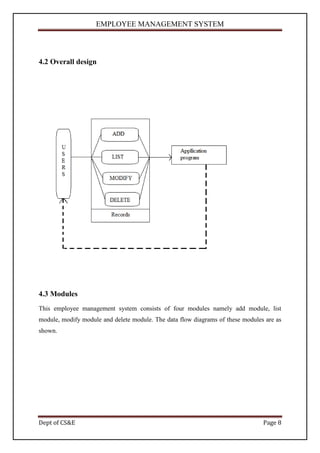
4.2 Overall design


4.3 Modules
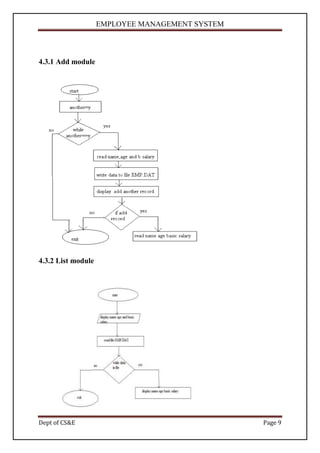
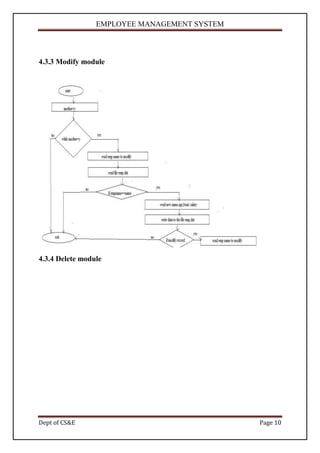
This employee management system consists of four modules namely add module, list
module, modify module and delete module. The data flow diagrams of these modules are as
shown.


Dept of CS&E                                                                    Page 8
EMPLOYEE MANAGEMENT SYSTEM


4.3.1 Add module


4.3.2 List module


Dept of CS&E                                     Page 9
EMPLOYEE MANAGEMENT SYSTEM


4.3.3 Modify module


4.3.4 Delete module


Dept of CS&E                                  Page 10
EMPLOYEE MANAGEMENT SYSTEM


CHAPTER 5
                                 IMPLEMENTATION

Pseudo code for add module:
start module

set variable another to y

while another equal to y then

    read name, age and basic salary

    write the data to the file

    display add another record, read yes or no

    if yes then

            read name, age and basic salary

    else

           return

   end if

end while

end module

Pseudo code for list module
start module

display employee name, age and basic salary

read file

while data in file then

display name, age and basic salary

end while

end module


Dept of CS&E                                           Page 11
EMPLOYEE MANAGEMENT SYSTEM


Pseudo code for modify module
start module

set variable another to y

while another equal to y

read employee name to modify

read file

ifempname is equal to name entered then

read new name, age and basic salary

write the data to the file

end if

end while

display modify another record

read yes or no

if yes then

read employee name to modify

else

return

end if

end module

Pseudo code for delete module
start module

set variable another to y

while another equal to y

read employee name to delete

set file pointer ft to the file temp.dat


Dept of CS&E                                         Page 12
EMPLOYEE MANAGEMENT SYSTEM


while data in file then

ifempname is not equal to the name entered then

write the data to the file pointed by file pointer ft

end if

end while

closefilepointerfp

closefilepointerft

remove emp.dat

rename temp.dat to emp.dat

setfilepointerfp to the file emp.dat

display delete another record

read yes or no

if yes then

read employee name to delete

else

return

end if

end while

end module


Dept of CS&E                                            Page 13
EMPLOYEE MANAGEMENT SYSTEM


CHAPTER 6
                                          TESTING

During systems testing, the system is used experimentally to ensure that the
software does notfail. In other words, we can say that it will run according to its
specifications and in the wayusers expect. Special test data are input for
processing, and the results examined. A limitednumber of users may be allowed to use
the system so that analyst can see whether they try to use it in unforeseen ways.Software
modules are tested for their functionality as perthe requirements identifiedduring
therequirements analysis phase.During the testing the program to be tested is executed with
certain test cases and output of thesetest cases is evaluated to check the correctness of the
program. It is the testing that performs first step in determining the errors in the program.

TEST CASES AND TEST CRITERIA
During Test Cases that are good at revealing the presence of faults is central to
successfultesting. The reason for this is that if there is a fault in the program, the program can
still providethe expected behavior on the certain inputs. Only for the set of inputs the faults
that exercise thefault in the program will the output of the program devise from the expected
behavior. Hence, itis fair to say that testing is as good as its test case. The number of test
cases used to determine errors in the program should be minimum. There aretwo fundamental
goals of a practical testing activity:-
• maximize the number of errors detected and.
• minimize the number of test cases.
As these two goals are contradictory so the problem of selecting test cases is a complex one.
While selecting the test cases the primary objective is to ensure that if there is an error or
fault inthe program, it is exercised by one of its test cases. An ideal test case is one which
succeeds(meaning that there are no errors, revealed in its execution) only it there are no errors
in the program one possible set of ideal test cases is one which includes all the possible inputs
to theprogram. This is often called "exhaustive testing", however it is impractical and
infeasible aseven a small program can have an infinite input domain. So to avoid this problem
we use "test criteria" in selection of the test cases. There are two aspectsof the test case
selection:-

Dept of CS&E                                                                             Page 14
EMPLOYEE MANAGEMENT SYSTEM


• specifying a criteria for evaluating the test cases.
• generating the set of cases that satisfy a given criteria.
The fully automated process of generating test criteria has not been yet found rather
guidelines are only the automated tool available to us previously. The two fundamental
properties for atesting criterion are:-
• Reliability a criterion is reliable if all the sets that satisfy the criteria detect the same error.
•Validity a criterion is valid if for any error in the program there is some set satisfyingthe
criteria that will reveal the error. The fundamental theorem of testing is that if a testing
criterion is valid and reliable, if a setsatisfying criteria succeeds then the program contains no
errors.


Dept of CS&E                                                                                   Page 15
EMPLOYEE MANAGEMENT SYSTEM


         CONCLUSION AND FUTURE ENHANCEMENT

      CONCLUSION
      In this report, an information system’s development has been presented. It
      wasemphasized on the basic steps, consequently taken during the project’s
      development course as a particular attention was turned to the basic operative
      functionsperformedupon the data into the database.


      FUTURE ENHANCEMENT
      As a future work, some additional stuff could be implemented and integrated into
      theapplication code making it much more reliable and flexible; especially what
      concerns apay-roll module, for instance.
      Apparently, the role of such systems is basic and essential within each company
      thatwants to keep a really good control and record concerning its personnel
      data,functionality and performance on all levels in its structure. Every organization,
      innowadays, has the necessity of managing its staff on a really good level as the staff
      hasdefinitely the greatest merit of building up a company as such as it is.
      The wellmanaged employee means giving the appropriate financial award-ness and all
      kind ofbenefits as such as they have been deserved. That’s why the development of
      suchsystems is not just a programming business – a lot of people are ordinarily
      involved insuch projects and one of the basic requirements is the reliability of the
      system,especially what concerns the storage of data and all of the operations that will
      beperformed upon it.


Dept of CS&E                                                                        Page 16
EMPLOYEE MANAGEMENT SYSTEM


                                  BIBLIOGRAPHY

      Bodnar     George       /Duquesne      University/,     Hopwood      William     /Florida
      AtlanticUniversity/, “Accounting Information systems”, Eighth Edition, Prentice
      Hall,Upper Saddle River, New Jersey .

      Andersen    Virginia,    Access     2000:   “The      Complete   Reference”,   Blacklick,
      USA:McGraw-Hill Professional Book Group, 2001

      http://msdn.microsoft.com/library/default.asp?url=/library/enus

      http://www.slideshare.net


Dept of CS&E                                                                          Page 17
EMPLOYEE MANAGEMENT SYSTEM


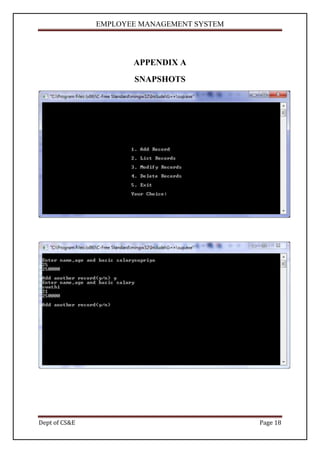
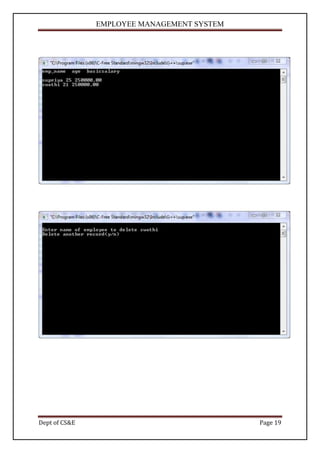
                      APPENDIX A
                      SNAPSHOTS


Dept of CS&E                                Page 18
EMPLOYEE MANAGEMENT SYSTEM


Dept of CS&E                                Page 19

Employee management system1

  • 1.
    EMPLOYEE MANAGEMENT SYSTEM CHAPTER1 INTRODUCTION The employee record system is very simple and for very beginner mini project. It is based on the menu-driven program for elementary database management. It employ all the basic technique of file handling in C. It consists of following features Writing the data in binary file Reading the data from binary file Modify the record Delete the record This project is a learning milestone for beginners who want to step into the database management project in C. Employee database management system is consistent of crucial work-related and important personal information about an employee. In a nutshell, it is an online inventory of all employees of an organization. Listed below are a few reasons why employee database management system is important for startups and small businesses: 1.1 Availability It performs as a readily available source of information between the organization and the employee. Contact information, salary information, posts, work schedule, education information etc. is what most database systems consist of. 1.2 Efficiency Employee database management systems are highly efficient. A member of the organization can easily retrieve information about his/her colleague whenever required, and that too on short notice. One can avoid making calls to the employee out on vacation just to retrieve an address to send an important letter. Dept of CS&E Page 1
  • 2.
    EMPLOYEE MANAGEMENT SYSTEM 1.3Accuracy Since the information is mostly fed in by the employees themselves you can be sure the information is accurate since it’s straight from the source. Moreover, an employee can access their information at any time. Therefore, he/she can keep it updated and correct mistakes, if any. 1.4 Updates on time-bound The information added to the employee database management system can be available for as long as an employee is working in a firm or if needed, longer than that. Also if at any point in time, the employee data changes, the employee themselves can make the alterations. As a result, obsolete data is a rare find on such systems. 1.5 Confidentiality Specific information about the employee can not only be set to be kept private from public viewing but can also be set to be kept private from anyone.It can insure availability, efficiency, accuracy, updates on time-bound information, confidentiality etc. You can worry less about managing a bulky dilapidated file or calling up your employees at inconvenient times or even be stranded without crucial information with the employee database management system. Dept of CS&E Page 2
  • 3.
    EMPLOYEE MANAGEMENT SYSTEM CHAPTER2 LITERATURE SURVEY 2.1 Existing system Existing system is based on standalone systems. It is developed under Windows 95 that is why it is not compatible with new operating system. The human resource administrator falls short of controlling the employee’s activities in analyzing his/her strengths and weakness. Existing employee management system is not much user friendly. 2.1.1 Disadvantages Need of extra manual effort. As current system is stand alone, normal employees cannot track their employee status. It used to take much time to find any employee. Not very much accurate. Compatible up to windows XP. Danger of losing files. 2.2 Proposed system The proposed system is intranet based system. So employee can also participate in this system and can track their status. The proposed system provides detailed general information about the employee along the educational, skill and project details. Dept of CS&E Page 3
  • 4.
    EMPLOYEE MANAGEMENT SYSTEM It enhances the human resource management in adding, viewing and updating employee’s details and generates various reports regarding employee’s skill and experience. The proposed system of human resource module is the right software to be incorporated into the automation of human resource software for helping the organization needs with respect to skillful human resource. 2.2.1 Advantages As it is intranet application it can be accessed by multiple users at a time. Proposed system provides domain login facility so no need to remember user id and password. Very fast and accurate. No need of extra manual effort. Just need a little knowledge to operate the system. Doesn’t require any extra hardware device. Dept of CS&E Page 4
  • 5.
    EMPLOYEE MANAGEMENT SYSTEM CHAPTER3 SYSTEM REQUIREMENTS HARDWARE REQUIREMENTS Processor: Intel core2 duo processor,2.00 GHz Hard disk drive: 297.2 GB RAM: 3 GB SOFTWARE REQUIREMENTS Software:Turbo C gcc compiler Dept of CS&E Page 5
  • 6.
    EMPLOYEE MANAGEMENT SYSTEM CHAPTER4 SYSTEM DESIGN Design the physical system.Specify input and output media.Design the database and specify backup procedures. Design physical information flow through the system and a physical design Walkthrough.Plan system implementation.Prepare a conversion schedule and target date.Determine training procedures, courses and timetable.Devise a test and implementation plan and specify any new hardware/software.Update benefits,costs,and conversion date and system constraints. Feasibility study.Requirements engineering.Architectural design module design. 4.1 Analysis Software development life cycle process specifies a method of developing the software. Eachsoftwaredevelopment projects starts with some needs and ends with some software that satisfiesthose needs. A software development life cycle specifies the set of activities that should be performed to go from user needs to final products.Depending on the nature of project, a suitable model is chosen and the entire process of softwarerequirement analysis, design, coding, testing and maintenance is performed accordingly. Dept of CS&E Page 6
  • 7.
    EMPLOYEE MANAGEMENT SYSTEM Fig 4.1 Iterative Water Fall Model An initial investigation culminates in a proposal that determines whether a system isfeasible or not. It determines its workability, impact on the organization, ability to meet user needs, and effective user resources. The objective of feasibility study is not solving the problem but to acquire a sense of its scope. During the study, the problem definition is crystallized andaspects of the problem to be included in the system are determined. Consequently, cost and benefits are estimated with greater accuracy at this stage. This is a bridge in between the User R e q u i r e m e n t s a n d t h e o u t p u t t h a t h e c a n a v a i l u n d e r a s e t o f g i v e n c o n s t r a i n t s , i n p u t s a n d outputs. Dept of CS&E Page 7
  • 8.
    EMPLOYEE MANAGEMENT SYSTEM 4.2Overall design 4.3 Modules This employee management system consists of four modules namely add module, list module, modify module and delete module. The data flow diagrams of these modules are as shown. Dept of CS&E Page 8
  • 9.
    EMPLOYEE MANAGEMENT SYSTEM 4.3.1Add module 4.3.2 List module Dept of CS&E Page 9
  • 10.
    EMPLOYEE MANAGEMENT SYSTEM 4.3.3Modify module 4.3.4 Delete module Dept of CS&E Page 10
  • 11.
    EMPLOYEE MANAGEMENT SYSTEM CHAPTER5 IMPLEMENTATION Pseudo code for add module: start module set variable another to y while another equal to y then read name, age and basic salary write the data to the file display add another record, read yes or no if yes then read name, age and basic salary else return end if end while end module Pseudo code for list module start module display employee name, age and basic salary read file while data in file then display name, age and basic salary end while end module Dept of CS&E Page 11
  • 12.
    EMPLOYEE MANAGEMENT SYSTEM Pseudocode for modify module start module set variable another to y while another equal to y read employee name to modify read file ifempname is equal to name entered then read new name, age and basic salary write the data to the file end if end while display modify another record read yes or no if yes then read employee name to modify else return end if end module Pseudo code for delete module start module set variable another to y while another equal to y read employee name to delete set file pointer ft to the file temp.dat Dept of CS&E Page 12
  • 13.
    EMPLOYEE MANAGEMENT SYSTEM whiledata in file then ifempname is not equal to the name entered then write the data to the file pointed by file pointer ft end if end while closefilepointerfp closefilepointerft remove emp.dat rename temp.dat to emp.dat setfilepointerfp to the file emp.dat display delete another record read yes or no if yes then read employee name to delete else return end if end while end module Dept of CS&E Page 13
  • 14.
    EMPLOYEE MANAGEMENT SYSTEM CHAPTER6 TESTING During systems testing, the system is used experimentally to ensure that the software does notfail. In other words, we can say that it will run according to its specifications and in the wayusers expect. Special test data are input for processing, and the results examined. A limitednumber of users may be allowed to use the system so that analyst can see whether they try to use it in unforeseen ways.Software modules are tested for their functionality as perthe requirements identifiedduring therequirements analysis phase.During the testing the program to be tested is executed with certain test cases and output of thesetest cases is evaluated to check the correctness of the program. It is the testing that performs first step in determining the errors in the program. TEST CASES AND TEST CRITERIA During Test Cases that are good at revealing the presence of faults is central to successfultesting. The reason for this is that if there is a fault in the program, the program can still providethe expected behavior on the certain inputs. Only for the set of inputs the faults that exercise thefault in the program will the output of the program devise from the expected behavior. Hence, itis fair to say that testing is as good as its test case. The number of test cases used to determine errors in the program should be minimum. There aretwo fundamental goals of a practical testing activity:- • maximize the number of errors detected and. • minimize the number of test cases. As these two goals are contradictory so the problem of selecting test cases is a complex one. While selecting the test cases the primary objective is to ensure that if there is an error or fault inthe program, it is exercised by one of its test cases. An ideal test case is one which succeeds(meaning that there are no errors, revealed in its execution) only it there are no errors in the program one possible set of ideal test cases is one which includes all the possible inputs to theprogram. This is often called "exhaustive testing", however it is impractical and infeasible aseven a small program can have an infinite input domain. So to avoid this problem we use "test criteria" in selection of the test cases. There are two aspectsof the test case selection:- Dept of CS&E Page 14
  • 15.
    EMPLOYEE MANAGEMENT SYSTEM •specifying a criteria for evaluating the test cases. • generating the set of cases that satisfy a given criteria. The fully automated process of generating test criteria has not been yet found rather guidelines are only the automated tool available to us previously. The two fundamental properties for atesting criterion are:- • Reliability a criterion is reliable if all the sets that satisfy the criteria detect the same error. •Validity a criterion is valid if for any error in the program there is some set satisfyingthe criteria that will reveal the error. The fundamental theorem of testing is that if a testing criterion is valid and reliable, if a setsatisfying criteria succeeds then the program contains no errors. Dept of CS&E Page 15
  • 16.
    EMPLOYEE MANAGEMENT SYSTEM CONCLUSION AND FUTURE ENHANCEMENT CONCLUSION In this report, an information system’s development has been presented. It wasemphasized on the basic steps, consequently taken during the project’s development course as a particular attention was turned to the basic operative functionsperformedupon the data into the database. FUTURE ENHANCEMENT As a future work, some additional stuff could be implemented and integrated into theapplication code making it much more reliable and flexible; especially what concerns apay-roll module, for instance. Apparently, the role of such systems is basic and essential within each company thatwants to keep a really good control and record concerning its personnel data,functionality and performance on all levels in its structure. Every organization, innowadays, has the necessity of managing its staff on a really good level as the staff hasdefinitely the greatest merit of building up a company as such as it is. The wellmanaged employee means giving the appropriate financial award-ness and all kind ofbenefits as such as they have been deserved. That’s why the development of suchsystems is not just a programming business – a lot of people are ordinarily involved insuch projects and one of the basic requirements is the reliability of the system,especially what concerns the storage of data and all of the operations that will beperformed upon it. Dept of CS&E Page 16
  • 17.
    EMPLOYEE MANAGEMENT SYSTEM BIBLIOGRAPHY Bodnar George /Duquesne University/, Hopwood William /Florida AtlanticUniversity/, “Accounting Information systems”, Eighth Edition, Prentice Hall,Upper Saddle River, New Jersey . Andersen Virginia, Access 2000: “The Complete Reference”, Blacklick, USA:McGraw-Hill Professional Book Group, 2001 http://msdn.microsoft.com/library/default.asp?url=/library/enus http://www.slideshare.net Dept of CS&E Page 17
  • 18.
    EMPLOYEE MANAGEMENT SYSTEM APPENDIX A SNAPSHOTS Dept of CS&E Page 18
  • 19.