EXAMINATION OF CERVICAL DISORDER
Presented by
Kaushal sinha
1st year PG
Dept. of panchakarma
SDM college of ayurveda
4/24/2016
1
CONTENT:-
 Introduction
 Region of spine
 Function of spine
 Examination of cervical spine
(A)General pysical examination
(B)Special test
(C)Range of movement
 conclusion
4/24/2016
2
INTRODUCTION
 33 vertebrae
 31 pair nerve roots
 23 disc
 Spinal cord-
Contained in epidural space
Network of sensory and motor
nerves
Firm, cord-like structure
Conus medullaris
Filum terminale
Cauda equina
Foramen
magnum
Conus
medularis
Cauda
equina
4/24/2016
3
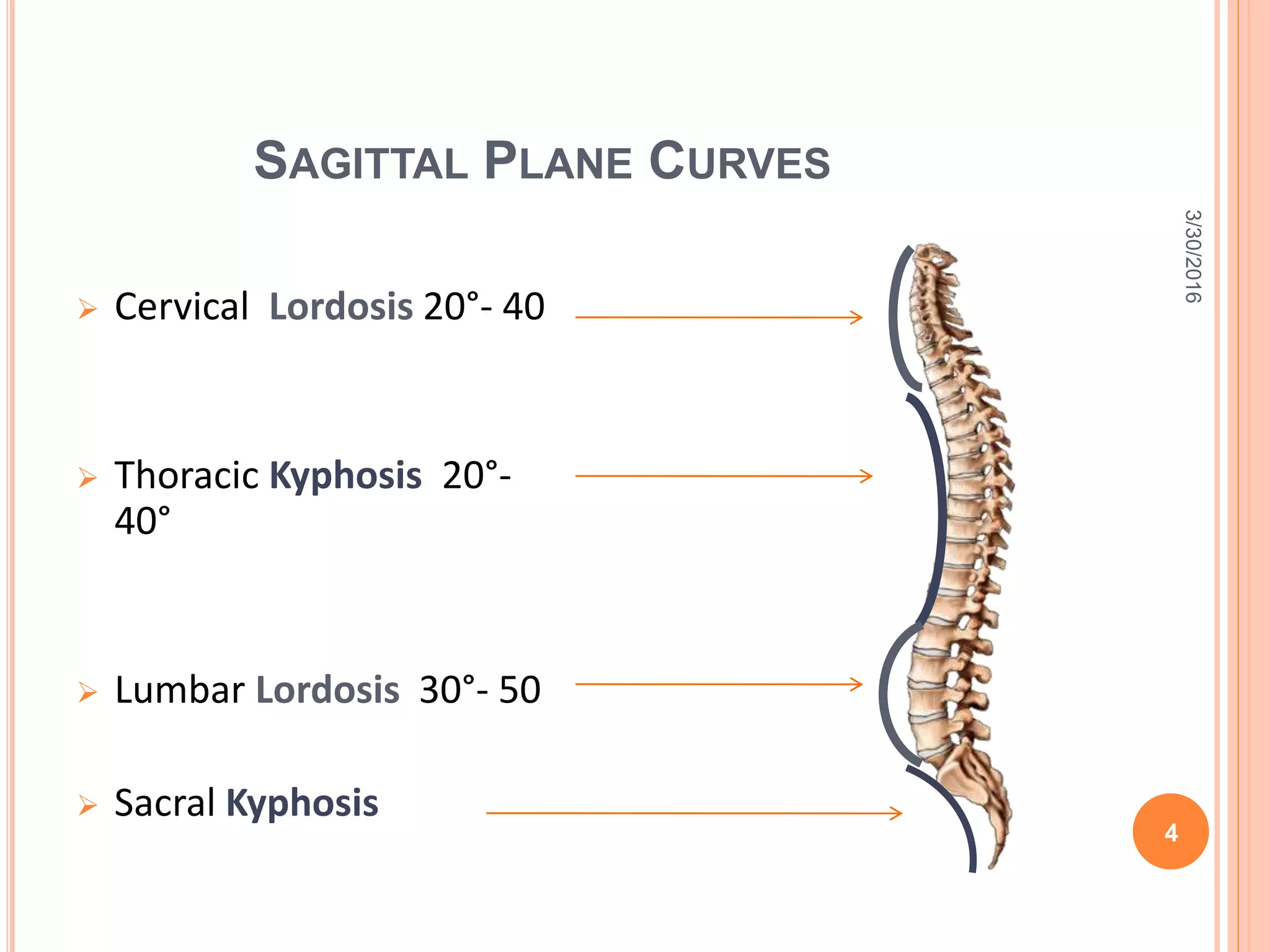
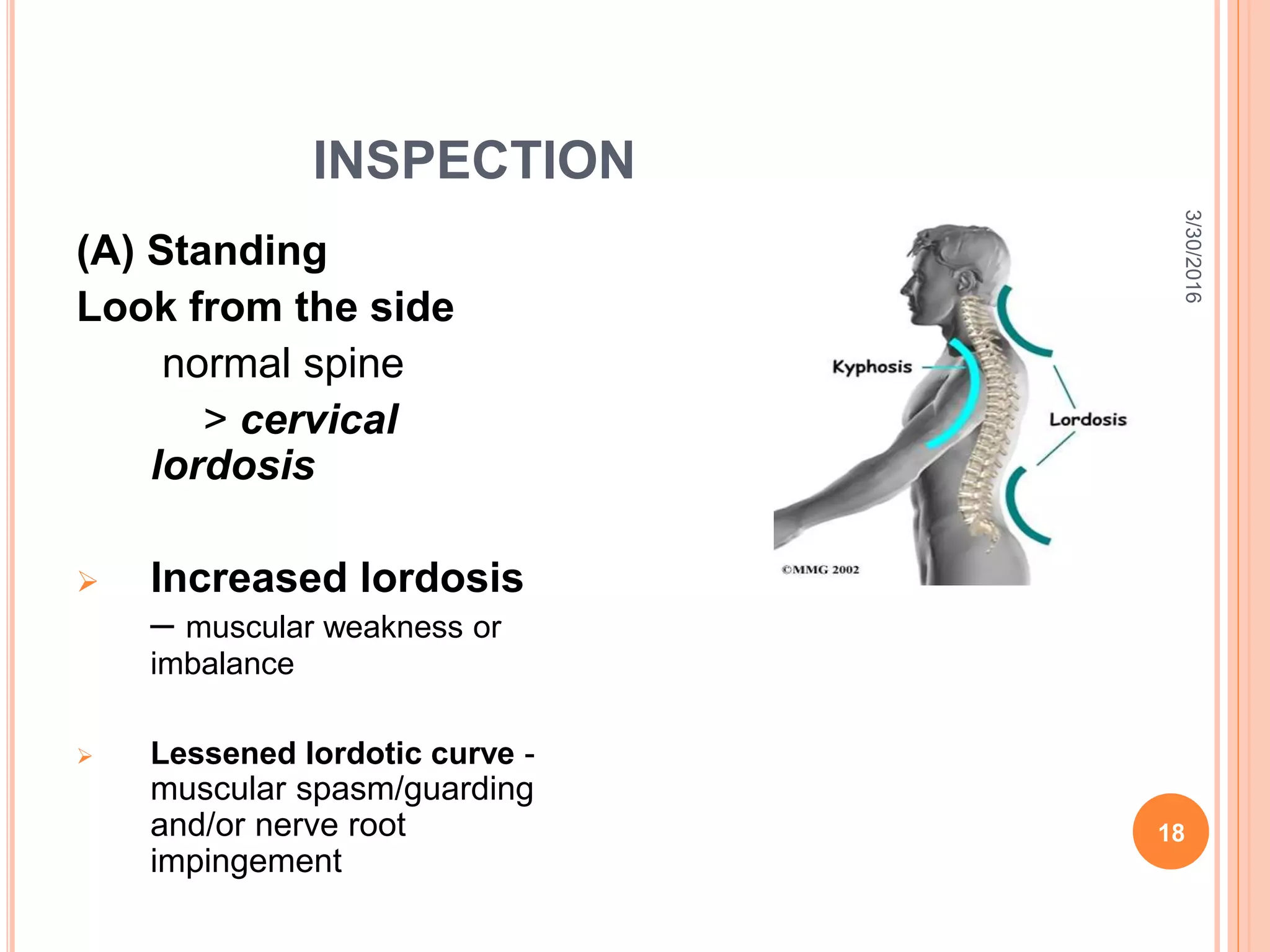
SAGITTAL PLANE CURVES
 Cervical Lordosis 20°- 40
 Thoracic Kyphosis 20°-
40°
 Lumbar Lordosis 30°- 50
 Sacral Kyphosis
4/24/2016
4
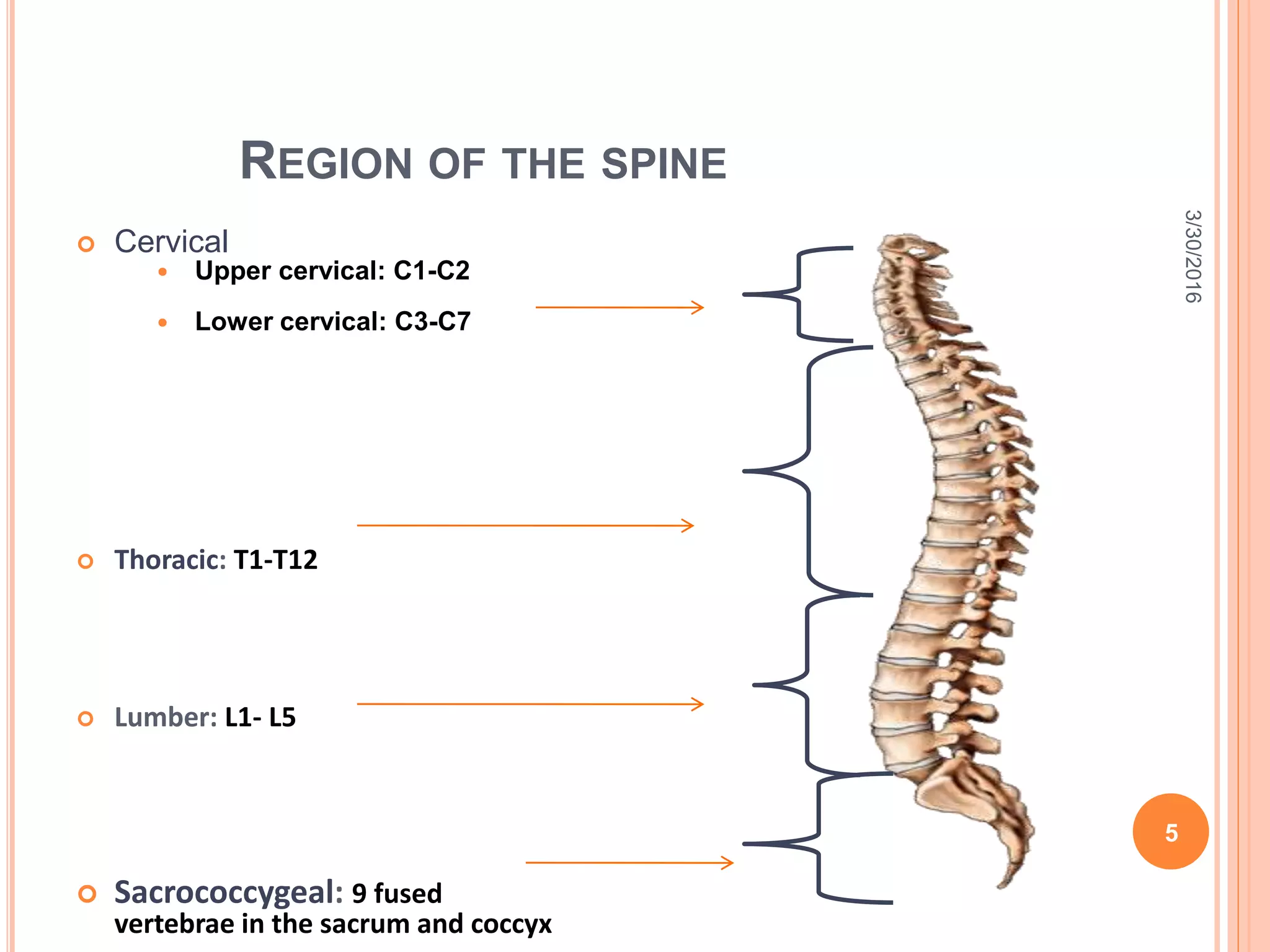
REGION OF THE SPINE
 Cervical
 Upper cervical: C1-C2
 Lower cervical: C3-C7
 Thoracic: T1-T12
 Lumber: L1- L5
 Sacrococcygeal: 9 fused
vertebrae in the sacrum and coccyx
4/24/2016
5
FUNCTIONS OF SPINE:-
 Posture
 Spinal cord encasement
 Weight transmission
 Posture
 Vital organs back support
 Muscles attachment
4/24/2016
6
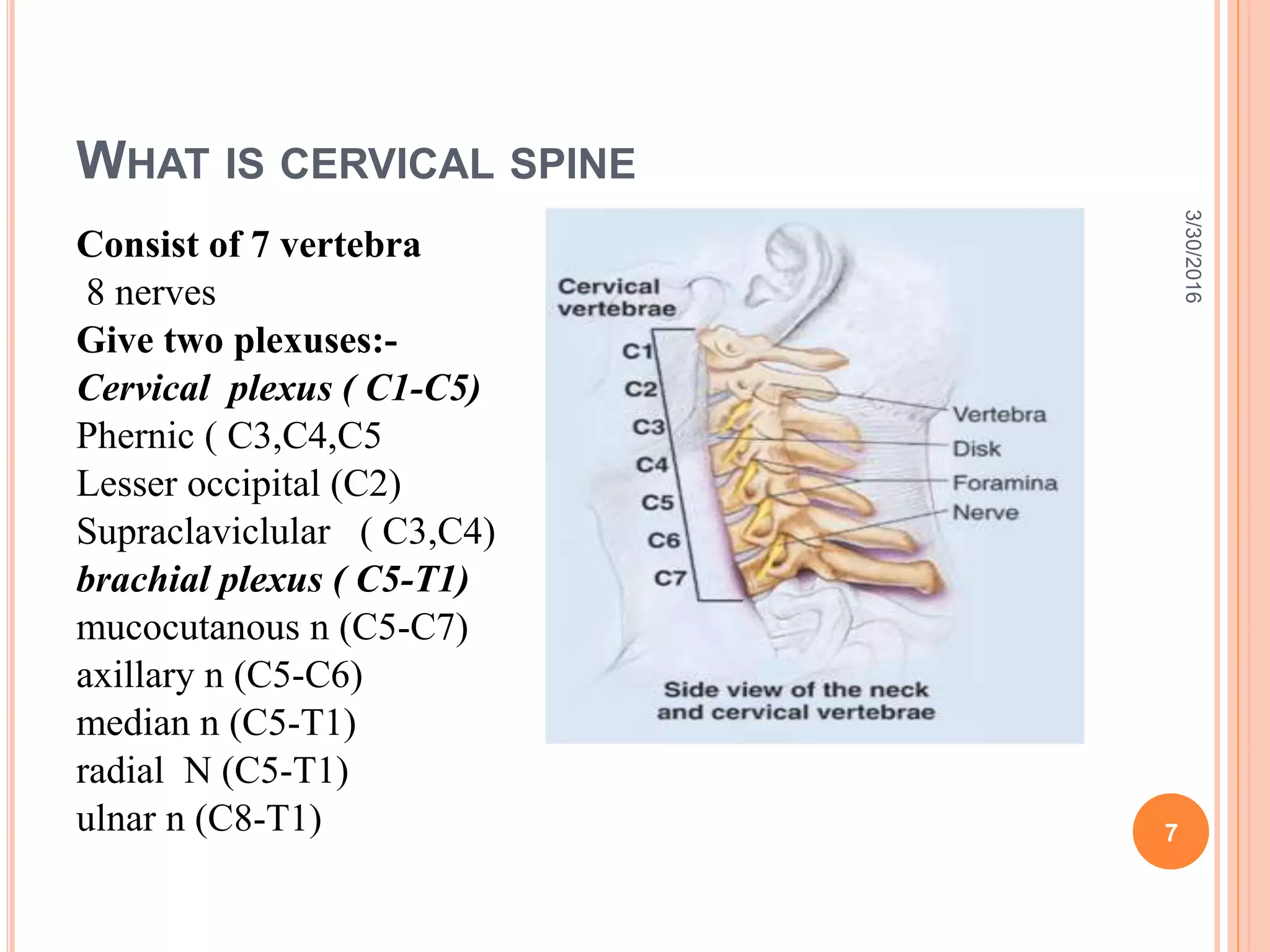
WHAT IS CERVICAL SPINE
Consist of 7 vertebra
8 nerves
Give two plexuses:-
Cervical plexus ( C1-C5)
Phernic ( C3,C4,C5
Lesser occipital (C2)
Supraclaviclular ( C3,C4)
brachial plexus ( C5-T1)
mucocutanous n (C5-C7)
axillary n (C5-C6)
median n (C5-T1)
radial N (C5-T1)
ulnar n (C8-T1)
4/24/2016
7
CERVICAL DISORDER
 Cervical spondylosis
 Cervical radiculopathy
 Cervical myelopathy
 Cervical Strain/spasm
 Cervical Sprain
 Cervical Stenosis
 HNP(Herniated Nucleus pulposus)
 Cervical Cord Neuropraxia
 Fractures/subluxation etc.
4/24/2016
8
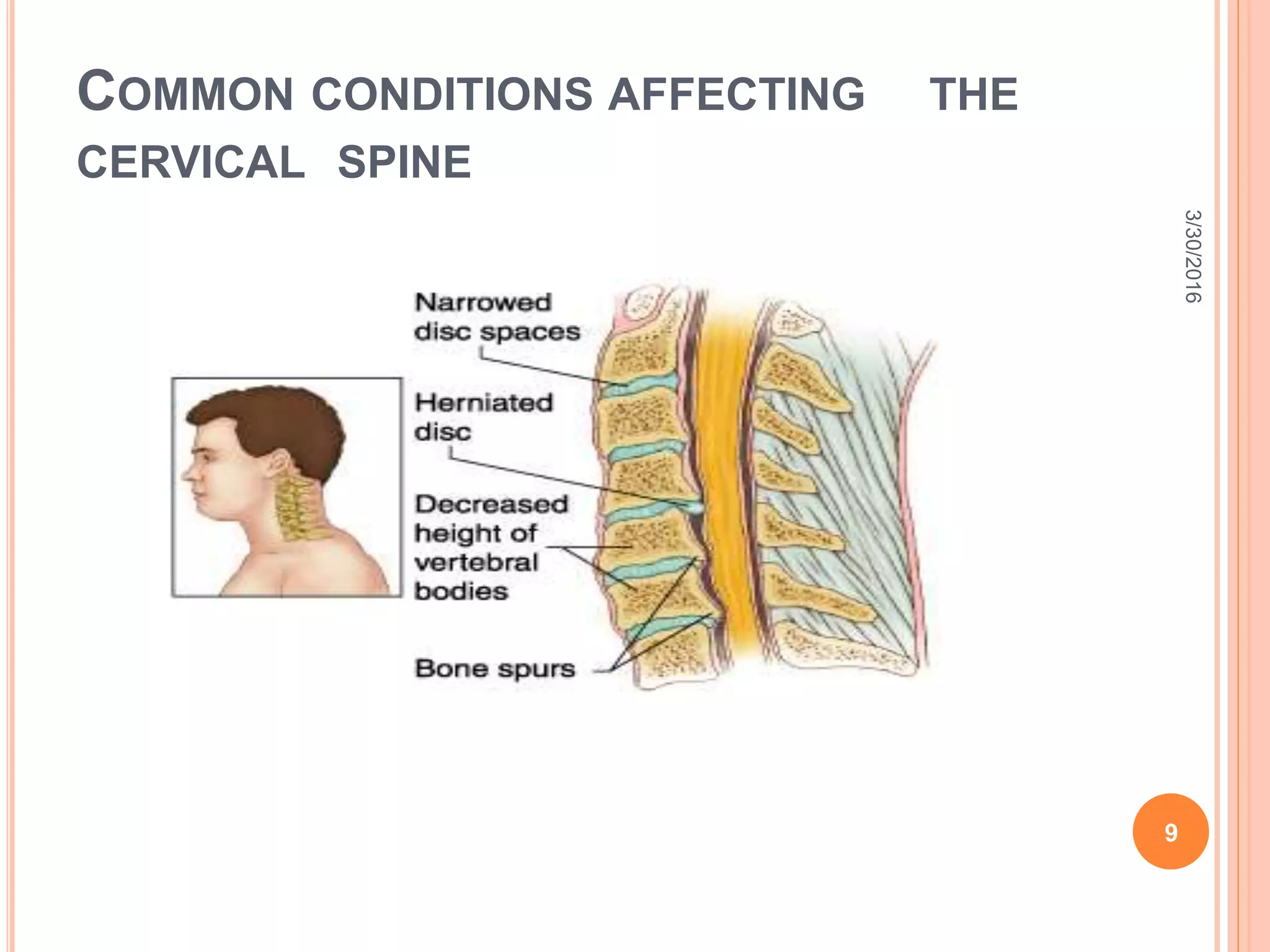
COMMON CONDITIONS AFFECTING THE
CERVICAL SPINE
4/24/2016
9
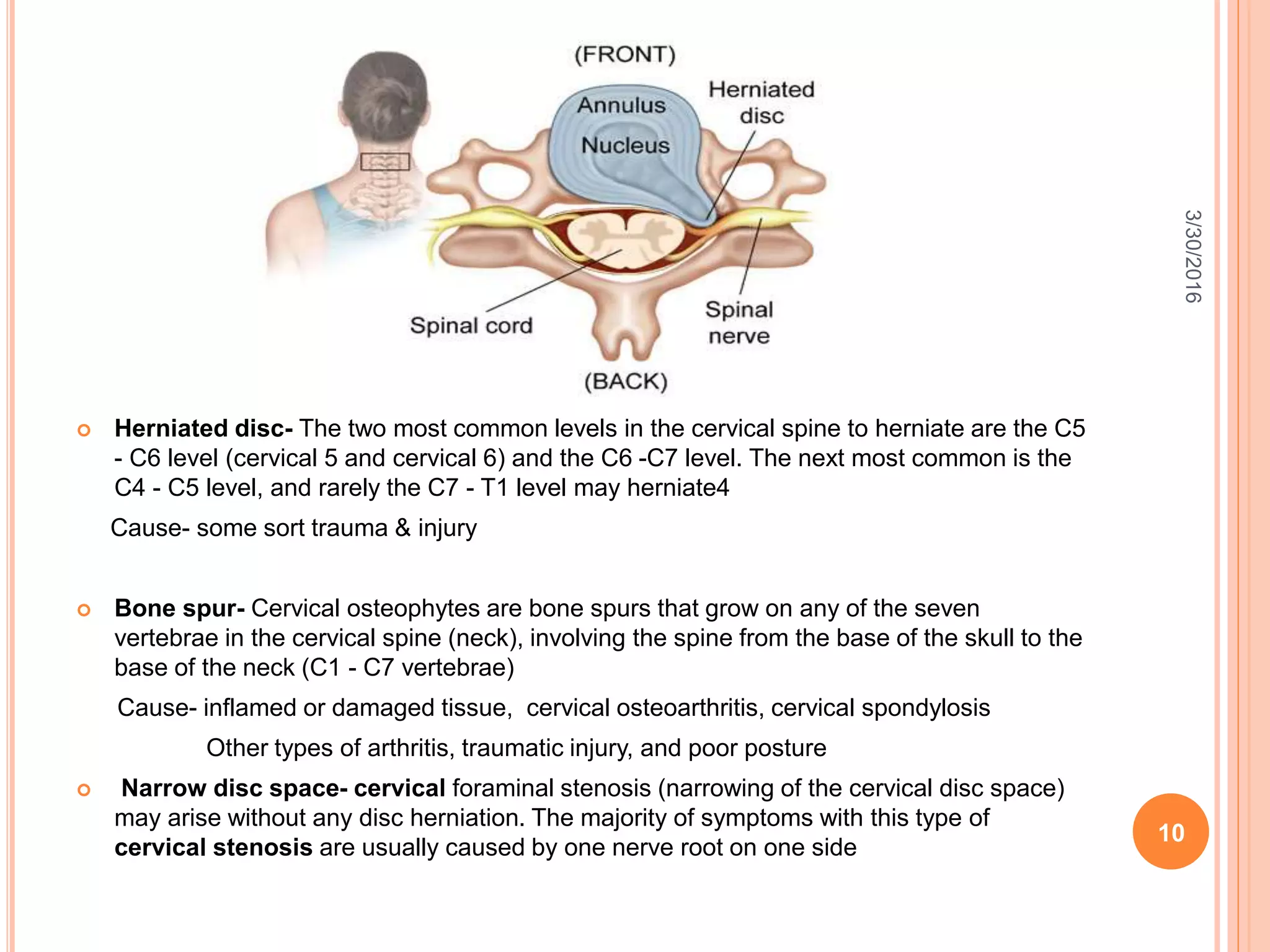
 Herniated disc- The two most common levels in the cervical spine to herniate are the C5
- C6 level (cervical 5 and cervical 6) and the C6 -C7 level. The next most common is the
C4 - C5 level, and rarely the C7 - T1 level may herniate4
Cause- some sort trauma & injury
 Bone spur- Cervical osteophytes are bone spurs that grow on any of the seven
vertebrae in the cervical spine (neck), involving the spine from the base of the skull to the
base of the neck (C1 - C7 vertebrae)
Cause- inflamed or damaged tissue, cervical osteoarthritis, cervical spondylosis
Other types of arthritis, traumatic injury, and poor posture
 Narrow disc space- cervical foraminal stenosis (narrowing of the cervical disc space)
may arise without any disc herniation. The majority of symptoms with this type of
cervical stenosis are usually caused by one nerve root on one side
4/24/2016
10
EXAMINATION OF CERVICAL SPINE
 History
 General Examination
 Inspection
 Palpation
 Special Test
 Range of Movement
4/24/2016
11
EXAMINATION TECHNIQUE:-
 Introduce yourself
 Ask permission to perform examination
 Explain the patient appropriately
 The patient must be exposed properly
 Tell the patient to let you know if anything you do
uncomfortable and painful
 When female patient make sure that female nurse
& assistant is present.
4/24/2016
12
HISTORY
 Male / Female
 Occupation
 Socio economic class
 Presenting chief complaints
 History of presenting ilness
 Treatment history
 Past history
 Personal history
 Family history
4/24/2016
13
ASK FOR…
 H/o Trauma
 H/o constitutional symptoms
 H/o Hemoptysis
 H/o Respirory symptoms,dysponea
 H/o Other joint involements
 H/o Pelvic inflammatory
 Treatment histoy
 Immunization history BCG,polio
4/24/2016
14
PAST HISTORY
 Similar complains
 Prolonged history
 Previous surgery
 DM
 HTN
 Tuberculosis
 Hematological disorder
 Any neurological disorder
4/24/2016
15
PERSONAL HISTORY
 Smoking
 Alcohol
 Drug addiction
 Diet
 Bowel bladder habbit
 Appetite
 Menstrual history in female
4/24/2016
16
FAMILY HISTORY
 Similar illness
 Tuberclosis
 HTN
 DM
4/24/2016
17
INSPECTION
(A) Standing
Look from the side
normal spine
> cervical
lordosis
 Increased lordosis
– muscular weakness or
imbalance
 Lessened lordotic curve -
muscular spasm/guarding
and/or nerve root
impingement
4/24/2016
18
(B) Position of Head Relative to Shoulders
 Head should be seated symmetrically on cervical
spine
 Lateral flexion -
from unilateral spasm of muscles – strain and/or
spasm (guarding)
 Rotation –
from unilateral spasm of sternomastoid muscle –
strain and/or spasm (guarding) or torticollis
4/24/2016
19
PALPATION
 Local rise in temperature
 Palpate all spinous process
 Prominent spinous process
Feel
→ The midline spinous
processes
→ The paraspinal soft tissues
→ The supraclavicular fossae –
for cervical ribs or enlarged
lymph nodes
→ The anterior neck structures
including the thyroid
4/24/2016
20
SPECIAL TESTS
 Cervical spine :
 Spurling test
 Compression test
 Distraction test
 Valsalva test
 Swallowing test
 Adson test
 Range of motion:
 Active
 Passive
4/24/2016
21
SPECIAL TEST:-
Movement
(A) Flexion
- ask the patient to
bend the head
forwards
- chin should be able
to touch the chest
- normal : 80°
(B) Extension
- ask the patient to look
up and back
- normal : 50°
4/24/2016
22
RANGE OF MOTION TESTING
Active:-
 Best done in sitting or
standing
 Flexion – touch chin to
chest
 Extension – look straight
above head
 Lateral flexion –
approximately 45
degrees
 Rotation – nose over tip
of shoulder
Passive:-
 Best done laying supine
 Flexion – firm end feel
 Extension – hard end feel
(occiput on cervical
spinous processes)
 Lateral flexion – firm end
feel (stabilize opposite
shoulder)
 Rotation – firm end feel
4/24/2016
23
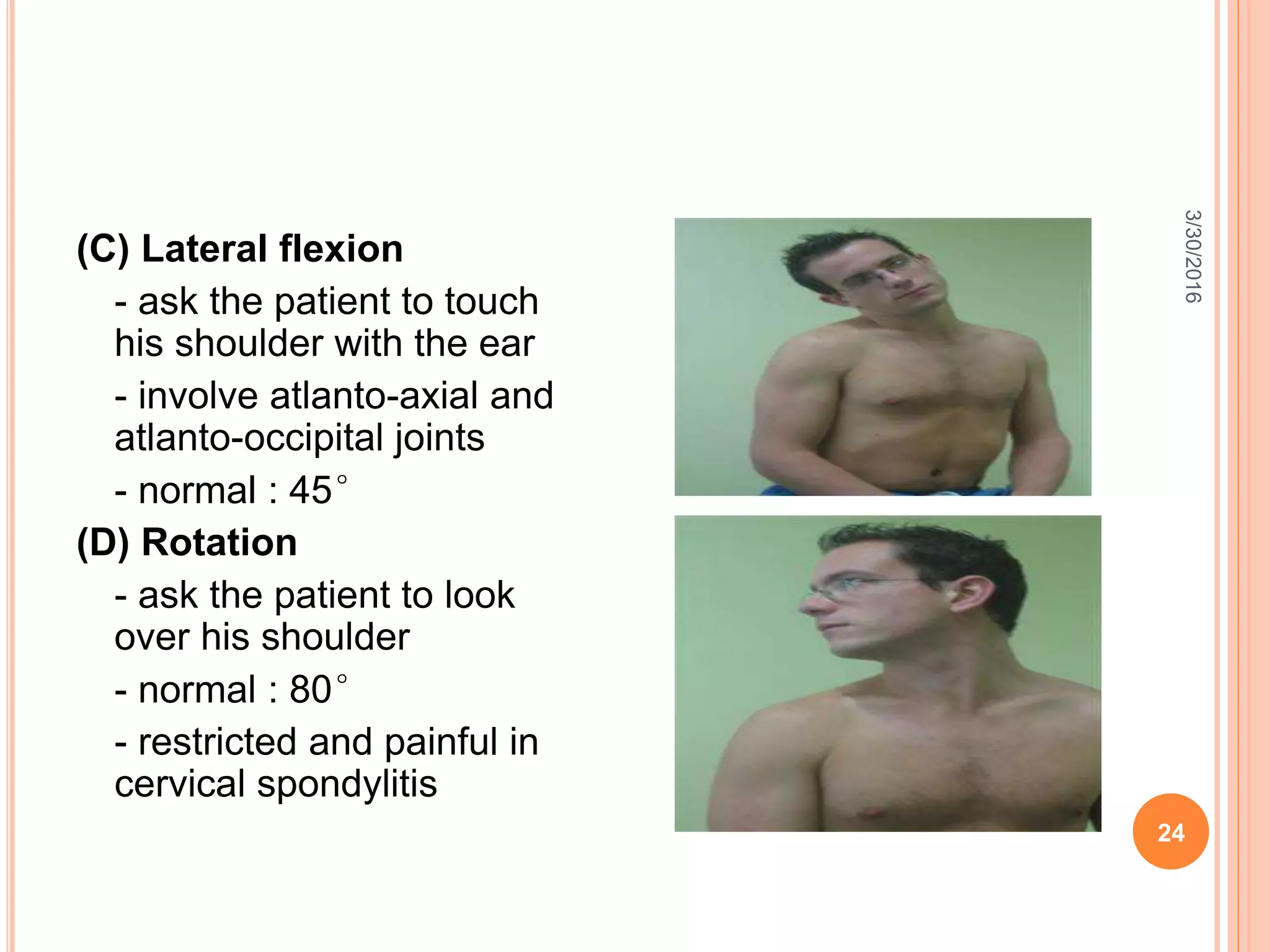
(C) Lateral flexion
- ask the patient to touch
his shoulder with the ear
- involve atlanto-axial and
atlanto-occipital joints
- normal : 45°
(D) Rotation
- ask the patient to look
over his shoulder
- normal : 80°
- restricted and painful in
cervical spondylitis
4/24/2016
24
COMPRESSION TEST
 Testing for compression of cervical
nerve root or facet joint irritation in the
lower cervical spine
 Ask the patient seat the table
 Patient head is natural,therapist stands
behind patient
 Positive sign –
 Radiating pain or other neurological
sign in the same side arm(nerve root)
and pain local to the neck or shoulder
 A narrowing of neural foramen,
pressure on the facet joints or muscle
spasm can cause increase pain upon
compression
4/24/2016
25
SPURLING TEST
 Same positioning as cervical
compression test
 Compression of a cervical nerve
root or facat joint irritation in the
lower cervical spine
 Patient slowly
extends,sidebend,and rotates
the head of affected side.
 Therapist carefully compression
downword on the head of patient
 Positive sign:-
Radiating pain or other
neurological sign in the same
side arm(nerve root) and pain
local to the neck or shoulder
(facet joint irretation)
4/24/2016
26
DISTRACTION TEST  To relive the pressure on the
cervical roots (may be used
after spurlling or
compression test)
 Place the open palm of one
hand under the pt’s chin,
and the other hand is upon
occiput & tempolallis
 Then, gradually lift
(distract) the head to
remove its weight from the
neck
 To demonstrate the effect
that neck traction might
have help in relieving the
pain by decreasing pressure
on the joint capsules around
the facet joints.
4/24/2016
27
VALSALVA TEST
 Ask pt to hold his breath and bear
down as if he were moving his bowels
 Then, ask whether he feels any
increase in pain and describe the
location
 This test increase intratechal pressure
 If a space occupying lesion, such as a
herniated disc or a tumor present in
cervical canal, pt may develop pain in
cervical spine secondary to increase
pressure
 The pain also may radiate to the
dermatome distribution of cervical
spine pathology
4/24/2016
28
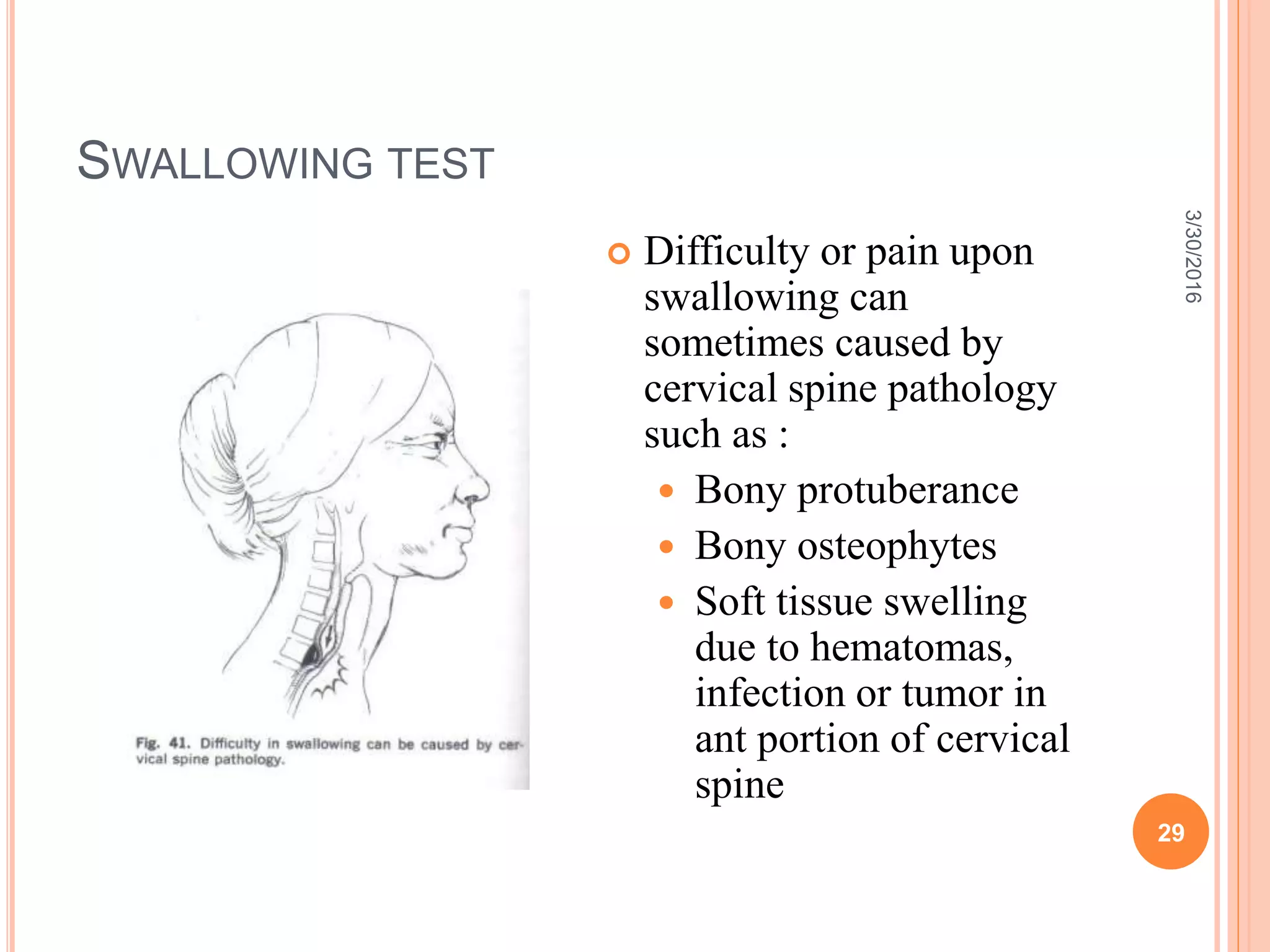
SWALLOWING TEST
 Difficulty or pain upon
swallowing can
sometimes caused by
cervical spine pathology
such as :
 Bony protuberance
 Bony osteophytes
 Soft tissue swelling
due to hematomas,
infection or tumor in
ant portion of cervical
spine
4/24/2016
29
LHERMITTE’S SIGN
 This sign detects protrusion
of cervical intervertebral disc
or an extradural spinal
tumour irritating the spinal
duramater.
 The patient sits on an
examining table,now the
head of the patient is bent
down passively(flexion of
cervical spine ) and
simultaneously the lower
limbs are lifted(flexing the hip
joints) keeping the knees
straight. This will causes
sharp pain radiating down the
spine and to both the
extremities.
4/24/2016
30
ADSON TEST
 Pull the arm downwards
 Palpate the radial pulse
 Turn the pt’s head to the same side and extend the neck
 Abduct, extend, and laterally rotate the shoulder.
 From this position, have the patient take a deep breath and
hold
 Feel the radial pulse
 Fading of the radial pulse indicates positive thoracic outlet
obstruction
4/24/2016
31
CONCLUSION:-
 Facet joint spondylosis and herniation of the intervertebral
disc are the most common causes of nerve root compression.
 Understanding the pathophysiology, diagnosis, treatment
indications, and treatment techniques will lead to rapid
diagnosis and improved patient care.
 This knowledge is important for all practitioners. Rapid
diagnosis and treatment will lead, ultimately, to a greater
chance for early recovery for the patient affected by this
condition.
4/24/2016
32
Thank you......
4/24/2016
33

Examination of cervical disorder

  • 1.
    EXAMINATION OF CERVICALDISORDER Presented by Kaushal sinha 1st year PG Dept. of panchakarma SDM college of ayurveda 4/24/2016 1
  • 2.
    CONTENT:-  Introduction  Regionof spine  Function of spine  Examination of cervical spine (A)General pysical examination (B)Special test (C)Range of movement  conclusion 4/24/2016 2
  • 3.
    INTRODUCTION  33 vertebrae 31 pair nerve roots  23 disc  Spinal cord- Contained in epidural space Network of sensory and motor nerves Firm, cord-like structure Conus medullaris Filum terminale Cauda equina Foramen magnum Conus medularis Cauda equina 4/24/2016 3
  • 4.
    SAGITTAL PLANE CURVES Cervical Lordosis 20°- 40  Thoracic Kyphosis 20°- 40°  Lumbar Lordosis 30°- 50  Sacral Kyphosis 4/24/2016 4
  • 5.
    REGION OF THESPINE  Cervical  Upper cervical: C1-C2  Lower cervical: C3-C7  Thoracic: T1-T12  Lumber: L1- L5  Sacrococcygeal: 9 fused vertebrae in the sacrum and coccyx 4/24/2016 5
  • 6.
    FUNCTIONS OF SPINE:- Posture  Spinal cord encasement  Weight transmission  Posture  Vital organs back support  Muscles attachment 4/24/2016 6
  • 7.
    WHAT IS CERVICALSPINE Consist of 7 vertebra 8 nerves Give two plexuses:- Cervical plexus ( C1-C5) Phernic ( C3,C4,C5 Lesser occipital (C2) Supraclaviclular ( C3,C4) brachial plexus ( C5-T1) mucocutanous n (C5-C7) axillary n (C5-C6) median n (C5-T1) radial N (C5-T1) ulnar n (C8-T1) 4/24/2016 7
  • 8.
    CERVICAL DISORDER  Cervicalspondylosis  Cervical radiculopathy  Cervical myelopathy  Cervical Strain/spasm  Cervical Sprain  Cervical Stenosis  HNP(Herniated Nucleus pulposus)  Cervical Cord Neuropraxia  Fractures/subluxation etc. 4/24/2016 8
  • 9.
    COMMON CONDITIONS AFFECTINGTHE CERVICAL SPINE 4/24/2016 9
  • 10.
     Herniated disc-The two most common levels in the cervical spine to herniate are the C5 - C6 level (cervical 5 and cervical 6) and the C6 -C7 level. The next most common is the C4 - C5 level, and rarely the C7 - T1 level may herniate4 Cause- some sort trauma & injury  Bone spur- Cervical osteophytes are bone spurs that grow on any of the seven vertebrae in the cervical spine (neck), involving the spine from the base of the skull to the base of the neck (C1 - C7 vertebrae) Cause- inflamed or damaged tissue, cervical osteoarthritis, cervical spondylosis Other types of arthritis, traumatic injury, and poor posture  Narrow disc space- cervical foraminal stenosis (narrowing of the cervical disc space) may arise without any disc herniation. The majority of symptoms with this type of cervical stenosis are usually caused by one nerve root on one side 4/24/2016 10
  • 11.
    EXAMINATION OF CERVICALSPINE  History  General Examination  Inspection  Palpation  Special Test  Range of Movement 4/24/2016 11
  • 12.
    EXAMINATION TECHNIQUE:-  Introduceyourself  Ask permission to perform examination  Explain the patient appropriately  The patient must be exposed properly  Tell the patient to let you know if anything you do uncomfortable and painful  When female patient make sure that female nurse & assistant is present. 4/24/2016 12
  • 13.
    HISTORY  Male /Female  Occupation  Socio economic class  Presenting chief complaints  History of presenting ilness  Treatment history  Past history  Personal history  Family history 4/24/2016 13
  • 14.
    ASK FOR…  H/oTrauma  H/o constitutional symptoms  H/o Hemoptysis  H/o Respirory symptoms,dysponea  H/o Other joint involements  H/o Pelvic inflammatory  Treatment histoy  Immunization history BCG,polio 4/24/2016 14
  • 15.
    PAST HISTORY  Similarcomplains  Prolonged history  Previous surgery  DM  HTN  Tuberculosis  Hematological disorder  Any neurological disorder 4/24/2016 15
  • 16.
    PERSONAL HISTORY  Smoking Alcohol  Drug addiction  Diet  Bowel bladder habbit  Appetite  Menstrual history in female 4/24/2016 16
  • 17.
    FAMILY HISTORY  Similarillness  Tuberclosis  HTN  DM 4/24/2016 17
  • 18.
    INSPECTION (A) Standing Look fromthe side normal spine > cervical lordosis  Increased lordosis – muscular weakness or imbalance  Lessened lordotic curve - muscular spasm/guarding and/or nerve root impingement 4/24/2016 18
  • 19.
    (B) Position ofHead Relative to Shoulders  Head should be seated symmetrically on cervical spine  Lateral flexion - from unilateral spasm of muscles – strain and/or spasm (guarding)  Rotation – from unilateral spasm of sternomastoid muscle – strain and/or spasm (guarding) or torticollis 4/24/2016 19
  • 20.
    PALPATION  Local risein temperature  Palpate all spinous process  Prominent spinous process Feel → The midline spinous processes → The paraspinal soft tissues → The supraclavicular fossae – for cervical ribs or enlarged lymph nodes → The anterior neck structures including the thyroid 4/24/2016 20
  • 21.
    SPECIAL TESTS  Cervicalspine :  Spurling test  Compression test  Distraction test  Valsalva test  Swallowing test  Adson test  Range of motion:  Active  Passive 4/24/2016 21
  • 22.
    SPECIAL TEST:- Movement (A) Flexion -ask the patient to bend the head forwards - chin should be able to touch the chest - normal : 80° (B) Extension - ask the patient to look up and back - normal : 50° 4/24/2016 22
  • 23.
    RANGE OF MOTIONTESTING Active:-  Best done in sitting or standing  Flexion – touch chin to chest  Extension – look straight above head  Lateral flexion – approximately 45 degrees  Rotation – nose over tip of shoulder Passive:-  Best done laying supine  Flexion – firm end feel  Extension – hard end feel (occiput on cervical spinous processes)  Lateral flexion – firm end feel (stabilize opposite shoulder)  Rotation – firm end feel 4/24/2016 23
  • 24.
    (C) Lateral flexion -ask the patient to touch his shoulder with the ear - involve atlanto-axial and atlanto-occipital joints - normal : 45° (D) Rotation - ask the patient to look over his shoulder - normal : 80° - restricted and painful in cervical spondylitis 4/24/2016 24
  • 25.
    COMPRESSION TEST  Testingfor compression of cervical nerve root or facet joint irritation in the lower cervical spine  Ask the patient seat the table  Patient head is natural,therapist stands behind patient  Positive sign –  Radiating pain or other neurological sign in the same side arm(nerve root) and pain local to the neck or shoulder  A narrowing of neural foramen, pressure on the facet joints or muscle spasm can cause increase pain upon compression 4/24/2016 25
  • 26.
    SPURLING TEST  Samepositioning as cervical compression test  Compression of a cervical nerve root or facat joint irritation in the lower cervical spine  Patient slowly extends,sidebend,and rotates the head of affected side.  Therapist carefully compression downword on the head of patient  Positive sign:- Radiating pain or other neurological sign in the same side arm(nerve root) and pain local to the neck or shoulder (facet joint irretation) 4/24/2016 26
  • 27.
    DISTRACTION TEST To relive the pressure on the cervical roots (may be used after spurlling or compression test)  Place the open palm of one hand under the pt’s chin, and the other hand is upon occiput & tempolallis  Then, gradually lift (distract) the head to remove its weight from the neck  To demonstrate the effect that neck traction might have help in relieving the pain by decreasing pressure on the joint capsules around the facet joints. 4/24/2016 27
  • 28.
    VALSALVA TEST  Askpt to hold his breath and bear down as if he were moving his bowels  Then, ask whether he feels any increase in pain and describe the location  This test increase intratechal pressure  If a space occupying lesion, such as a herniated disc or a tumor present in cervical canal, pt may develop pain in cervical spine secondary to increase pressure  The pain also may radiate to the dermatome distribution of cervical spine pathology 4/24/2016 28
  • 29.
    SWALLOWING TEST  Difficultyor pain upon swallowing can sometimes caused by cervical spine pathology such as :  Bony protuberance  Bony osteophytes  Soft tissue swelling due to hematomas, infection or tumor in ant portion of cervical spine 4/24/2016 29
  • 30.
    LHERMITTE’S SIGN  Thissign detects protrusion of cervical intervertebral disc or an extradural spinal tumour irritating the spinal duramater.  The patient sits on an examining table,now the head of the patient is bent down passively(flexion of cervical spine ) and simultaneously the lower limbs are lifted(flexing the hip joints) keeping the knees straight. This will causes sharp pain radiating down the spine and to both the extremities. 4/24/2016 30
  • 31.
    ADSON TEST  Pullthe arm downwards  Palpate the radial pulse  Turn the pt’s head to the same side and extend the neck  Abduct, extend, and laterally rotate the shoulder.  From this position, have the patient take a deep breath and hold  Feel the radial pulse  Fading of the radial pulse indicates positive thoracic outlet obstruction 4/24/2016 31
  • 32.
    CONCLUSION:-  Facet jointspondylosis and herniation of the intervertebral disc are the most common causes of nerve root compression.  Understanding the pathophysiology, diagnosis, treatment indications, and treatment techniques will lead to rapid diagnosis and improved patient care.  This knowledge is important for all practitioners. Rapid diagnosis and treatment will lead, ultimately, to a greater chance for early recovery for the patient affected by this condition. 4/24/2016 32
  • 33.

Editor's Notes