CLINICAL EVALUATION
OF NOSE
Moderator: Prof .Dr.N.Dhinakaran MS
Presenter: Dr.s.vinitha PG
 History taking
 General Examination
 Systemic Examination
 Local Examination
 Investigation
 Conclusion
C O N T E N T S
History taking:
Name,age,sex,occupation, address
Chief complaints:
1.Nasal obstruction
2.Nasal discharge
3.Epistaxis
4.Loss of smell
5.sneezing
6.Hawking sensation
7.cough
8.Headache
9.Facial pain
10.voice change
11.External nasal deformity
12.snoring
Nasal obstruction:
 Side: right/left/bilateral
 Duration:
 Severity: persistent/intermittent
 Progressive or non-progressive
 Associated with climatic changes (allergic rhinitis)
 Relieved with medication
 Association with purulent nasal discharge
Unilateral
 C shaped DNS
 FB
 AC polyp
 U/L atrophic rhinitis
 Rhinosporidiosis
 Stewart's granuloma
 Benign & malignant lesion
Bilateral
 S shaped DNS
 Rhinitis
 Ethmoidal polyp
 Atrophic rhinitis
 AR
 VMR
 Growth in nasopharynx
Intermittent
 VMR
 AR
 Early stage of ethmoidal polyposis
Progressive
 Malignancy
 Final stage of polyp
Relieved with medication
 Inflammatory-
AllergicRhinitis,Chronic Rhinitis
 VMR
 Ethmoidal polyposis
Drug induced obstruction
 Antihypertensive- methyl
dopa,hydralazine,prazosin
 Anti depressants-alprax
 Betablocker_propranolol,nadol
ol
 OCP
 ergot
 Iodides & alcohol
Obstruction after washing face with water: VMR
Obstruction more during expiration:AC polyp(ball valve
phenomenon
Nasal discharge:
 Side
 Duration
 Nature:
watery/mucoid/purulent/muco
purulent
 color
 Blood stained
 Foul smell +/-
 Crust+/-
Unilateral Nasal discharge Bilateral nasal discharge
 Foreign body
 u/l sinusitis
 Rhinitis caseosa
 Fungal sinusitis
 malignancy
 Chronic sinusitis
 polyp with 2' infection
 atrophic rhinitis with sinusitis
Watery nasal discharge
 Common cold
 AR
 VMR
 CSF leak
Purulent nasal discharge
 Chronic sinusitis
 atrophic sinusitis with 2' infection
 Rhinitis caseosa
 Malignancy with 2' sinusitis
Bloody nasal discharge
 Chronic sinusitis
 fungal sinusitis
 chronic granulomatous condition
 benign & malignant disease
Thick nasal discharge
 Cystic fibrosis
 karatagners syndrome
 AFS
EPISTAXIS
Commonest cause
1.children- nose picking 3.adult: hypertension
2.adolescent-JNA(recurrent) 4.Elder: HT f/b malignancy
Other causes
LOCAL:
1.Trauma,sx
2.infection
3.Granulomatous condition
4.Physiological:
puberty,extremes of temp,high altitude
5.vicarious menstruation
6.congenital: telangiectasia
7.Tumors
SYSTEMIC:
1.Bleeding diathesis
2.leukemia/Anemia
3.Hodgkin
4.liver disease/Vit k defn
5.RHD (ms)
DRUG INDUCED
IDIOPATHIC
Smell disturbances
ANOSMIA:total loss of smell
HYPOSMIA:reduced
PAROSMIA: altered sense of smell
CACOSMIA: any smell experienced as foul
Causes:
 Rhinitis
 Trauma to cribriform plate
 P' effect - intracranial
abscess,tumors, meningitis
 Olfactory Neuroblastoma
 Psychogenic
 Organic :temporal lobe
epilepsy
 Tumors: frontal/temporal
HEAD ACHE
1.site: frontal, temporal, vertex,occipital
OFFICE headache/ morning headache-frontal sinusitis
Spectacle headache- Ethmoiditis
occipital- sphenoiditis,tension,HT,cervical causes
2.side: U/L(migraine ) or B/L
3.Duration
4.Dull/ throbbing(vascular)
5.periodicity: Migraine
6.agg/ relieving factor
7.associated with vomit/ophthalmic changes/ aura
Facial pain
Side,severity,continuous/intermittent, agg&relieving factor
Causes
 Neuralgia- 1)Primary -trigeminal,glossopharyngeal
2)secondary-dental,cervical
3)central-herpetic,brain stem lesion,thalamus lesion
 Glossodynia
 Ocular
 TMJ Dysfn
 Vascular:migraine/temporal arteritis
 atypical facial pain
Voice change
Rhinolalia clausa:
Nasal /nasopharyngeal obstruction
Rhinolalia aperta:
Cleft palate,following adenoidectomy
FAMILY HISTORY:
Allergy(drugs,dust)
Dm,SHT,CAD,PTB
MENSTRUAL HISTORY:
Menarche/menopause
Cycles: regular/ duration
LMP
GENERAL EXAMINATION:
• Conscious, oriented,
• Build and nourishment
• VITALS: BP,PR,RR,Temp
"PICCLE""
Pallor
Icterus
Cyanosis.
Clubbing
Lymph node& thyroid gland enlargement
Pedal edema
Systemic Examination
Cvs,RS,GIT
LOCAL EXAMINATION:
 Face
 External nose
 Columella
 Vestibule
 Anterior rhinoscopy
 Posterior rhinoscopy
 Paranasal sinuses
 Cold.spatula test
Examination of face:
Dark circles- Allergic & chronic rhinitis
Redness- erysipelas
Furunculosis
Septal abscess
Osteomyelitis
Of nasal bone
Facial cellulitis
Ethmoiditis
Agressive bact,fungal rhinosinusitis
Furunculosis
Angioneurotic edema
Post trauma
• Vesicles
• Fissures
• Crusts • Ulceration
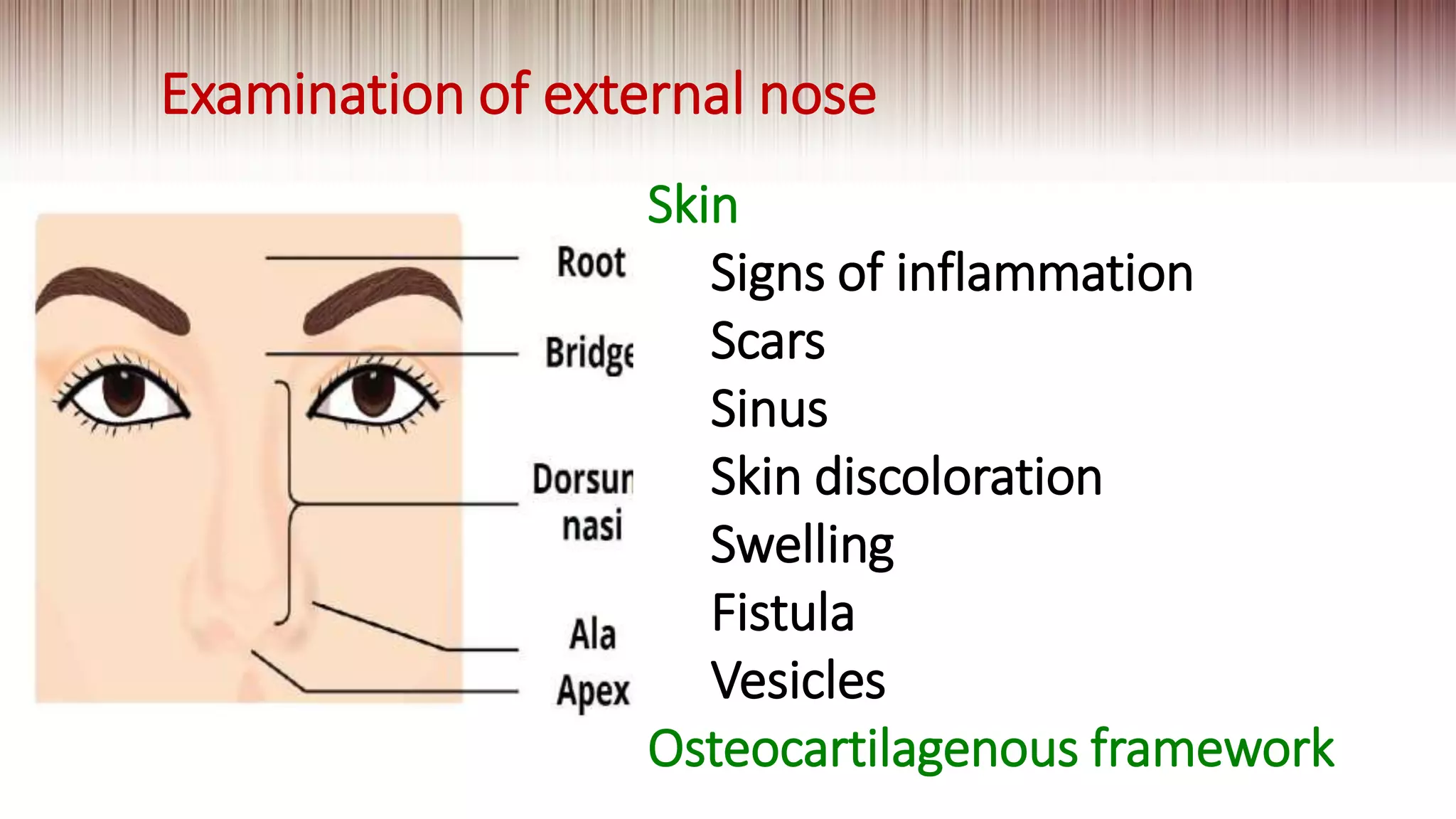
Examination of external nose
Skin
Signs of inflammation
Scars
Sinus
Skin discoloration
Swelling
Fistula
Vesicles
Osteocartilagenous framework
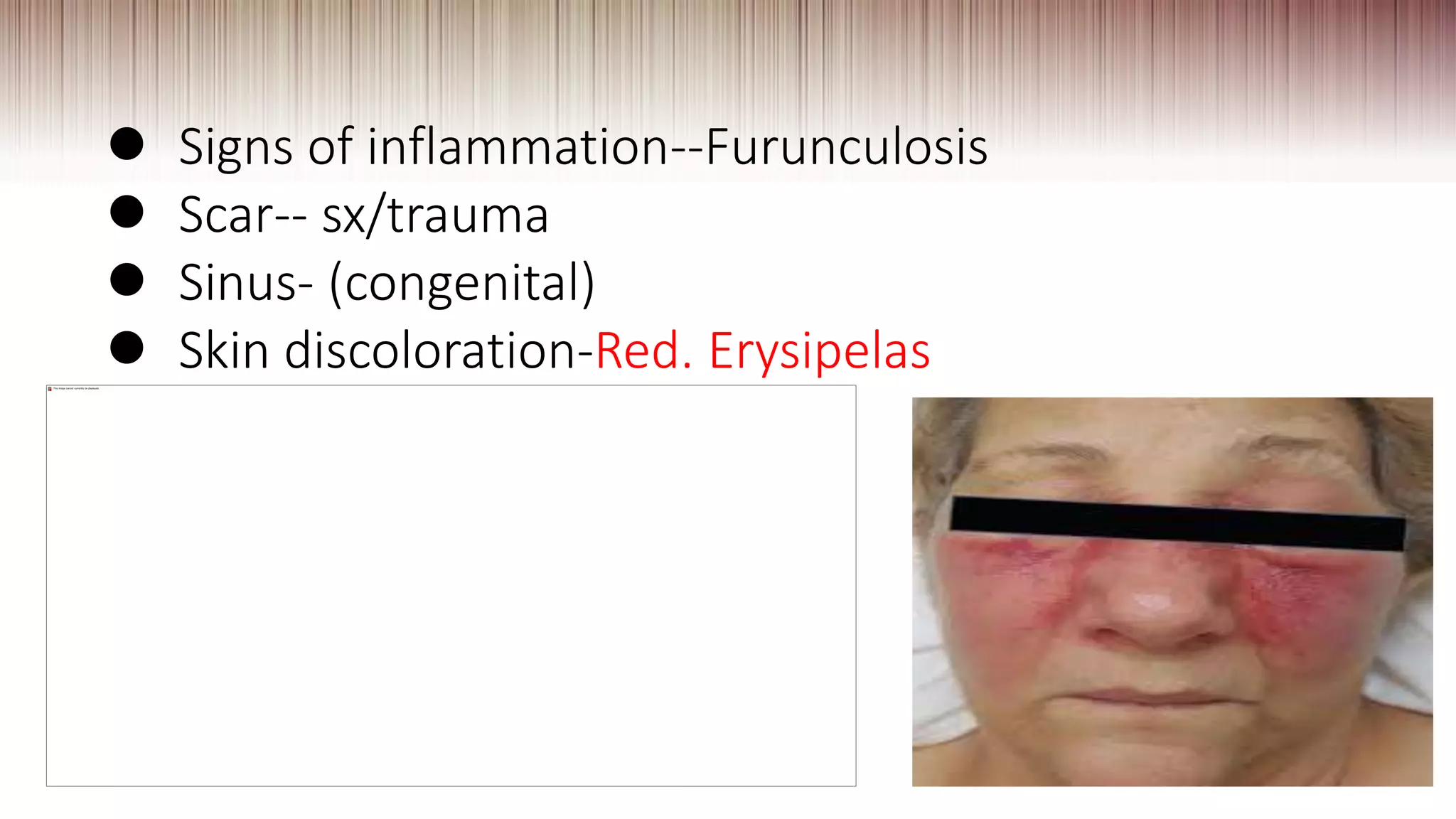
 Signs of inflammation--Furunculosis
 Scar-- sx/trauma
 Sinus- (congenital)
 Skin discoloration-Red. Erysipelas
Generalised swelling , yellowish nodule
surrounded by hyperemic boggy
mucosa__ sarcoidosis
Diffuse bulbous affliction of nasal tip-
lupus pernio/mortimer's malady
(cutaneous sarcoid)
Swelling--dermoid,glioma.
Mucocele,encepahlocele
osteoma,fibrous dysplasia,
osteomyelitis & malignancy of maxillarysinus
Frustenberg test
(+) Meningocele
 Vesicles- herpes simplex,zoster
 Crease-allergic salute,VMR, chronic
rhinitis
 Thickened skin in nasal tip-Acne
rosacea
 Fistula-osteomyelitis
Osteocartilagenous framework
Congenital
Congenital
Also look for fissured nose,columellar retraction, supratip
depression
Acquired:
Saddle nose: leprosy, Syphilis
Rhinoscleroma.
Trauma,surgery
Parrot nose: crouzen
Tapir nose: rhinoscleroma,
Leishmaniasis
Crooked nose: trauma
Increased intercanthal distance:
advanced ethmoidal polyposis
Malignancy of nasal & pns
Down's syndrome
Skin mobility:
Decreased in scar frmn , malignancy
Increased thickness:
Abscess,cyst,rhinophyma
Fluctuation:
Abscess,cyst
EXAMINATION OF COLUMELLA
 Scar
 Fissures- AR,VMR,CRS
 Ulceration-AR,VMR,CR
 Crusting
 Destruction- granulomatous
disease
EXAMINATION OF VESTIBULE
 Follicles- Folliculitis
 Pus points- furunculosis
 Edema- vestibulitis
 Crusts- Eczema, vestibulitis
 Scar- trauma,sx, granulomatous condition
 Vestibular stenosis-infection
TB,leprosy, syphilis,lupus
Sarcoidosis, rhinoscleroma
Post sx craniofacial resection
 Neoplasm,caudal dislocation
EXAMINATION OF NASAL CAVITY
ANTERIOR RHINOSCOPY:
Hold it in the left hand
Floor of nose
Inferior turbinate
Septum
Middle turbinate
Middle meatus
Roof
Mucosa:
1)color::Pink- normal
Hyperemic- rhinitis, sinusitis,septal abscess
Pale- Allergic rhinitis, Anemia, granulomatous
condition
2) Dryness
3)Crust
Floor of nose:
• Defects- cleft palate
• Swelling-osteopetrositis of palate,dental
cyst,hemangioma, neoplasm
• Granulation- foreign body
NASAL SEPTUM:
Bleeding points,dns,spur,,swelling,ulcers, perforation
DNS:
Cottle's classification of DNS:
1.Simple DNS:. Mild deflection obstructing nasal cavity
2.Obstructed DNS: severe deflection touching lateral wall
On applying vasoconstrictors ,septum & turbinates gets
separated
3.Impacted DNS:marked angulation of septum in contact with
lateral wall even after application of vasoconstrictors
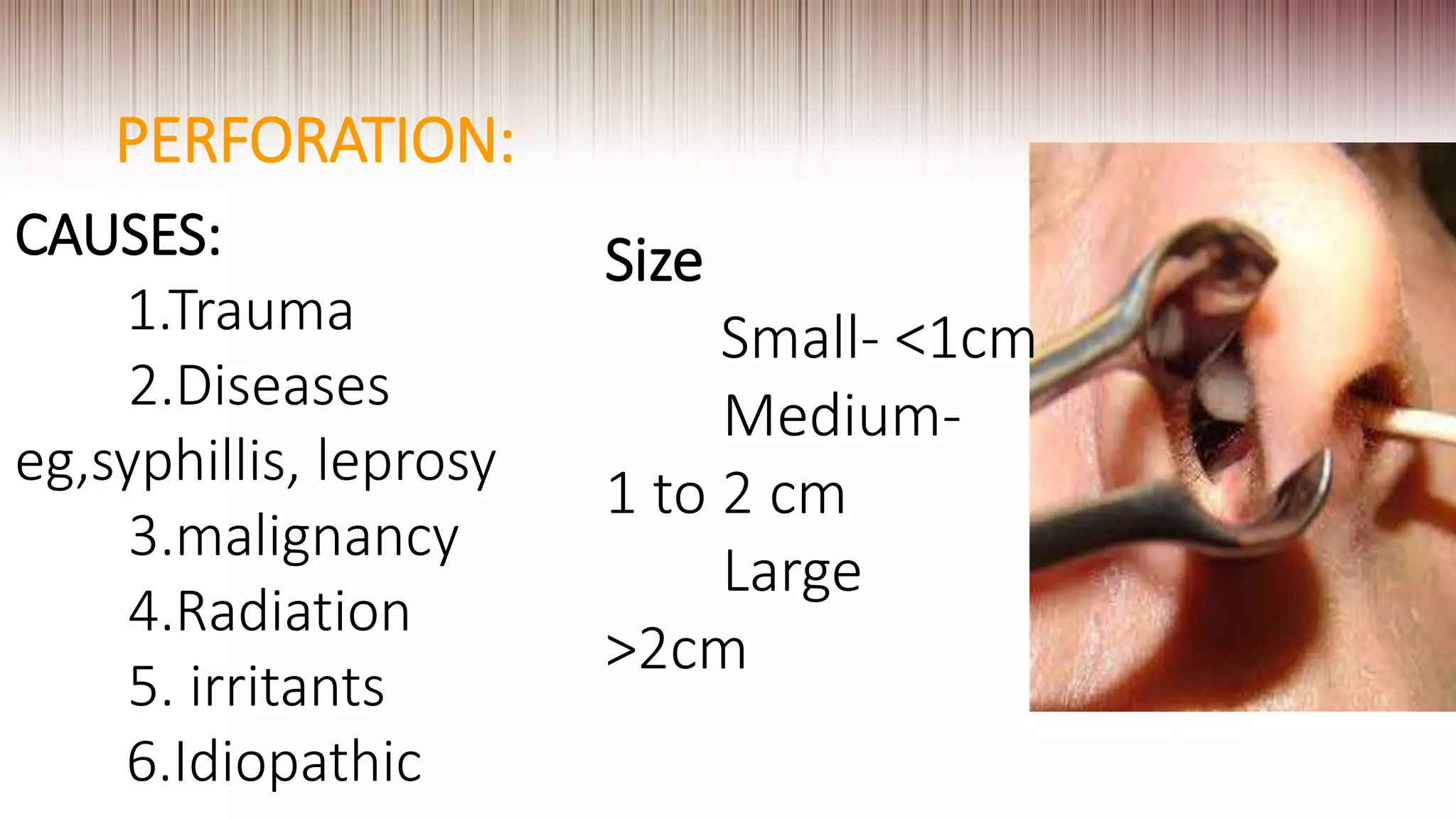
PERFORATION:
CAUSES:
1.Trauma
2.Diseases
eg,syphillis, leprosy
3.malignancy
4.Radiation
5. irritants
6.Idiopathic
Size
Small- <1cm
Medium-
1 to 2 cm
Large
>2cm
NASAL PASSAGE: Patency, adhesions,
synechiae,stenosis,FB,rhinolith,growth
 Narrow: DNS,HT of turbinates,polyps,growth
 Wide: Atrophic rhinitis,rhinitis sicca
LATERAL WALL OF NOSE:
INFERIOR TURBINATE:.
Atrophic turbinate: Atrophic
rhinitis,post surgery
Hypertrophic : chronic hypertrophic
rhinitis
Mulberry: chronic HT
rhinitis,AR,VMR, Rhinitis medicamentosa
MIDDLE TURBINATE:
Hypertrophied- concha bullosa
Types1.Inferior[bulbous]
2.superior[lamellar]
3.Extensive type
Atrophied turbinate- Atrophic rhinitis,
Rhinitis sicca,
Atrophic stage of rhinoscleroma
Paradoxical middle turbinate Double turbinate
UP bends ant & in contact with MT
Polypoidal mucosa over turbinate
Seen in AR
Kupferberg's classification:AFS
Stage 0: no nasal edema
Stage 1: nasal edema with or without allergic mucin
Stage 2: polypoidal mucosa with or without allergic
Or fungal mucin
Stage 3: Polyps with allergic and fungal mucin
Crusts:
Atrophic rhinitis -greenish yellow
Rhinitis sicca- black
Invasive fungal sinusitis-black
Rhinitis caseosa
Wegners granuloma
Stewart granuloma
NODULES: TB,leprosy,Sarcoidosis
Wegners & Stewart granuloma
MIDDLE MEATUS
Pus(+)-sinusitis of anterior grp
Polyps(+)- Ethmoidal-multiple grape like,adult
Antral-U/L,post,children
Fungal-U/L,allergic mucin
Malignant
Mass- Benign(osteoma)
Malignant (sarcoma)
MASS
Size,site,color,
sessile/pedunculated,
single/multiple,
surface-smooth/irregular/surface studded with yellow spots
PROBE TEST
Sensitive to touch +/-
Bleeds on toucn+/-
Consistency,
Mobility,
margins
non sensitive to touch
not bleeds on touch
Pink,pedunculated
Yellow studs
Bleeds on touch
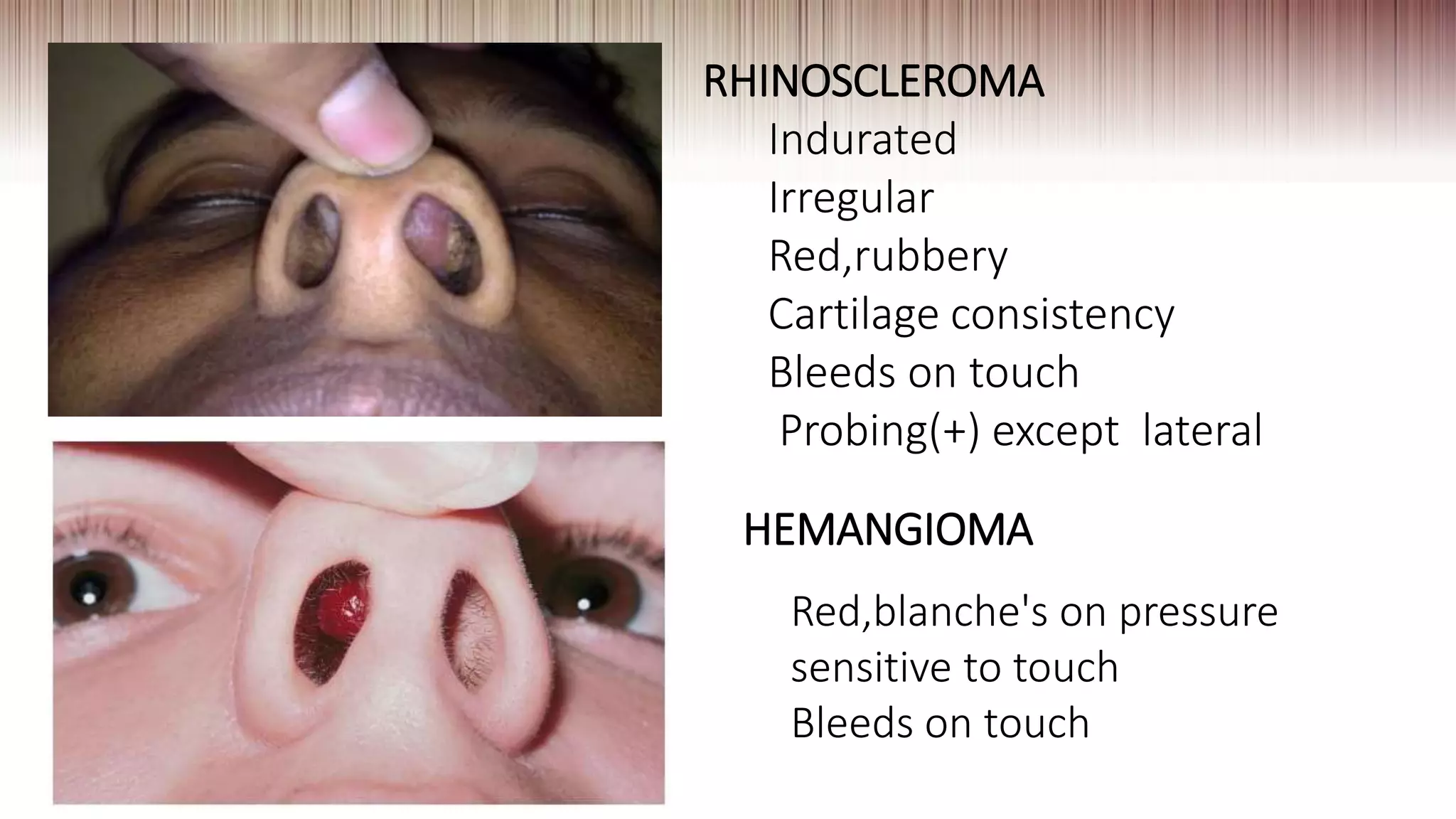
RHINOSCLEROMA
Indurated
Irregular
Red,rubbery
Cartilage consistency
Bleeds on touch
Probing(+) except lateral
HEMANGIOMA
Red,blanche's on pressure
sensitive to touch
Bleeds on touch
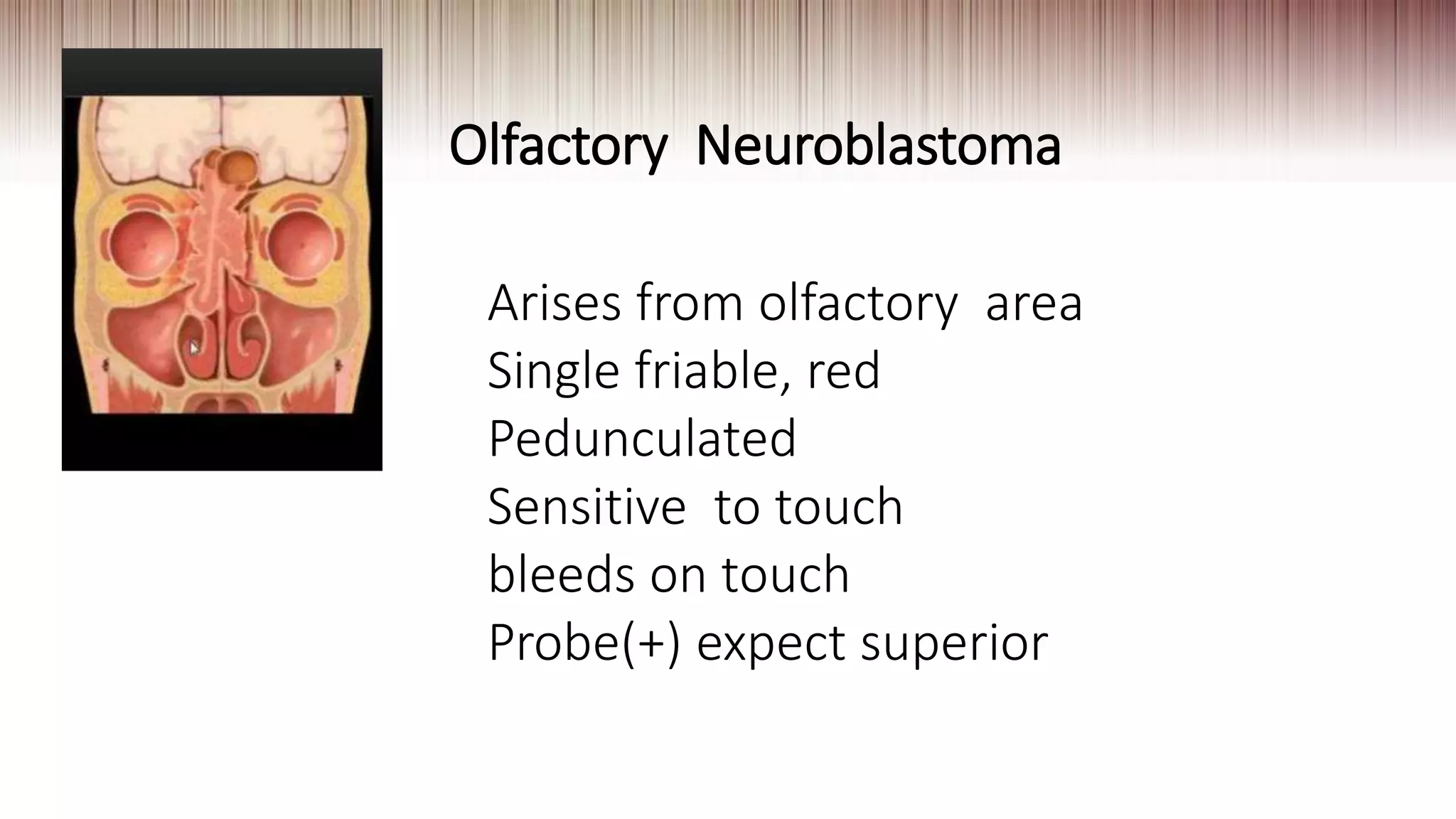
Olfactory Neuroblastoma
Arises from olfactory area
Single friable, red
Pedunculated
Sensitive to touch
bleeds on touch
Probe(+) expect superior
POSTERIOR RHINOSCOPY
 Choana- patency,polyp,growth
 posterior end of nasal septum
 Adenoids
 Posterior end of turbinates
 middle& sup.meatus-discharge
 Eustachian opening
 Tubal elevation
EXAMINATION OF PNS
Maxillary sinus:
Tenderness elicited by pressure over canine fossa
Ethmoidal sinus:
pressure on medialwall of orbit just behind root of nose
Frontal sinus:
pressure on the ant. wall of frontal sinus above medial eyebrow &
on floor of frontal sinus above medial canthus
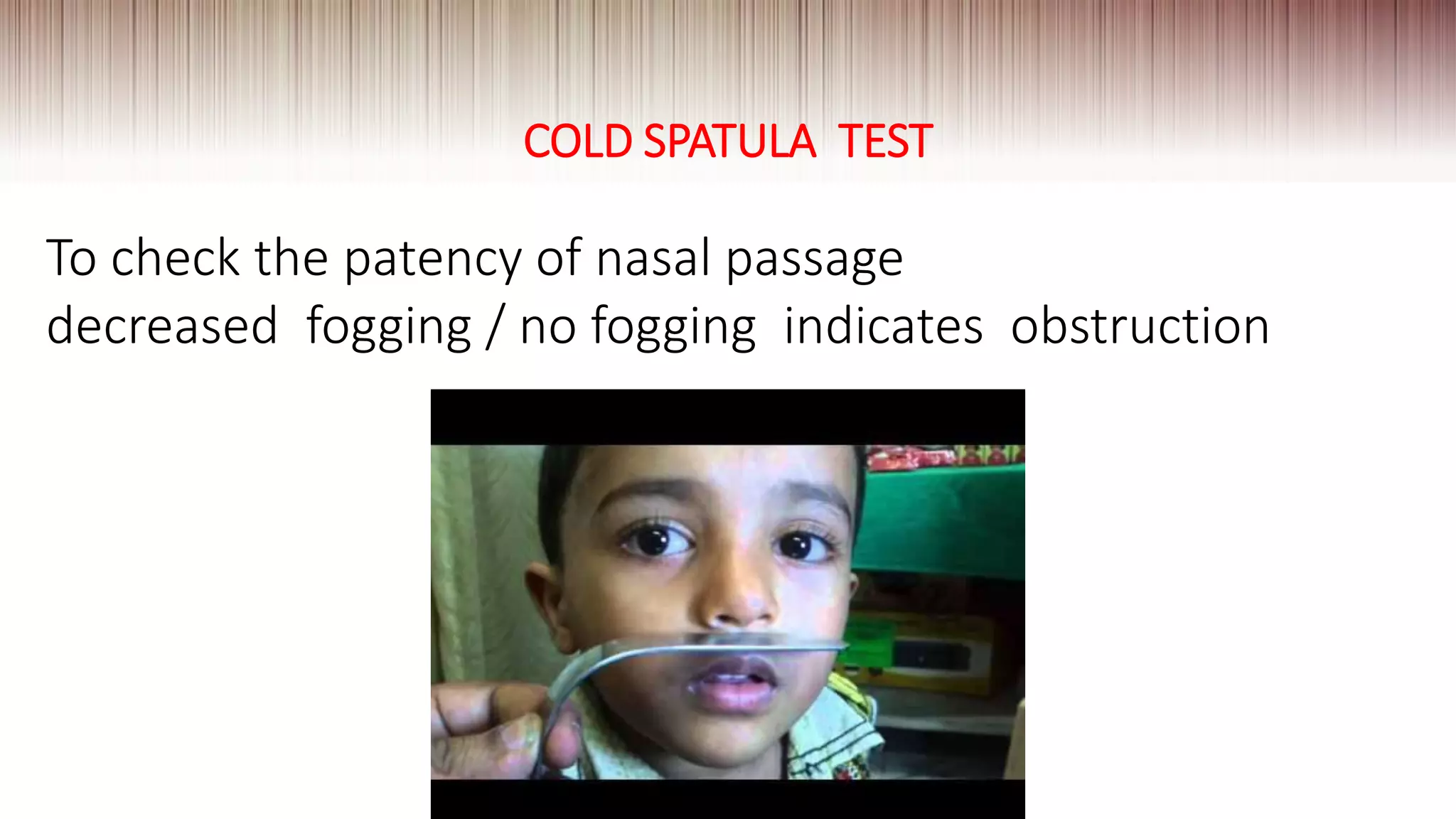
COLD SPATULA TEST
To check the patency of nasal passage
decreased fogging / no fogging indicates obstruction
COTTLE'S TEST
Nasal obstruction improves in case of
nasal valve obstrn
BLOOD INVESTIGATION
Hb
TC DC AEC
ESR
Allergy
Total IgE
Systemic disease
Sweat chloride test
ANCA
DNE
PSG
PLATELET
BT CT
PT APTT
In vivo test
skin test
Nasal cytology for
Eosinophil
Sputum AFB
Mantoux test
Radiology
X-ray PNS,nasopharynx
CXR PA view
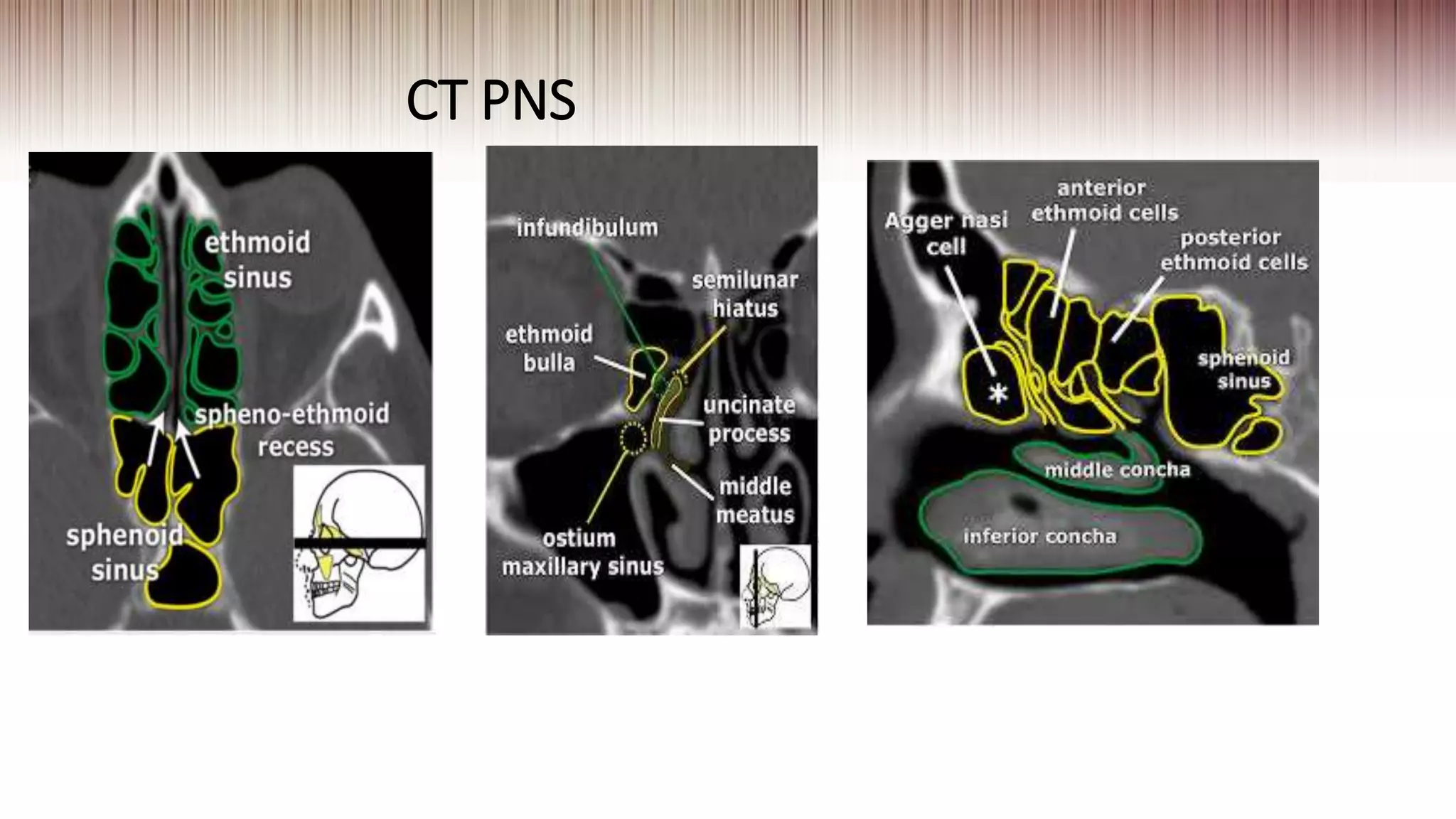
CT PNS
RBS/FBS/PPBS
RFT
LFT
In vitro test
Radio allergosorbent
test(RAST)
Fluoro allergosorbent
VDRL,TPI,TPHA
Nasal swab culture
Others
VCA,EA,nuclear Ag
Olfaction
CSF leak identification
INVESTIGATION
INVESTIGATION
1.HB- anemia (AR,malignancy, granulomatous condition)
2.TC,DC-inc(bacterial infection)
Dec(viral infection)
3.AEC:Absolute eosinophil count: Allergy
4.Nasal cytology for eosinophill
5.Total Ig E : Allergy
6.Platelet : Epistaxis,preop(N- hereditary telengiectasia)
7.BT,CT,PT,APTT-Epistaxis,anticoagulant therapy
8.ESR-inc (chronic infection, granulomatous condition, lymphoma,malignancy)
9.RBS- to r/o DM
10.RFT- preop,wegner granulomatosis,to monitor antifungal therapy in AFS
11.VDRL,TPI,TPHA- septal perforation (syphilis)
12.Sweat test: >70mmol of Nacl/100g sweat
13.Nasal swabs culture:☆chronic sinusitis
☆Granulomatous
☆Atrophic rhinitis
☆vestibulitis
☆CST
14.sptum AFB
15.Mantoux test
SKIN TEST
Principle: To initiate allergic response( wheal and flare)
By injecting specific allergens
Which induces Sensitized mast cells in tthe skin (within 2 to20
minutes.)
Negative control: Here 0.4% phenolated saline is used
Positive control. Here 1:500 or l : 1000 w/v histamine solution is used which
excludes a false negative test due to (a) loss of potency of allergens, (b)prior
use of drugs.
FACTORS AFFECTING skin
test:
😀volume of antigen introduced
😀potency of antigen
😀degree of sensitization
😀reactivity of skin
FALSE POSITIVE
Improper preparation of allergen
more of glycerin
large volume
1.Prick test
2.Intradermal skin test
3.scratch test - contactdermatitis
4.skin end point titration test
RAST
In vitro test
Uses enzyme to label anti IgG
Measured in spectrometry
Skin test(in vivo)
DIAGNOSTIC NASAL ENDOSCOPY
GRAY( GRBY)
Green 0'
Red 30'
Black 45'
Yellow 70'
First Pass
Floor,IT,Septum, Choana,nasopharynx, ET
opening,TT,FOR,
inferior meatus,NLD opening
SECOND PASS
Passed medial to middle turbinate & posteriorly
sphenoethmoidal recess
Sphenoid ostium
Superior turbinate
olfactory cleft region
Third pass
Middle meatus and its
structures
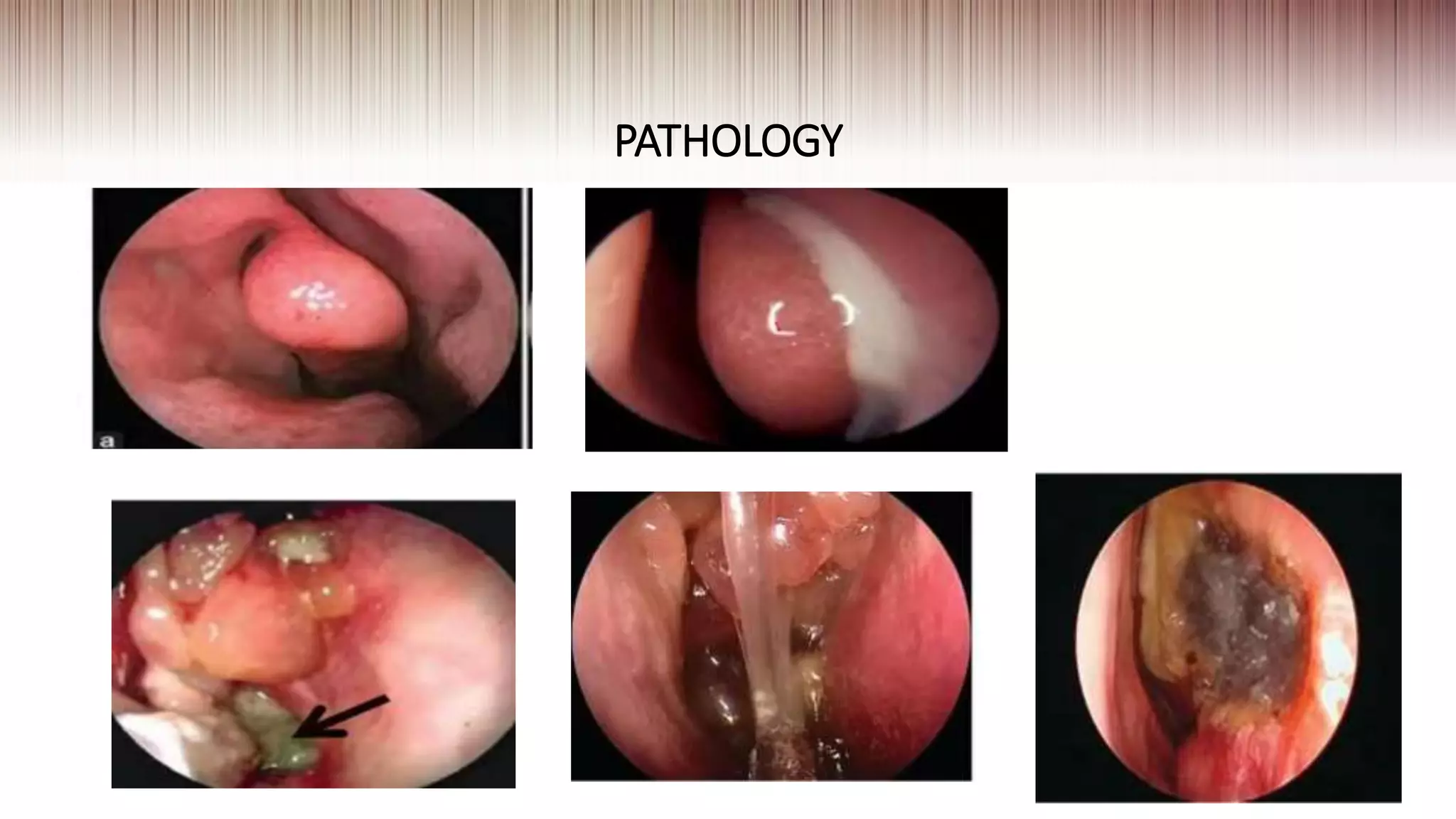
PATHOLOGY
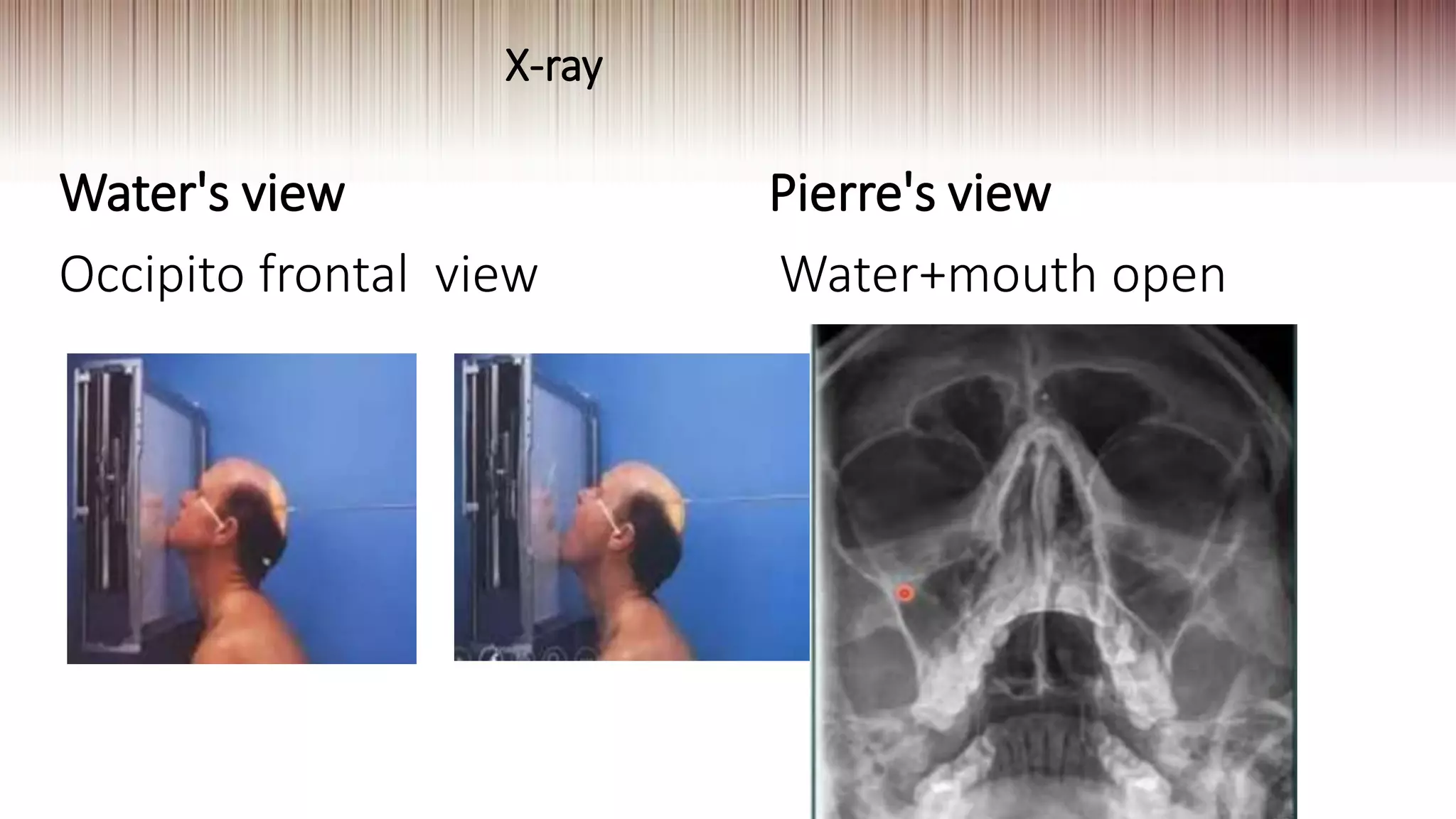
X-ray
Water's view
Occipito frontal view
Pierre's view
Water+mouth open
Caldwell's view
Occipito frontal view
Basal view
Submento vertical view
Lateral view
CT PNS
THANK
YOU

Exam of nose pg

  • 1.
    CLINICAL EVALUATION OF NOSE Moderator:Prof .Dr.N.Dhinakaran MS Presenter: Dr.s.vinitha PG
  • 2.
     History taking General Examination  Systemic Examination  Local Examination  Investigation  Conclusion C O N T E N T S
  • 3.
    History taking: Name,age,sex,occupation, address Chiefcomplaints: 1.Nasal obstruction 2.Nasal discharge 3.Epistaxis 4.Loss of smell 5.sneezing 6.Hawking sensation 7.cough 8.Headache 9.Facial pain 10.voice change 11.External nasal deformity 12.snoring
  • 4.
    Nasal obstruction:  Side:right/left/bilateral  Duration:  Severity: persistent/intermittent  Progressive or non-progressive  Associated with climatic changes (allergic rhinitis)  Relieved with medication  Association with purulent nasal discharge
  • 5.
    Unilateral  C shapedDNS  FB  AC polyp  U/L atrophic rhinitis  Rhinosporidiosis  Stewart's granuloma  Benign & malignant lesion Bilateral  S shaped DNS  Rhinitis  Ethmoidal polyp  Atrophic rhinitis  AR  VMR  Growth in nasopharynx Intermittent  VMR  AR  Early stage of ethmoidal polyposis Progressive  Malignancy  Final stage of polyp
  • 6.
    Relieved with medication Inflammatory- AllergicRhinitis,Chronic Rhinitis  VMR  Ethmoidal polyposis Drug induced obstruction  Antihypertensive- methyl dopa,hydralazine,prazosin  Anti depressants-alprax  Betablocker_propranolol,nadol ol  OCP  ergot  Iodides & alcohol Obstruction after washing face with water: VMR Obstruction more during expiration:AC polyp(ball valve phenomenon
  • 7.
    Nasal discharge:  Side Duration  Nature: watery/mucoid/purulent/muco purulent  color  Blood stained  Foul smell +/-  Crust+/-
  • 8.
    Unilateral Nasal dischargeBilateral nasal discharge  Foreign body  u/l sinusitis  Rhinitis caseosa  Fungal sinusitis  malignancy  Chronic sinusitis  polyp with 2' infection  atrophic rhinitis with sinusitis Watery nasal discharge  Common cold  AR  VMR  CSF leak Purulent nasal discharge  Chronic sinusitis  atrophic sinusitis with 2' infection  Rhinitis caseosa  Malignancy with 2' sinusitis
  • 9.
    Bloody nasal discharge Chronic sinusitis  fungal sinusitis  chronic granulomatous condition  benign & malignant disease Thick nasal discharge  Cystic fibrosis  karatagners syndrome  AFS
  • 10.
    EPISTAXIS Commonest cause 1.children- nosepicking 3.adult: hypertension 2.adolescent-JNA(recurrent) 4.Elder: HT f/b malignancy Other causes LOCAL: 1.Trauma,sx 2.infection 3.Granulomatous condition 4.Physiological: puberty,extremes of temp,high altitude 5.vicarious menstruation 6.congenital: telangiectasia 7.Tumors SYSTEMIC: 1.Bleeding diathesis 2.leukemia/Anemia 3.Hodgkin 4.liver disease/Vit k defn 5.RHD (ms) DRUG INDUCED IDIOPATHIC
  • 11.
    Smell disturbances ANOSMIA:total lossof smell HYPOSMIA:reduced PAROSMIA: altered sense of smell CACOSMIA: any smell experienced as foul Causes:  Rhinitis  Trauma to cribriform plate  P' effect - intracranial abscess,tumors, meningitis  Olfactory Neuroblastoma  Psychogenic  Organic :temporal lobe epilepsy  Tumors: frontal/temporal
  • 12.
    HEAD ACHE 1.site: frontal,temporal, vertex,occipital OFFICE headache/ morning headache-frontal sinusitis Spectacle headache- Ethmoiditis occipital- sphenoiditis,tension,HT,cervical causes 2.side: U/L(migraine ) or B/L 3.Duration 4.Dull/ throbbing(vascular) 5.periodicity: Migraine 6.agg/ relieving factor 7.associated with vomit/ophthalmic changes/ aura
  • 13.
    Facial pain Side,severity,continuous/intermittent, agg&relievingfactor Causes  Neuralgia- 1)Primary -trigeminal,glossopharyngeal 2)secondary-dental,cervical 3)central-herpetic,brain stem lesion,thalamus lesion  Glossodynia  Ocular  TMJ Dysfn  Vascular:migraine/temporal arteritis  atypical facial pain
  • 14.
    Voice change Rhinolalia clausa: Nasal/nasopharyngeal obstruction Rhinolalia aperta: Cleft palate,following adenoidectomy
  • 16.
  • 17.
    GENERAL EXAMINATION: • Conscious,oriented, • Build and nourishment • VITALS: BP,PR,RR,Temp "PICCLE"" Pallor Icterus Cyanosis. Clubbing Lymph node& thyroid gland enlargement Pedal edema Systemic Examination Cvs,RS,GIT
  • 18.
    LOCAL EXAMINATION:  Face External nose  Columella  Vestibule  Anterior rhinoscopy  Posterior rhinoscopy  Paranasal sinuses  Cold.spatula test
  • 19.
    Examination of face: Darkcircles- Allergic & chronic rhinitis Redness- erysipelas Furunculosis Septal abscess Osteomyelitis Of nasal bone
  • 20.
    Facial cellulitis Ethmoiditis Agressive bact,fungalrhinosinusitis Furunculosis Angioneurotic edema Post trauma
  • 21.
  • 22.
    • Crusts •Ulceration
  • 23.
    Examination of externalnose Skin Signs of inflammation Scars Sinus Skin discoloration Swelling Fistula Vesicles Osteocartilagenous framework
  • 24.
     Signs ofinflammation--Furunculosis  Scar-- sx/trauma  Sinus- (congenital)  Skin discoloration-Red. Erysipelas
  • 25.
    Generalised swelling ,yellowish nodule surrounded by hyperemic boggy mucosa__ sarcoidosis Diffuse bulbous affliction of nasal tip- lupus pernio/mortimer's malady (cutaneous sarcoid)
  • 26.
    Swelling--dermoid,glioma. Mucocele,encepahlocele osteoma,fibrous dysplasia, osteomyelitis &malignancy of maxillarysinus Frustenberg test (+) Meningocele
  • 27.
     Vesicles- herpessimplex,zoster  Crease-allergic salute,VMR, chronic rhinitis  Thickened skin in nasal tip-Acne rosacea  Fistula-osteomyelitis
  • 28.
  • 29.
    Congenital Also look forfissured nose,columellar retraction, supratip depression
  • 30.
    Acquired: Saddle nose: leprosy,Syphilis Rhinoscleroma. Trauma,surgery Parrot nose: crouzen Tapir nose: rhinoscleroma, Leishmaniasis Crooked nose: trauma
  • 31.
    Increased intercanthal distance: advancedethmoidal polyposis Malignancy of nasal & pns Down's syndrome Skin mobility: Decreased in scar frmn , malignancy Increased thickness: Abscess,cyst,rhinophyma Fluctuation: Abscess,cyst
  • 32.
    EXAMINATION OF COLUMELLA Scar  Fissures- AR,VMR,CRS  Ulceration-AR,VMR,CR  Crusting  Destruction- granulomatous disease
  • 33.
    EXAMINATION OF VESTIBULE Follicles- Folliculitis  Pus points- furunculosis  Edema- vestibulitis  Crusts- Eczema, vestibulitis  Scar- trauma,sx, granulomatous condition  Vestibular stenosis-infection TB,leprosy, syphilis,lupus Sarcoidosis, rhinoscleroma Post sx craniofacial resection  Neoplasm,caudal dislocation
  • 34.
    EXAMINATION OF NASALCAVITY ANTERIOR RHINOSCOPY: Hold it in the left hand Floor of nose Inferior turbinate Septum Middle turbinate Middle meatus Roof
  • 35.
    Mucosa: 1)color::Pink- normal Hyperemic- rhinitis,sinusitis,septal abscess Pale- Allergic rhinitis, Anemia, granulomatous condition 2) Dryness 3)Crust
  • 36.
    Floor of nose: •Defects- cleft palate • Swelling-osteopetrositis of palate,dental cyst,hemangioma, neoplasm • Granulation- foreign body
  • 37.
  • 38.
    Cottle's classification ofDNS: 1.Simple DNS:. Mild deflection obstructing nasal cavity 2.Obstructed DNS: severe deflection touching lateral wall On applying vasoconstrictors ,septum & turbinates gets separated 3.Impacted DNS:marked angulation of septum in contact with lateral wall even after application of vasoconstrictors
  • 39.
  • 40.
    NASAL PASSAGE: Patency,adhesions, synechiae,stenosis,FB,rhinolith,growth  Narrow: DNS,HT of turbinates,polyps,growth  Wide: Atrophic rhinitis,rhinitis sicca
  • 41.
    LATERAL WALL OFNOSE: INFERIOR TURBINATE:. Atrophic turbinate: Atrophic rhinitis,post surgery Hypertrophic : chronic hypertrophic rhinitis Mulberry: chronic HT rhinitis,AR,VMR, Rhinitis medicamentosa
  • 42.
    MIDDLE TURBINATE: Hypertrophied- conchabullosa Types1.Inferior[bulbous] 2.superior[lamellar] 3.Extensive type
  • 43.
    Atrophied turbinate- Atrophicrhinitis, Rhinitis sicca, Atrophic stage of rhinoscleroma
  • 44.
    Paradoxical middle turbinateDouble turbinate UP bends ant & in contact with MT
  • 45.
    Polypoidal mucosa overturbinate Seen in AR Kupferberg's classification:AFS Stage 0: no nasal edema Stage 1: nasal edema with or without allergic mucin Stage 2: polypoidal mucosa with or without allergic Or fungal mucin Stage 3: Polyps with allergic and fungal mucin
  • 46.
    Crusts: Atrophic rhinitis -greenishyellow Rhinitis sicca- black Invasive fungal sinusitis-black Rhinitis caseosa Wegners granuloma Stewart granuloma NODULES: TB,leprosy,Sarcoidosis Wegners & Stewart granuloma
  • 47.
    MIDDLE MEATUS Pus(+)-sinusitis ofanterior grp Polyps(+)- Ethmoidal-multiple grape like,adult Antral-U/L,post,children Fungal-U/L,allergic mucin Malignant Mass- Benign(osteoma) Malignant (sarcoma)
  • 48.
    MASS Size,site,color, sessile/pedunculated, single/multiple, surface-smooth/irregular/surface studded withyellow spots PROBE TEST Sensitive to touch +/- Bleeds on toucn+/- Consistency, Mobility, margins
  • 49.
    non sensitive totouch not bleeds on touch Pink,pedunculated Yellow studs Bleeds on touch
  • 50.
    RHINOSCLEROMA Indurated Irregular Red,rubbery Cartilage consistency Bleeds ontouch Probing(+) except lateral HEMANGIOMA Red,blanche's on pressure sensitive to touch Bleeds on touch
  • 51.
    Olfactory Neuroblastoma Arises fromolfactory area Single friable, red Pedunculated Sensitive to touch bleeds on touch Probe(+) expect superior
  • 52.
    POSTERIOR RHINOSCOPY  Choana-patency,polyp,growth  posterior end of nasal septum  Adenoids  Posterior end of turbinates  middle& sup.meatus-discharge  Eustachian opening  Tubal elevation
  • 53.
    EXAMINATION OF PNS Maxillarysinus: Tenderness elicited by pressure over canine fossa Ethmoidal sinus: pressure on medialwall of orbit just behind root of nose Frontal sinus: pressure on the ant. wall of frontal sinus above medial eyebrow & on floor of frontal sinus above medial canthus
  • 54.
    COLD SPATULA TEST Tocheck the patency of nasal passage decreased fogging / no fogging indicates obstruction
  • 55.
    COTTLE'S TEST Nasal obstructionimproves in case of nasal valve obstrn
  • 56.
    BLOOD INVESTIGATION Hb TC DCAEC ESR Allergy Total IgE Systemic disease Sweat chloride test ANCA DNE PSG PLATELET BT CT PT APTT In vivo test skin test Nasal cytology for Eosinophil Sputum AFB Mantoux test Radiology X-ray PNS,nasopharynx CXR PA view CT PNS RBS/FBS/PPBS RFT LFT In vitro test Radio allergosorbent test(RAST) Fluoro allergosorbent VDRL,TPI,TPHA Nasal swab culture Others VCA,EA,nuclear Ag Olfaction CSF leak identification INVESTIGATION
  • 57.
    INVESTIGATION 1.HB- anemia (AR,malignancy,granulomatous condition) 2.TC,DC-inc(bacterial infection) Dec(viral infection) 3.AEC:Absolute eosinophil count: Allergy 4.Nasal cytology for eosinophill 5.Total Ig E : Allergy 6.Platelet : Epistaxis,preop(N- hereditary telengiectasia) 7.BT,CT,PT,APTT-Epistaxis,anticoagulant therapy 8.ESR-inc (chronic infection, granulomatous condition, lymphoma,malignancy) 9.RBS- to r/o DM 10.RFT- preop,wegner granulomatosis,to monitor antifungal therapy in AFS
  • 58.
    11.VDRL,TPI,TPHA- septal perforation(syphilis) 12.Sweat test: >70mmol of Nacl/100g sweat 13.Nasal swabs culture:☆chronic sinusitis ☆Granulomatous ☆Atrophic rhinitis ☆vestibulitis ☆CST 14.sptum AFB 15.Mantoux test
  • 59.
    SKIN TEST Principle: Toinitiate allergic response( wheal and flare) By injecting specific allergens Which induces Sensitized mast cells in tthe skin (within 2 to20 minutes.) Negative control: Here 0.4% phenolated saline is used Positive control. Here 1:500 or l : 1000 w/v histamine solution is used which excludes a false negative test due to (a) loss of potency of allergens, (b)prior use of drugs.
  • 60.
    FACTORS AFFECTING skin test: 😀volumeof antigen introduced 😀potency of antigen 😀degree of sensitization 😀reactivity of skin FALSE POSITIVE Improper preparation of allergen more of glycerin large volume
  • 61.
    1.Prick test 2.Intradermal skintest 3.scratch test - contactdermatitis 4.skin end point titration test RAST In vitro test Uses enzyme to label anti IgG Measured in spectrometry Skin test(in vivo)
  • 62.
    DIAGNOSTIC NASAL ENDOSCOPY GRAY(GRBY) Green 0' Red 30' Black 45' Yellow 70'
  • 63.
    First Pass Floor,IT,Septum, Choana,nasopharynx,ET opening,TT,FOR, inferior meatus,NLD opening
  • 64.
    SECOND PASS Passed medialto middle turbinate & posteriorly sphenoethmoidal recess Sphenoid ostium Superior turbinate olfactory cleft region
  • 65.
    Third pass Middle meatusand its structures
  • 66.
  • 67.
    X-ray Water's view Occipito frontalview Pierre's view Water+mouth open
  • 68.
    Caldwell's view Occipito frontalview Basal view Submento vertical view
  • 69.
  • 70.
  • 71.