LACRIMAL DISORDERS IN
CHILDREN
CHAPTER 25-VOLUME 2
SCOTT BROWN
By
Dr.S.YOGESHWARI
LACRIMAL SYSTEM
The lacrimal system - secretory portion &
drainage system.
• The secretory portion –lacrimal gland (reflex tearing )
and accessory lacrimal glands (basal tear secretion)
together with the Meibomian glands and the goblet
cells (secret components of the tear film).
• The drainage system -lacrimal puncta,
canaliculi,
lacrimal sac
nasolacrimal duct
• This active system pumps tears from the conjunctival
sac into the inferior meatus of nose.
ANATOMY
• Lacrimal gland- anterior aspect of the
supratemporal orbit.
• Ducts of the gland open Into the conjunctiva in
the superior fornix.
• lacrimal gland develops from ectoderm that is
supported by embryonic skull cap mesoderm.
• lacrimal gland grow up to 4 years.
• The lacrimal outflow system from surface
ectoderm
• Lacrimalsac- sits in the bony lacrimal fossa,
separated from the middle meatus of the nose by
the maxilla and lacrimal bone.
• lacrimal sac extends superiorly under the
medial canthal ligament as its fundus.
• Nasolacrimal duct passes in downward, lateral and
posterior direction.
• NLD-surrounded by bone in its upper part but
membranous inferiorly and opens into the medial wall of
the inferior meatus of the nose through Hasner’s valve.
• This can be located endoscopically in the inferior meatus
approximately 1 cm posterior to the nasal spine.
DRY EYES IN CHILDREN
present with irritable, gritty eyes,diffusely injected, punctate
keratopathy, Staining occurs with fluorescein dye.
• Congenital alacrima,.
• Alacrima - Allgrove syndrome(familial alacrima, achalasia cardia ,
glucocorticoid deficiency)
Anhydrotic ectodermal dysplasia
Riley–Day syndrome (familial dysautonomia),
• Acquired tear insufficiency -Epstein–Barr infection(HIV
infection)(bonemarrow transplantation) .
• Children with Sjogren’s syndrome often have lacrimal gland
involvement, and they may have recurrent parotid gland swelling
salivary gland involvement.(recurrent parotitis, keratoconjunctivitis
sicca, and early tooth decay due to xerostomia)
LACRIMAL TUMOURS& GRANULOMAS
• Orbital‘pseudotumour’ (now idiopathic orbital
inflammatory disease)- painful swelling-responds to
steroids
• Malignant epithelial tumours including mixed-cell
adenocystic
• Lacrimal gland enlargement –sarcoidosis
&leukaemia.
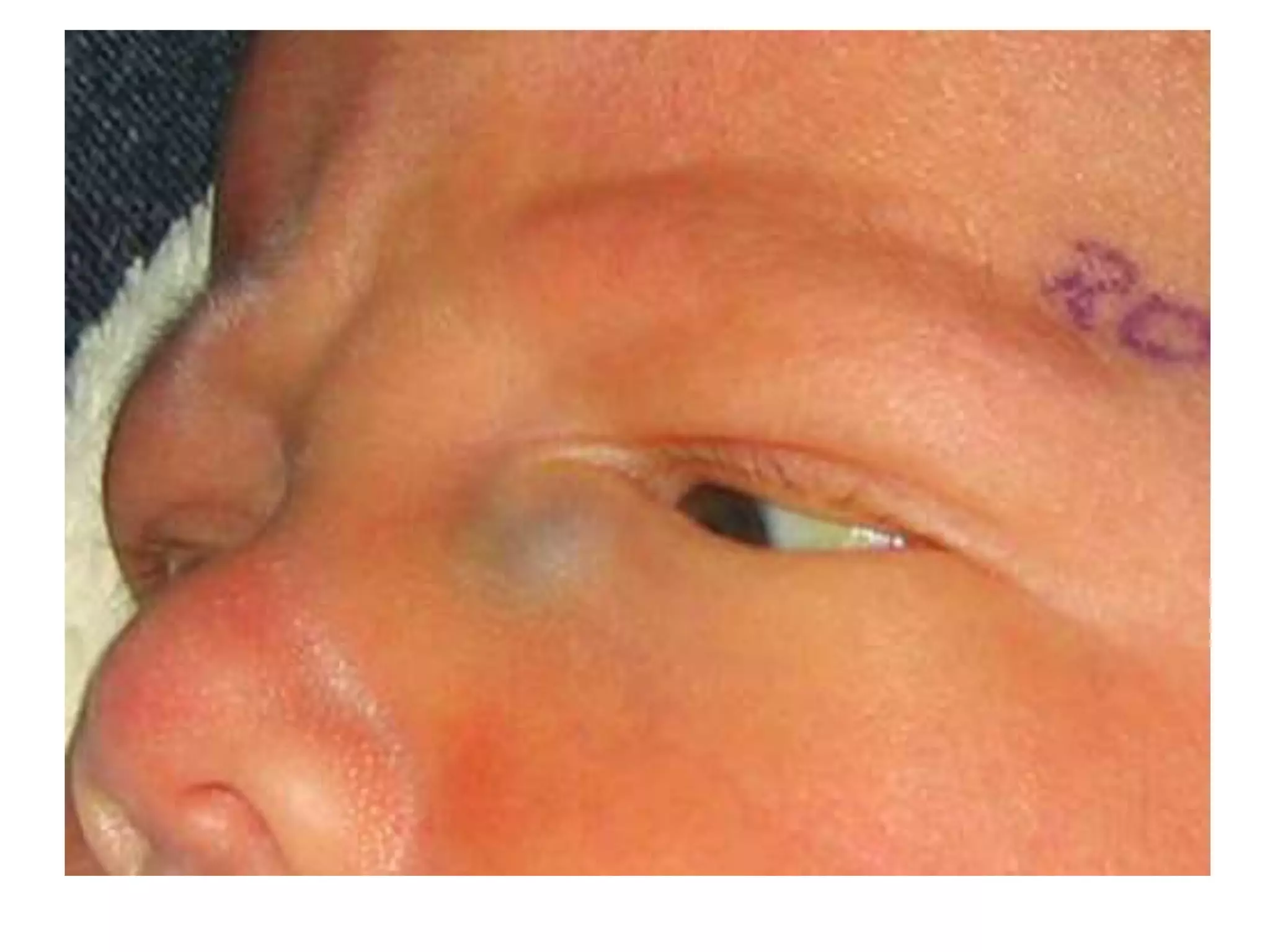
• Dacrocystocoele - congenital swelling located at
medial canthus d/t trapped fluid inside the lacrimal
sac & NLD. [tense, blue, non-pulsatile swelling
below the medial canthus seen at birth]
• DD-meningo encephalocoele
meningocoele
midline nasal dermoid cyst
capillary haemangioma.
• MRI scan -in excluding other pathology.
• usually made clinically.
• Rx-Observation for first 2 weeks of life- improve
spontaneously. If complication-Sx
CONGENITAL NASOLACRIMAL
DUCT OBSTRUCTION
• 20% of infants-epiphora during first month
• Spontaneous resolution is rapid during the first year
of life
• CNLDO - delay in maturation of the lacrimal drainage
system resulting in persistent membranous
obstruction or stenosis@ hasner’s valve.
• O/E-increased tear meniscus ,stickiness or crusting
on the lashes, mucocoele: contents can be expressed
into conjunctival sac. fluorescein disappearance test
(FDT) done for confirmation
• Rx- observation- at least 1 year old.
• Between 12 and 24 months -resolution is quicker with
probing.
• PROBING- step wise manner
nose is first prepared with vasoconstrictor solution
infracture of the inferior turbinate with a Freer elevator.
nasal endoscope(2.7 mm/3mm) is introduced into the
inferior meatus- itself is often therapeutic
fluorescein appearance is checked by syringing seen by
nasendoscope
then probe via upper canaliculus
• If atresia –membrane incised endoscpically
• Distal bony atresia- endoscopic DCR
(dacryocystorhinostomy)
• stenotic flow of fluorescene flush
through the valve of Hasner within the
inferior meatus of the right nasal
cavity.
• Older children/upper (proximal)NLD obstruction-
endoscopic DCR
• Endo probing adv- identified and treated at first probing
itself &increase success rate
• Other Rx-
Intubation of system with silicone tube
ballon catheter dilatation
Compliaction- cheese wiring in canaliculi
dislocation
infection
scarring
• DCR- persistent epiphora despite probing
bony atresia
acquired diseases by infection/trauma
CONGENITAL FISTULA/PUNCTAL &
CANALICULAR ABNORMALITIES
• Fistula –rare ,appear as double puncta, left
untreated unless epiphora develops
• Punctal stenosis/atresia – often asymptomatic
• Narrow puncta- dilated with ‘nettleship’
lacrimal dilator
• Membranous obstruction-pierced with needla
and dilated
ACQUIRED CONDITIONS OF THE
LACRIMAL DRAINAGE APPARATUS
• Acute dacryocystitis - common in infants with a
dacryocystocoele.Rx- prompt intervention with
intravenous antibiotics as retrobulbar abscesses may
occur. Cultures should be taken .
• Probing & Skin incisions should not be performed as
damage to the congested epithelium may cause false
passage formation and lead to orbital cellulitis and
fistula formation.
• Pyocele developed- evacuation performed through
the skin with a needle through the lower pole of the
sac or by urgent endonasal DCR if the pus is found to
be inspissated or loculated.
• Acquired NLD obstruction-
facia trauma
chronic allergic rhinitis
persistent URTI
Lacrimal disorders in children

Lacrimal disorders in children

  • 1.
    LACRIMAL DISORDERS IN CHILDREN CHAPTER25-VOLUME 2 SCOTT BROWN By Dr.S.YOGESHWARI
  • 2.
    LACRIMAL SYSTEM The lacrimalsystem - secretory portion & drainage system. • The secretory portion –lacrimal gland (reflex tearing ) and accessory lacrimal glands (basal tear secretion) together with the Meibomian glands and the goblet cells (secret components of the tear film). • The drainage system -lacrimal puncta, canaliculi, lacrimal sac nasolacrimal duct • This active system pumps tears from the conjunctival sac into the inferior meatus of nose.
  • 4.
    ANATOMY • Lacrimal gland-anterior aspect of the supratemporal orbit. • Ducts of the gland open Into the conjunctiva in the superior fornix. • lacrimal gland develops from ectoderm that is supported by embryonic skull cap mesoderm. • lacrimal gland grow up to 4 years. • The lacrimal outflow system from surface ectoderm
  • 5.
    • Lacrimalsac- sitsin the bony lacrimal fossa, separated from the middle meatus of the nose by the maxilla and lacrimal bone. • lacrimal sac extends superiorly under the medial canthal ligament as its fundus. • Nasolacrimal duct passes in downward, lateral and posterior direction. • NLD-surrounded by bone in its upper part but membranous inferiorly and opens into the medial wall of the inferior meatus of the nose through Hasner’s valve. • This can be located endoscopically in the inferior meatus approximately 1 cm posterior to the nasal spine.
  • 6.
    DRY EYES INCHILDREN present with irritable, gritty eyes,diffusely injected, punctate keratopathy, Staining occurs with fluorescein dye. • Congenital alacrima,. • Alacrima - Allgrove syndrome(familial alacrima, achalasia cardia , glucocorticoid deficiency) Anhydrotic ectodermal dysplasia Riley–Day syndrome (familial dysautonomia), • Acquired tear insufficiency -Epstein–Barr infection(HIV infection)(bonemarrow transplantation) . • Children with Sjogren’s syndrome often have lacrimal gland involvement, and they may have recurrent parotid gland swelling salivary gland involvement.(recurrent parotitis, keratoconjunctivitis sicca, and early tooth decay due to xerostomia)
  • 7.
    LACRIMAL TUMOURS& GRANULOMAS •Orbital‘pseudotumour’ (now idiopathic orbital inflammatory disease)- painful swelling-responds to steroids • Malignant epithelial tumours including mixed-cell adenocystic • Lacrimal gland enlargement –sarcoidosis &leukaemia. • Dacrocystocoele - congenital swelling located at medial canthus d/t trapped fluid inside the lacrimal sac & NLD. [tense, blue, non-pulsatile swelling below the medial canthus seen at birth]
  • 9.
    • DD-meningo encephalocoele meningocoele midlinenasal dermoid cyst capillary haemangioma. • MRI scan -in excluding other pathology. • usually made clinically. • Rx-Observation for first 2 weeks of life- improve spontaneously. If complication-Sx
  • 10.
    CONGENITAL NASOLACRIMAL DUCT OBSTRUCTION •20% of infants-epiphora during first month • Spontaneous resolution is rapid during the first year of life • CNLDO - delay in maturation of the lacrimal drainage system resulting in persistent membranous obstruction or stenosis@ hasner’s valve. • O/E-increased tear meniscus ,stickiness or crusting on the lashes, mucocoele: contents can be expressed into conjunctival sac. fluorescein disappearance test (FDT) done for confirmation
  • 11.
    • Rx- observation-at least 1 year old. • Between 12 and 24 months -resolution is quicker with probing. • PROBING- step wise manner nose is first prepared with vasoconstrictor solution infracture of the inferior turbinate with a Freer elevator. nasal endoscope(2.7 mm/3mm) is introduced into the inferior meatus- itself is often therapeutic fluorescein appearance is checked by syringing seen by nasendoscope then probe via upper canaliculus • If atresia –membrane incised endoscpically • Distal bony atresia- endoscopic DCR (dacryocystorhinostomy)
  • 12.
    • stenotic flowof fluorescene flush through the valve of Hasner within the inferior meatus of the right nasal cavity.
  • 13.
    • Older children/upper(proximal)NLD obstruction- endoscopic DCR • Endo probing adv- identified and treated at first probing itself &increase success rate • Other Rx- Intubation of system with silicone tube ballon catheter dilatation Compliaction- cheese wiring in canaliculi dislocation infection scarring • DCR- persistent epiphora despite probing bony atresia acquired diseases by infection/trauma
  • 14.
    CONGENITAL FISTULA/PUNCTAL & CANALICULARABNORMALITIES • Fistula –rare ,appear as double puncta, left untreated unless epiphora develops • Punctal stenosis/atresia – often asymptomatic • Narrow puncta- dilated with ‘nettleship’ lacrimal dilator • Membranous obstruction-pierced with needla and dilated
  • 15.
    ACQUIRED CONDITIONS OFTHE LACRIMAL DRAINAGE APPARATUS • Acute dacryocystitis - common in infants with a dacryocystocoele.Rx- prompt intervention with intravenous antibiotics as retrobulbar abscesses may occur. Cultures should be taken . • Probing & Skin incisions should not be performed as damage to the congested epithelium may cause false passage formation and lead to orbital cellulitis and fistula formation. • Pyocele developed- evacuation performed through the skin with a needle through the lower pole of the sac or by urgent endonasal DCR if the pus is found to be inspissated or loculated.
  • 16.
    • Acquired NLDobstruction- facia trauma chronic allergic rhinitis persistent URTI