Experiment No.: 11 Date:
VANE SHEAR TEST
Object and scope:
To determine the un-drained shear strength of soft cohesive soil in remolded condition.
Reference:
IS: 2720 (Part -30) 1968
Theory:
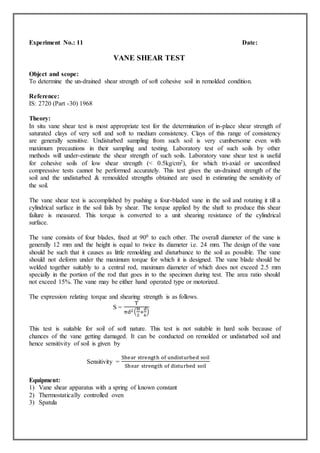
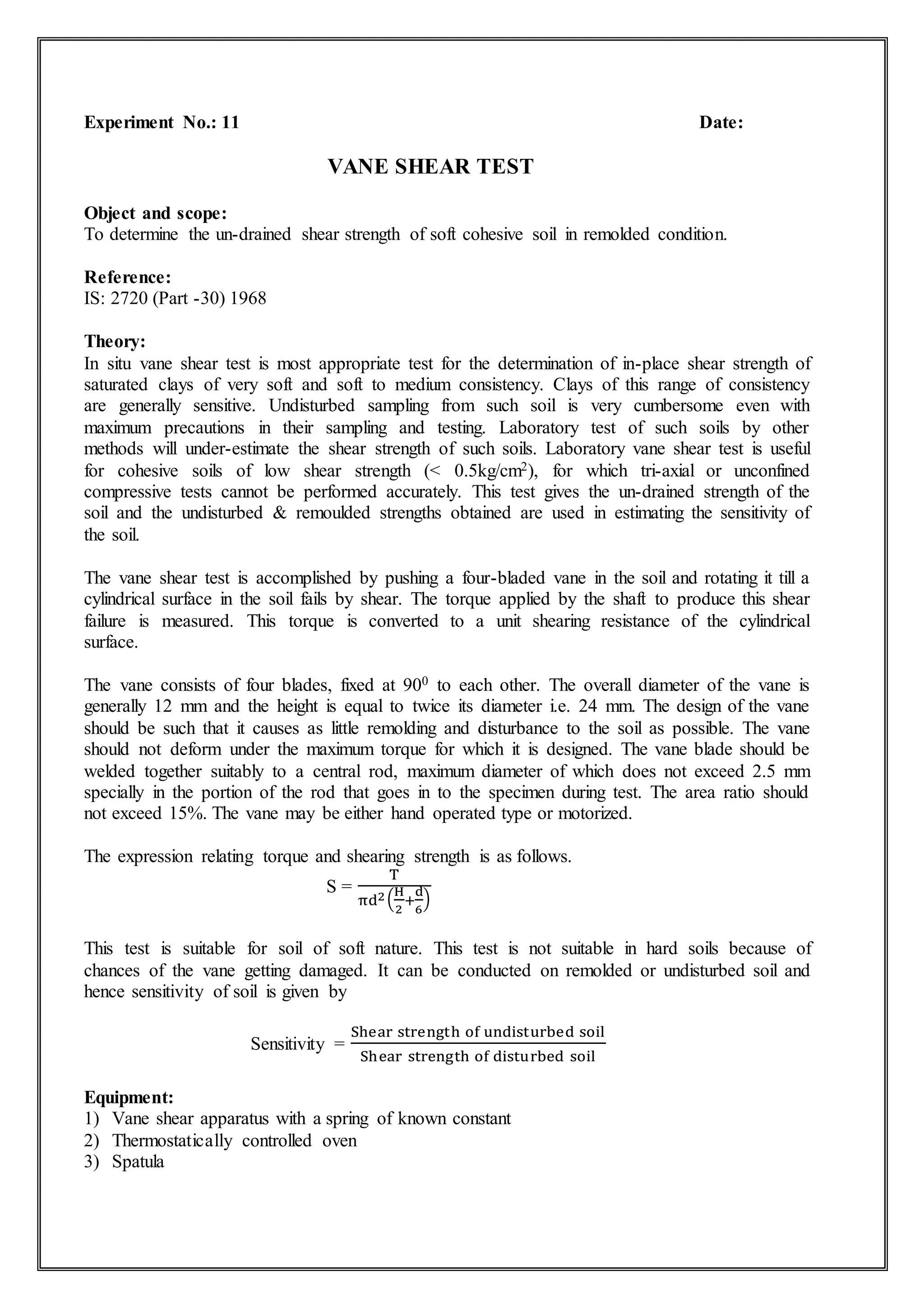
In situ vane shear test is most appropriate test for the determination of in-place shear strength of
saturated clays of very soft and soft to medium consistency. Clays of this range of consistency
are generally sensitive. Undisturbed sampling from such soil is very cumbersome even with
maximum precautions in their sampling and testing. Laboratory test of such soils by other
methods will under-estimate the shear strength of such soils. Laboratory vane shear test is useful
for cohesive soils of low shear strength (< 0.5kg/cm2), for which tri-axial or unconfined
compressive tests cannot be performed accurately. This test gives the un-drained strength of the
soil and the undisturbed & remoulded strengths obtained are used in estimating the sensitivity of
the soil.
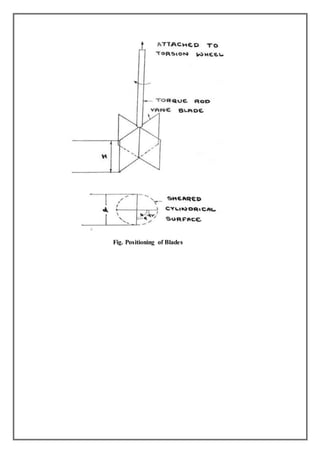
The vane shear test is accomplished by pushing a four-bladed vane in the soil and rotating it till a
cylindrical surface in the soil fails by shear. The torque applied by the shaft to produce this shear
failure is measured. This torque is converted to a unit shearing resistance of the cylindrical
surface.
The vane consists of four blades, fixed at 900 to each other. The overall diameter of the vane is
generally 12 mm and the height is equal to twice its diameter i.e. 24 mm. The design of the vane
should be such that it causes as little remolding and disturbance to the soil as possible. The vane
should not deform under the maximum torque for which it is designed. The vane blade should be
welded together suitably to a central rod, maximum diameter of which does not exceed 2.5 mm
specially in the portion of the rod that goes in to the specimen during test. The area ratio should
not exceed 15%. The vane may be either hand operated type or motorized.
The expression relating torque and shearing strength is as follows.
S =
T
πd2(
H
2
+
d
6
)
This test is suitable for soil of soft nature. This test is not suitable in hard soils because of
chances of the vane getting damaged. It can be conducted on remolded or undisturbed soil and
hence sensitivity of soil is given by
Sensitivity =
Shear strength of undisturbed soil
Shear strength of disturbed soil
Equipment:
1) Vane shear apparatus with a spring of known constant
2) Thermostatically controlled oven
3) Spatula
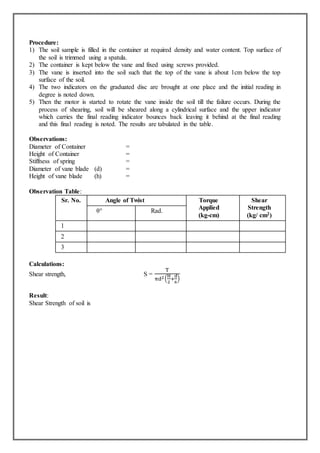
Procedure:
1) The soil sample is filled in the container at required density and water content. Top surface of
the soil is trimmed using a spatula.
2) The container is kept below the vane and fixed using screws provided.
3) The vane is inserted into the soil such that the top of the vane is about 1cm below the top
surface of the soil.
4) The two indicators on the graduated disc are brought at one place and the initial reading in
degree is noted down.
5) Then the motor is started to rotate the vane inside the soil till the failure occurs. During the
process of shearing, soil will be sheared along a cylindrical surface and the upper indicator
which carries the final reading indicator bounces back leaving it behind at the final reading
and this final reading is noted. The results are tabulated in the table.
Observations:
Diameter of Container =
Height of Container =
Stiffness of spring =
Diameter of vane blade (d) =
Height of vane blade (h) =
Observation Table:
Sr. No. Angle of Twist Torque
Applied
(kg-cm)
Shear
Strength
(kg/ cm2)
θ° Rad.
1
2
3
Calculations:
Shear strength, S =
T
πd2(
H
2
+
d
6
)
Result:
Shear Strength of soil is
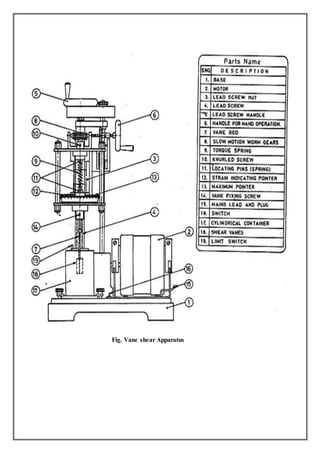
Fig. Vane shear Apparatus
Fig. Positioning of Blades

Ex 11 vane shear test

  • 1.
    Experiment No.: 11Date: VANE SHEAR TEST Object and scope: To determine the un-drained shear strength of soft cohesive soil in remolded condition. Reference: IS: 2720 (Part -30) 1968 Theory: In situ vane shear test is most appropriate test for the determination of in-place shear strength of saturated clays of very soft and soft to medium consistency. Clays of this range of consistency are generally sensitive. Undisturbed sampling from such soil is very cumbersome even with maximum precautions in their sampling and testing. Laboratory test of such soils by other methods will under-estimate the shear strength of such soils. Laboratory vane shear test is useful for cohesive soils of low shear strength (< 0.5kg/cm2), for which tri-axial or unconfined compressive tests cannot be performed accurately. This test gives the un-drained strength of the soil and the undisturbed & remoulded strengths obtained are used in estimating the sensitivity of the soil. The vane shear test is accomplished by pushing a four-bladed vane in the soil and rotating it till a cylindrical surface in the soil fails by shear. The torque applied by the shaft to produce this shear failure is measured. This torque is converted to a unit shearing resistance of the cylindrical surface. The vane consists of four blades, fixed at 900 to each other. The overall diameter of the vane is generally 12 mm and the height is equal to twice its diameter i.e. 24 mm. The design of the vane should be such that it causes as little remolding and disturbance to the soil as possible. The vane should not deform under the maximum torque for which it is designed. The vane blade should be welded together suitably to a central rod, maximum diameter of which does not exceed 2.5 mm specially in the portion of the rod that goes in to the specimen during test. The area ratio should not exceed 15%. The vane may be either hand operated type or motorized. The expression relating torque and shearing strength is as follows. S = T πd2( H 2 + d 6 ) This test is suitable for soil of soft nature. This test is not suitable in hard soils because of chances of the vane getting damaged. It can be conducted on remolded or undisturbed soil and hence sensitivity of soil is given by Sensitivity = Shear strength of undisturbed soil Shear strength of disturbed soil Equipment: 1) Vane shear apparatus with a spring of known constant 2) Thermostatically controlled oven 3) Spatula
  • 2.
    Procedure: 1) The soilsample is filled in the container at required density and water content. Top surface of the soil is trimmed using a spatula. 2) The container is kept below the vane and fixed using screws provided. 3) The vane is inserted into the soil such that the top of the vane is about 1cm below the top surface of the soil. 4) The two indicators on the graduated disc are brought at one place and the initial reading in degree is noted down. 5) Then the motor is started to rotate the vane inside the soil till the failure occurs. During the process of shearing, soil will be sheared along a cylindrical surface and the upper indicator which carries the final reading indicator bounces back leaving it behind at the final reading and this final reading is noted. The results are tabulated in the table. Observations: Diameter of Container = Height of Container = Stiffness of spring = Diameter of vane blade (d) = Height of vane blade (h) = Observation Table: Sr. No. Angle of Twist Torque Applied (kg-cm) Shear Strength (kg/ cm2) θ° Rad. 1 2 3 Calculations: Shear strength, S = T πd2( H 2 + d 6 ) Result: Shear Strength of soil is
  • 3.
    Fig. Vane shearApparatus
  • 4.