Tri-axial
test
content
no

title

page

1

objective

3

2

theory

4-6

3

Equipment

7

4

Procedure

8-9

-PREPARERATION OF SAMPLE

5

Data and analysis

10-13

6

discussion

14

7

conclusion

15

8

reference

16
Objective:
Student should be able to
Measure the shear strength parameters using the
tri-axial test.
Theory
When conducting site investigations for buildings, in
most circumstances short term stability will be the most
critical. Therefore this document will deal only with the
determination of total shear strength parameters of
cohesive soils using, Unconsolidated Undrained Tests.
There may be instances where effective shear strength
parameters are required, and they would require other
forms of tests such as Consolidated Undrained or
Drained. Determination of those parameters will be
dealt with in the proposed Sri Lankan standard on
laboratory testing of soils.
Specimens used for the test are of cylindrical shape and
should be undisturbed. Specimen is subjected to a
confining fluid pressure in a tri-axial chamber and axial
load (deviator load) is applied in a strain controlled or
stress controlled manner. In all stages of the test
untrained conditions are maintained without allowing
for any pore water pressure dissipation. Method does
not generally measure pore water pressures and
parameters determined are therefore in terms of total
stresses.
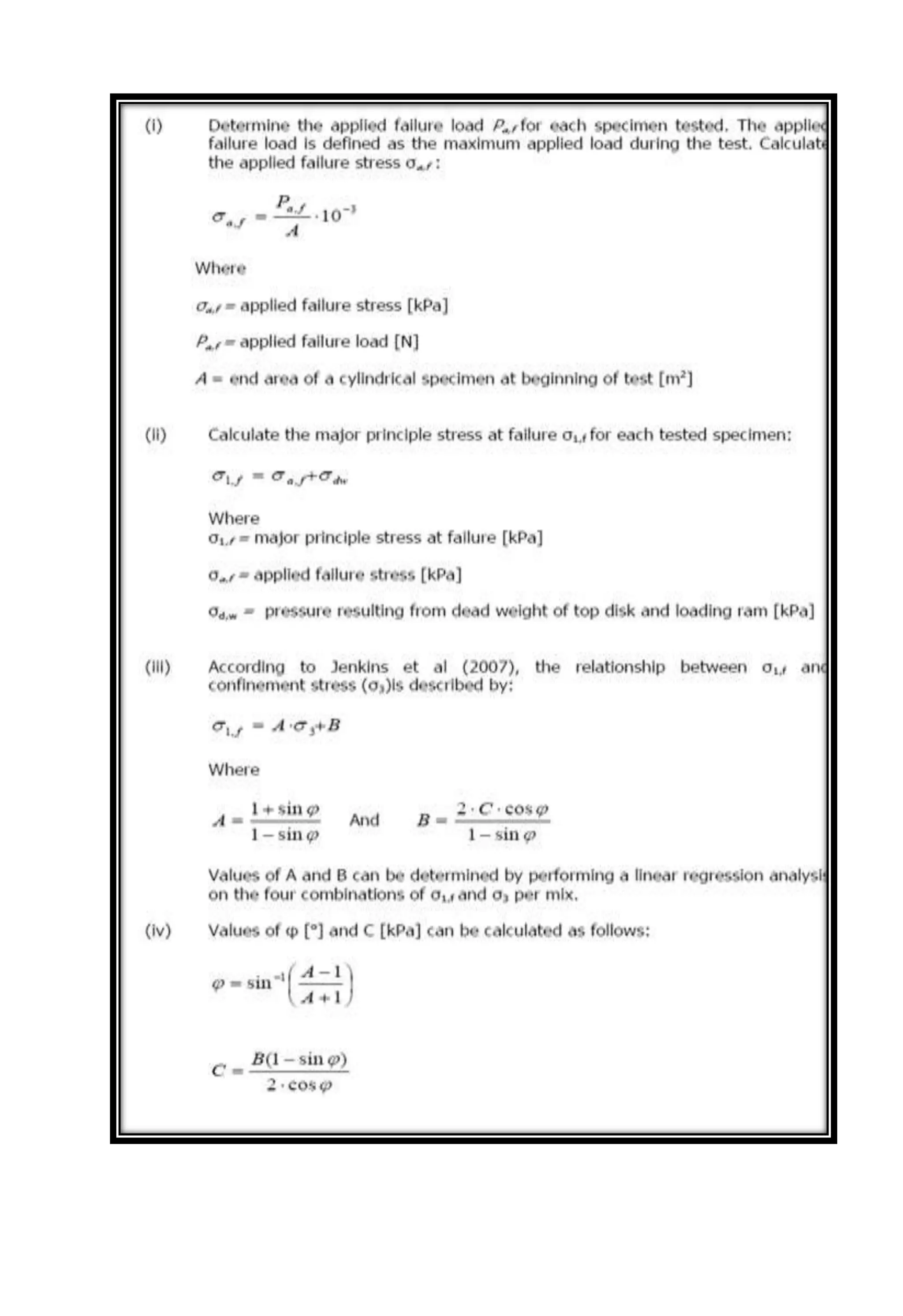
Determine the applied failure load Pa,f for each
specimen tested. The applied failure load is defined as
the maximum applied load during the test. Calculate the
applied failure stress σa,f :
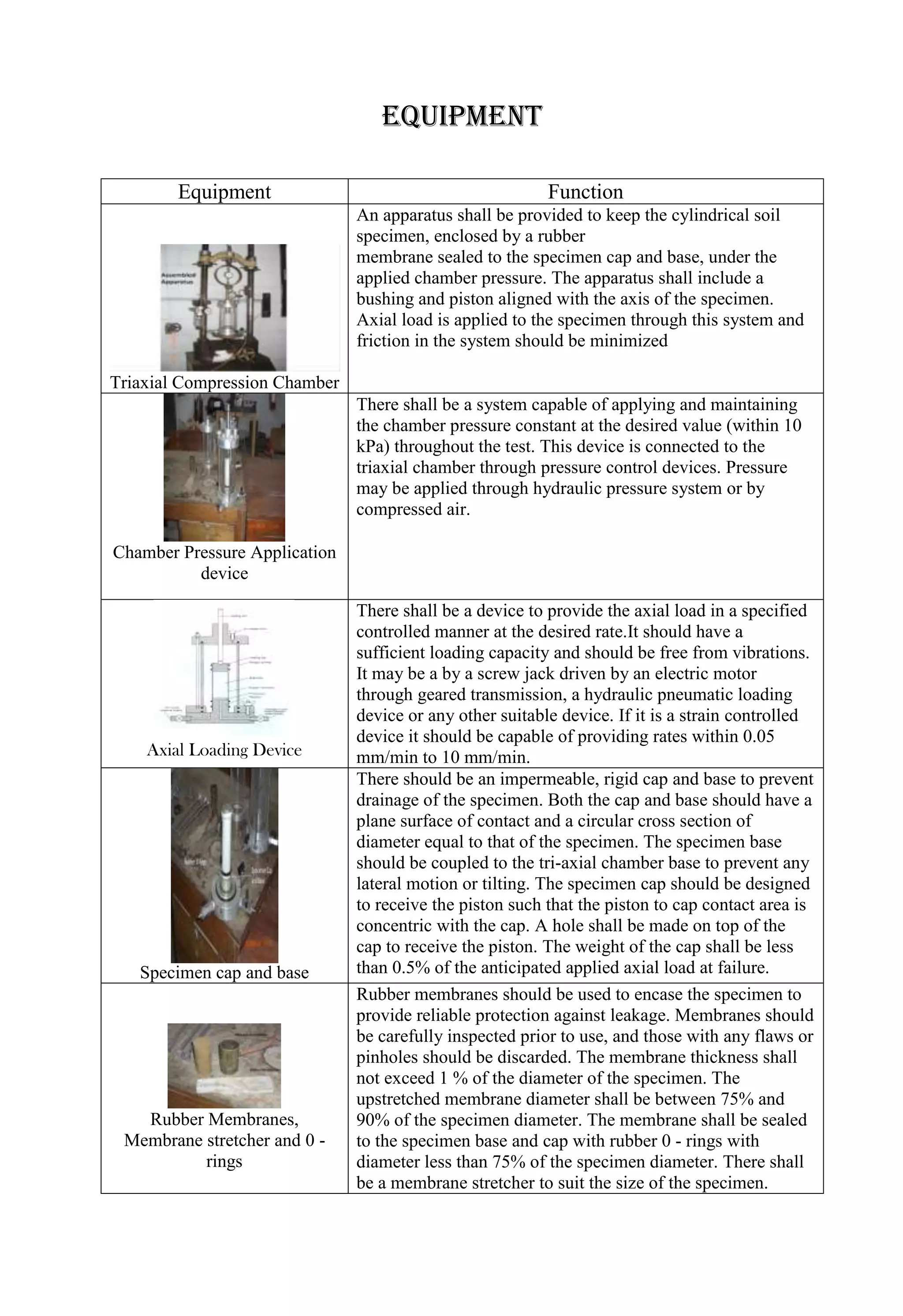
equipment
Equipment

Function
An apparatus shall be provided to keep the cylindrical soil
specimen, enclosed by a rubber
membrane sealed to the specimen cap and base, under the
applied chamber pressure. The apparatus shall include a
bushing and piston aligned with the axis of the specimen.
Axial load is applied to the specimen through this system and
friction in the system should be minimized

Triaxial Compression Chamber
There shall be a system capable of applying and maintaining
the chamber pressure constant at the desired value (within 10
kPa) throughout the test. This device is connected to the
triaxial chamber through pressure control devices. Pressure
may be applied through hydraulic pressure system or by
compressed air.
Chamber Pressure Application
device

Axial Loading Device

Specimen cap and base

Rubber Membranes,
Membrane stretcher and 0 rings

There shall be a device to provide the axial load in a specified
controlled manner at the desired rate.It should have a
sufficient loading capacity and should be free from vibrations.
It may be a by a screw jack driven by an electric motor
through geared transmission, a hydraulic pneumatic loading
device or any other suitable device. If it is a strain controlled
device it should be capable of providing rates within 0.05
mm/min to 10 mm/min.
There should be an impermeable, rigid cap and base to prevent
drainage of the specimen. Both the cap and base should have a
plane surface of contact and a circular cross section of
diameter equal to that of the specimen. The specimen base
should be coupled to the tri-axial chamber base to prevent any
lateral motion or tilting. The specimen cap should be designed
to receive the piston such that the piston to cap contact area is
concentric with the cap. A hole shall be made on top of the
cap to receive the piston. The weight of the cap shall be less
than 0.5% of the anticipated applied axial load at failure.
Rubber membranes should be used to encase the specimen to
provide reliable protection against leakage. Membranes should
be carefully inspected prior to use, and those with any flaws or
pinholes should be discarded. The membrane thickness shall
not exceed 1 % of the diameter of the specimen. The
upstretched membrane diameter shall be between 75% and
90% of the specimen diameter. The membrane shall be sealed
to the specimen base and cap with rubber 0 - rings with
diameter less than 75% of the specimen diameter. There shall
be a membrane stretcher to suit the size of the specimen.
procedures:
Preparation of the Sample
Specimens used for the test shall be undisturbed. They should
be of a minimum diameter 33 mm and a have a length/diameter
ratio between 2 and 3. Specimen should be weighed to the
nearest 0.01 g prior to the testing.Specimens should be handled
very carefully to minimize disturbance, change cross section or
loss of moisture. Specimens shall be uniform circular cross
section with ends perpendicular to the axis of the specimen. If
excessive irregularities are present at the ends due to crumbling,
crushing or pebbles, ends may be packed with soil from the
trimmings to produce the desired surface. Weight of the
specimen should be determined and encased by the membrane
and sealed to the specimen base and cap immediately after the
preparation, with the help of 0 rings.
Procedure of Testing
Tri-axial chamber shall be assembled with the specimen
encased in rubber membrane, and sealed to the specimen cap
and base and kept in position. Axial load piston should be
brought to contact with the specimen cap and proper seating
should be provided. When dealing with soft soils special care
must be taken not to overload the specimen with the weight of
the piston. Chamber shall be filled with the confining fluid
(usually water) and placed in position in the axial loading
device. Special care should be taken in aligning the axial load
device, the axial load measuring device and the tri-axial
chamber to prevent application of lateral force to the
pistonduring testing.
Thereafter the chamber pressure maintaining and measuring
device shall be attached and adjusted to provide the desired
chamber pressure.
Axial load measuring device is usually located outside the triaxial chamber and chamber pressure will produce an upward
force on the piston that will react against the axial loading
device. In this case axial load measuring device should be
adjusted to read zero prior to the application of the deviator
load.
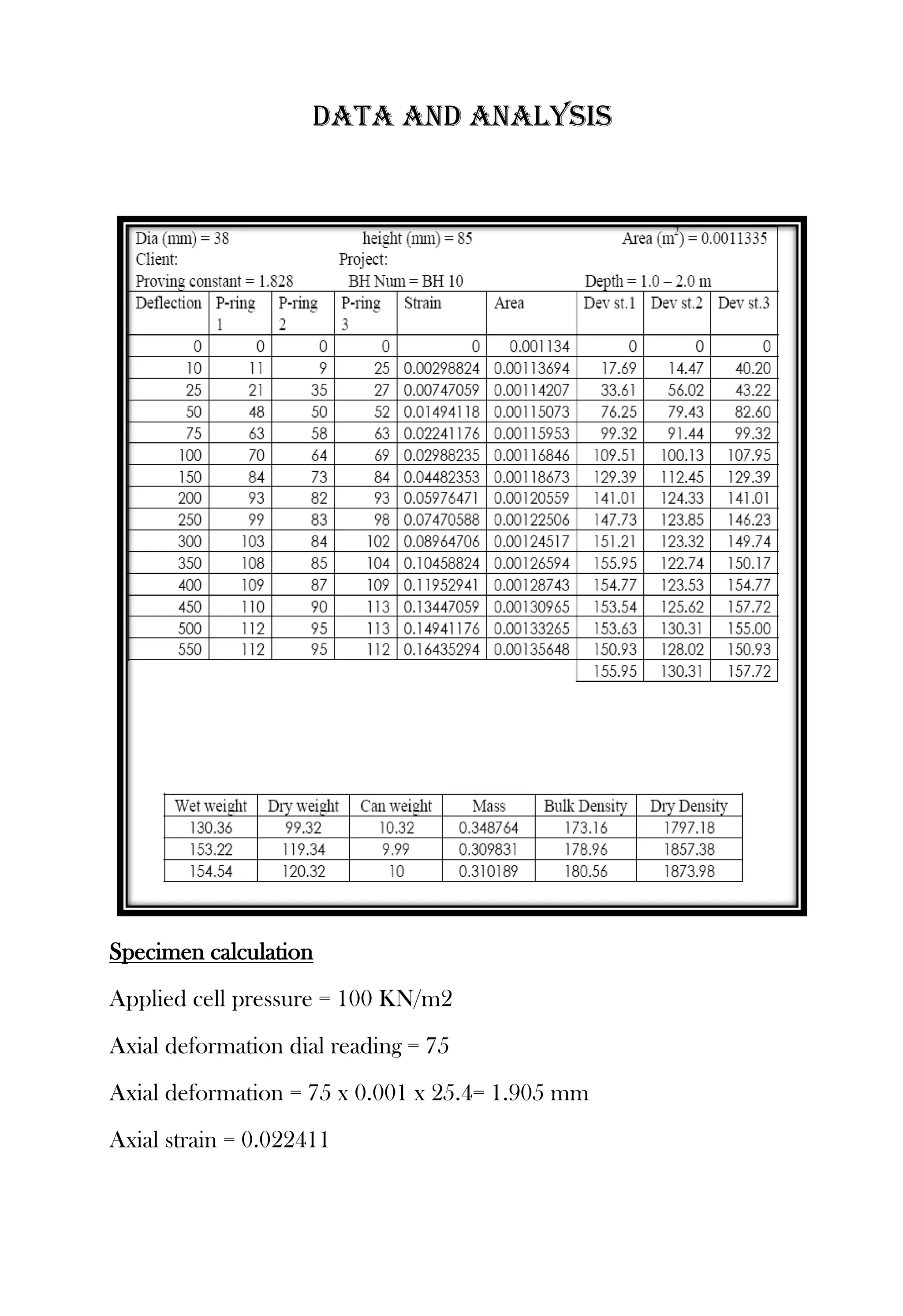
Data and analysis

Specimen calculation
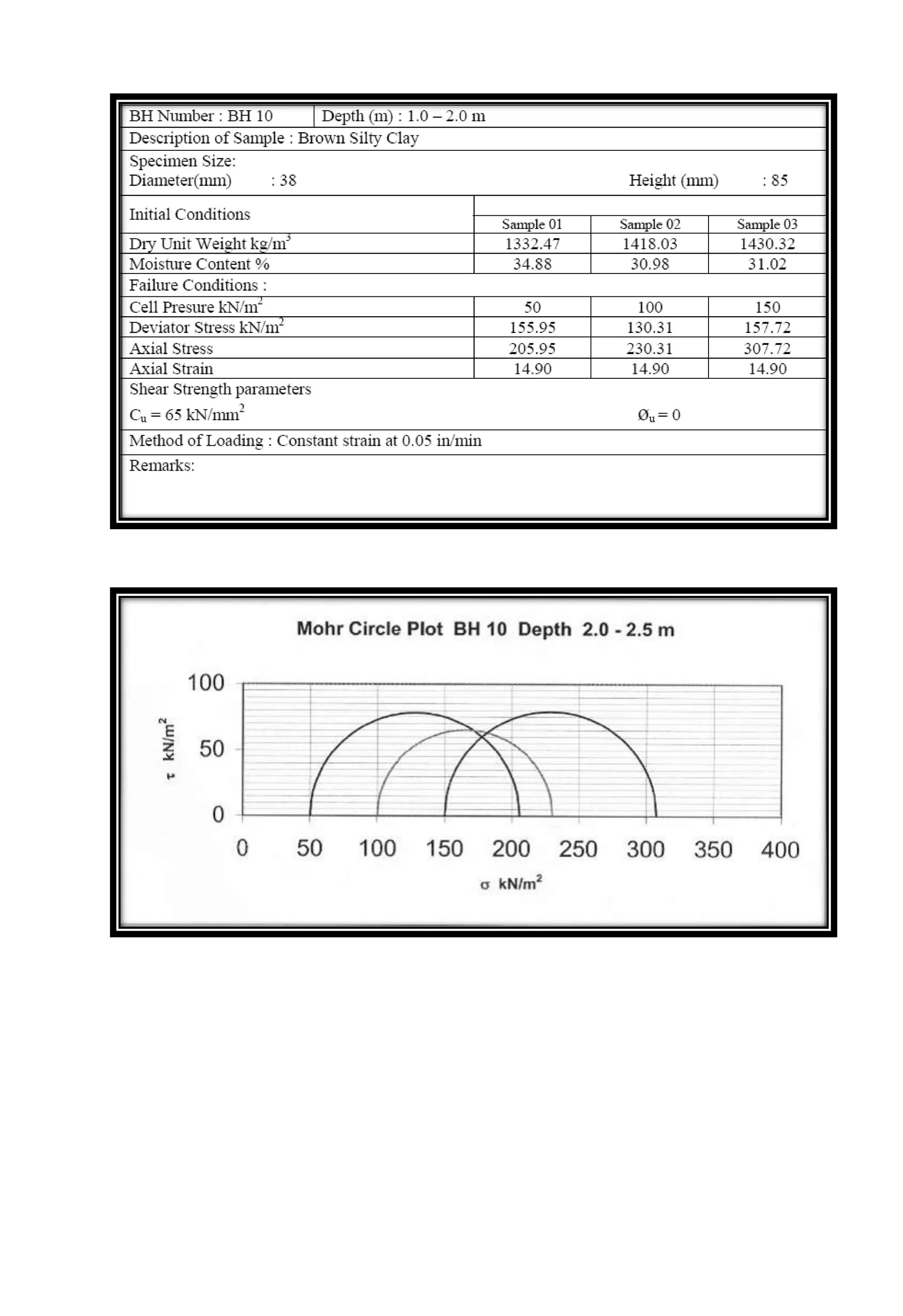
Applied cell pressure = 100 KN/m2
Axial deformation dial reading = 75
Axial deformation = 75 x 0.001 x 25.4= 1.905 mm
Axial strain = 0.022411
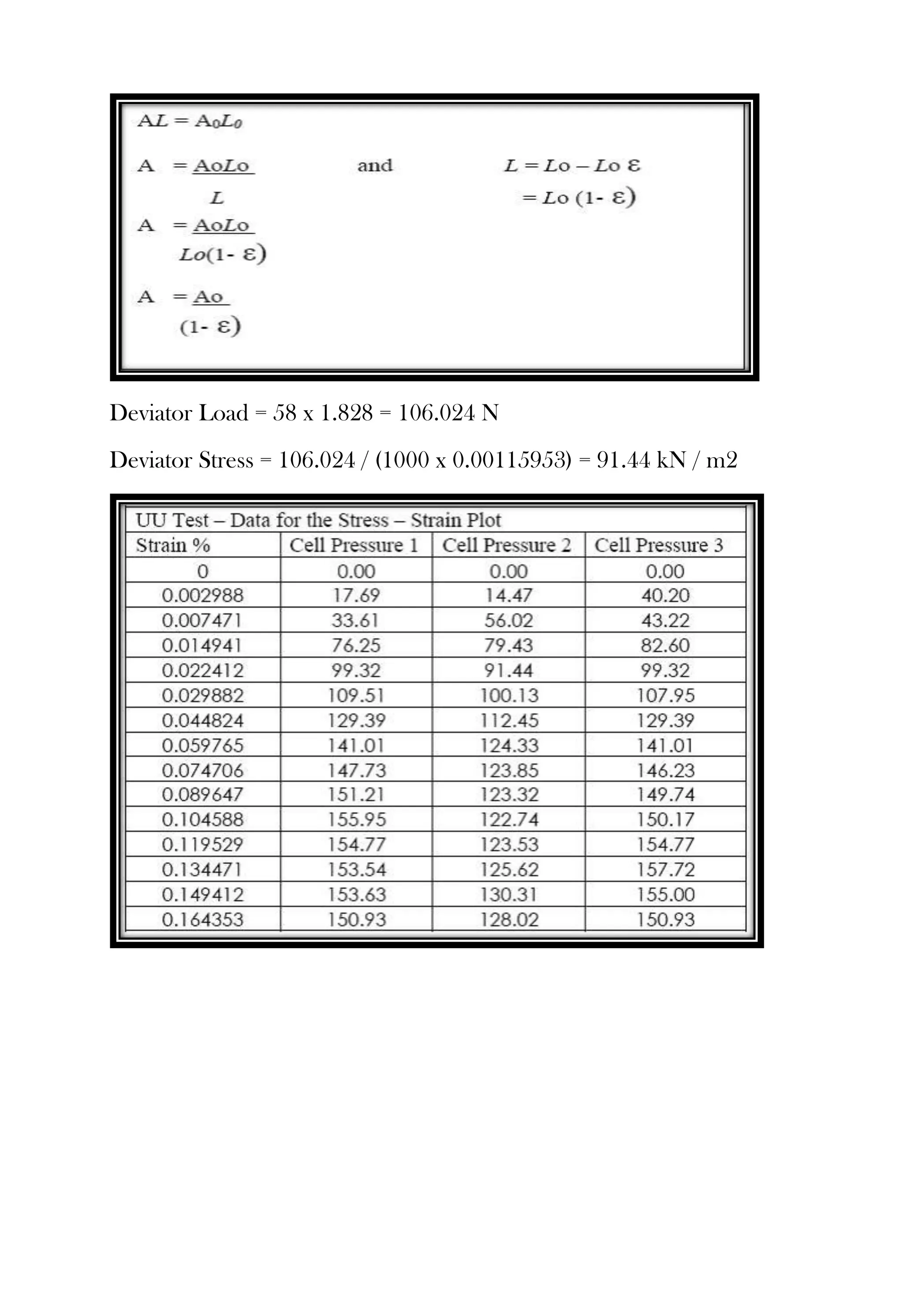
Deviator Load = 58 x 1.828 = 106.024 N
Deviator Stress = 106.024 / (1000 x 0.00115953) = 91.44 kN / m2
Discussion
 We were supposed to test three samples, but because of obstacles we faced
such as broken membrane, we could only do one sample.
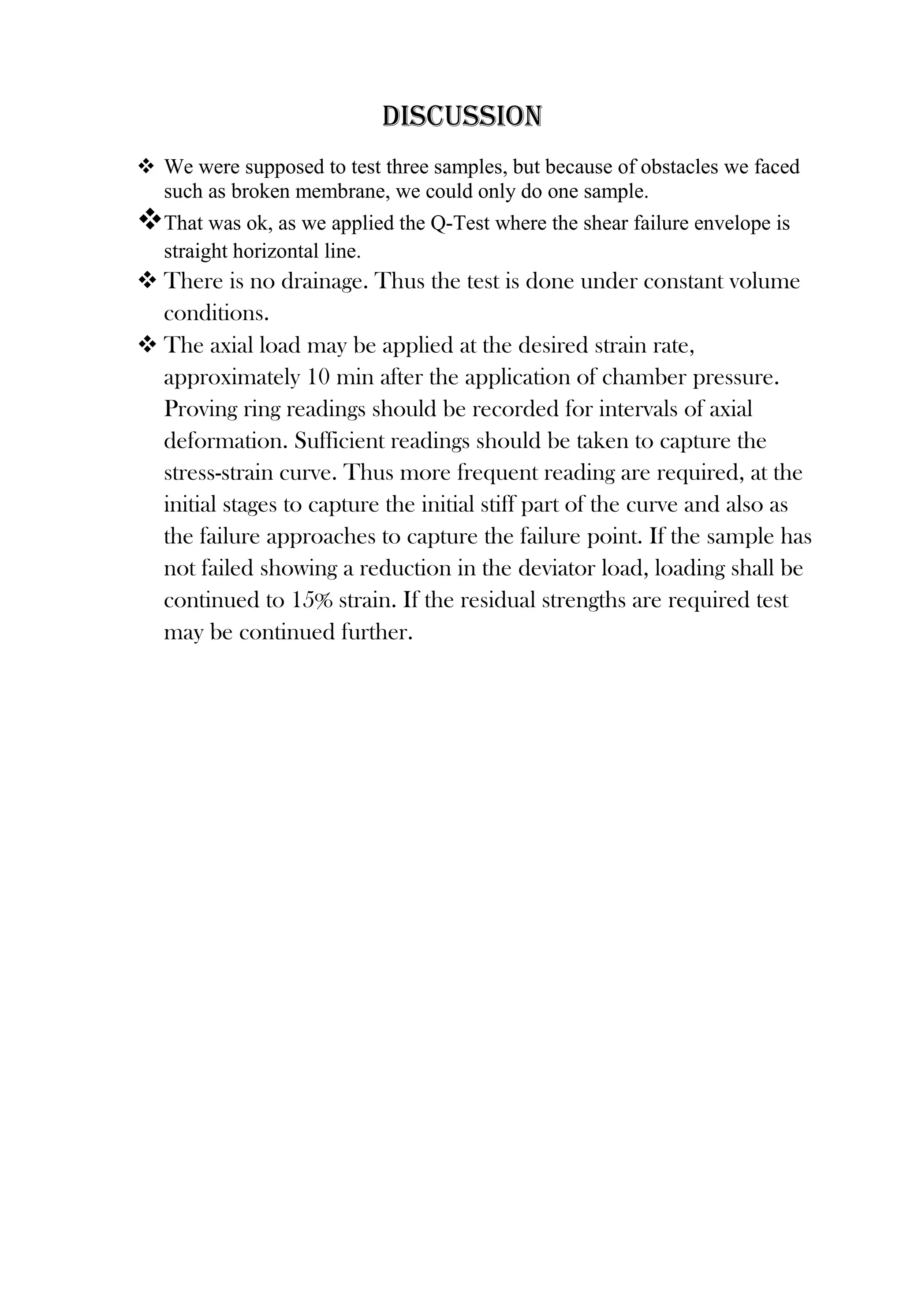
That was ok, as we applied the Q-Test where the shear failure envelope is
straight horizontal line.

 There is no drainage. Thus the test is done under constant volume
conditions.
 The axial load may be applied at the desired strain rate,
approximately 10 min after the application of chamber pressure.
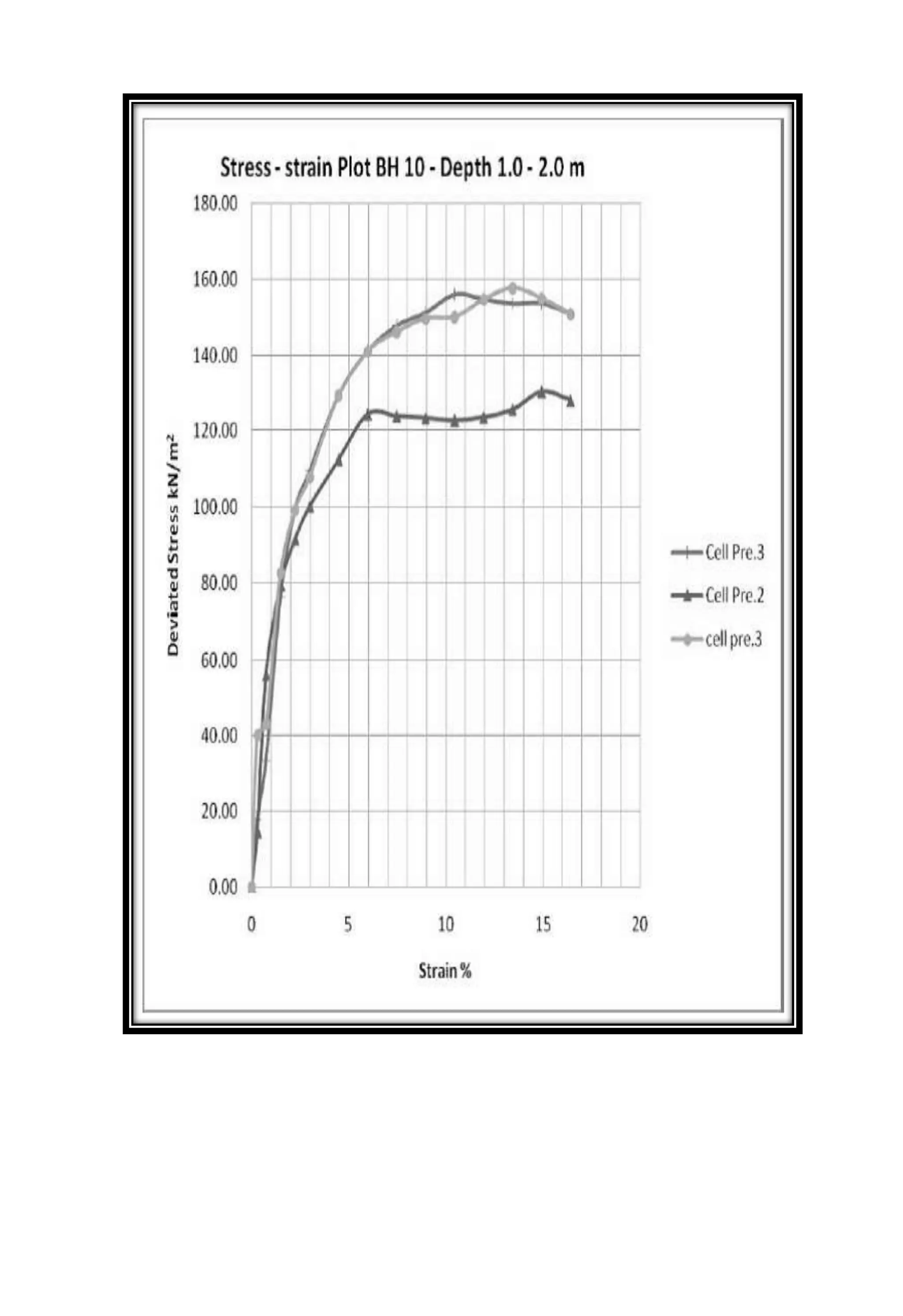
Proving ring readings should be recorded for intervals of axial
deformation. Sufficient readings should be taken to capture the
stress-strain curve. Thus more frequent reading are required, at the
initial stages to capture the initial stiff part of the curve and also as
the failure approaches to capture the failure point. If the sample has
not failed showing a reduction in the deviator load, loading shall be
continued to 15% strain. If the residual strengths are required test
may be continued further.
Conclusion

At the end of the test specimen shall be taken out, failure
patterns may be noted and moisture contentof the sample
should be determined. Test should be performed on at
least two other identical samples at different chamber
pressures to construct the failure envelope and to
determine the shear strength parameters
reference
1. Norliza Muhammad, mechanic laboratory,(2006). Gradation Test. (2007),
Norliza Muhammad, FajarBaktiSdn. Bhd.
2. M.S. Mamlouk and J.P. Zaniewski, mechanic of structur Engineers, 1999,
Addison-Wesley, Menlo Park CA

Tri axial test

  • 1.
  • 2.
  • 3.
    Objective: Student should beable to Measure the shear strength parameters using the tri-axial test.
  • 4.
    Theory When conducting siteinvestigations for buildings, in most circumstances short term stability will be the most critical. Therefore this document will deal only with the determination of total shear strength parameters of cohesive soils using, Unconsolidated Undrained Tests. There may be instances where effective shear strength parameters are required, and they would require other forms of tests such as Consolidated Undrained or Drained. Determination of those parameters will be dealt with in the proposed Sri Lankan standard on laboratory testing of soils. Specimens used for the test are of cylindrical shape and should be undisturbed. Specimen is subjected to a confining fluid pressure in a tri-axial chamber and axial load (deviator load) is applied in a strain controlled or stress controlled manner. In all stages of the test untrained conditions are maintained without allowing for any pore water pressure dissipation. Method does not generally measure pore water pressures and parameters determined are therefore in terms of total stresses.
  • 5.
    Determine the appliedfailure load Pa,f for each specimen tested. The applied failure load is defined as the maximum applied load during the test. Calculate the applied failure stress σa,f :
  • 7.
    equipment Equipment Function An apparatus shallbe provided to keep the cylindrical soil specimen, enclosed by a rubber membrane sealed to the specimen cap and base, under the applied chamber pressure. The apparatus shall include a bushing and piston aligned with the axis of the specimen. Axial load is applied to the specimen through this system and friction in the system should be minimized Triaxial Compression Chamber There shall be a system capable of applying and maintaining the chamber pressure constant at the desired value (within 10 kPa) throughout the test. This device is connected to the triaxial chamber through pressure control devices. Pressure may be applied through hydraulic pressure system or by compressed air. Chamber Pressure Application device Axial Loading Device Specimen cap and base Rubber Membranes, Membrane stretcher and 0 rings There shall be a device to provide the axial load in a specified controlled manner at the desired rate.It should have a sufficient loading capacity and should be free from vibrations. It may be a by a screw jack driven by an electric motor through geared transmission, a hydraulic pneumatic loading device or any other suitable device. If it is a strain controlled device it should be capable of providing rates within 0.05 mm/min to 10 mm/min. There should be an impermeable, rigid cap and base to prevent drainage of the specimen. Both the cap and base should have a plane surface of contact and a circular cross section of diameter equal to that of the specimen. The specimen base should be coupled to the tri-axial chamber base to prevent any lateral motion or tilting. The specimen cap should be designed to receive the piston such that the piston to cap contact area is concentric with the cap. A hole shall be made on top of the cap to receive the piston. The weight of the cap shall be less than 0.5% of the anticipated applied axial load at failure. Rubber membranes should be used to encase the specimen to provide reliable protection against leakage. Membranes should be carefully inspected prior to use, and those with any flaws or pinholes should be discarded. The membrane thickness shall not exceed 1 % of the diameter of the specimen. The upstretched membrane diameter shall be between 75% and 90% of the specimen diameter. The membrane shall be sealed to the specimen base and cap with rubber 0 - rings with diameter less than 75% of the specimen diameter. There shall be a membrane stretcher to suit the size of the specimen.
  • 8.
    procedures: Preparation of theSample Specimens used for the test shall be undisturbed. They should be of a minimum diameter 33 mm and a have a length/diameter ratio between 2 and 3. Specimen should be weighed to the nearest 0.01 g prior to the testing.Specimens should be handled very carefully to minimize disturbance, change cross section or loss of moisture. Specimens shall be uniform circular cross section with ends perpendicular to the axis of the specimen. If excessive irregularities are present at the ends due to crumbling, crushing or pebbles, ends may be packed with soil from the trimmings to produce the desired surface. Weight of the specimen should be determined and encased by the membrane and sealed to the specimen base and cap immediately after the preparation, with the help of 0 rings.
  • 9.
    Procedure of Testing Tri-axialchamber shall be assembled with the specimen encased in rubber membrane, and sealed to the specimen cap and base and kept in position. Axial load piston should be brought to contact with the specimen cap and proper seating should be provided. When dealing with soft soils special care must be taken not to overload the specimen with the weight of the piston. Chamber shall be filled with the confining fluid (usually water) and placed in position in the axial loading device. Special care should be taken in aligning the axial load device, the axial load measuring device and the tri-axial chamber to prevent application of lateral force to the pistonduring testing. Thereafter the chamber pressure maintaining and measuring device shall be attached and adjusted to provide the desired chamber pressure. Axial load measuring device is usually located outside the triaxial chamber and chamber pressure will produce an upward force on the piston that will react against the axial loading device. In this case axial load measuring device should be adjusted to read zero prior to the application of the deviator load.
  • 10.
    Data and analysis Specimencalculation Applied cell pressure = 100 KN/m2 Axial deformation dial reading = 75 Axial deformation = 75 x 0.001 x 25.4= 1.905 mm Axial strain = 0.022411
  • 11.
    Deviator Load =58 x 1.828 = 106.024 N Deviator Stress = 106.024 / (1000 x 0.00115953) = 91.44 kN / m2
  • 14.
    Discussion  We weresupposed to test three samples, but because of obstacles we faced such as broken membrane, we could only do one sample. That was ok, as we applied the Q-Test where the shear failure envelope is straight horizontal line.  There is no drainage. Thus the test is done under constant volume conditions.  The axial load may be applied at the desired strain rate, approximately 10 min after the application of chamber pressure. Proving ring readings should be recorded for intervals of axial deformation. Sufficient readings should be taken to capture the stress-strain curve. Thus more frequent reading are required, at the initial stages to capture the initial stiff part of the curve and also as the failure approaches to capture the failure point. If the sample has not failed showing a reduction in the deviator load, loading shall be continued to 15% strain. If the residual strengths are required test may be continued further.
  • 15.
    Conclusion At the endof the test specimen shall be taken out, failure patterns may be noted and moisture contentof the sample should be determined. Test should be performed on at least two other identical samples at different chamber pressures to construct the failure envelope and to determine the shear strength parameters
  • 16.
    reference 1. Norliza Muhammad,mechanic laboratory,(2006). Gradation Test. (2007), Norliza Muhammad, FajarBaktiSdn. Bhd. 2. M.S. Mamlouk and J.P. Zaniewski, mechanic of structur Engineers, 1999, Addison-Wesley, Menlo Park CA