Download to read offline
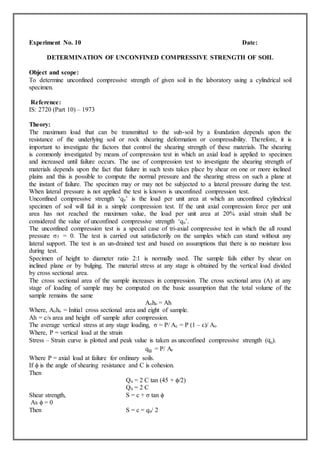
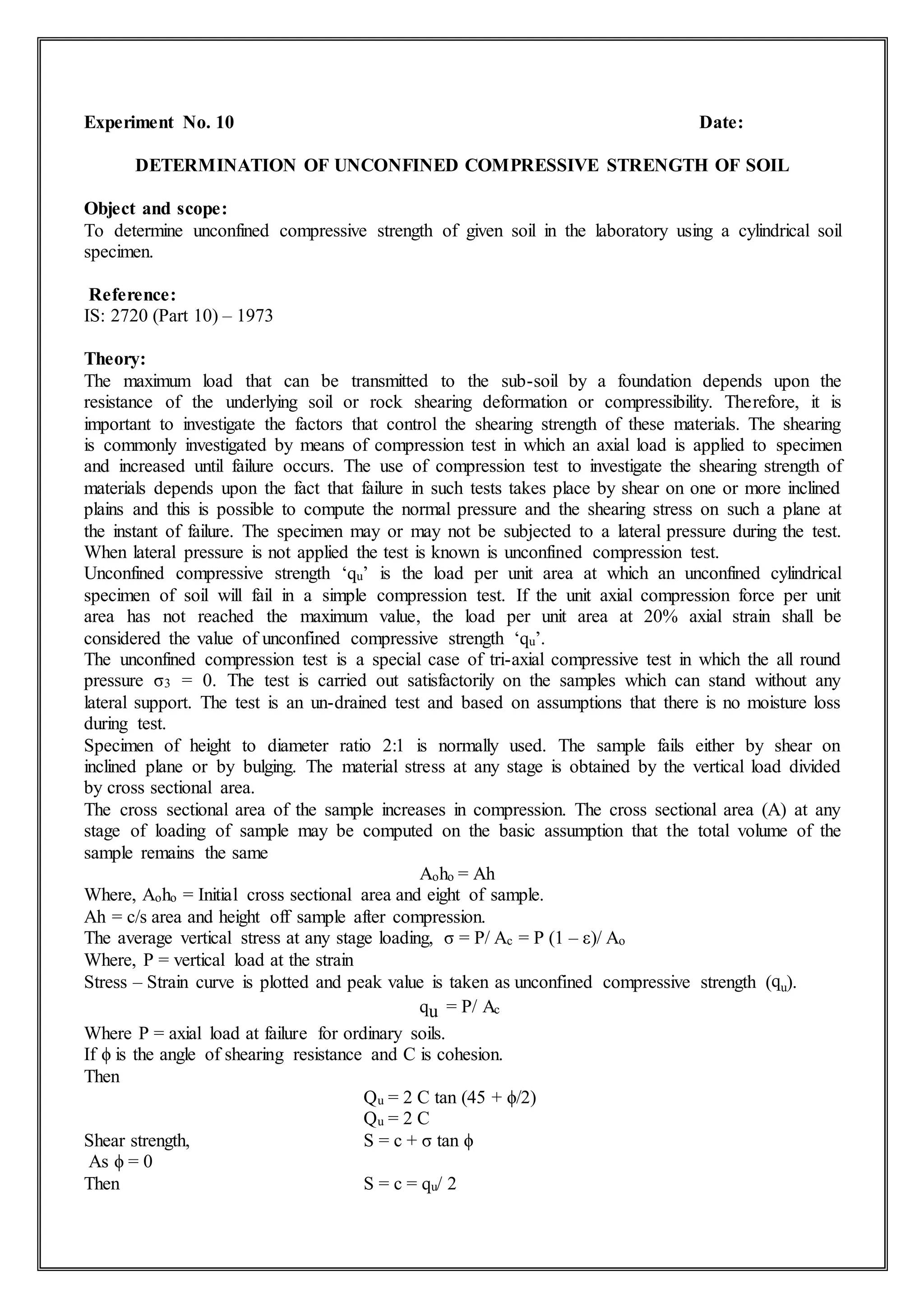
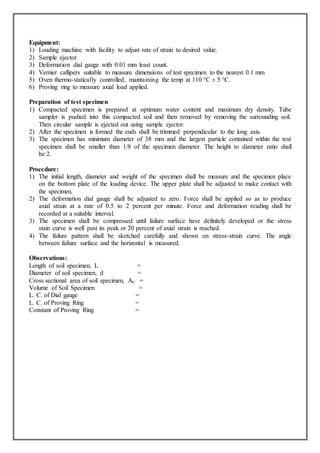
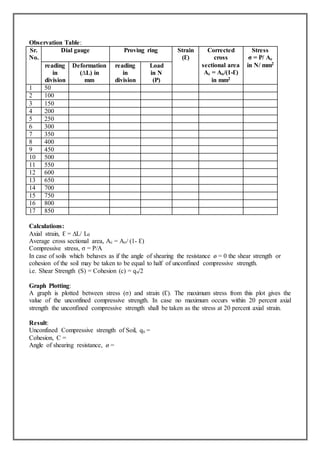
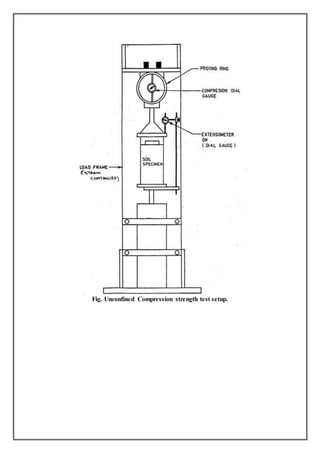

1) The experiment determines the unconfined compressive strength (qu) of soil, which is the maximum load per unit area at which an unconfined cylindrical soil specimen fails during compression testing. 2) A cylindrical soil specimen is prepared at optimum moisture content and maximum dry density, and compressed axially between loading plates at a controlled strain rate while measuring load and deformation. 3) The stress-strain curve is plotted, and qu is taken as either the peak stress or stress at 20% axial strain. Shear strength S of the soil is then calculated as qu/2, assuming the soil's angle of shearing resistance φ is 0.


![Geotechnical Engineering-II [Lec #4: Unconfined Compression Test]](https://cdn.slidesharecdn.com/ss_thumbnails/4-180930132645-thumbnail.jpg?width=640&height=640&fit=bounds)


![Geotechnical Engineering-II [Lec #13: Elastic Settlements]](https://cdn.slidesharecdn.com/ss_thumbnails/13-181020124852-thumbnail.jpg?width=640&height=640&fit=bounds)


![Geotechnical Engineering-I [Lec #29: Soil Exploration - II]](https://cdn.slidesharecdn.com/ss_thumbnails/29-180924141840-thumbnail.jpg?width=640&height=640&fit=bounds)


