http://www.free-powerpoint-templates-design.com
FIELD VANE
SHEAR TEST
REPORTERS FOR TODAY
JOHN FEL
Reporter 1
CZARLON
Reporter 2
SALIC
Reporter 3
ALDRIN
Reporter 4
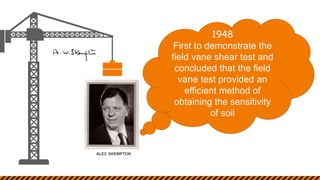
ALEC SKEMPTON
1948
First to demonstrate the
field vane shear test and
concluded that the field
vane test provided an
efficient method of
obtaining the sensitivity
of soil
What is…..
Field Vane Shear Test
01
Undisturbed vs Remolded
02
Soil Sensitivity
03
Let us define first the basic things you have to learn in this topic
Field vane shear test
The vane shear test is an in-situ geotechnical testing
methods used to estimate the undrained shear
strength of fully saturated clays without disturbance.
The test is relatively simple, quick, and provides a
cost-effective way of estimating the soil shear strength;
therefore, it is widely used in geotechnical
investigations.
UNDISTURBED VS
REMOLDED
•Undisturbed soil is a type of soil that
has its internal structure unmodified
and undisturbed.
•Remolded soil is a type of soil that
has had its natural internal structure
modified or disturbed by manipulation
so that it lacks shear strength and
gains compressibility
SOIL SENSITIVITY
Soil sensitivity is defined as the ratio of
peak to remoulded shear strength
Soil sensitivity is an important measure
of the loss of strength and structure in
the soil body under the effect of static or
seismic loading
S = Undisturbed Shear Strength /
Remolded
PROCEDURE
FIELD TEST
02
03
04
Begin Penetration
01
SET-UP
05
Penetrate first 20 cm
Twist the device (for
undisturbed) twist
again for (remolded)
Repeat 3 and 4 until
desired depth
1956
Opposed past
conclusions and
concluded that only
laboratory vane shear
test is reliable indicators
of soil sensitivity.
W. J. Eden and J. J. Hamilton
Lab Vane Shear Test
Under special condition, the vane shear test can be
also carried out in the laboratory on undisturbed soil
specimens; however, the use of the vane shear test in
in-situ testing is much more common.
The laboratory vane shear test for the measurement of
shear strength of cohesive soils. This test gives the
undrained strength of the soil, in undisturbed as well
as remoulded conditions both.
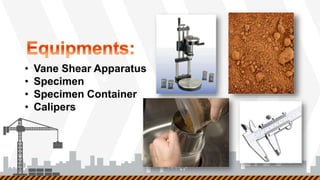
• Vane Shear Apparatus
• Specimen
• Specimen Container
• Calipers
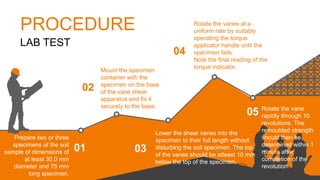
PROCEDURE
LAB TEST
02
03
04
Mount the specimen
container with the
specimen on the base
of the vane shear
apparatus and fix it
securely to the base.
01
Prepare two or three
specimens of the soil
sample of dimensions of
at least 30.0 mm
diameter and 75 mm
long specimen.
05
Lower the shear vanes into the
specimen to their full length without
disturbing the soil specimen. The top
of the vanes should be atleast 10 mm
below the top of the specimen.
Rotate the vanes at a
uniform rate by suitably
operating the torque
applicator handle until the
specimen fails.
Note the final reading of the
torque indicator.
Rotate the vane
rapidly through 10
revolutions. The
remoulded strength
should then be
determined within 1
minute after
completion of the
revolution.
Benefits and Consequences
easy and quick to perform
can also be performed in
the laboratory
ideal for the determination of undrained
shear strength of non-fissured and
fully saturated clay
can also get the shear strength of soft
clays at greater depth
not suitable for clay which cont
ains sand or silt laminations
cannot be conducted on fissured
clay
if the failure envelope is horizontal, it do
es not give accurate results
“ Save the Earth, Our Mother,
Conserve and protect our Water,
Do it now, not Later,
Or We will Suffer, Forever.”
Thank You!

433225288-Vane-Shear-Test (1).pptx ziauddin

  • 1.
  • 2.
    REPORTERS FOR TODAY JOHNFEL Reporter 1 CZARLON Reporter 2 SALIC Reporter 3 ALDRIN Reporter 4
  • 3.
    ALEC SKEMPTON 1948 First todemonstrate the field vane shear test and concluded that the field vane test provided an efficient method of obtaining the sensitivity of soil
  • 4.
    What is….. Field VaneShear Test 01 Undisturbed vs Remolded 02 Soil Sensitivity 03 Let us define first the basic things you have to learn in this topic
  • 5.
    Field vane sheartest The vane shear test is an in-situ geotechnical testing methods used to estimate the undrained shear strength of fully saturated clays without disturbance. The test is relatively simple, quick, and provides a cost-effective way of estimating the soil shear strength; therefore, it is widely used in geotechnical investigations.
  • 6.
    UNDISTURBED VS REMOLDED •Undisturbed soilis a type of soil that has its internal structure unmodified and undisturbed. •Remolded soil is a type of soil that has had its natural internal structure modified or disturbed by manipulation so that it lacks shear strength and gains compressibility
  • 7.
    SOIL SENSITIVITY Soil sensitivityis defined as the ratio of peak to remoulded shear strength Soil sensitivity is an important measure of the loss of strength and structure in the soil body under the effect of static or seismic loading S = Undisturbed Shear Strength / Remolded
  • 8.
    PROCEDURE FIELD TEST 02 03 04 Begin Penetration 01 SET-UP 05 Penetratefirst 20 cm Twist the device (for undisturbed) twist again for (remolded) Repeat 3 and 4 until desired depth
  • 9.
    1956 Opposed past conclusions and concludedthat only laboratory vane shear test is reliable indicators of soil sensitivity. W. J. Eden and J. J. Hamilton
  • 10.
    Lab Vane ShearTest Under special condition, the vane shear test can be also carried out in the laboratory on undisturbed soil specimens; however, the use of the vane shear test in in-situ testing is much more common. The laboratory vane shear test for the measurement of shear strength of cohesive soils. This test gives the undrained strength of the soil, in undisturbed as well as remoulded conditions both.
  • 11.
    • Vane ShearApparatus • Specimen • Specimen Container • Calipers
  • 12.
    PROCEDURE LAB TEST 02 03 04 Mount thespecimen container with the specimen on the base of the vane shear apparatus and fix it securely to the base. 01 Prepare two or three specimens of the soil sample of dimensions of at least 30.0 mm diameter and 75 mm long specimen. 05 Lower the shear vanes into the specimen to their full length without disturbing the soil specimen. The top of the vanes should be atleast 10 mm below the top of the specimen. Rotate the vanes at a uniform rate by suitably operating the torque applicator handle until the specimen fails. Note the final reading of the torque indicator. Rotate the vane rapidly through 10 revolutions. The remoulded strength should then be determined within 1 minute after completion of the revolution.
  • 13.
    Benefits and Consequences easyand quick to perform can also be performed in the laboratory ideal for the determination of undrained shear strength of non-fissured and fully saturated clay can also get the shear strength of soft clays at greater depth not suitable for clay which cont ains sand or silt laminations cannot be conducted on fissured clay if the failure envelope is horizontal, it do es not give accurate results
  • 14.
    “ Save theEarth, Our Mother, Conserve and protect our Water, Do it now, not Later, Or We will Suffer, Forever.”
  • 15.