WELCOME
1
GREEN CONCRETE:
EFFICIENT AND ECO-FRIENDLY
CONSTRUCTION MATERIAL
INTRODUCTION
 The concrete is made with concrete wastes which are eco-friendly
so called as Green concrete.
 Green concrete is a concept of using eco-friendly materials in
concrete, to make the system more sustainable.
 Green concrete is very often and also cheap to produce, because
for example, waste products are used as a partial substitute.
 for cement, charges for the disposal of waste are avoided, energy
consumption in production is lower, and durability is
greater. This concrete should not be confused with its color.
Materials for Green Concrete
 Recycled Demolition Waste Aggregate
 Recycled Concrete Aggregate
 Blast furnace Slag
 Manufactured Sand
 Glass Aggregate
 Fly ash
 Quarry dust
 Marble powder
 Waste paper pulp
OBJECTIVES
 The main ingredient in concrete is cement and it
consists of Limestone (Calcium Carbonate ).
 During manufacture of cement, its ingredients are
heated to about 800°C – 10000°C.
 During this process the Carbon Dioxide is driven off.
 Approximately 1kg of cement releases about 900gms of
Carbon Dioxide into the atmosphere.
 Therefore, green concrete came into existence to reduce
the emission of carbon dioxide.
ADVANTAGES
• It has good thermal resistance.
• It has good acid resistance.
• It increases compressive strength.
• It increases split tensile strength.
• Reduce consumption of the cement.
• Reduce the environmental pollution.
• It is cheaper.User-friendly.
• Optimized mix designs mean easier handling,better
consistency and easier finishing.
• Reduction in shrinkage & creep.
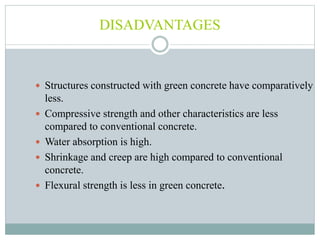
DISADVANTAGES
 Structures constructed with green concrete have comparatively
less.
 Compressive strength and other characteristics are less
compared to conventional concrete.
 Water absorption is high.
 Shrinkage and creep are high compared to conventional
concrete.
 Flexural strength is less in green concrete.
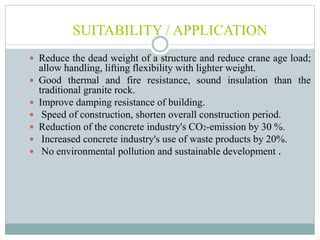
SUITABILITY / APPLICATION
 Reduce the dead weight of a structure and reduce crane age load;
allow handling, lifting flexibility with lighter weight.
 Good thermal and fire resistance, sound insulation than the
traditional granite rock.
 Improve damping resistance of building.
 Speed of construction, shorten overall construction period.
 Reduction of the concrete industry's CO2-emission by 30 %.
 Increased concrete industry's use of waste products by 20%.
 No environmental pollution and sustainable development .
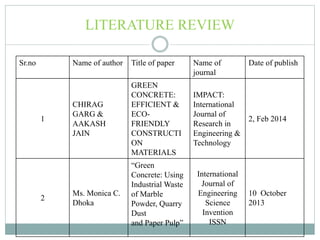
LITERATURE REVIEW
Sr.no Name of author Title of paper Name of
journal
Date of publish
1
CHIRAG
GARG &
AAKASH
JAIN
GREEN
CONCRETE:
EFFICIENT &
ECO-
FRIENDLY
CONSTRUCTI
ON
MATERIALS
IMPACT:
International
Journal of
Research in
Engineering &
Technology
2, Feb 2014
2
Ms. Monica C.
Dhoka
“Green
Concrete: Using
Industrial Waste
of Marble
Powder, Quarry
Dust
and Paper Pulp”
International
Journal of
Engineering
Science
Invention
ISSN
10 October
2013
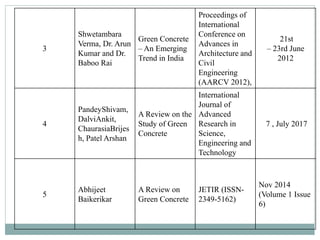
3
Shwetambara
Verma, Dr. Arun
Kumar and Dr.
Baboo Rai
Green Concrete
– An Emerging
Trend in India
Proceedings of
International
Conference on
Advances in
Architecture and
Civil
Engineering
(AARCV 2012),
21st
– 23rd June
2012
4
PandeyShivam,
DalviAnkit,
ChaurasiaBrijes
h, Patel Arshan
A Review on the
Study of Green
Concrete
International
Journal of
Advanced
Research in
Science,
Engineering and
Technology
7 , July 2017
5
Abhijeet
Baikerikar
A Review on
Green Concrete
JETIR (ISSN-
2349-5162)
Nov 2014
(Volume 1 Issue
6)
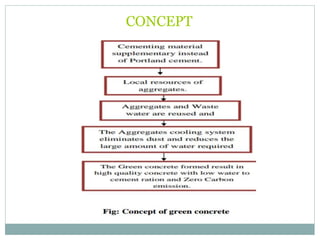
CONCEPT
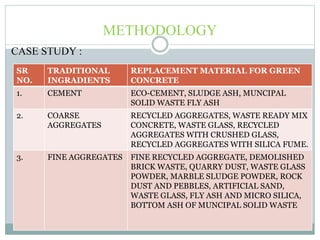
METHODOLOGY
CASE STUDY :
SR
NO.
TRADITIONAL
INGRADIENTS
REPLACEMENT MATERIAL FOR GREEN
CONCRETE
1. CEMENT ECO-CEMENT, SLUDGE ASH, MUNCIPAL
SOLID WASTE FLY ASH
2. COARSE
AGGREGATES
RECYCLED AGGREGATES, WASTE READY MIX
CONCRETE, WASTE GLASS, RECYCLED
AGGREGATES WITH CRUSHED GLASS,
RECYCLED AGGREGATES WITH SILICA FUME.
3. FINE AGGREGATES FINE RECYCLED AGGREGATE, DEMOLISHED
BRICK WASTE, QUARRY DUST, WASTE GLASS
POWDER, MARBLE SLUDGE POWDER, ROCK
DUST AND PEBBLES, ARTIFICIAL SAND,
WASTE GLASS, FLY ASH AND MICRO SILICA,
BOTTOM ASH OF MUNCIPAL SOLID WASTE
CONCLUSION
 There is significant potential in waste materials to produce
green concrete.
 Use of concrete product like green concrete in future will not
only reduce the emission of CO2 in environment and
environmental impact but it is also economical to produce.
 The water absorption of green concrete is slightly higher than
conventional concrete.
 The replacement of traditional ingredients of concrete by waste
materials and by products gives an opportunity to manufacture.
 economical and environment friendly concrete.
 The cost per unit volume of concrete with waste materials like
quarry dust is lower than the corresponding control concrete
mixes.
REFERENCE
[1]CHIRAG GARG & AAKASH JAIN 2014 ''green concrete: efficient &
eco-friendly construction materials."international journal of
research in engineering & technology (impact: ijret) issn(e): 2321-
8843;issn(p): 2347-4599vol. 2, issue 2, feb 2014, 259-264
[2]MS. MONICA C. DHOKA 2013"green concrete: using industrial
waste of marble powder, quarry dust and paper pulp”international
journal of engineering science inventionissn (online): 2319 – 6734,
issn (print): 2319 – 6726www.ijesi.org volume 2 issue 10ǁ october
2013 ǁ pp.67-70
[3]PANDEYSHIVAM,ETAL 2017, a review on the study of
green concrete,issn: 2350-0328international journal of advanced
researchinscience,engineeringandtechnologyvol.4,issue7,july201
7
[4]SHWETAMBARA VERMA,2012,green concrete – an
emerging trend in india,eedings of international conference on
advances in architecture and civil engineering (aarcv 2012), 21st
–23rd june 2012 paper id sam101, vol. 1
Thank You!!!

Green concrete

  • 1.
  • 2.
    1 GREEN CONCRETE: EFFICIENT ANDECO-FRIENDLY CONSTRUCTION MATERIAL
  • 3.
    INTRODUCTION  The concreteis made with concrete wastes which are eco-friendly so called as Green concrete.  Green concrete is a concept of using eco-friendly materials in concrete, to make the system more sustainable.  Green concrete is very often and also cheap to produce, because for example, waste products are used as a partial substitute.  for cement, charges for the disposal of waste are avoided, energy consumption in production is lower, and durability is greater. This concrete should not be confused with its color.
  • 4.
    Materials for GreenConcrete  Recycled Demolition Waste Aggregate  Recycled Concrete Aggregate  Blast furnace Slag  Manufactured Sand  Glass Aggregate  Fly ash  Quarry dust  Marble powder  Waste paper pulp
  • 5.
    OBJECTIVES  The mainingredient in concrete is cement and it consists of Limestone (Calcium Carbonate ).  During manufacture of cement, its ingredients are heated to about 800°C – 10000°C.  During this process the Carbon Dioxide is driven off.  Approximately 1kg of cement releases about 900gms of Carbon Dioxide into the atmosphere.  Therefore, green concrete came into existence to reduce the emission of carbon dioxide.
  • 6.
    ADVANTAGES • It hasgood thermal resistance. • It has good acid resistance. • It increases compressive strength. • It increases split tensile strength. • Reduce consumption of the cement. • Reduce the environmental pollution. • It is cheaper.User-friendly. • Optimized mix designs mean easier handling,better consistency and easier finishing. • Reduction in shrinkage & creep.
  • 7.
    DISADVANTAGES  Structures constructedwith green concrete have comparatively less.  Compressive strength and other characteristics are less compared to conventional concrete.  Water absorption is high.  Shrinkage and creep are high compared to conventional concrete.  Flexural strength is less in green concrete.
  • 8.
    SUITABILITY / APPLICATION Reduce the dead weight of a structure and reduce crane age load; allow handling, lifting flexibility with lighter weight.  Good thermal and fire resistance, sound insulation than the traditional granite rock.  Improve damping resistance of building.  Speed of construction, shorten overall construction period.  Reduction of the concrete industry's CO2-emission by 30 %.  Increased concrete industry's use of waste products by 20%.  No environmental pollution and sustainable development .
  • 9.
    LITERATURE REVIEW Sr.no Nameof author Title of paper Name of journal Date of publish 1 CHIRAG GARG & AAKASH JAIN GREEN CONCRETE: EFFICIENT & ECO- FRIENDLY CONSTRUCTI ON MATERIALS IMPACT: International Journal of Research in Engineering & Technology 2, Feb 2014 2 Ms. Monica C. Dhoka “Green Concrete: Using Industrial Waste of Marble Powder, Quarry Dust and Paper Pulp” International Journal of Engineering Science Invention ISSN 10 October 2013
  • 10.
    3 Shwetambara Verma, Dr. Arun Kumarand Dr. Baboo Rai Green Concrete – An Emerging Trend in India Proceedings of International Conference on Advances in Architecture and Civil Engineering (AARCV 2012), 21st – 23rd June 2012 4 PandeyShivam, DalviAnkit, ChaurasiaBrijes h, Patel Arshan A Review on the Study of Green Concrete International Journal of Advanced Research in Science, Engineering and Technology 7 , July 2017 5 Abhijeet Baikerikar A Review on Green Concrete JETIR (ISSN- 2349-5162) Nov 2014 (Volume 1 Issue 6)
  • 11.
  • 12.
    METHODOLOGY CASE STUDY : SR NO. TRADITIONAL INGRADIENTS REPLACEMENTMATERIAL FOR GREEN CONCRETE 1. CEMENT ECO-CEMENT, SLUDGE ASH, MUNCIPAL SOLID WASTE FLY ASH 2. COARSE AGGREGATES RECYCLED AGGREGATES, WASTE READY MIX CONCRETE, WASTE GLASS, RECYCLED AGGREGATES WITH CRUSHED GLASS, RECYCLED AGGREGATES WITH SILICA FUME. 3. FINE AGGREGATES FINE RECYCLED AGGREGATE, DEMOLISHED BRICK WASTE, QUARRY DUST, WASTE GLASS POWDER, MARBLE SLUDGE POWDER, ROCK DUST AND PEBBLES, ARTIFICIAL SAND, WASTE GLASS, FLY ASH AND MICRO SILICA, BOTTOM ASH OF MUNCIPAL SOLID WASTE
  • 13.
    CONCLUSION  There issignificant potential in waste materials to produce green concrete.  Use of concrete product like green concrete in future will not only reduce the emission of CO2 in environment and environmental impact but it is also economical to produce.  The water absorption of green concrete is slightly higher than conventional concrete.  The replacement of traditional ingredients of concrete by waste materials and by products gives an opportunity to manufacture.  economical and environment friendly concrete.  The cost per unit volume of concrete with waste materials like quarry dust is lower than the corresponding control concrete mixes.
  • 14.
    REFERENCE [1]CHIRAG GARG &AAKASH JAIN 2014 ''green concrete: efficient & eco-friendly construction materials."international journal of research in engineering & technology (impact: ijret) issn(e): 2321- 8843;issn(p): 2347-4599vol. 2, issue 2, feb 2014, 259-264 [2]MS. MONICA C. DHOKA 2013"green concrete: using industrial waste of marble powder, quarry dust and paper pulp”international journal of engineering science inventionissn (online): 2319 – 6734, issn (print): 2319 – 6726www.ijesi.org volume 2 issue 10ǁ october 2013 ǁ pp.67-70
  • 15.
    [3]PANDEYSHIVAM,ETAL 2017, areview on the study of green concrete,issn: 2350-0328international journal of advanced researchinscience,engineeringandtechnologyvol.4,issue7,july201 7 [4]SHWETAMBARA VERMA,2012,green concrete – an emerging trend in india,eedings of international conference on advances in architecture and civil engineering (aarcv 2012), 21st –23rd june 2012 paper id sam101, vol. 1
  • 16.