Principles of Management ANEES HASSAN SCIENCE COLLEGE HYDERABAD  Asghar Ali Narejo
Evolution of Management Management, as a concept as we know it today, is associated with ‘mass consumption’ – leading to production of ‘standardized’ goods in large volumes; Prior to the “Industrial Revolution”, man made devices were in use in sizeable numbers – but often one of a kind and crafted rather than manufactured  Example: watches and clocks. However, many of the supportive processes can be traced to early roots: logistics, scheduling Example: boat building; automation.  Example: printing. The advent of the management as a science can therefore be traced to late 18 th  /early 19 th  century.
Elements of modern management, with a focus on ‘man’ i.e. HR concepts first began to appear in the West around the same time: as a  reaction to the harsh behaviour  of autocratic businessmen like Henry Ford. It evolved through ‘(labour) Welfare’, ‘Industrial Relations’, ‘Personnel Management’ to its current form.  (Marxism was becoming a recognizable philosophy in Europe!); as a  need to utilize human resource better  due the adverse supply-demand situation. Employment in the ‘industry’ had overtaken agricultural labour. This was aggravated in Europe, by WW I. In the 20’s,  Rationalization & Efficiency  were the buzz-words (Taylor, Fayol etc.), calling for a  scientific approach  to selection and work allocation – the corner-stones of modern production management: Standardization  of parts and work elements resulted in ability to make work repetitive for individuals (‘do-ers’)
End of WW II brought in an era of un-sated demand, resulting in a boom for production activity – more of everything was required. Quantity backed by efficiency were the guiding principles: an era of ‘Optimization’ driven by suppliers’ choice rather than customers’ wants.  However, some people – notably Japan – restarted their devastated economy with different orientation: Quality. The key was true economy of all resources with the customer as the focal point – since they did not have the luxury of a surplus funded, hungry market. By the late 60’s, demand tended to slow down and the growing competition gave customers greater choice – ‘quality’ as an important buying criterion emerged. OPEC crisis in mid-70’s turned the world around on its head! Energy the prime mover of industrial world became very expensive. The demand boom faded – with customers demanding quality and lower prices and better service.
First inventions of ‘mass production’ were linked to textile manufacturing (Spinning Jenny/ Hargreaves) – which combined with use of water power (Arkwright), made a powerful social impact in the late 1700s; Watt’s steam engine completely revolutionized  harnessing of mechanical power  for production (first to use were cotton mills) and transport; Poor Reliability of early machines led to the creation of machine tools – the Lathe (Maudslay) in 1790, with which to turnout   parts to closer tolerances and fit. This led to creation of  ‘interchangeable parts’  – and the first uses were in manufacture of muskets and pistols! These were the  triggers for   ‘ mass production ’ :  mechanical   power & interchangeable parts ; leading to production moving away from homes and craft-shops to work-shops / factories. By 1900 (in the West),  nearly  everything was being produced by the factory system.
Division of Labour:  under this principle, work could be organized/grouped into a set of specific, related tasks – which were repetitive in nature. Man could be trained to perform this set of tasks only, so that  efficiency  of task performance was maximized.  When extended throughout the organization, this took the form of  ‘Specialization’   - with the organization benefiting from the maximum use of specialist skills. Both economically and under supply-shortage conditions, this worked well. Much of this was an extension of trade/craft skill-groups organization (guilds) which was the hallmark of pre-industrial ‘production’. Till the end of the 30’s, these fundamentals were refined, polished(e.g. Organization structures) and extended ( e.g. work-measurements) in a  relentless focus on efficiency . With WW II, a further  need for reliability  gave birth to the principles of sampling & inspection –  statistical methods  were introduced to regulate  quality of output .
This brought to the forefront the philosophy and practice of  Total Quality  as the guiding force for manufacturing – later to spread into management of operations and enterprises: Central to this theme is the dominance of the  Customer ; Customers were any person or person receiving goods and/or services – internal or external; Quality was redefined as  ‘ fitness for use ’  – elevated from the narrow confines of conformance to specifications; Continuous improvement  was the key to continuity and success against demands of customer and competition; importantly, everybody could contribute – quality is every- body’s business; Particularly, for production, quality means best products at least cost –  reduced waste  of all resources, spawning a host of (linked) programs to conserve time, money & effort: Just – in – Time, SMED/OTED; Lean manufacturing; Q-circles/Kaizen/6-sigma; 5-S, TPM, DoE;
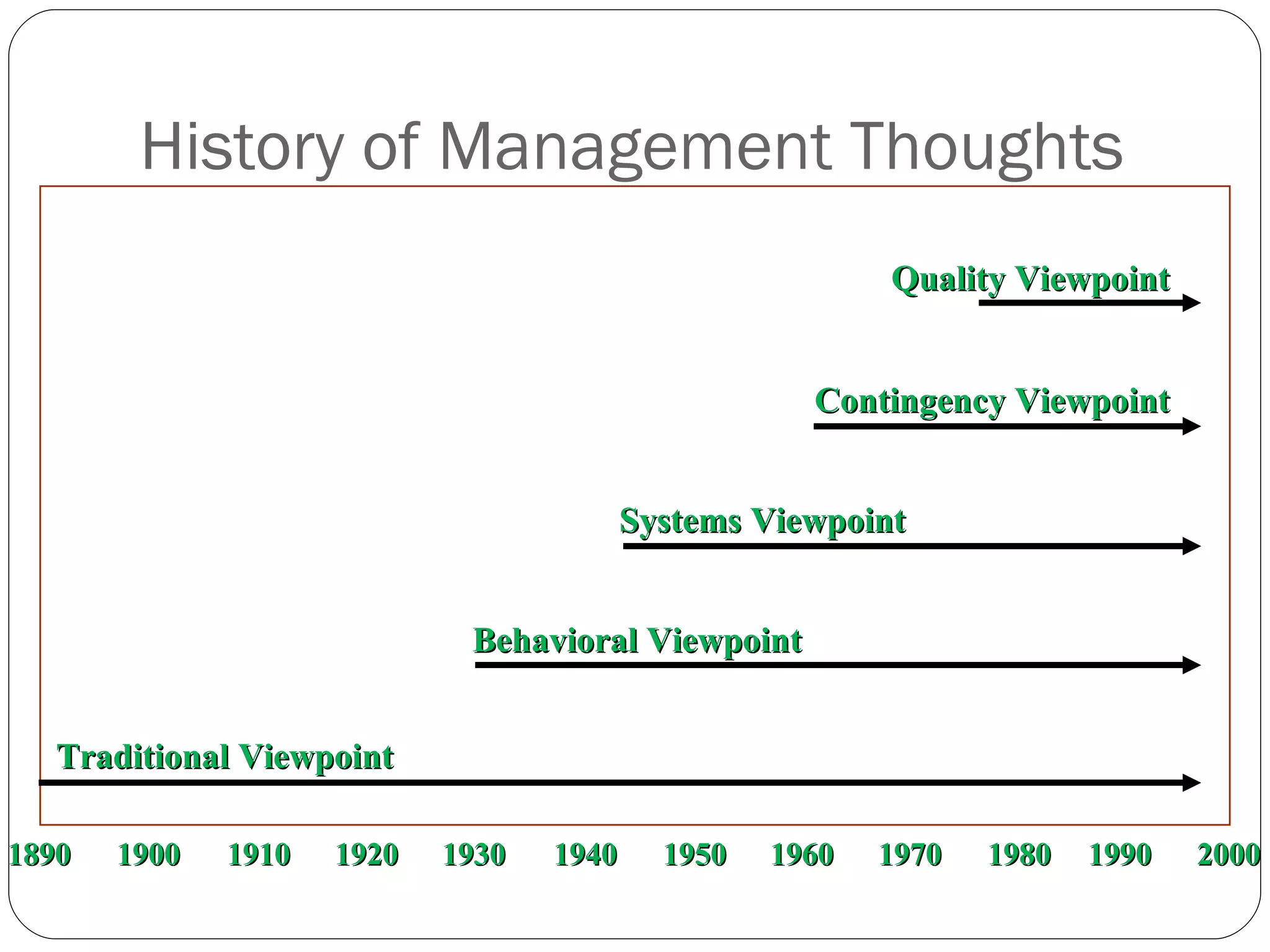
History of Management Thoughts Traditional Viewpoint Behavioral Viewpoint Systems Viewpoint Contingency Viewpoint Quality Viewpoint 1890 1900 1910 1920 1930 1940 1950 1960 1970 1980 1990 2000
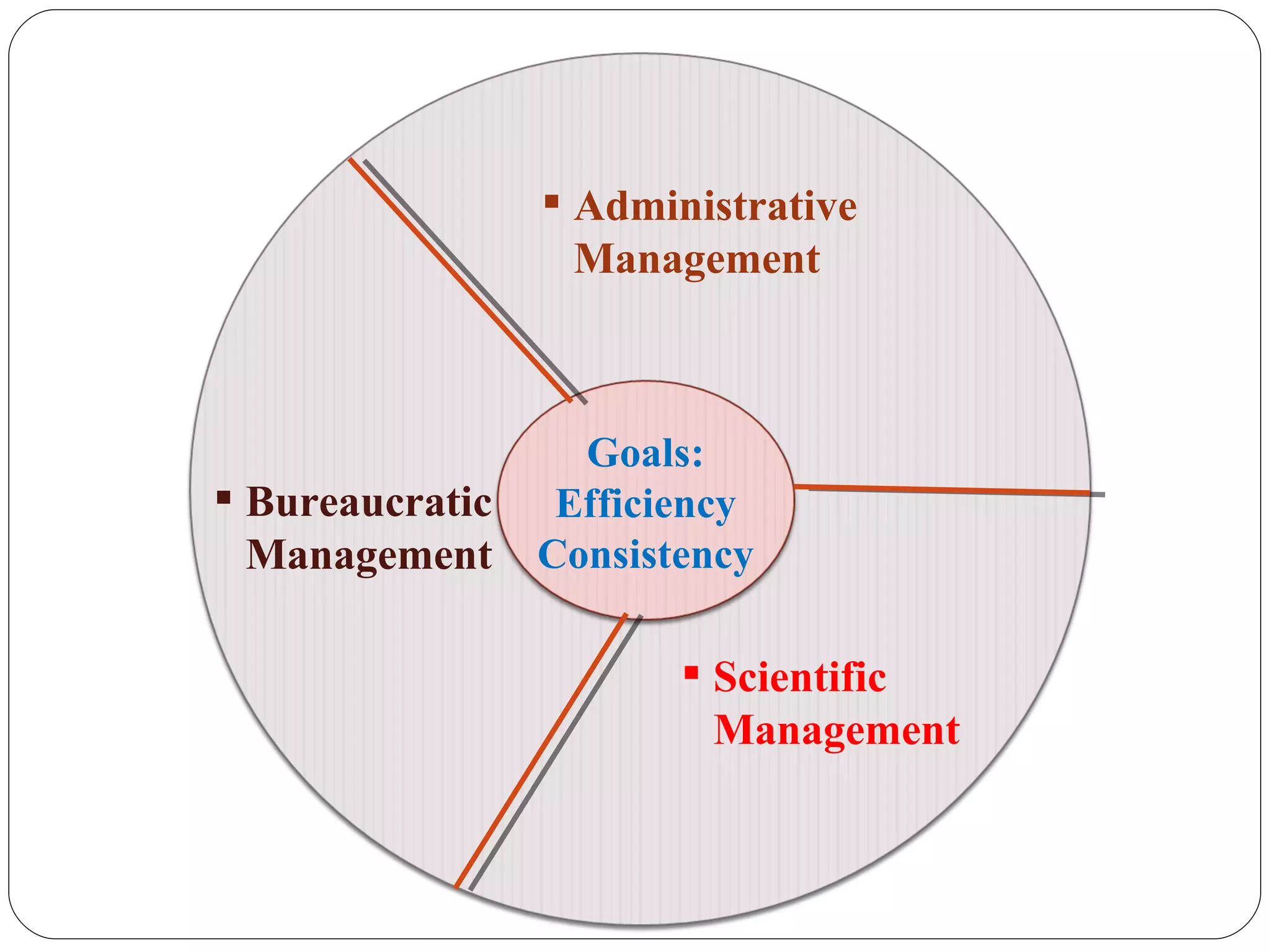
Administrative Management Bureaucratic Management Scientific Management Goals: Efficiency Consistency
Classical Management  A set of Management Theories that focus on the increasing the efficiency of the organization as a whole.
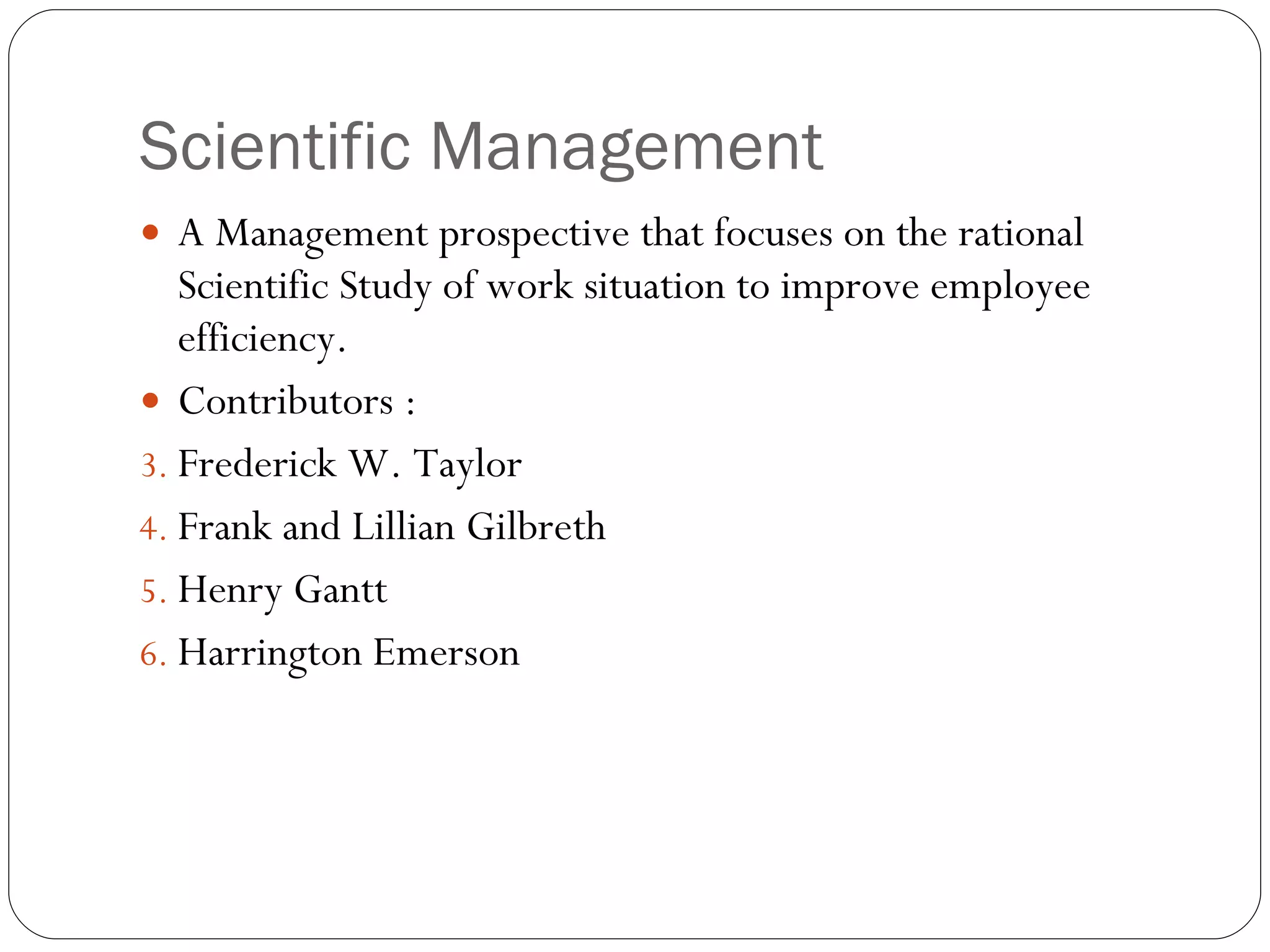
Scientific Management A Management prospective that focuses on the rational Scientific Study of work situation to improve employee efficiency. Contributors : Frederick W. Taylor Frank and Lillian Gilbreth Henry Gantt Harrington Emerson
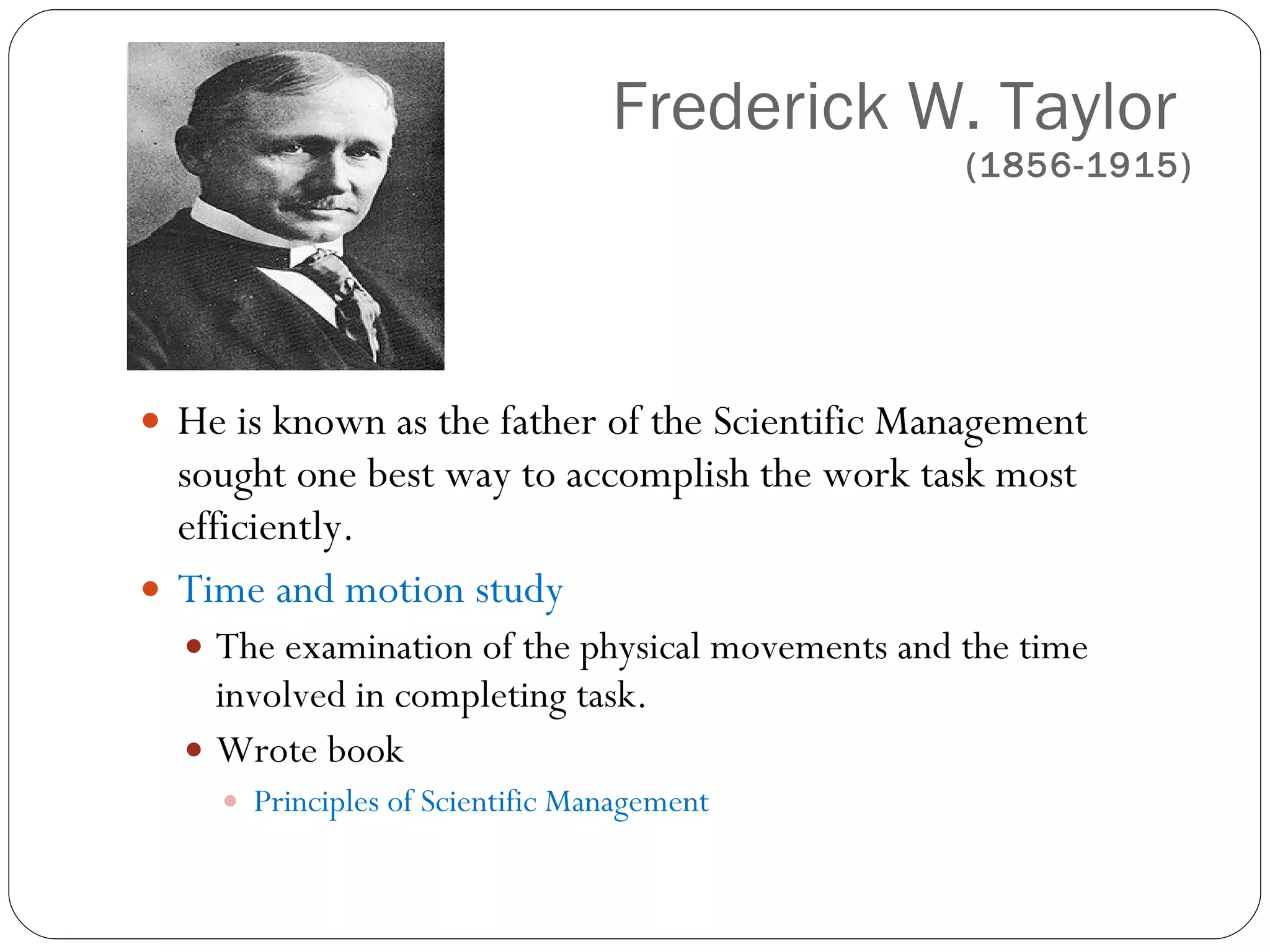
Frederick W. Taylor  (1856-1915) He is known as the father of the Scientific Management sought one best way to accomplish the work task most efficiently.  Time and motion study  The examination of the physical movements and the time involved in completing task. Wrote book Principles of Scientific Management
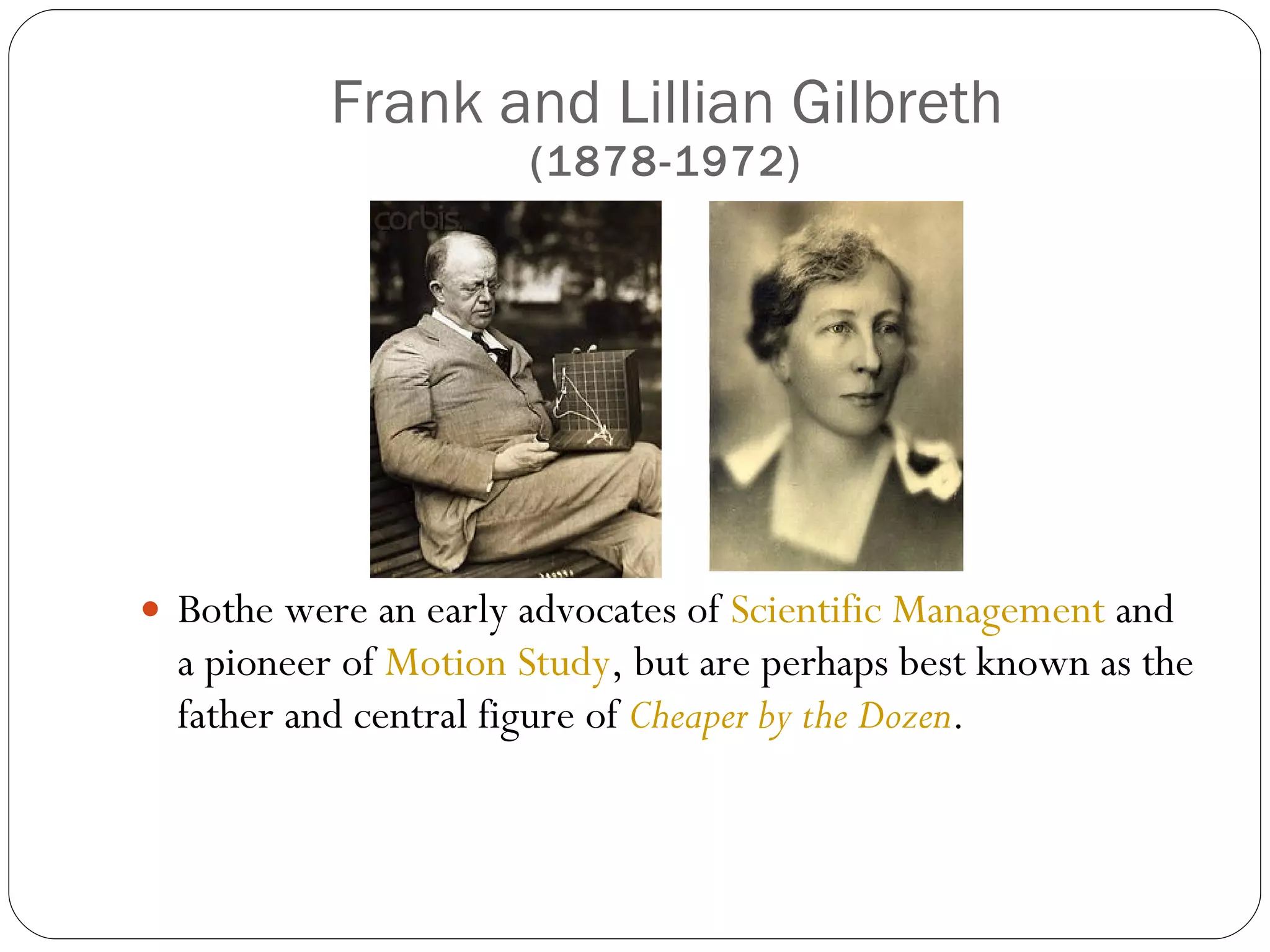
Frank and Lillian Gilbreth (1878-1972) Bothe were an early advocates of  Scientific Management  and a pioneer of  Motion Study , but are perhaps best known as the father and central figure of  Cheaper by the Dozen .
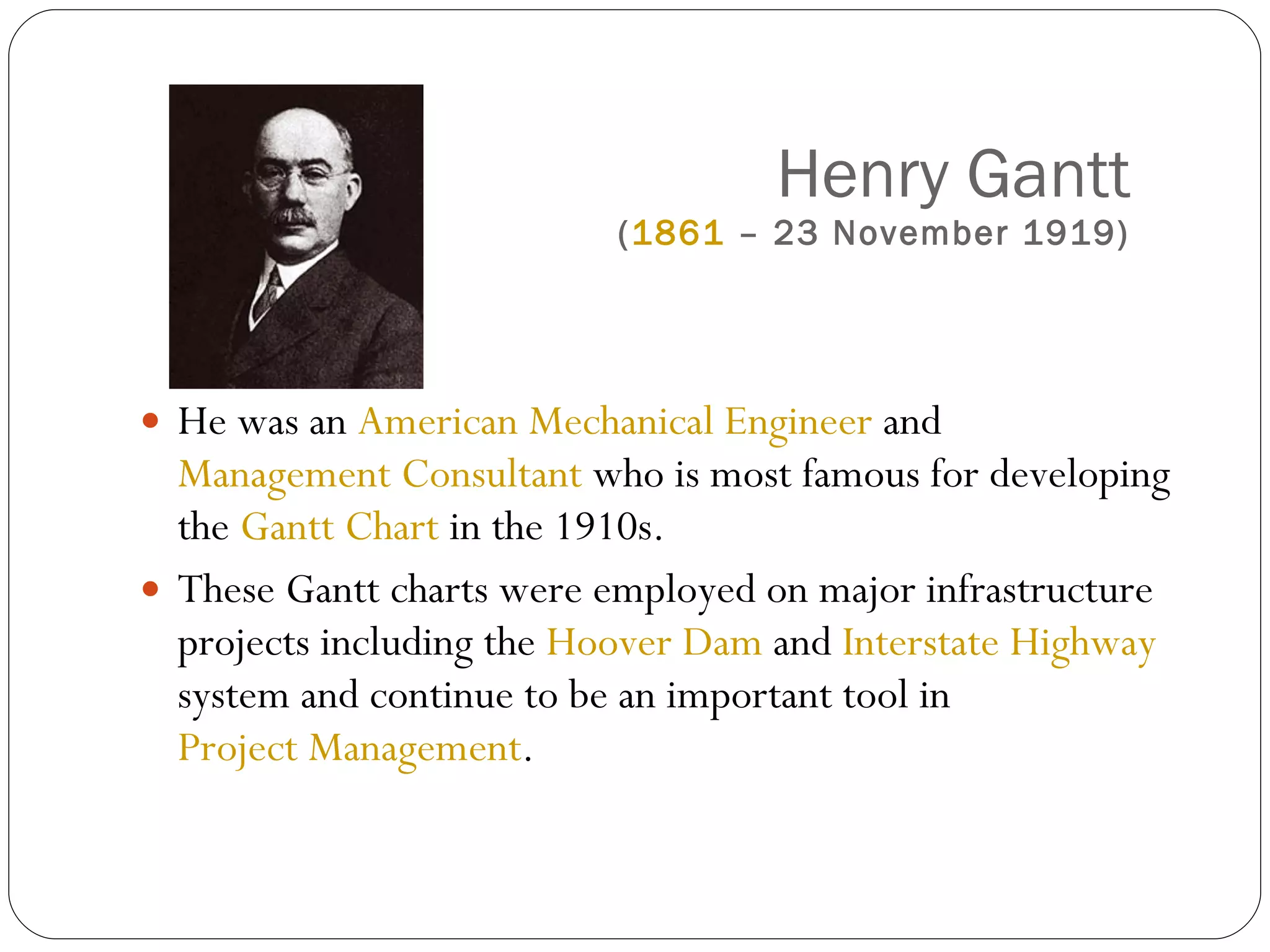
Henry Gantt ( 1861  – 23 November 1919) He was an  American   Mechanical Engineer  and  Management Consultant  who is most famous for developing the  Gantt Chart  in the 1910s. These Gantt charts were employed on major infrastructure projects including the  Hoover Dam  and  Interstate Highway  system and continue to be an important tool in  Project Management .
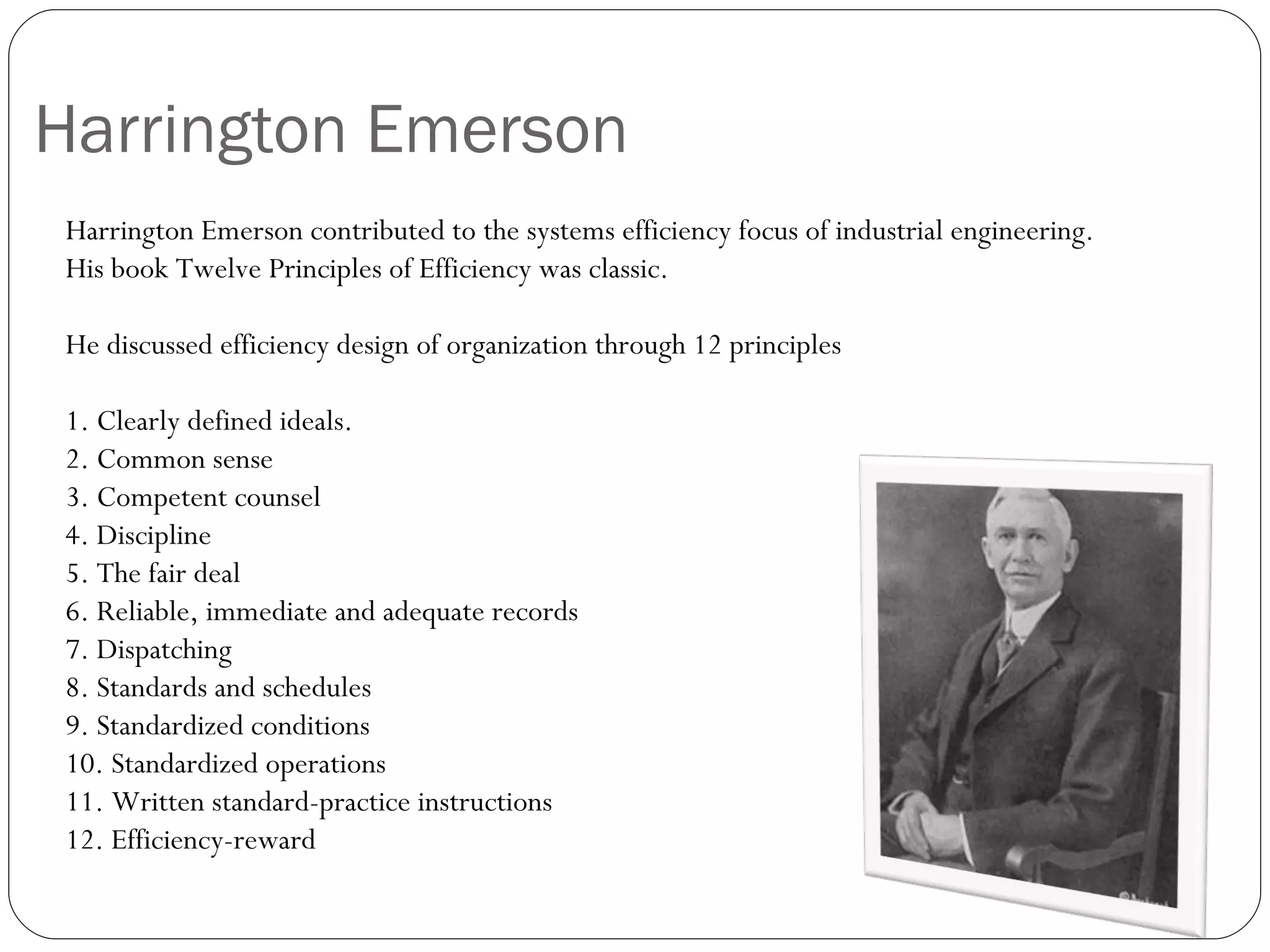
Harrington Emerson  Harrington Emerson contributed to the systems efficiency focus of industrial engineering.  His book Twelve Principles of Efficiency was classic.   He discussed efficiency design of organization through 12 principles   1. Clearly defined ideals. 2. Common sense 3. Competent counsel 4. Discipline 5. The fair deal 6. Reliable, immediate and adequate records 7. Dispatching 8. Standards and schedules 9. Standardized conditions 10. Standardized operations 11. Written standard-practice instructions 12. Efficiency-reward
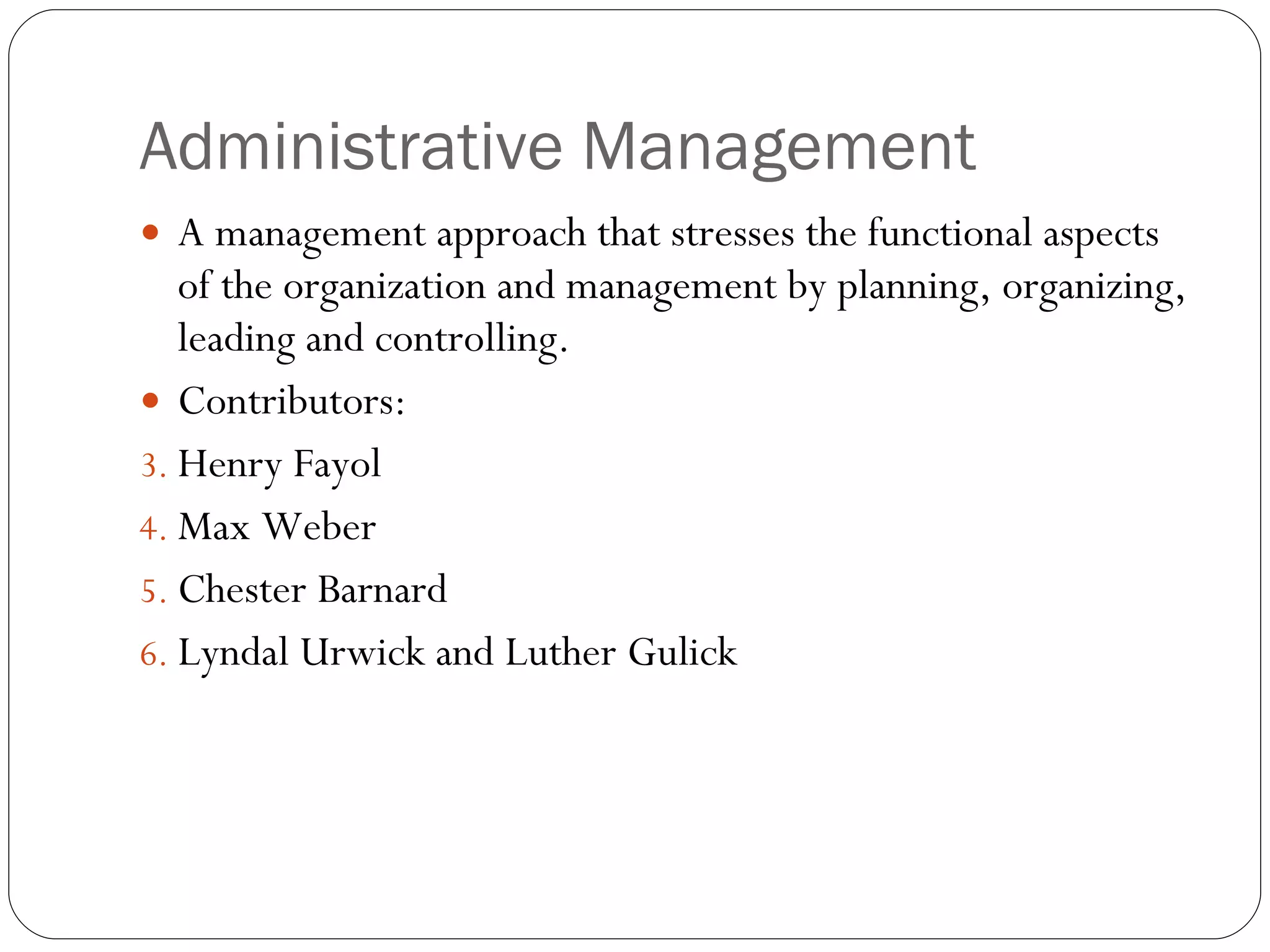
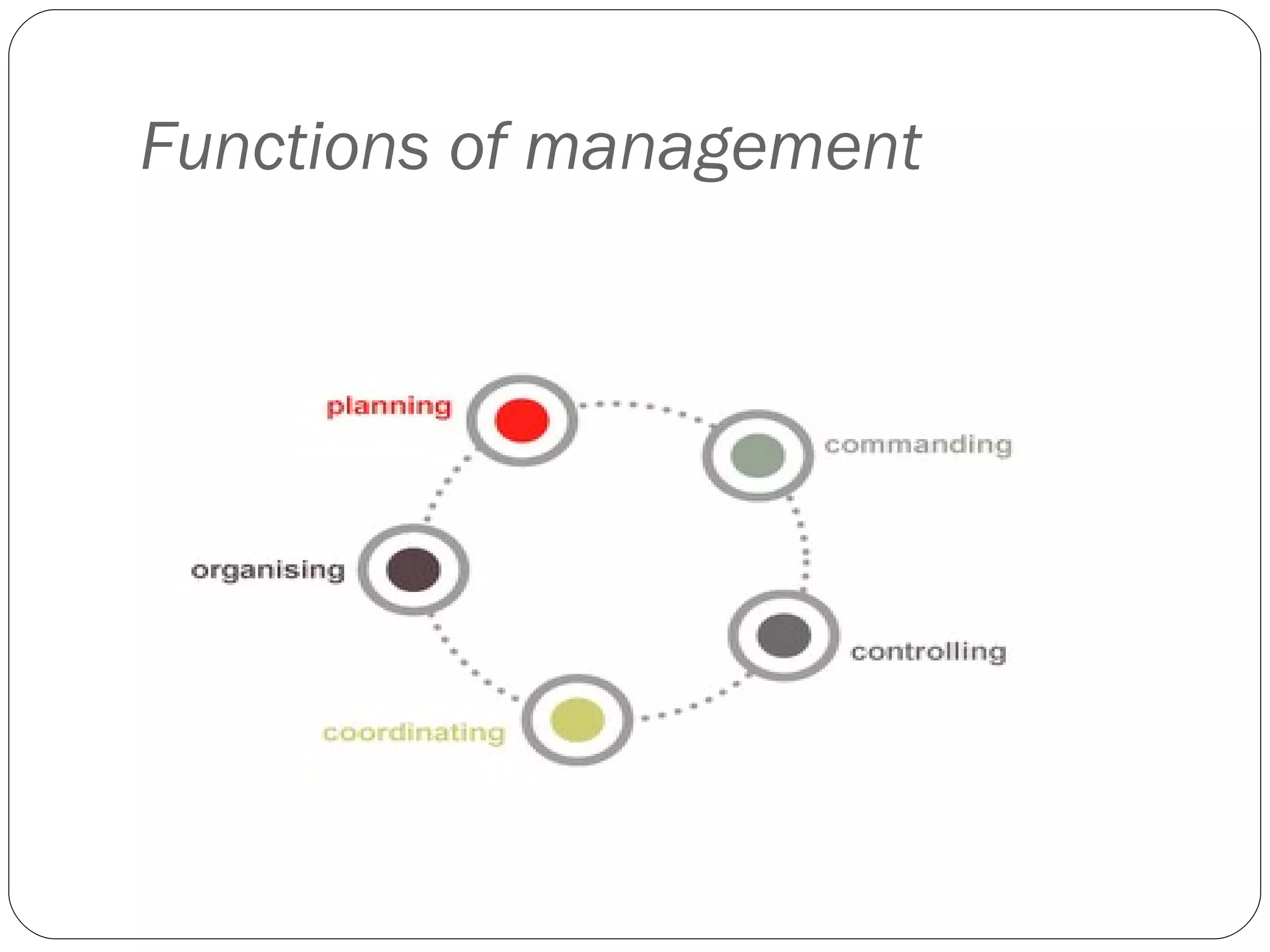
Administrative Management A management approach that stresses the functional aspects of the organization and management by planning, organizing, leading and controlling. Contributors: Henry Fayol Max Weber Chester Barnard Lyndal Urwick and Luther Gulick
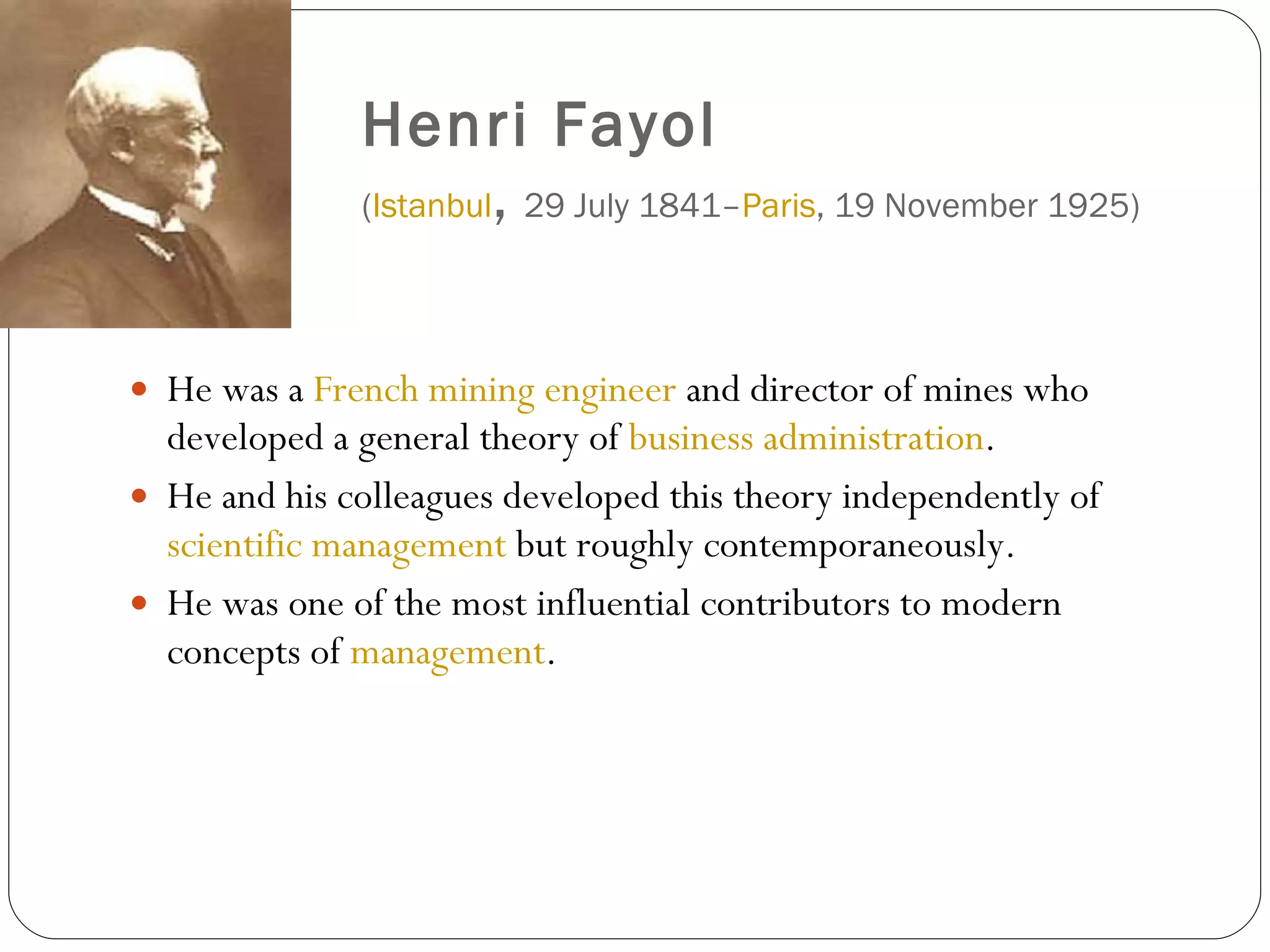
Henri Fayol   ( Istanbul ,  29 July 1841– Paris , 19 November 1925)  He was a  French   mining engineer  and director of mines who developed a general theory of  business administration .   He and his colleagues developed this theory independently of  scientific management  but roughly contemporaneously.  He was one of the most influential contributors to modern concepts of  management .
Functions of management
Management Principles: Developed by Henri Fayol:   Specialization of labor.  Specializing encourages continuous improvement in skills and the development of improvements in methods. Authority.  The right to give orders and the power to exact obedience. Discipline . No slacking, bending of rules.   Unity of command . Each employee has one and only one boss. Unity of direction . A single mind generates a single plan and all play their part in that plan. Subordination of Individual Interests . When at work, only work things should be pursued or thought about. Remuneration . Employees receive fair payment for services, not what the company can get away with. Centralization.  Consolidation of management functions. Decisions are made from the top. Scalar Chain (line of authority).  Formal chain of command running from top to bottom of the organization, like military.
Conti……. Order . All materials and personnel have a prescribed place, and they must remain there. Equity.  Equality of treatment (but not necessarily identical treatment) Personnel Tenure.  Limited turnover of personnel. Lifetime employment for good workers. Initiative . Thinking out a plan and do what it takes to make it happen. Esprit de corps . Harmony, cohesion among personnel
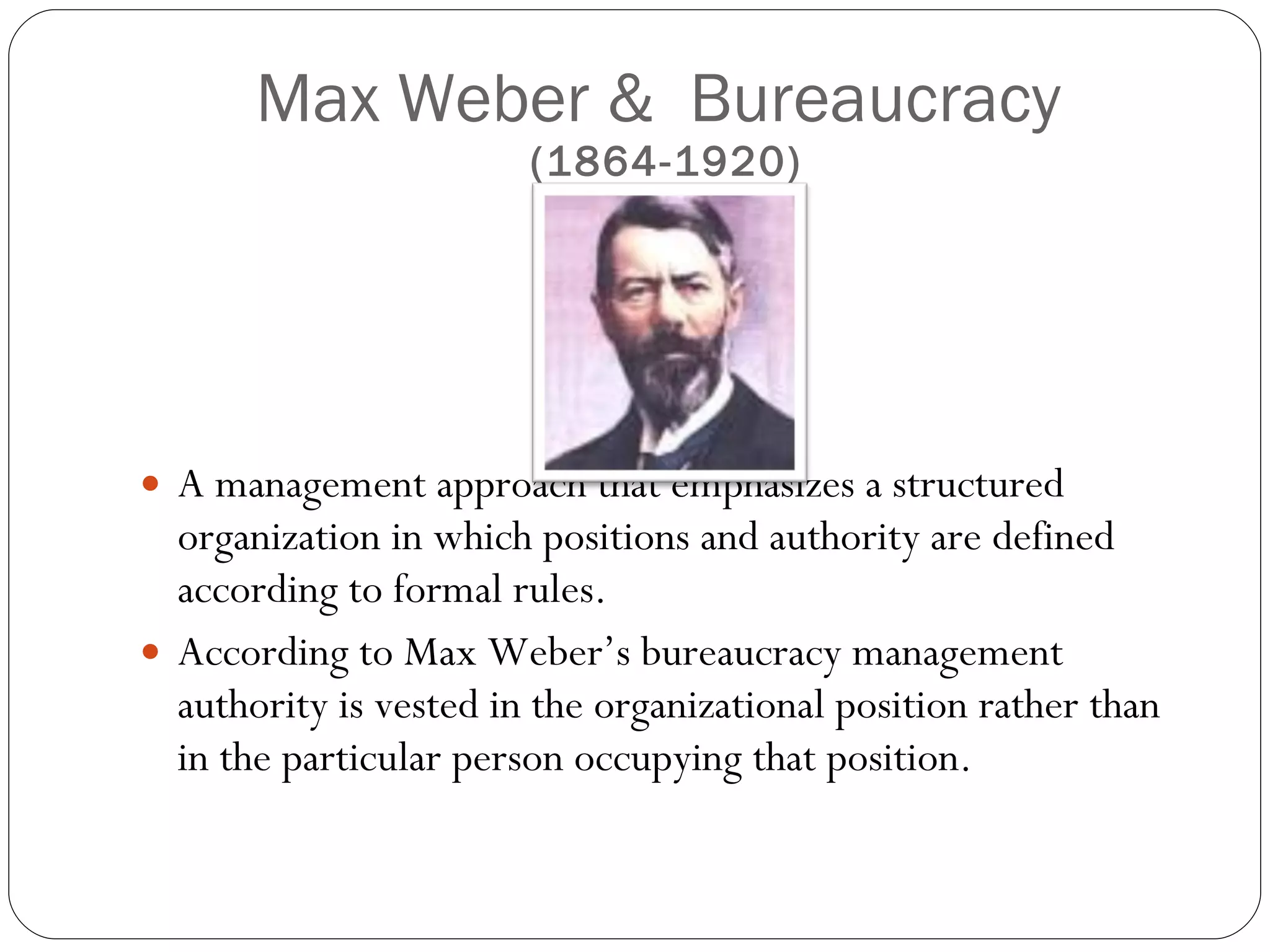
Max Weber &  Bureaucracy  (1864-1920) A management approach that emphasizes a structured organization in which positions and authority are defined according to formal rules. According to Max Weber’s bureaucracy management authority is vested in the organizational position rather than in the particular person occupying that position.
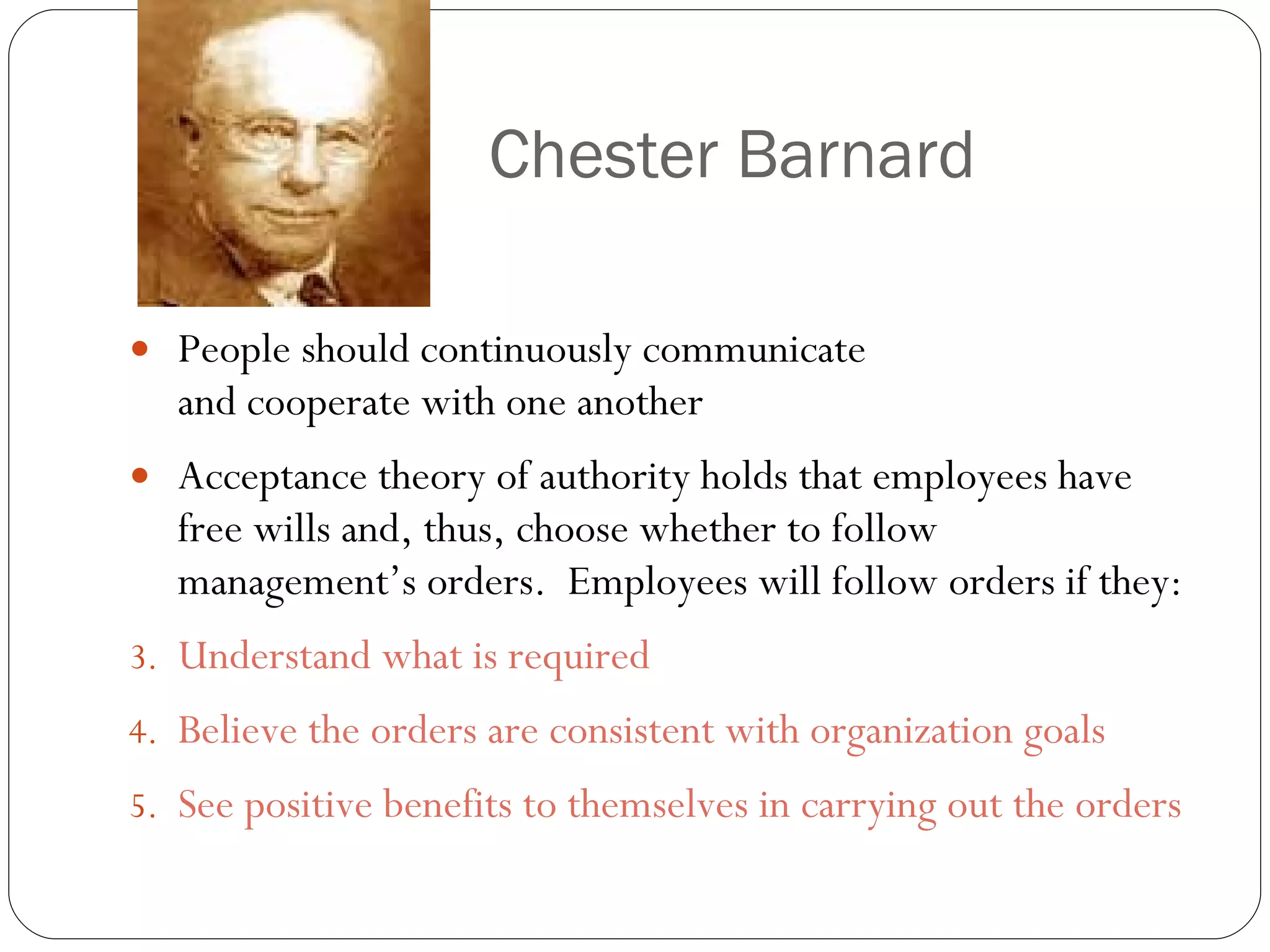
Chester Barnard People should continuously communicate and cooperate with one another Acceptance theory of authority holds that employees have free wills and, thus, choose whether to follow management’s orders.  Employees will follow orders if they: Understand what is required Believe the orders are consistent with organization goals See positive benefits to themselves in carrying out the orders
 
Lyndal Urwick and Luther Gulick The worked together and designed it according to acronym POSDCORB. Planning Organizing  Staffing  Directing Coordinating Reporting  Budgeting Their work was an important step in principles of Scientific Management with the thinking of Weber and Fayol.
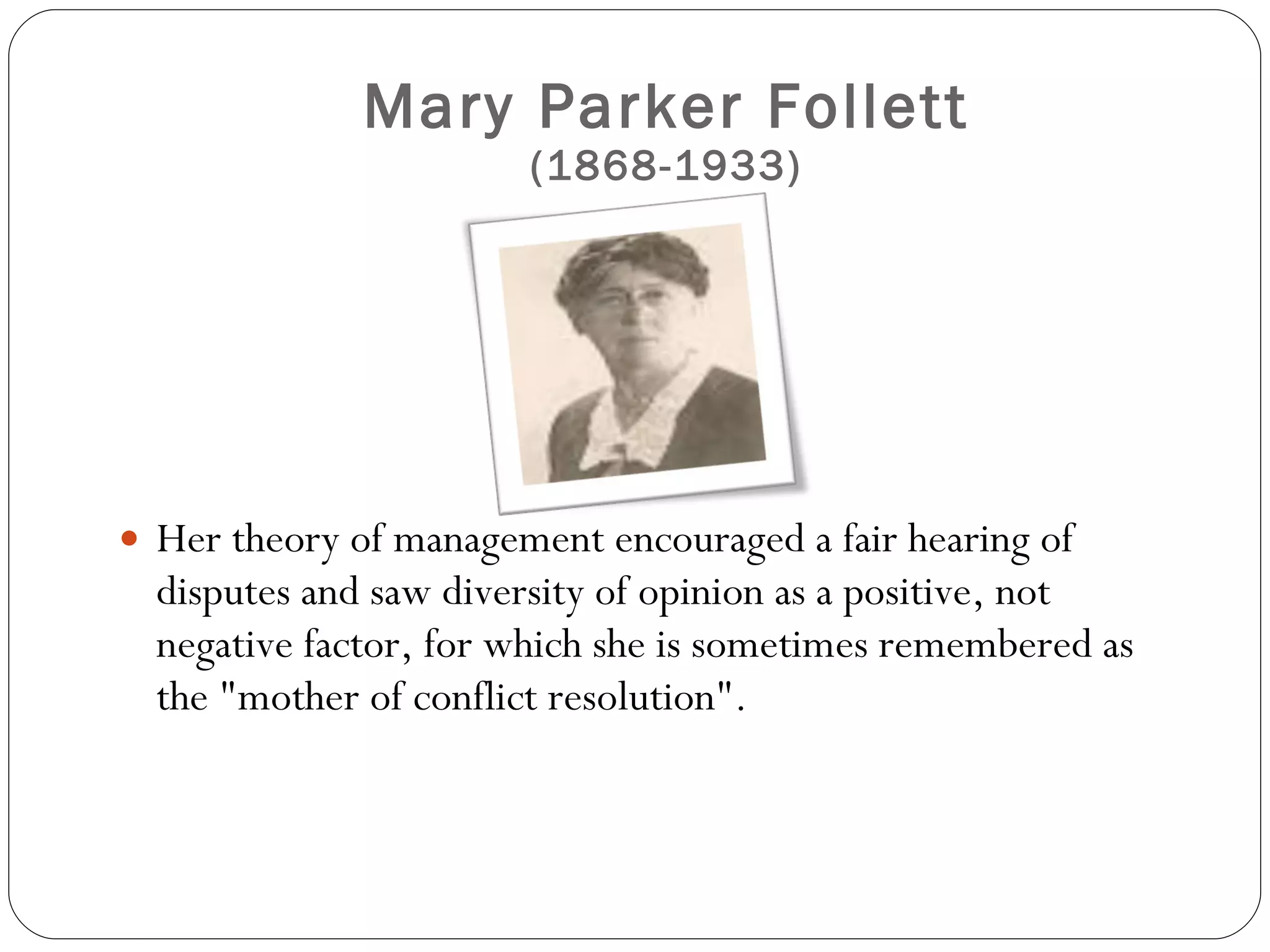
Mary Parker Follett (1868-1933) Her theory of management encouraged a fair hearing of disputes and saw diversity of opinion as a positive, not negative factor, for which she is sometimes remembered as the "mother of conflict resolution".
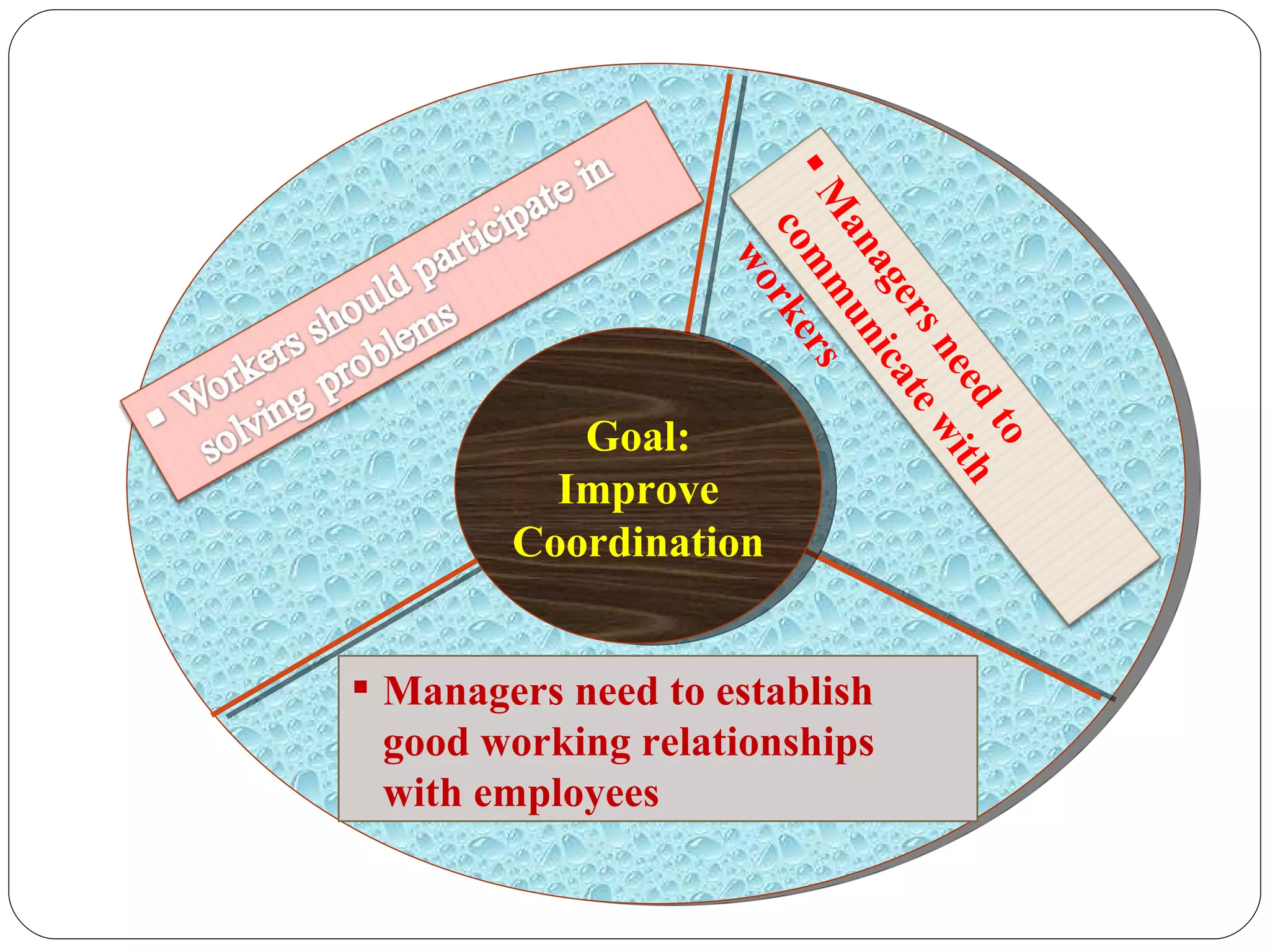
Managers need to establish good working relationships with employees Goal: Improve Coordination Managers need to communicate with workers
Hawthorne Studies Studies of how characteristics of the work setting affected worker fatigue and performance at the Hawthorne Works of the Western Electric Company from 1924-1932. Worker productivity was measured at various levels of light illumination. Researchers found that regardless of whether the light levels were raised or lowered, worker productivity increased.
Human Relation Movement A management prospective that views employees as responding to the interpersonal processes within the work unit.
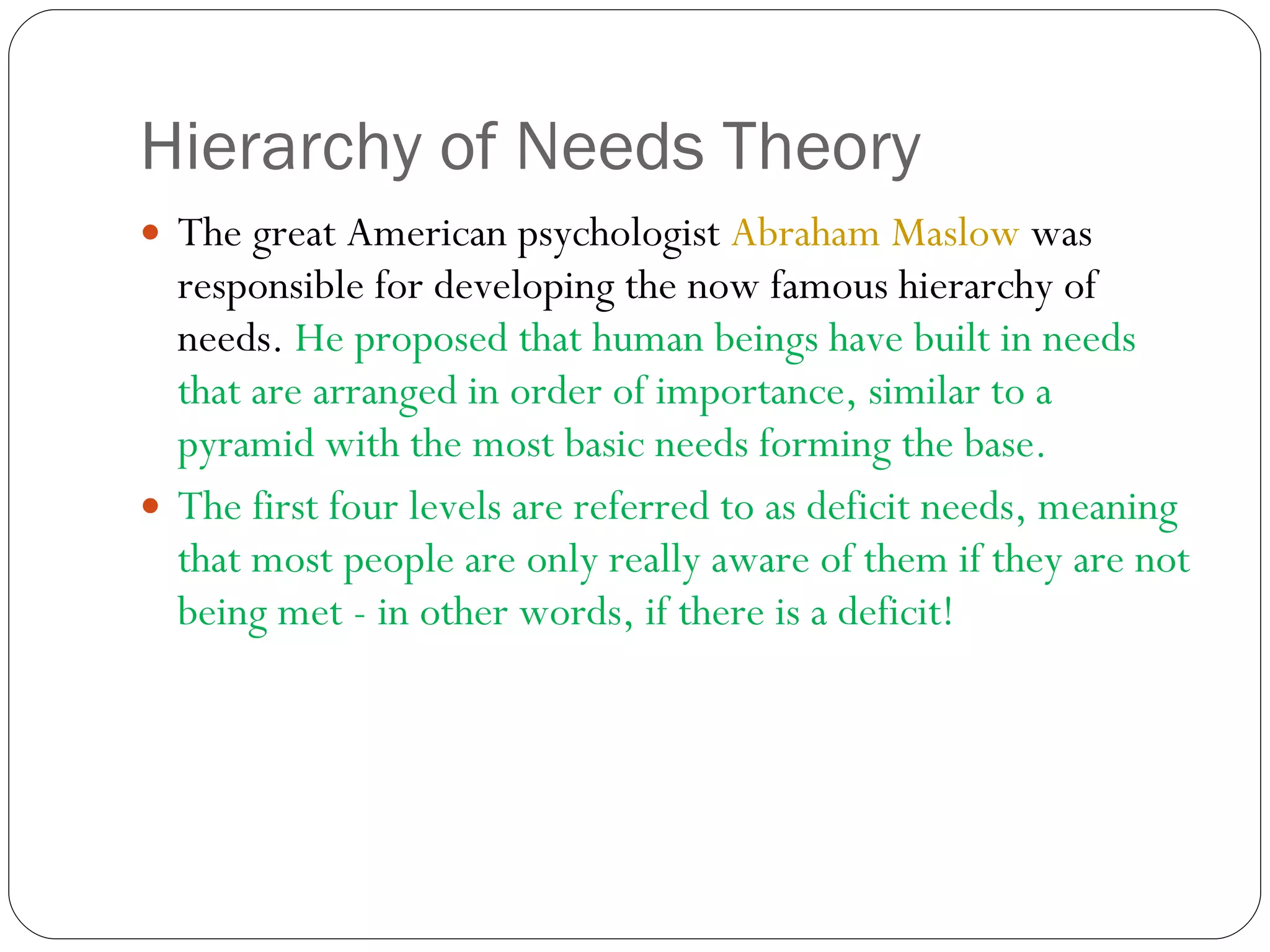
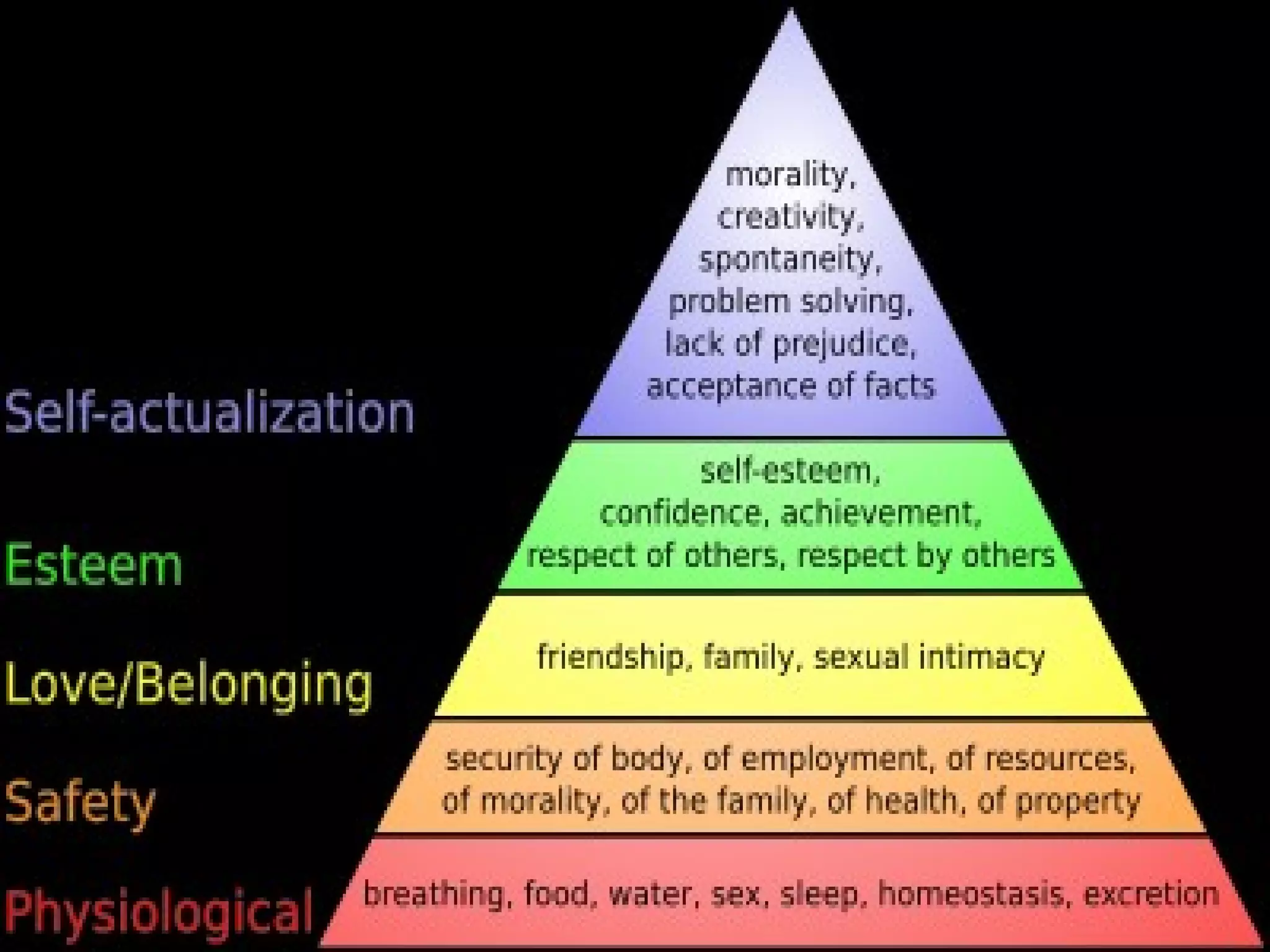
Hierarchy of Needs Theory The great American psychologist  Abraham Maslow  was responsible for developing the now famous hierarchy of needs.  He proposed that human beings have built in needs that are arranged in order of importance, similar to a pyramid with the most basic needs forming the base.  The first four levels are referred to as deficit needs, meaning that most people are only really aware of them if they are not being met - in other words, if there is a deficit!
 
Theory X  ('Authoritarian Management' Style) The average person dislikes work and will avoid it he/she can. Therefore most people must be forced with the threat of  punishment to work towards organizational objectives. The average person prefers to be directed; to avoid responsibility; is relatively unambitious, and wants security above all else.
Theory - y  ('Participative Management' Style) Effort in work is as natural as work and play. People will apply self-control and self-direction in the pursuit of organizational objectives, without external control or the threat of punishment. Commitment to objectives is a function of rewards associated with their achievement. People  usually  accept and often seek responsibility. The capacity to use a high degree of imagination, ingenuity and creativity in solving organizational problems is widely, not narrowly, distributed in the population. In industry the intellectual potential of the average person is only partly utilized.
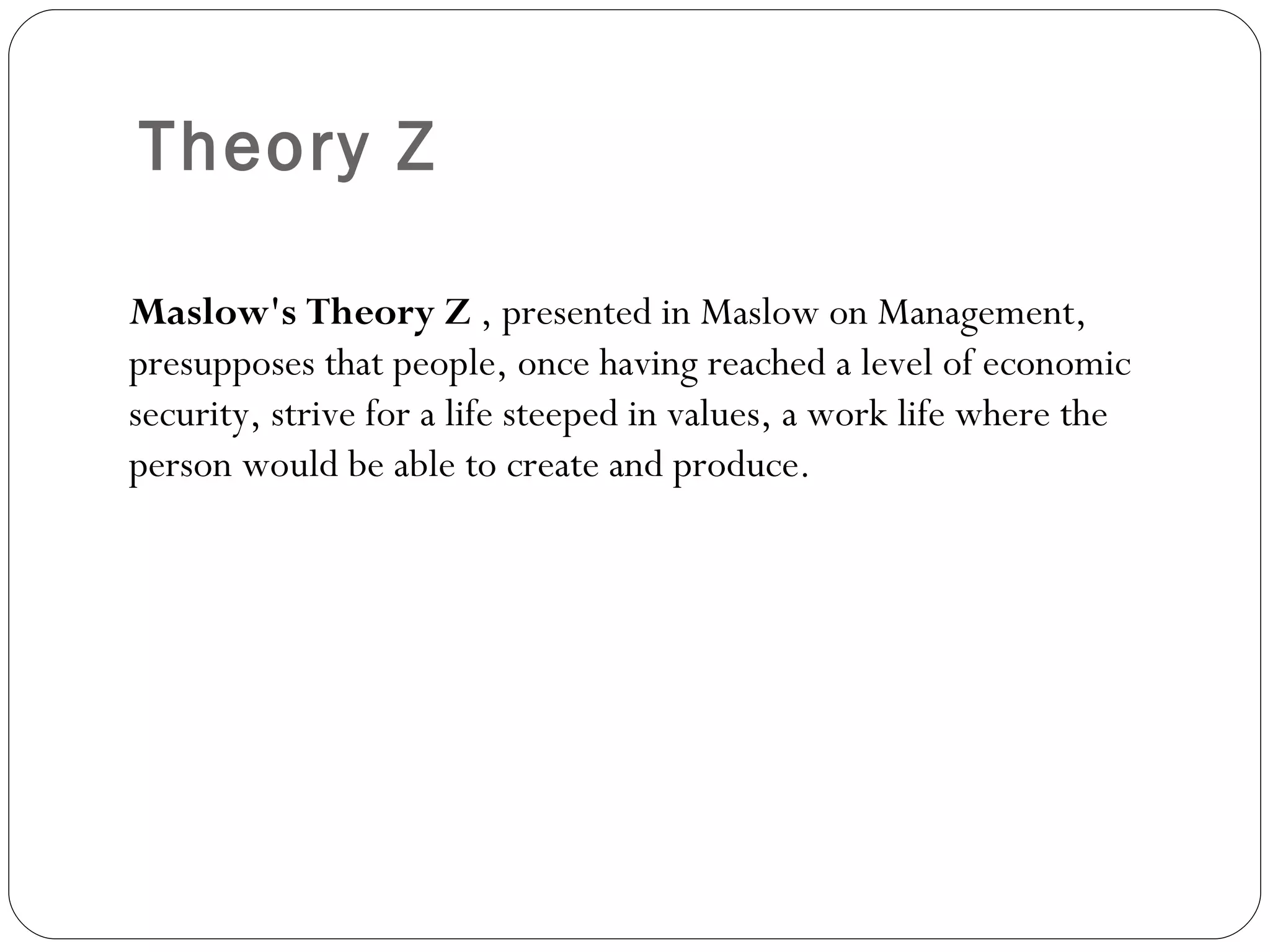
Theory Z Maslow's Theory Z  , presented in Maslow on Management, presupposes that people, once having reached a level of economic security, strive for a life steeped in values, a work life where the person would be able to create and produce.
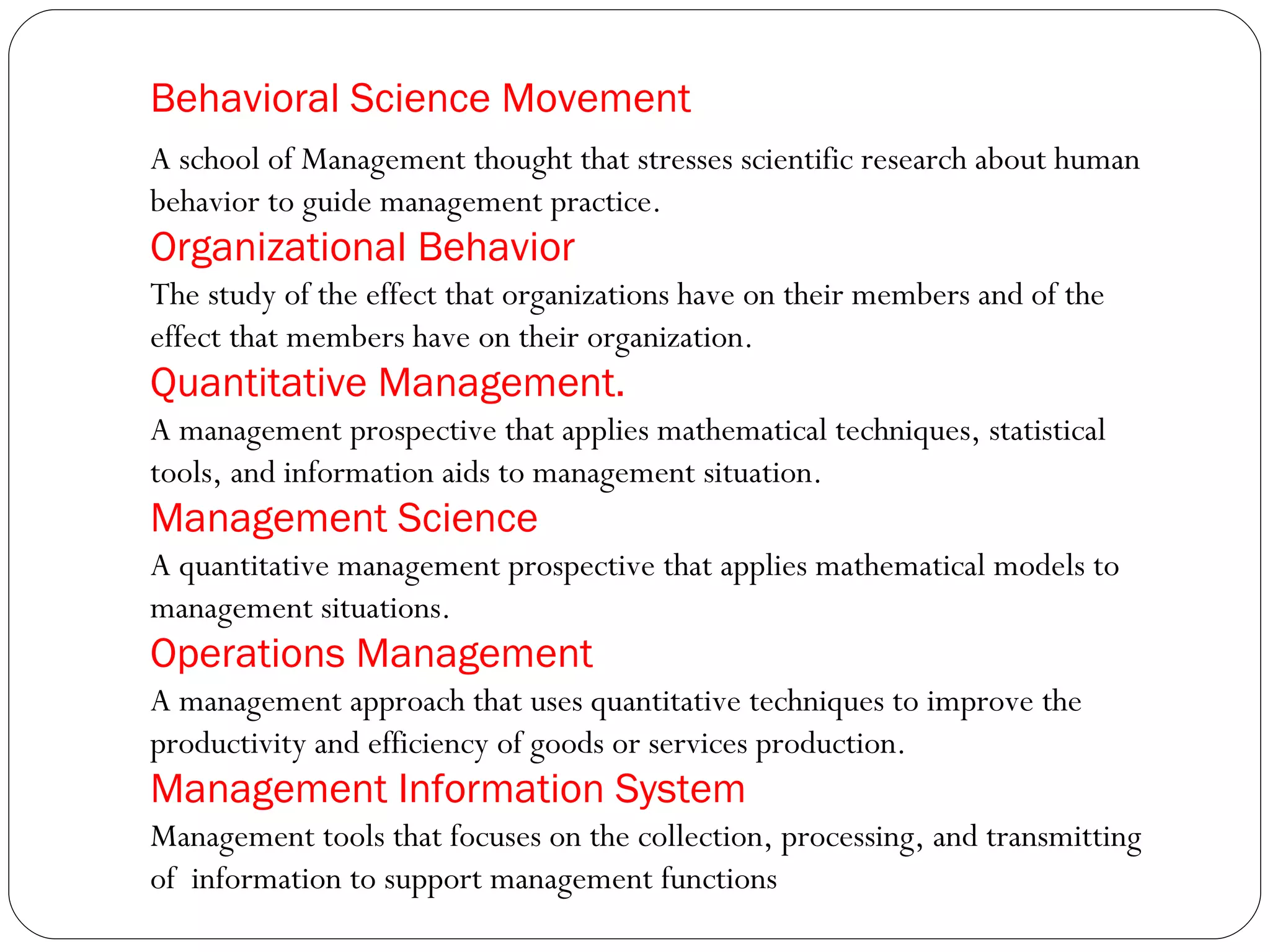
Behavioral Science Movement A school of Management thought that stresses scientific research about human behavior to guide management practice. Organizational Behavior The study of the effect that organizations have on their members and of the effect that members have on their organization. Quantitative Management. A management prospective that applies mathematical techniques, statistical tools, and information aids to management situation. Management Science A quantitative management prospective that applies mathematical models to management situations. Operations Management A management approach that uses quantitative techniques to improve the productivity and efficiency of goods or services production. Management Information System Management tools that focuses on the collection, processing, and transmitting of  information to support management functions
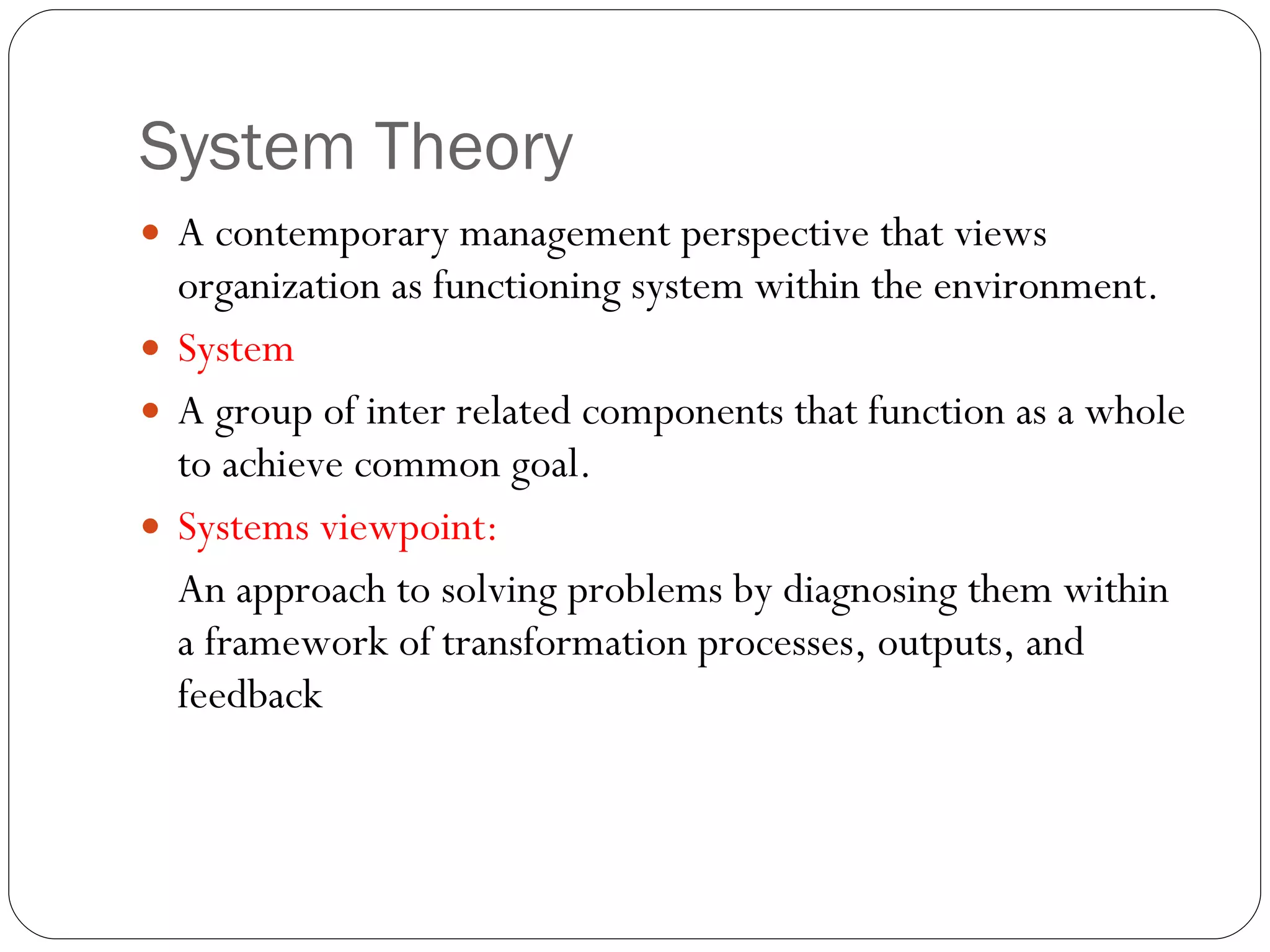
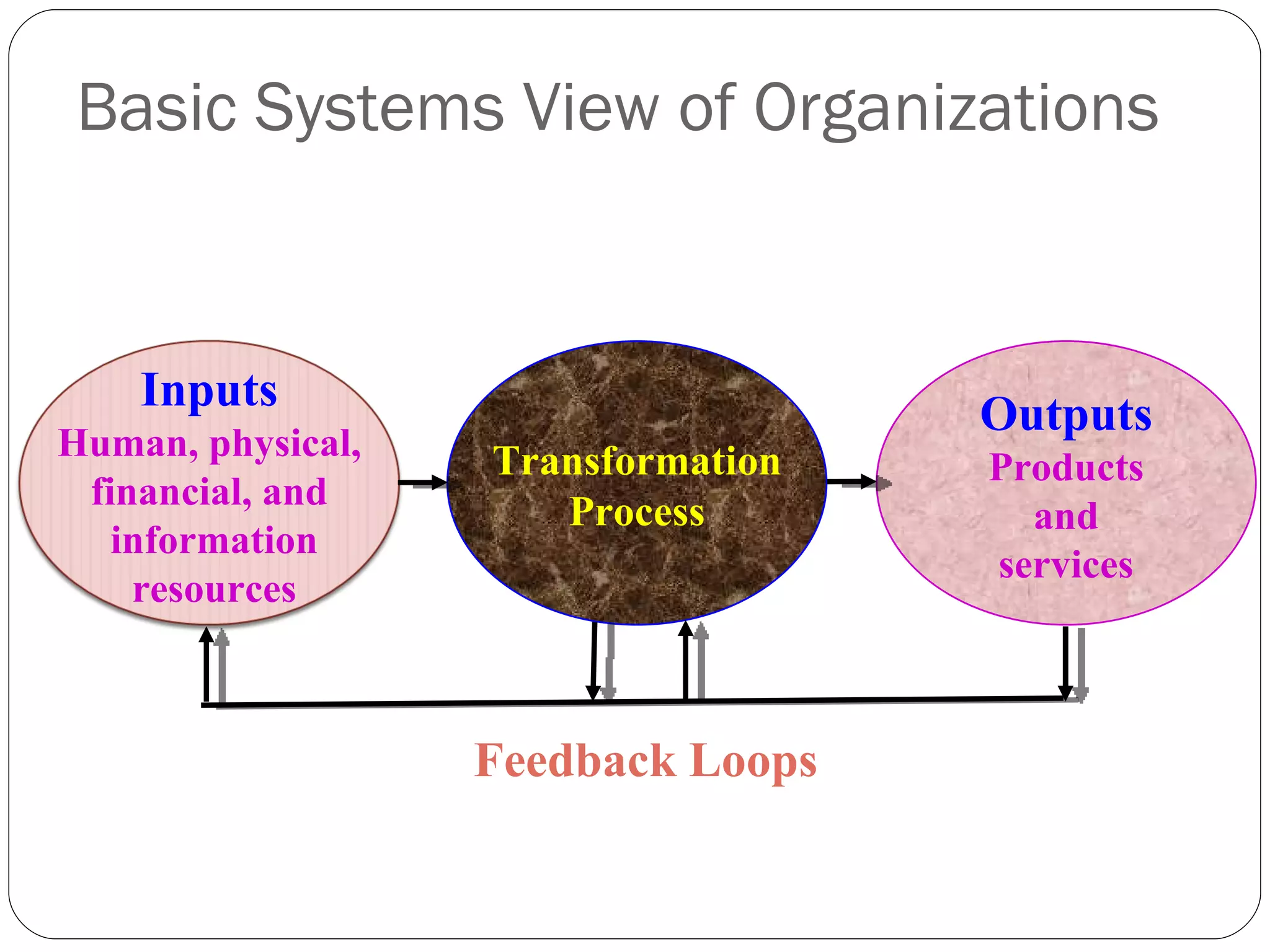
System Theory A contemporary management perspective that views organization as functioning system within the environment. System  A group of inter related components that function as a whole to achieve common goal. Systems viewpoint:  An approach to solving problems by diagnosing them within a framework of transformation processes, outputs, and feedback
Transformation Process Outputs Products and services Feedback Loops Basic Systems View of Organizations Inputs Human, physical, financial, and  information  resources
System Types Closed system:   Limits its interactions with the environment (e.g., stamping department in GM assembly plant ) Open system:  Interacts with the external environment (e.g., marketing department)
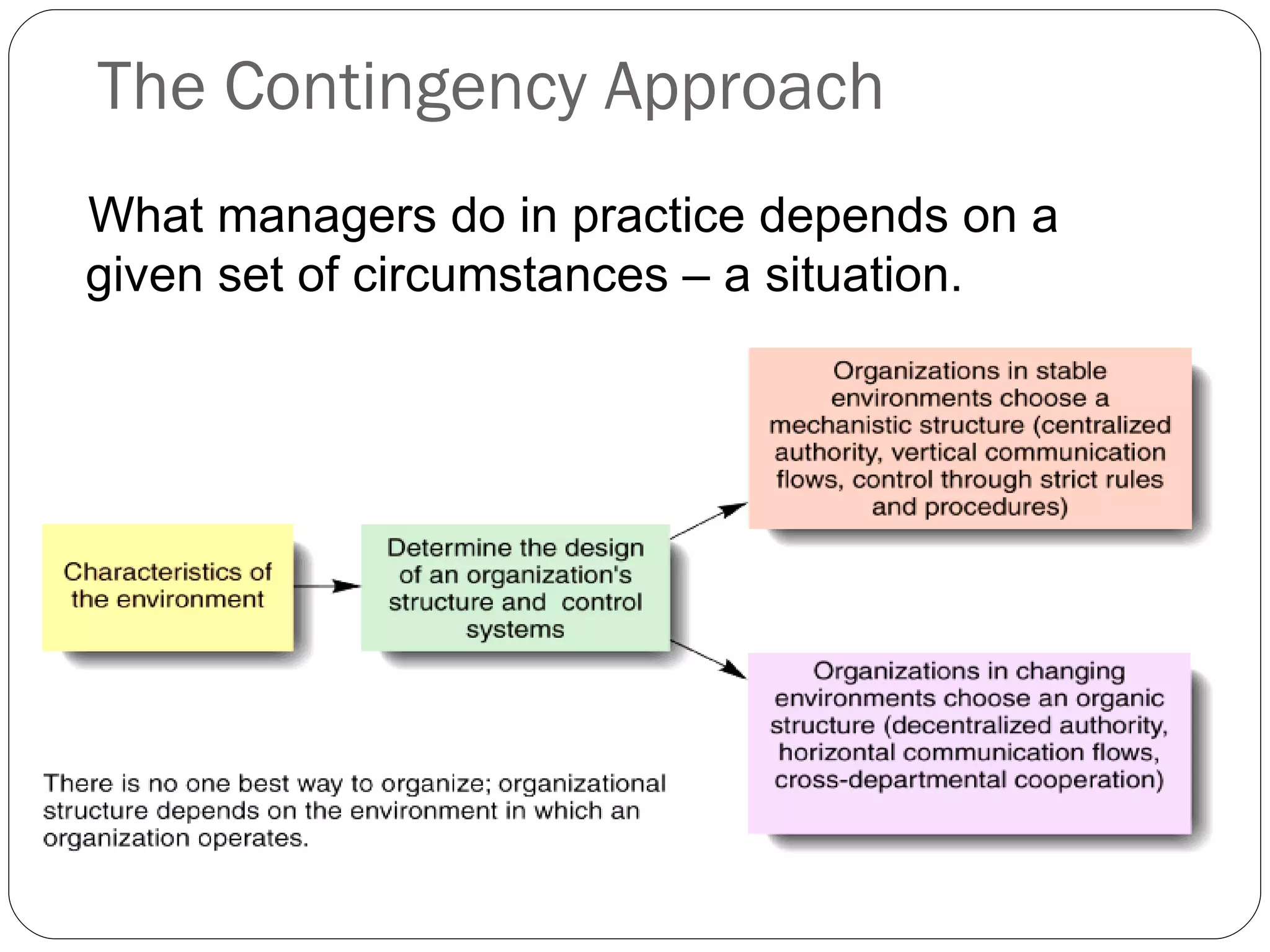
The Contingency Approach What managers do in practice depends on a given set of circumstances – a situation.
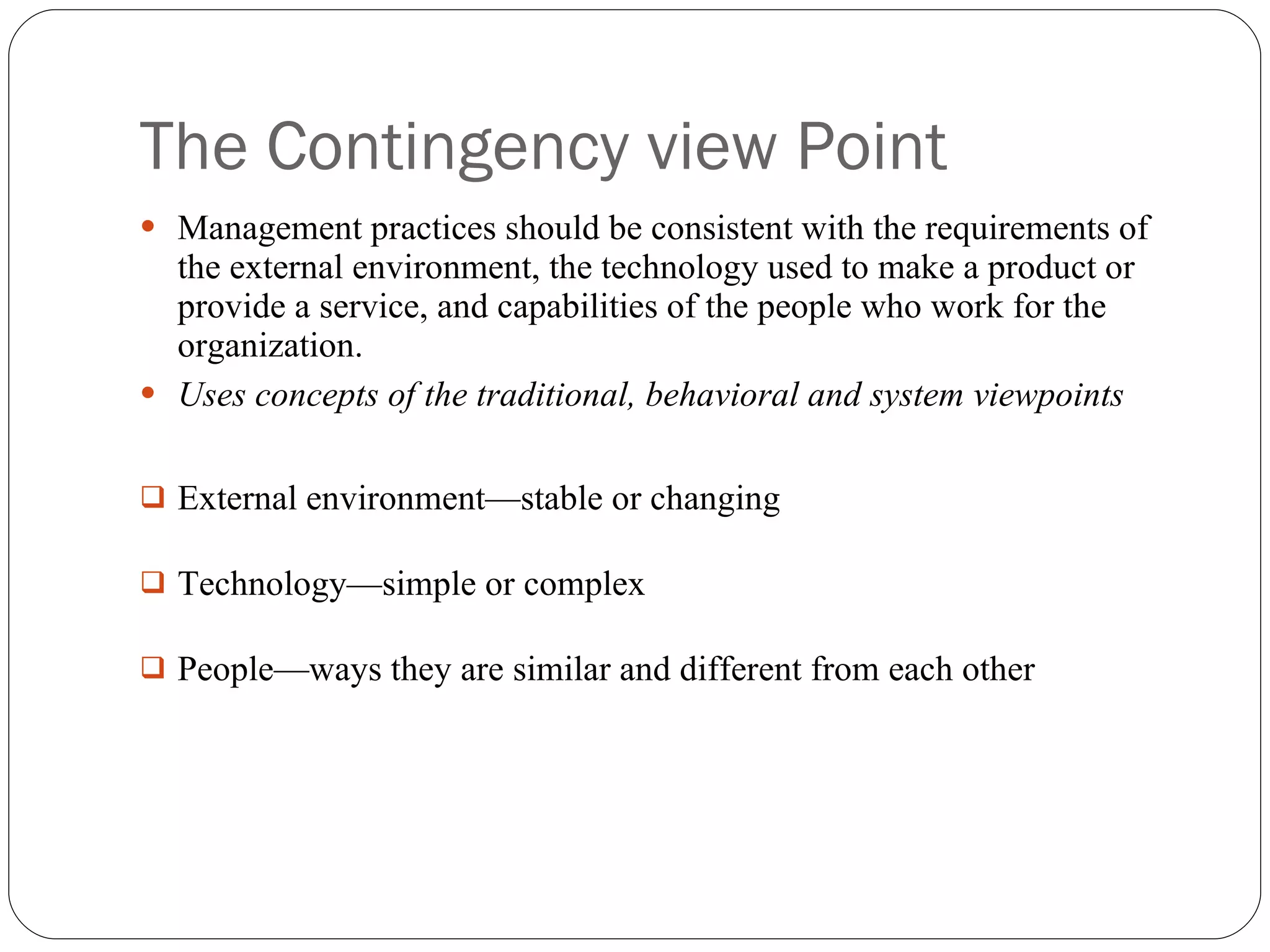
The Contingency view Point Management practices should be consistent with the requirements of the external environment, the technology used to make a product or provide a service, and capabilities of the people who work for the organization. Uses concepts of the traditional, behavioral and system viewpoints External environment—stable or changing Technology—simple or complex People—ways they are similar and different from each other
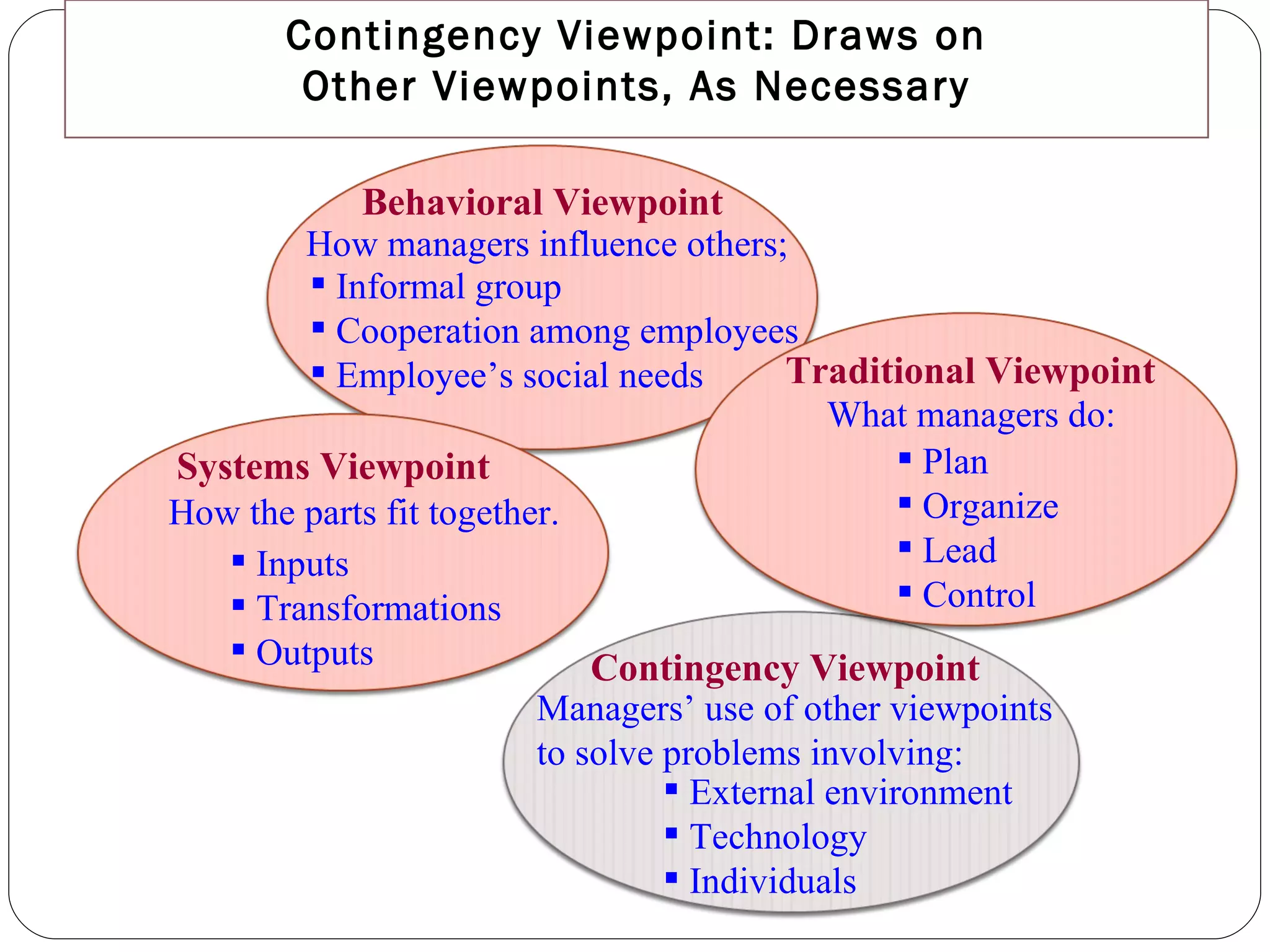
Behavioral Viewpoint How managers influence others; Informal group Cooperation among employees Employee’s social needs Systems Viewpoint How the parts fit together. Inputs Transformations Outputs Traditional Viewpoint What managers do: Plan Organize Lead Control Contingency Viewpoint Managers’ use of other viewpoints to solve problems involving: External environment Technology Individuals Contingency Viewpoint: Draws on Other Viewpoints, As Necessary
Keeping Smile…………… Asghar Ali Narejo Contact: 0300-3141046 E-mail:  [email_address] ANEES HASSAN SCIENCE COLLEGE HYDERABD

Management thought.l2

  • 1.
    Principles of ManagementANEES HASSAN SCIENCE COLLEGE HYDERABAD Asghar Ali Narejo
  • 2.
    Evolution of ManagementManagement, as a concept as we know it today, is associated with ‘mass consumption’ – leading to production of ‘standardized’ goods in large volumes; Prior to the “Industrial Revolution”, man made devices were in use in sizeable numbers – but often one of a kind and crafted rather than manufactured Example: watches and clocks. However, many of the supportive processes can be traced to early roots: logistics, scheduling Example: boat building; automation. Example: printing. The advent of the management as a science can therefore be traced to late 18 th /early 19 th century.
  • 3.
    Elements of modernmanagement, with a focus on ‘man’ i.e. HR concepts first began to appear in the West around the same time: as a reaction to the harsh behaviour of autocratic businessmen like Henry Ford. It evolved through ‘(labour) Welfare’, ‘Industrial Relations’, ‘Personnel Management’ to its current form. (Marxism was becoming a recognizable philosophy in Europe!); as a need to utilize human resource better due the adverse supply-demand situation. Employment in the ‘industry’ had overtaken agricultural labour. This was aggravated in Europe, by WW I. In the 20’s, Rationalization & Efficiency were the buzz-words (Taylor, Fayol etc.), calling for a scientific approach to selection and work allocation – the corner-stones of modern production management: Standardization of parts and work elements resulted in ability to make work repetitive for individuals (‘do-ers’)
  • 4.
    End of WWII brought in an era of un-sated demand, resulting in a boom for production activity – more of everything was required. Quantity backed by efficiency were the guiding principles: an era of ‘Optimization’ driven by suppliers’ choice rather than customers’ wants. However, some people – notably Japan – restarted their devastated economy with different orientation: Quality. The key was true economy of all resources with the customer as the focal point – since they did not have the luxury of a surplus funded, hungry market. By the late 60’s, demand tended to slow down and the growing competition gave customers greater choice – ‘quality’ as an important buying criterion emerged. OPEC crisis in mid-70’s turned the world around on its head! Energy the prime mover of industrial world became very expensive. The demand boom faded – with customers demanding quality and lower prices and better service.
  • 5.
    First inventions of‘mass production’ were linked to textile manufacturing (Spinning Jenny/ Hargreaves) – which combined with use of water power (Arkwright), made a powerful social impact in the late 1700s; Watt’s steam engine completely revolutionized harnessing of mechanical power for production (first to use were cotton mills) and transport; Poor Reliability of early machines led to the creation of machine tools – the Lathe (Maudslay) in 1790, with which to turnout parts to closer tolerances and fit. This led to creation of ‘interchangeable parts’ – and the first uses were in manufacture of muskets and pistols! These were the triggers for ‘ mass production ’ : mechanical power & interchangeable parts ; leading to production moving away from homes and craft-shops to work-shops / factories. By 1900 (in the West), nearly everything was being produced by the factory system.
  • 6.
    Division of Labour: under this principle, work could be organized/grouped into a set of specific, related tasks – which were repetitive in nature. Man could be trained to perform this set of tasks only, so that efficiency of task performance was maximized. When extended throughout the organization, this took the form of ‘Specialization’ - with the organization benefiting from the maximum use of specialist skills. Both economically and under supply-shortage conditions, this worked well. Much of this was an extension of trade/craft skill-groups organization (guilds) which was the hallmark of pre-industrial ‘production’. Till the end of the 30’s, these fundamentals were refined, polished(e.g. Organization structures) and extended ( e.g. work-measurements) in a relentless focus on efficiency . With WW II, a further need for reliability gave birth to the principles of sampling & inspection – statistical methods were introduced to regulate quality of output .
  • 7.
    This brought tothe forefront the philosophy and practice of Total Quality as the guiding force for manufacturing – later to spread into management of operations and enterprises: Central to this theme is the dominance of the Customer ; Customers were any person or person receiving goods and/or services – internal or external; Quality was redefined as ‘ fitness for use ’ – elevated from the narrow confines of conformance to specifications; Continuous improvement was the key to continuity and success against demands of customer and competition; importantly, everybody could contribute – quality is every- body’s business; Particularly, for production, quality means best products at least cost – reduced waste of all resources, spawning a host of (linked) programs to conserve time, money & effort: Just – in – Time, SMED/OTED; Lean manufacturing; Q-circles/Kaizen/6-sigma; 5-S, TPM, DoE;
  • 8.
    History of ManagementThoughts Traditional Viewpoint Behavioral Viewpoint Systems Viewpoint Contingency Viewpoint Quality Viewpoint 1890 1900 1910 1920 1930 1940 1950 1960 1970 1980 1990 2000
  • 9.
    Administrative Management BureaucraticManagement Scientific Management Goals: Efficiency Consistency
  • 10.
    Classical Management A set of Management Theories that focus on the increasing the efficiency of the organization as a whole.
  • 11.
    Scientific Management AManagement prospective that focuses on the rational Scientific Study of work situation to improve employee efficiency. Contributors : Frederick W. Taylor Frank and Lillian Gilbreth Henry Gantt Harrington Emerson
  • 12.
    Frederick W. Taylor (1856-1915) He is known as the father of the Scientific Management sought one best way to accomplish the work task most efficiently. Time and motion study The examination of the physical movements and the time involved in completing task. Wrote book Principles of Scientific Management
  • 13.
    Frank and LillianGilbreth (1878-1972) Bothe were an early advocates of Scientific Management and a pioneer of Motion Study , but are perhaps best known as the father and central figure of Cheaper by the Dozen .
  • 14.
    Henry Gantt (1861 – 23 November 1919) He was an American Mechanical Engineer and Management Consultant who is most famous for developing the Gantt Chart in the 1910s. These Gantt charts were employed on major infrastructure projects including the Hoover Dam and Interstate Highway system and continue to be an important tool in Project Management .
  • 15.
    Harrington Emerson Harrington Emerson contributed to the systems efficiency focus of industrial engineering. His book Twelve Principles of Efficiency was classic.   He discussed efficiency design of organization through 12 principles   1. Clearly defined ideals. 2. Common sense 3. Competent counsel 4. Discipline 5. The fair deal 6. Reliable, immediate and adequate records 7. Dispatching 8. Standards and schedules 9. Standardized conditions 10. Standardized operations 11. Written standard-practice instructions 12. Efficiency-reward
  • 16.
    Administrative Management Amanagement approach that stresses the functional aspects of the organization and management by planning, organizing, leading and controlling. Contributors: Henry Fayol Max Weber Chester Barnard Lyndal Urwick and Luther Gulick
  • 17.
    Henri Fayol ( Istanbul , 29 July 1841– Paris , 19 November 1925) He was a French mining engineer and director of mines who developed a general theory of business administration . He and his colleagues developed this theory independently of scientific management but roughly contemporaneously. He was one of the most influential contributors to modern concepts of management .
  • 18.
  • 19.
    Management Principles: Developedby Henri Fayol:   Specialization of labor. Specializing encourages continuous improvement in skills and the development of improvements in methods. Authority. The right to give orders and the power to exact obedience. Discipline . No slacking, bending of rules. Unity of command . Each employee has one and only one boss. Unity of direction . A single mind generates a single plan and all play their part in that plan. Subordination of Individual Interests . When at work, only work things should be pursued or thought about. Remuneration . Employees receive fair payment for services, not what the company can get away with. Centralization. Consolidation of management functions. Decisions are made from the top. Scalar Chain (line of authority). Formal chain of command running from top to bottom of the organization, like military.
  • 20.
    Conti……. Order .All materials and personnel have a prescribed place, and they must remain there. Equity. Equality of treatment (but not necessarily identical treatment) Personnel Tenure. Limited turnover of personnel. Lifetime employment for good workers. Initiative . Thinking out a plan and do what it takes to make it happen. Esprit de corps . Harmony, cohesion among personnel
  • 21.
    Max Weber & Bureaucracy (1864-1920) A management approach that emphasizes a structured organization in which positions and authority are defined according to formal rules. According to Max Weber’s bureaucracy management authority is vested in the organizational position rather than in the particular person occupying that position.
  • 22.
    Chester Barnard Peopleshould continuously communicate and cooperate with one another Acceptance theory of authority holds that employees have free wills and, thus, choose whether to follow management’s orders. Employees will follow orders if they: Understand what is required Believe the orders are consistent with organization goals See positive benefits to themselves in carrying out the orders
  • 23.
  • 24.
    Lyndal Urwick andLuther Gulick The worked together and designed it according to acronym POSDCORB. Planning Organizing Staffing Directing Coordinating Reporting Budgeting Their work was an important step in principles of Scientific Management with the thinking of Weber and Fayol.
  • 25.
    Mary Parker Follett(1868-1933) Her theory of management encouraged a fair hearing of disputes and saw diversity of opinion as a positive, not negative factor, for which she is sometimes remembered as the "mother of conflict resolution".
  • 26.
    Managers need toestablish good working relationships with employees Goal: Improve Coordination Managers need to communicate with workers
  • 27.
    Hawthorne Studies Studiesof how characteristics of the work setting affected worker fatigue and performance at the Hawthorne Works of the Western Electric Company from 1924-1932. Worker productivity was measured at various levels of light illumination. Researchers found that regardless of whether the light levels were raised or lowered, worker productivity increased.
  • 28.
    Human Relation MovementA management prospective that views employees as responding to the interpersonal processes within the work unit.
  • 29.
    Hierarchy of NeedsTheory The great American psychologist Abraham Maslow was responsible for developing the now famous hierarchy of needs. He proposed that human beings have built in needs that are arranged in order of importance, similar to a pyramid with the most basic needs forming the base. The first four levels are referred to as deficit needs, meaning that most people are only really aware of them if they are not being met - in other words, if there is a deficit!
  • 30.
  • 31.
    Theory X ('Authoritarian Management' Style) The average person dislikes work and will avoid it he/she can. Therefore most people must be forced with the threat of punishment to work towards organizational objectives. The average person prefers to be directed; to avoid responsibility; is relatively unambitious, and wants security above all else.
  • 32.
    Theory - y ('Participative Management' Style) Effort in work is as natural as work and play. People will apply self-control and self-direction in the pursuit of organizational objectives, without external control or the threat of punishment. Commitment to objectives is a function of rewards associated with their achievement. People usually accept and often seek responsibility. The capacity to use a high degree of imagination, ingenuity and creativity in solving organizational problems is widely, not narrowly, distributed in the population. In industry the intellectual potential of the average person is only partly utilized.
  • 33.
    Theory Z Maslow'sTheory Z , presented in Maslow on Management, presupposes that people, once having reached a level of economic security, strive for a life steeped in values, a work life where the person would be able to create and produce.
  • 34.
    Behavioral Science MovementA school of Management thought that stresses scientific research about human behavior to guide management practice. Organizational Behavior The study of the effect that organizations have on their members and of the effect that members have on their organization. Quantitative Management. A management prospective that applies mathematical techniques, statistical tools, and information aids to management situation. Management Science A quantitative management prospective that applies mathematical models to management situations. Operations Management A management approach that uses quantitative techniques to improve the productivity and efficiency of goods or services production. Management Information System Management tools that focuses on the collection, processing, and transmitting of information to support management functions
  • 35.
    System Theory Acontemporary management perspective that views organization as functioning system within the environment. System A group of inter related components that function as a whole to achieve common goal. Systems viewpoint: An approach to solving problems by diagnosing them within a framework of transformation processes, outputs, and feedback
  • 36.
    Transformation Process OutputsProducts and services Feedback Loops Basic Systems View of Organizations Inputs Human, physical, financial, and information resources
  • 37.
    System Types Closedsystem: Limits its interactions with the environment (e.g., stamping department in GM assembly plant ) Open system: Interacts with the external environment (e.g., marketing department)
  • 38.
    The Contingency ApproachWhat managers do in practice depends on a given set of circumstances – a situation.
  • 39.
    The Contingency viewPoint Management practices should be consistent with the requirements of the external environment, the technology used to make a product or provide a service, and capabilities of the people who work for the organization. Uses concepts of the traditional, behavioral and system viewpoints External environment—stable or changing Technology—simple or complex People—ways they are similar and different from each other
  • 40.
    Behavioral Viewpoint Howmanagers influence others; Informal group Cooperation among employees Employee’s social needs Systems Viewpoint How the parts fit together. Inputs Transformations Outputs Traditional Viewpoint What managers do: Plan Organize Lead Control Contingency Viewpoint Managers’ use of other viewpoints to solve problems involving: External environment Technology Individuals Contingency Viewpoint: Draws on Other Viewpoints, As Necessary
  • 41.
    Keeping Smile…………… AsgharAli Narejo Contact: 0300-3141046 E-mail: [email_address] ANEES HASSAN SCIENCE COLLEGE HYDERABD