Evolution Of Microprocessor Based 
由NordriDesign™提供 
www.nordridesign.com 
System 
By Aneeta S Antony
Page 2 
LOGO 
 The Natural Evolution of microcomputer based system 
instrument is toward more intelligent devices. 
 More and more memory is being squeezed into smaller 
and smaller spaces (IC's) 
 Just like Laptops Battery powered patient worn portable 
instrument is getting commercial. 
 The PC has become a powerful tool in biomedical 
computing applications. 
 There's possibility that in future instruments be developed 
which at one time couldn't be developed due to size, cost, 
or power consumptions.
Page 3 
LOGO 
 Evolution of microcomputer based medical instruments has 
followed evolution of microprocessor itself 
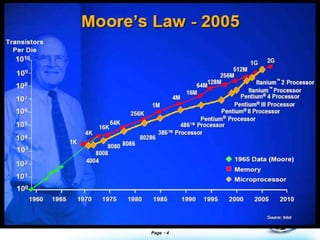
 According to Moore the number of transistors that could be put 
on a single chip doubled every two years. 
 PC itself has become a powerful tool in biomedical 
computing requirements as development of the biomedical 
equipments went on in parallel with the microprocessor. 
 In near future many new medical instruments would be 
developed which could address many problems that couldn't 
be addressed earlier all this would be possible because of the 
rapid development of microprocessor and its continuous 
evolution in terms of decreased size cost and power and 
increased memory and computing power.
Page 4 
LOGO
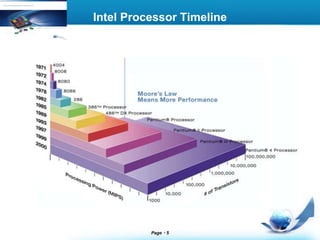
LOGO Intel Processor Timeline 
Page 5
LOGO EVOLUTION OF PERSONAL COMPUTER 
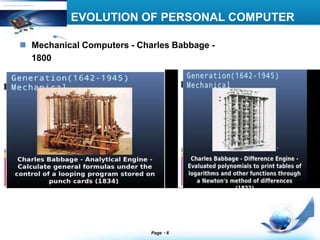
 Mechanical Computers - Charles Babbage - 
Page 6 
1800
Page 7 
LOGO 
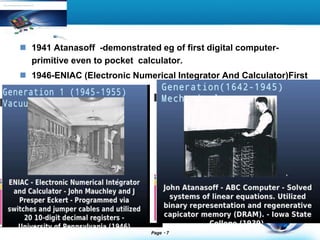
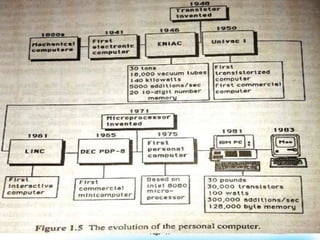
 1941 Atanasoff -demonstrated eg of first digital computer-primitive 
even to pocket calculator. 
 1946-ENIAC (Electronic Numerical Integrator And Calculator)First 
serious Digital Computer.
Page 8 
LOGO 
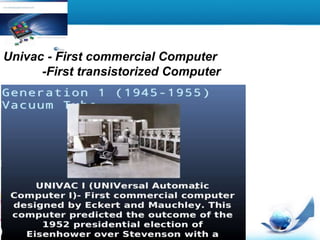
Univac - First commercial Computer 
-First transistorized Computer
Page 9 
LOGO 
-LINC (Laboratory Instrument Computer ).Idea behind this 
was to transform a general purpose computer to a 
laboratory instrument for biomedical applications. 
).Idea behind this was to transform a general purpose 
computer to a laboratory instrument for biomedical 
applications. 
This was done by reprogramming it. 
-Most Successful one 
-First Interactive one 
eg. An ECG could be captured and displayed directly 
-It would have been the first PC if it were smaller and 
costed less 
-First Game Computer
Page 10 
LOGO 
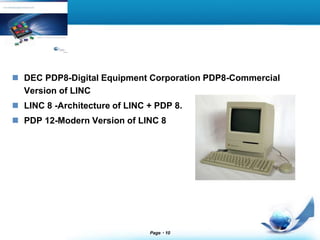
 DEC PDP8-Digital Equipment Corporation PDP8-Commercial 
Version of LINC 
 LINC 8 -Architecture of LINC + PDP 8. 
 PDP 12-Modern Version of LINC 8
Page 11 
LOGO
LOGO UBIQUITOUS PC (Present Everywhere 
Page 12 
Common)PC 
•Historical Landmark IBM's 8 bit Zilog Z80 with OS 
called CP/M 
•It's Disadvantage of having no standard way to format 
•a floppy disk to transfer data from one company's PC 
to other, 
•was overcome by the 16 bit Intel 8080 processor, 
DOS and an uniform floppy disk operator. 
•First IBM PC 1981 used Intel 8088 which provided 
0.1MIPS 
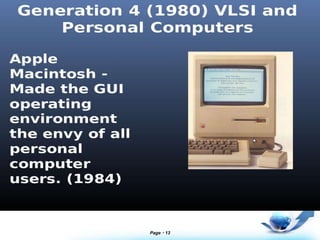
•Apple's Macintosh was introduced with GUI
Page 13 
LOGO
LOGO Relation between cost and computing 
Page 14 
power 
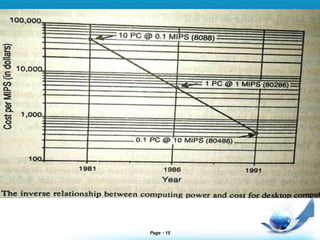
 Inverse Relation 
 Initially 10 PCs each of $ 5000 i.e. 50000$ was required to 
provide 1MIPS 
 With IBMPC/AT with Intel 80286 provided 1MIPS using 1 PC of 
$5000 
 Intel i486 delivers 10 MIPS for same $5000 
 From historical data cost per MIPS is decreasing 
logarithmically 
 Present eg Intel core i7 920(Quad core) 82,300 MIPS at 2.93 GHz
Page 15 
LOGO
Page 16 
LOGO 
Number of components in a PC decrease with increase 
in computing performance 
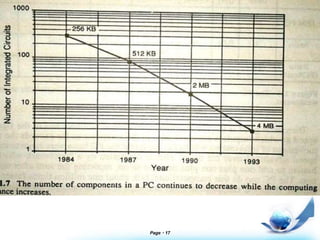
 Number of components in a fully functional PC has decreased 
logarithmically 
 To illustrate this in 1983 300 IC's were required in each PC 
today a PC can be built with 18 IC's. 
 Number Of Bits 
 1970's - 8 bit processors 
 1980's -16 bit processors 
 1990's -32 bit processors 
 2000 -64 bit processors
Page 17 
LOGO
Page 18 
LOGO
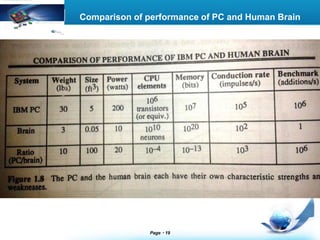
LOGO Comparison of performance of PC and Human Brain 
Page 19
Page 20 
LOGO 
Example of ECG 
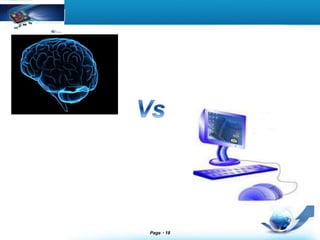
Brain Vs Computer.
21
22

Evolution of Microprocessors

  • 1.
    Evolution Of MicroprocessorBased 由NordriDesign™提供 www.nordridesign.com System By Aneeta S Antony
  • 2.
    Page 2 LOGO  The Natural Evolution of microcomputer based system instrument is toward more intelligent devices.  More and more memory is being squeezed into smaller and smaller spaces (IC's)  Just like Laptops Battery powered patient worn portable instrument is getting commercial.  The PC has become a powerful tool in biomedical computing applications.  There's possibility that in future instruments be developed which at one time couldn't be developed due to size, cost, or power consumptions.
  • 3.
    Page 3 LOGO  Evolution of microcomputer based medical instruments has followed evolution of microprocessor itself  According to Moore the number of transistors that could be put on a single chip doubled every two years.  PC itself has become a powerful tool in biomedical computing requirements as development of the biomedical equipments went on in parallel with the microprocessor.  In near future many new medical instruments would be developed which could address many problems that couldn't be addressed earlier all this would be possible because of the rapid development of microprocessor and its continuous evolution in terms of decreased size cost and power and increased memory and computing power.
  • 4.
  • 5.
    LOGO Intel ProcessorTimeline Page 5
  • 6.
    LOGO EVOLUTION OFPERSONAL COMPUTER  Mechanical Computers - Charles Babbage - Page 6 1800
  • 7.
    Page 7 LOGO  1941 Atanasoff -demonstrated eg of first digital computer-primitive even to pocket calculator.  1946-ENIAC (Electronic Numerical Integrator And Calculator)First serious Digital Computer.
  • 8.
    Page 8 LOGO Univac - First commercial Computer -First transistorized Computer
  • 9.
    Page 9 LOGO -LINC (Laboratory Instrument Computer ).Idea behind this was to transform a general purpose computer to a laboratory instrument for biomedical applications. ).Idea behind this was to transform a general purpose computer to a laboratory instrument for biomedical applications. This was done by reprogramming it. -Most Successful one -First Interactive one eg. An ECG could be captured and displayed directly -It would have been the first PC if it were smaller and costed less -First Game Computer
  • 10.
    Page 10 LOGO  DEC PDP8-Digital Equipment Corporation PDP8-Commercial Version of LINC  LINC 8 -Architecture of LINC + PDP 8.  PDP 12-Modern Version of LINC 8
  • 11.
  • 12.
    LOGO UBIQUITOUS PC(Present Everywhere Page 12 Common)PC •Historical Landmark IBM's 8 bit Zilog Z80 with OS called CP/M •It's Disadvantage of having no standard way to format •a floppy disk to transfer data from one company's PC to other, •was overcome by the 16 bit Intel 8080 processor, DOS and an uniform floppy disk operator. •First IBM PC 1981 used Intel 8088 which provided 0.1MIPS •Apple's Macintosh was introduced with GUI
  • 13.
  • 14.
    LOGO Relation betweencost and computing Page 14 power  Inverse Relation  Initially 10 PCs each of $ 5000 i.e. 50000$ was required to provide 1MIPS  With IBMPC/AT with Intel 80286 provided 1MIPS using 1 PC of $5000  Intel i486 delivers 10 MIPS for same $5000  From historical data cost per MIPS is decreasing logarithmically  Present eg Intel core i7 920(Quad core) 82,300 MIPS at 2.93 GHz
  • 15.
  • 16.
    Page 16 LOGO Number of components in a PC decrease with increase in computing performance  Number of components in a fully functional PC has decreased logarithmically  To illustrate this in 1983 300 IC's were required in each PC today a PC can be built with 18 IC's.  Number Of Bits  1970's - 8 bit processors  1980's -16 bit processors  1990's -32 bit processors  2000 -64 bit processors
  • 17.
  • 18.
  • 19.
    LOGO Comparison ofperformance of PC and Human Brain Page 19
  • 20.
    Page 20 LOGO Example of ECG Brain Vs Computer.
  • 21.
  • 22.