EVOLUTION OF DIGITAL LOGIC
FAMILY
PRESENTED BY
1. ANIK, ANIRBAN SAHA 18-36207-
1
2. DATTA, BISHOWJIT 18-37372-
1
3. RAYHAN, MD. ABU MASUM 18-37219-
1
4. SHARMA, ANINDA KUMAR 17-35513-
3
INTRODUCTION
IN COMPUTER ENGINEERING, A LOGIC FAMILY MAY REFER TO
ONE OF TWO RELATED CONCEPTS. A "LOGIC FAMILY" MAY
ALSO REFER TO A SET OF TECHNIQUES USED TO IMPLEMENT
LOGIC WITHIN VLSI INTEGRATED CIRCUITS SUCH AS CENTRAL
PROCESSORS, MEMORIES, OR OTHER COMPLEX FUNCTIONS.
THE MOST COMMON LOGIC FAMILY IN MODERN
SEMICONDUCTOR DEVICES IS METAL–OXIDE–SEMICONDUCTOR
(MOS) LOGIC, DUE TO LOW POWER CONSUMPTION, SMALL
TRANSISTOR SIZES, AND HIGH TRANSISTOR DENSITY.
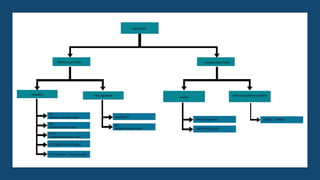
BIPOLAR LOGIC FAMILY(BJT)
THE BIPOLAR JUNCTION TRANSISTOR IS A
SEMICONDUCTOR DEVICE WHICH CAN BE USED
FOR SWITCHING OR AMPLIFICATION.
BIPOLAR JUNCTION TRANSISTOR BJT IS TWO
TYPES:
1. SATURATED
2. NON-SATURATED
SATURATE
D
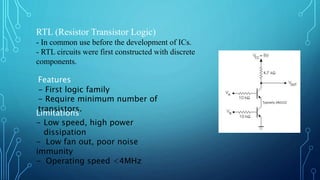
RTL (Resistor Transistor Logic)
- In common use before the development of ICs.
- RTL circuits were first constructed with discrete
components.
Features
- First logic family
- Require minimum number of
transistors.
Limitations
- Low speed, high power
dissipation
- Low fan out, poor noise
immunity
- Operating speed <4MHz
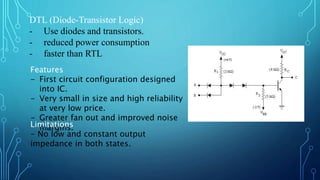
DTL (Diode-Transistor Logic)
- Use diodes and transistors.
- reduced power consumption
- faster than RTL
Features
- First circuit configuration designed
into IC.
- Very small in size and high reliability
at very low price.
- Greater fan out and improved noise
margins.Limitations
- No low and constant output
impedance in both states.
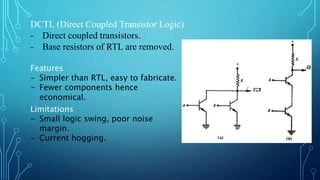
DCTL (Direct Coupled Transistor Logic)
- Direct coupled transistors.
- Base resistors of RTL are removed.
Features
- Simpler than RTL, easy to fabricate.
- Fewer components hence
economical.
Limitations
- Small logic swing, poor noise
margin.
- Current hogging.
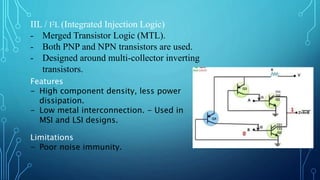
IIL / I2L (Integrated Injection Logic)
- Merged Transistor Logic (MTL).
- Both PNP and NPN transistors are used.
- Designed around multi-collector inverting
transistors.
Features
- High component density, less power
dissipation.
- Low metal interconnection. - Used in
MSI and LSI designs.
Limitations
- Poor noise immunity.
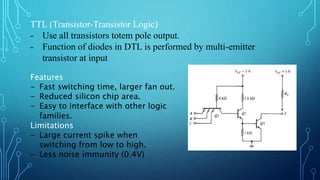
TTL (Transistor-Transistor Logic)
- Use all transistors totem pole output.
- Function of diodes in DTL is performed by multi-emitter
transistor at input
Features
- Fast switching time, larger fan out.
- Reduced silicon chip area.
- Easy to interface with other logic
families.
Limitations
- Large current spike when
switching from low to high.
- Less noise immunity (0.4V)
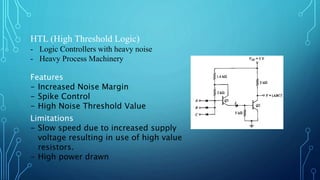
HTL (High Threshold Logic)
- Logic Controllers with heavy noise
- Heavy Process Machinery
Features
- Increased Noise Margin
- Spike Control
- High Noise Threshold Value
Limitations
- Slow speed due to increased supply
voltage resulting in use of high value
resistors.
- High power drawn
NON-
SATURATED
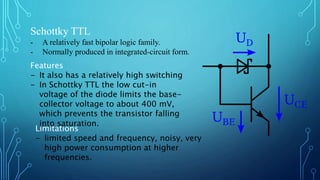
Schottky TTL
- A relatively fast bipolar logic family.
- Normally produced in integrated-circuit form.
Limitations
- limited speed and frequency, noisy, very
high power consumption at higher
frequencies.
Features
- It also has a relatively high switching
- In Schottky TTL the low cut-in
voltage of the diode limits the base-
collector voltage to about 400 mV,
which prevents the transistor falling
into saturation.
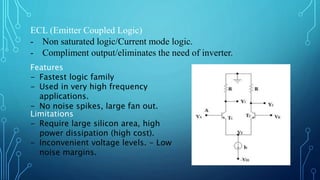
ECL (Emitter Coupled Logic)
- Non saturated logic/Current mode logic.
- Compliment output/eliminates the need of inverter.
Features
- Fastest logic family
- Used in very high frequency
applications.
- No noise spikes, large fan out.
Limitations
- Require large silicon area, high
power dissipation (high cost).
- Inconvenient voltage levels. - Low
noise margins.
UNIPOLAR LOGIC
FAMILY(FET)
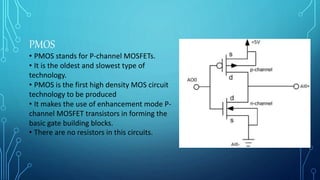
PMOS
• PMOS stands for P-channel MOSFETs.
• It is the oldest and slowest type of
technology.
• PMOS is the first high density MOS circuit
technology to be produced
• It makes the use of enhancement mode P-
channel MOSFET transistors in forming the
basic gate building blocks.
• There are no resistors in this circuits.
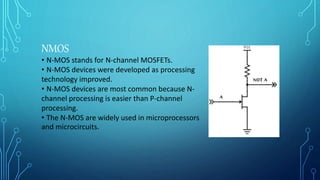
NMOS
• N-MOS stands for N-channel MOSFETs.
• N-MOS devices were developed as processing
technology improved.
• N-MOS devices are most common because N-
channel processing is easier than P-channel
processing.
• The N-MOS are widely used in microprocessors
and microcircuits.
CMOS
• CMOS stands for complementary MOSFETs.
• CMOS devices are chips in which both P-channel
and N-channel enhancement MOSFETs are
connected in a push-pull arrangement.
• CMOS are simple , small in size ,cheaper in
fabrication and consume very little power.
CHARACTERISTICS OF LOGIC FAMILIES
THE MAIN CHARACTERISTICS OF LOGIC FAMILIES
INCLUDE:
- FAN-IN
- FAN-OUT
- POWER DISSIPATION (pd)
- PROPAGATION DELAY (tp)
- NOISE MARGIN
- SPEED-POWER PRODUCT (SPP)
FAN-IN: THE NO OF INPUT OF A GATE THAT CAN BE HANDLED
WITHOUT IMPAIRING ITS NORMAL OPERATION IS KNOWN AS FAN-IN.
FAN-OUT: THE MAXIMUM NO OF DIGITAL INPUT OF LOAD THAT THE
OUTPUT OF SINGLE LOGIC GATE CAN FEED OR DRIVE WITHOUT
IMPAIRING ITS NORMAL OPERATION IS KNOWN AS FAN-OUT.
POWER DISSIPATION: POWER DISSIPATION IS THE POWER CONSUMED
BY THE LOGIC GATES THAT MUST BE AVAILABLE FROM THE POWER
SUPPLY.
PROPAGATION DELAY: TIME TAKEN FOR THE OUTPUT OF A GATE TO
CHANGE AFTER THE INPUT IS APPLIED.
NOISE MARGIN: CIRCUITS ABILITY TO TOLERATE NOISE AT THE INPUT
SIDE IS KNOWN AS NOISE IMMUNITY.
SPEED-POWER PRODUCT: IT MEASURES THE PERFORMANCE OF A
LOGIC CIRCUITS TAKING INTO ACCOUNT THE tP AND Pd.
CONCLUSION
Each logic family has unique electrical and electronics
characteristic so they are unique and we can optimize them in
circuit design by understanding their functionality and
behavior.
THANK
YOU

Evolution of digital logic family

  • 1.
  • 2.
    PRESENTED BY 1. ANIK,ANIRBAN SAHA 18-36207- 1 2. DATTA, BISHOWJIT 18-37372- 1 3. RAYHAN, MD. ABU MASUM 18-37219- 1 4. SHARMA, ANINDA KUMAR 17-35513- 3
  • 3.
    INTRODUCTION IN COMPUTER ENGINEERING,A LOGIC FAMILY MAY REFER TO ONE OF TWO RELATED CONCEPTS. A "LOGIC FAMILY" MAY ALSO REFER TO A SET OF TECHNIQUES USED TO IMPLEMENT LOGIC WITHIN VLSI INTEGRATED CIRCUITS SUCH AS CENTRAL PROCESSORS, MEMORIES, OR OTHER COMPLEX FUNCTIONS. THE MOST COMMON LOGIC FAMILY IN MODERN SEMICONDUCTOR DEVICES IS METAL–OXIDE–SEMICONDUCTOR (MOS) LOGIC, DUE TO LOW POWER CONSUMPTION, SMALL TRANSISTOR SIZES, AND HIGH TRANSISTOR DENSITY.
  • 5.
    BIPOLAR LOGIC FAMILY(BJT) THEBIPOLAR JUNCTION TRANSISTOR IS A SEMICONDUCTOR DEVICE WHICH CAN BE USED FOR SWITCHING OR AMPLIFICATION. BIPOLAR JUNCTION TRANSISTOR BJT IS TWO TYPES: 1. SATURATED 2. NON-SATURATED
  • 6.
  • 7.
    RTL (Resistor TransistorLogic) - In common use before the development of ICs. - RTL circuits were first constructed with discrete components. Features - First logic family - Require minimum number of transistors. Limitations - Low speed, high power dissipation - Low fan out, poor noise immunity - Operating speed <4MHz
  • 8.
    DTL (Diode-Transistor Logic) -Use diodes and transistors. - reduced power consumption - faster than RTL Features - First circuit configuration designed into IC. - Very small in size and high reliability at very low price. - Greater fan out and improved noise margins.Limitations - No low and constant output impedance in both states.
  • 9.
    DCTL (Direct CoupledTransistor Logic) - Direct coupled transistors. - Base resistors of RTL are removed. Features - Simpler than RTL, easy to fabricate. - Fewer components hence economical. Limitations - Small logic swing, poor noise margin. - Current hogging.
  • 10.
    IIL / I2L(Integrated Injection Logic) - Merged Transistor Logic (MTL). - Both PNP and NPN transistors are used. - Designed around multi-collector inverting transistors. Features - High component density, less power dissipation. - Low metal interconnection. - Used in MSI and LSI designs. Limitations - Poor noise immunity.
  • 11.
    TTL (Transistor-Transistor Logic) -Use all transistors totem pole output. - Function of diodes in DTL is performed by multi-emitter transistor at input Features - Fast switching time, larger fan out. - Reduced silicon chip area. - Easy to interface with other logic families. Limitations - Large current spike when switching from low to high. - Less noise immunity (0.4V)
  • 12.
    HTL (High ThresholdLogic) - Logic Controllers with heavy noise - Heavy Process Machinery Features - Increased Noise Margin - Spike Control - High Noise Threshold Value Limitations - Slow speed due to increased supply voltage resulting in use of high value resistors. - High power drawn
  • 13.
  • 14.
    Schottky TTL - Arelatively fast bipolar logic family. - Normally produced in integrated-circuit form. Limitations - limited speed and frequency, noisy, very high power consumption at higher frequencies. Features - It also has a relatively high switching - In Schottky TTL the low cut-in voltage of the diode limits the base- collector voltage to about 400 mV, which prevents the transistor falling into saturation.
  • 15.
    ECL (Emitter CoupledLogic) - Non saturated logic/Current mode logic. - Compliment output/eliminates the need of inverter. Features - Fastest logic family - Used in very high frequency applications. - No noise spikes, large fan out. Limitations - Require large silicon area, high power dissipation (high cost). - Inconvenient voltage levels. - Low noise margins.
  • 16.
  • 17.
    PMOS • PMOS standsfor P-channel MOSFETs. • It is the oldest and slowest type of technology. • PMOS is the first high density MOS circuit technology to be produced • It makes the use of enhancement mode P- channel MOSFET transistors in forming the basic gate building blocks. • There are no resistors in this circuits.
  • 18.
    NMOS • N-MOS standsfor N-channel MOSFETs. • N-MOS devices were developed as processing technology improved. • N-MOS devices are most common because N- channel processing is easier than P-channel processing. • The N-MOS are widely used in microprocessors and microcircuits.
  • 19.
    CMOS • CMOS standsfor complementary MOSFETs. • CMOS devices are chips in which both P-channel and N-channel enhancement MOSFETs are connected in a push-pull arrangement. • CMOS are simple , small in size ,cheaper in fabrication and consume very little power.
  • 20.
    CHARACTERISTICS OF LOGICFAMILIES THE MAIN CHARACTERISTICS OF LOGIC FAMILIES INCLUDE: - FAN-IN - FAN-OUT - POWER DISSIPATION (pd) - PROPAGATION DELAY (tp) - NOISE MARGIN - SPEED-POWER PRODUCT (SPP)
  • 21.
    FAN-IN: THE NOOF INPUT OF A GATE THAT CAN BE HANDLED WITHOUT IMPAIRING ITS NORMAL OPERATION IS KNOWN AS FAN-IN. FAN-OUT: THE MAXIMUM NO OF DIGITAL INPUT OF LOAD THAT THE OUTPUT OF SINGLE LOGIC GATE CAN FEED OR DRIVE WITHOUT IMPAIRING ITS NORMAL OPERATION IS KNOWN AS FAN-OUT. POWER DISSIPATION: POWER DISSIPATION IS THE POWER CONSUMED BY THE LOGIC GATES THAT MUST BE AVAILABLE FROM THE POWER SUPPLY. PROPAGATION DELAY: TIME TAKEN FOR THE OUTPUT OF A GATE TO CHANGE AFTER THE INPUT IS APPLIED. NOISE MARGIN: CIRCUITS ABILITY TO TOLERATE NOISE AT THE INPUT SIDE IS KNOWN AS NOISE IMMUNITY. SPEED-POWER PRODUCT: IT MEASURES THE PERFORMANCE OF A LOGIC CIRCUITS TAKING INTO ACCOUNT THE tP AND Pd.
  • 22.
    CONCLUSION Each logic familyhas unique electrical and electronics characteristic so they are unique and we can optimize them in circuit design by understanding their functionality and behavior.
  • 23.

Editor's Notes

  • #4 In computer engineering, a logic family may refer to one of two related concepts. A logic family of monolithic digital integrated circuit devices is a group of electronic logic gates constructed using one of several different designs, usually with compatible logic levels and power supply characteristics within a family. Many logic families were produced as individual components, each containing one or a few related basic logical functions, which could be used as "building-blocks" to create systems or as so-called "glue" to interconnect more complex integrated circuits. A "logic family" may also refer to a set of techniques used to implement logic within VLSI integrated circuits such as central processors, memories, or other complex functions. Some such logic families use static techniques to minimize design complexity. Other such logic families, such as domino logic, use clocked dynamic techniques to minimize size, power consumption and delay. Before the widespread use of integrated circuits, various solid-state and vacuum-tube logic systems were used but these were never as standardized and interoperable as the integrated-circuit devices. The most common logic family in modern semiconductor devices is metal–oxide–semiconductor (MOS) logic, due to low power consumption, small transistor sizes, and high transistor density.
  • #8 In common use before the development of ICs. Common Emitter Configuration. - Logic 1: 1-3.6 V and Logic 0: 0.2V
  • #9 Input is fed through diodes followed by transistor at the output side.
  • #15 whose internal configuration is similar to normal TTL except that Schottky transistors are used.