COMPUTER
EVOLUTION
WHAT IS COMPUTER?
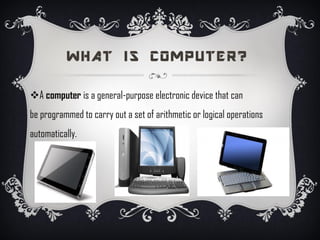
A computer is a general-purpose electronic device that can
be programmed to carry out a set of arithmetic or logical operations
automatically.
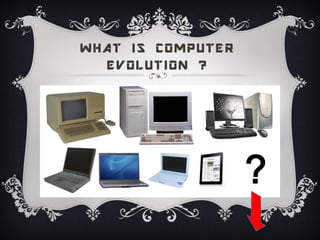
WHAT IS COMPUTER
EVOLUTION ?
EVOLUTION OF COMPUTER
Computer evolution starts in 1940 with vacuum tube circuitry and goes to
the present day — and beyond — with artificial intelligence.
There are five generations in computer history.
FIRST GENERATION (1940-1956)
VACUUM TUBES
The first generation computers
used
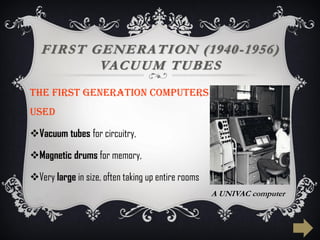
Vacuum tubes for circuitry,
Magnetic drums for memory,
Very large in size, often taking up entire rooms
A UNIVAC computer
FIRST GENERATION (1940-1956)
VACUUM TUBES
The first generation computers
used
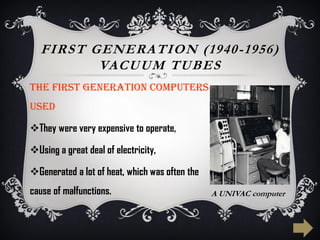
They were very expensive to operate,
Using a great deal of electricity,
Generated a lot of heat, which was often the
cause of malfunctions. A UNIVAC computer
FIRST GENERATION (1940-1956)
VACUUM TUBES
The first generation computers
used
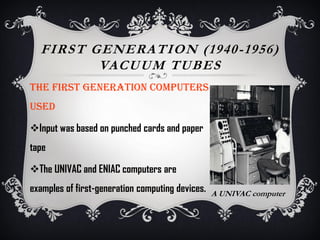
Input was based on punched cards and paper
tape
The UNIVAC and ENIAC computers are
examples of first-generation computing devices. A UNIVAC computer
SECOND GENERATION (1956-1963)
TRANSISTORS
The second generation
computers used
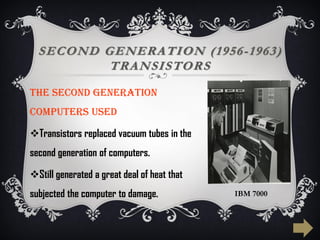
Transistors replaced vacuum tubes in the
second generation of computers.
Still generated a great deal of heat that
subjected the computer to damage. IBM 7000
SECOND GENERATION (1956-1963)
TRANSISTORS
The second generation
computers used
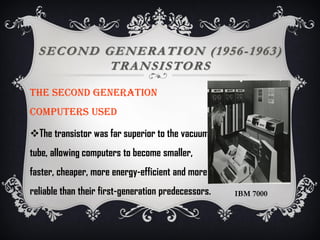
The transistor was far superior to the vacuum
tube, allowing computers to become smaller,
faster, cheaper, more energy-efficient and more
reliable than their first-generation predecessors. IBM 7000
SECOND GENERATION (1956-1963)
TRANSISTORS
The second generation
computers used
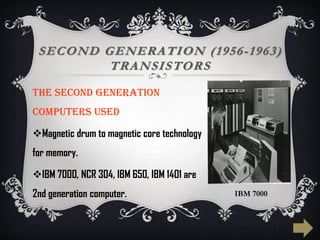
Magnetic drum to magnetic core technology
for memory.
IBM 7000, NCR 304, IBM 650, IBM 1401 are
2nd generation computer. IBM 7000
THIRD GENERATION (1964-1971)
INTEGRATED CIRCUITS
The THIRD generation
computers used
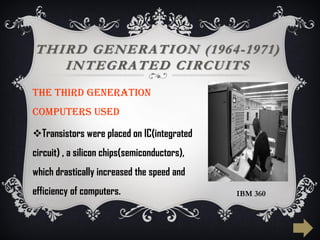
Transistors were placed on IC(integrated
circuit) , a silicon chips(semiconductors),
which drastically increased the speed and
efficiency of computers. IBM 360
THIRD GENERATION (1964-1971)
INTEGRATED CIRCUITS
The THIRD generation
computers used
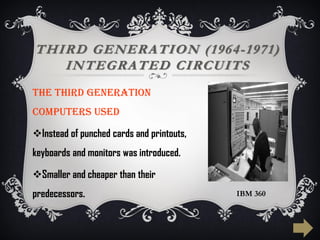
Instead of punched cards and printouts,
keyboards and monitors was introduced.
Smaller and cheaper than their
predecessors. IBM 360
THIRD GENERATION (1964-1971)
INTEGRATED CIRCUITS
The THIRD generation computers
used
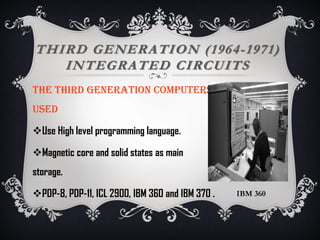
Use High level programming language.
Magnetic core and solid states as main
storage.
PDP-8, PDP-11, ICL 2900, IBM 360 and IBM 370 . IBM 360
FORTH GENERATION (1971-
PRESENT) MICROPROCESSORS
The FORTH generation
computers use
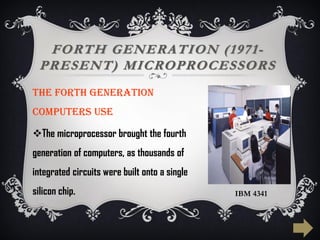
The microprocessor brought the fourth
generation of computers, as thousands of
integrated circuits were built onto a single
silicon chip. IBM 4341
FORTH GENERATION (1971-
PRESENT) MICROPROCESSORS
The FORTH generation
computers use
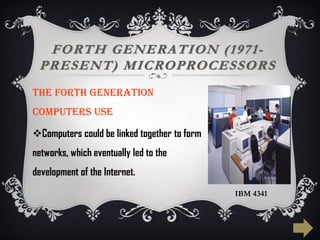
Computers could be linked together to form
networks, which eventually led to the
development of the Internet.
IBM 4341
FORTH GENERATION (1971-
PRESENT) MICROPROCESSORS
The FORTH generation
computers use
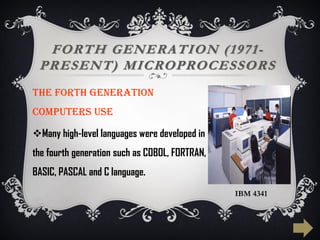
Many high-level languages were developed in
the fourth generation such as COBOL, FORTRAN,
BASIC, PASCAL and C language.
IBM 4341
FORTH GENERATION (1971-
PRESENT) MICROPROCESSORS
The FORTH generation
computers use
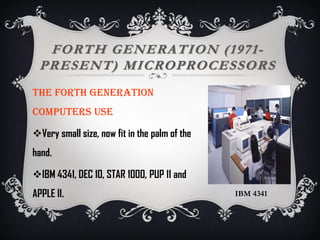
Very small size, now fit in the palm of the
hand.
IBM 4341, DEC 10, STAR 1000, PUP 11 and
APPLE II. IBM 4341
FIFTH GENERATION (PRESENT AND
BEYOND)
ARTIFICIAL INTELLIGENCE
The FIFTH generation
computers WILL used
Fifth generation computer based on artificial
intelligence, are still in development.
 Voice recognition
?
FIFTH GENERATION (PRESENT AND
BEYOND)
ARTIFICIAL INTELLIGENCE
The FIFTH generation computers
WILL used
They will be able to recognize image and graphs,
The use of parallel processing,
Quantum computation and molecular and
nanotechnology.
FI
F
T
H
G
en
er
ati
on
(P
re
se
nt
an
?
FIFTH GENERATION (PRESENT AND
BEYOND)
ARTIFICIAL INTELLIGENCE
The FIFTH generation computers
WILL used
The goal of fifth-generation computing is to
develop devices that respond to natural
language input and are capable of learning and self-
organization.
?
Evolution of Computer

Evolution of Computer

  • 1.
  • 2.
    WHAT IS COMPUTER? Acomputer is a general-purpose electronic device that can be programmed to carry out a set of arithmetic or logical operations automatically.
  • 3.
  • 4.
    EVOLUTION OF COMPUTER Computerevolution starts in 1940 with vacuum tube circuitry and goes to the present day — and beyond — with artificial intelligence. There are five generations in computer history.
  • 5.
    FIRST GENERATION (1940-1956) VACUUMTUBES The first generation computers used Vacuum tubes for circuitry, Magnetic drums for memory, Very large in size, often taking up entire rooms A UNIVAC computer
  • 6.
    FIRST GENERATION (1940-1956) VACUUMTUBES The first generation computers used They were very expensive to operate, Using a great deal of electricity, Generated a lot of heat, which was often the cause of malfunctions. A UNIVAC computer
  • 7.
    FIRST GENERATION (1940-1956) VACUUMTUBES The first generation computers used Input was based on punched cards and paper tape The UNIVAC and ENIAC computers are examples of first-generation computing devices. A UNIVAC computer
  • 8.
    SECOND GENERATION (1956-1963) TRANSISTORS Thesecond generation computers used Transistors replaced vacuum tubes in the second generation of computers. Still generated a great deal of heat that subjected the computer to damage. IBM 7000
  • 9.
    SECOND GENERATION (1956-1963) TRANSISTORS Thesecond generation computers used The transistor was far superior to the vacuum tube, allowing computers to become smaller, faster, cheaper, more energy-efficient and more reliable than their first-generation predecessors. IBM 7000
  • 10.
    SECOND GENERATION (1956-1963) TRANSISTORS Thesecond generation computers used Magnetic drum to magnetic core technology for memory. IBM 7000, NCR 304, IBM 650, IBM 1401 are 2nd generation computer. IBM 7000
  • 11.
    THIRD GENERATION (1964-1971) INTEGRATEDCIRCUITS The THIRD generation computers used Transistors were placed on IC(integrated circuit) , a silicon chips(semiconductors), which drastically increased the speed and efficiency of computers. IBM 360
  • 12.
    THIRD GENERATION (1964-1971) INTEGRATEDCIRCUITS The THIRD generation computers used Instead of punched cards and printouts, keyboards and monitors was introduced. Smaller and cheaper than their predecessors. IBM 360
  • 13.
    THIRD GENERATION (1964-1971) INTEGRATEDCIRCUITS The THIRD generation computers used Use High level programming language. Magnetic core and solid states as main storage. PDP-8, PDP-11, ICL 2900, IBM 360 and IBM 370 . IBM 360
  • 14.
    FORTH GENERATION (1971- PRESENT)MICROPROCESSORS The FORTH generation computers use The microprocessor brought the fourth generation of computers, as thousands of integrated circuits were built onto a single silicon chip. IBM 4341
  • 15.
    FORTH GENERATION (1971- PRESENT)MICROPROCESSORS The FORTH generation computers use Computers could be linked together to form networks, which eventually led to the development of the Internet. IBM 4341
  • 16.
    FORTH GENERATION (1971- PRESENT)MICROPROCESSORS The FORTH generation computers use Many high-level languages were developed in the fourth generation such as COBOL, FORTRAN, BASIC, PASCAL and C language. IBM 4341
  • 17.
    FORTH GENERATION (1971- PRESENT)MICROPROCESSORS The FORTH generation computers use Very small size, now fit in the palm of the hand. IBM 4341, DEC 10, STAR 1000, PUP 11 and APPLE II. IBM 4341
  • 18.
    FIFTH GENERATION (PRESENTAND BEYOND) ARTIFICIAL INTELLIGENCE The FIFTH generation computers WILL used Fifth generation computer based on artificial intelligence, are still in development.  Voice recognition ?
  • 19.
    FIFTH GENERATION (PRESENTAND BEYOND) ARTIFICIAL INTELLIGENCE The FIFTH generation computers WILL used They will be able to recognize image and graphs, The use of parallel processing, Quantum computation and molecular and nanotechnology. FI F T H G en er ati on (P re se nt an ?
  • 20.
    FIFTH GENERATION (PRESENTAND BEYOND) ARTIFICIAL INTELLIGENCE The FIFTH generation computers WILL used The goal of fifth-generation computing is to develop devices that respond to natural language input and are capable of learning and self- organization. ?