GENERATIONS OF COMPUTERS
• The computer has evolved from large – sized simple
calculating machine to a smaller but much more powerful
machine.
• The evolution of computer to the current state is defined in
terms of the generations of computers.
• Each generation of computer is designed based on a new
technological development, resulting in better, cheaper and
smaller computers that are more powerful, faster and efficient
than their predecessors.
GENERATIONS OF COMPUTER
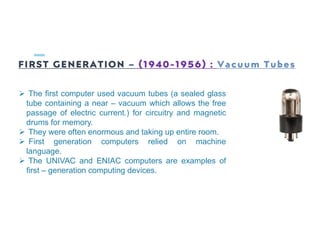
FIRST GENERATION – (1940-1956) : Vacuum Tubes
 The first computer used vacuum tubes (a sealed glass
tube containing a near – vacuum which allows the free
passage of electric current.) for circuitry and magnetic
drums for memory.
 They were often enormous and taking up entire room.
 First generation computers relied on machine
language.
 The UNIVAC and ENIAC computers are examples of
first – generation computing devices.
FIRST GENERATIONS 0F COMPUTER
Advantages :
• It was only electronic device.
• First device to hold memory.
Disadvantages :
• Vacuum tubes burn frequently.
• They were producing heat.
• Maintenance problems.
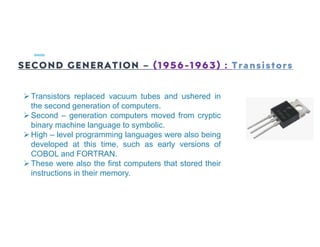
SECOND GENERATION – (1956-1963) : Transistors
Transistors replaced vacuum tubes and ushered in
the second generation of computers.
Second – generation computers moved from cryptic
binary machine language to symbolic.
High – level programming languages were also being
developed at this time, such as early versions of
COBOL and FORTRAN.
These were also the first computers that stored their
instructions in their memory.
SECOND GENERATIONS 0F COMPUTER
Advantages :
• Size reduced considerably.
• The very fast.
• Very much reliable.
Disadvantages :
• They over heated quickly.
• Maintenance problems.
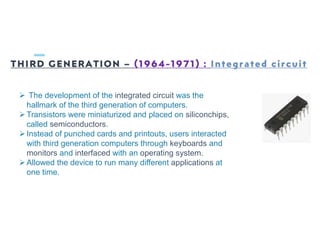
THIRD GENERATION – (1964-1971) : Integrated circuit
 The development of the integrated circuit was the
hallmark of the third generation of computers.
Transistors were miniaturized and placed on siliconchips,
called semiconductors.
Instead of punched cards and printouts, users interacted
with third generation computers through keyboards and
monitors and interfaced with an operating system.
Allowed the device to run many different applications at
one time.
THIRD GENERATIONS 0F COMPUTER
Advantages :
• ICs are very small in size.
• Improved performance.
• Production cost cheap.
Disadvantages :
• ICs are sophisticated.
• Air conditioning was required.
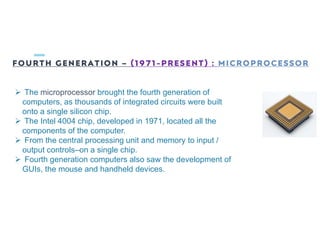
FOURTH GENERATION – (1971-PRESENT) : MICROPROCESSOR
 The microprocessor brought the fourth generation of
computers, as thousands of integrated circuits were built
onto a single silicon chip.
 The Intel 4004 chip, developed in 1971, located all the
components of the computer.
 From the central processing unit and memory to input /
output controls–on a single chip.
 Fourth generation computers also saw the development of
GUIs, the mouse and handheld devices.
FOURTH GENERATIONS 0F COMPUTER
Advantages :
• The air conditioner is not required.
• Totally used for general purposes.
• Heat generated is negligible which is good.
Disadvantages :
• There are a lot of cases required for air conditioning.
• Highly sophisticated production was easier and cheaper.
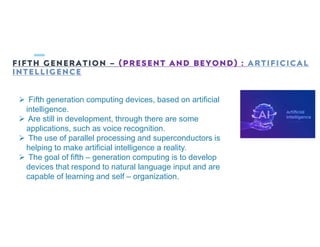
FIFTH GENERATION – (PRESENT AND BEYOND) : ARTIFICICAL
INTELLIGENCE
 Fifth generation computing devices, based on artificial
intelligence.
 Are still in development, through there are some
applications, such as voice recognition.
 The use of parallel processing and superconductors is
helping to make artificial intelligence a reality.
 The goal of fifth – generation computing is to develop
devices that respond to natural language input and are
capable of learning and self – organization.
FIFTH GENERATIONS 0F COMPUTER
Advantages :
• More reliable and faster than its predecessor.
• Easily available in different sizes with unique and different
features.
Disadvantages :
• Cooling system was required.
• Costly and not versatile.
• Only used for specific purpose.
THANK YOU

[ generation of computer ].pdf for BCA students

  • 1.
  • 2.
    • The computerhas evolved from large – sized simple calculating machine to a smaller but much more powerful machine. • The evolution of computer to the current state is defined in terms of the generations of computers. • Each generation of computer is designed based on a new technological development, resulting in better, cheaper and smaller computers that are more powerful, faster and efficient than their predecessors. GENERATIONS OF COMPUTER
  • 3.
    FIRST GENERATION –(1940-1956) : Vacuum Tubes  The first computer used vacuum tubes (a sealed glass tube containing a near – vacuum which allows the free passage of electric current.) for circuitry and magnetic drums for memory.  They were often enormous and taking up entire room.  First generation computers relied on machine language.  The UNIVAC and ENIAC computers are examples of first – generation computing devices.
  • 4.
    FIRST GENERATIONS 0FCOMPUTER Advantages : • It was only electronic device. • First device to hold memory. Disadvantages : • Vacuum tubes burn frequently. • They were producing heat. • Maintenance problems.
  • 5.
    SECOND GENERATION –(1956-1963) : Transistors Transistors replaced vacuum tubes and ushered in the second generation of computers. Second – generation computers moved from cryptic binary machine language to symbolic. High – level programming languages were also being developed at this time, such as early versions of COBOL and FORTRAN. These were also the first computers that stored their instructions in their memory.
  • 6.
    SECOND GENERATIONS 0FCOMPUTER Advantages : • Size reduced considerably. • The very fast. • Very much reliable. Disadvantages : • They over heated quickly. • Maintenance problems.
  • 7.
    THIRD GENERATION –(1964-1971) : Integrated circuit  The development of the integrated circuit was the hallmark of the third generation of computers. Transistors were miniaturized and placed on siliconchips, called semiconductors. Instead of punched cards and printouts, users interacted with third generation computers through keyboards and monitors and interfaced with an operating system. Allowed the device to run many different applications at one time.
  • 8.
    THIRD GENERATIONS 0FCOMPUTER Advantages : • ICs are very small in size. • Improved performance. • Production cost cheap. Disadvantages : • ICs are sophisticated. • Air conditioning was required.
  • 9.
    FOURTH GENERATION –(1971-PRESENT) : MICROPROCESSOR  The microprocessor brought the fourth generation of computers, as thousands of integrated circuits were built onto a single silicon chip.  The Intel 4004 chip, developed in 1971, located all the components of the computer.  From the central processing unit and memory to input / output controls–on a single chip.  Fourth generation computers also saw the development of GUIs, the mouse and handheld devices.
  • 10.
    FOURTH GENERATIONS 0FCOMPUTER Advantages : • The air conditioner is not required. • Totally used for general purposes. • Heat generated is negligible which is good. Disadvantages : • There are a lot of cases required for air conditioning. • Highly sophisticated production was easier and cheaper.
  • 11.
    FIFTH GENERATION –(PRESENT AND BEYOND) : ARTIFICICAL INTELLIGENCE  Fifth generation computing devices, based on artificial intelligence.  Are still in development, through there are some applications, such as voice recognition.  The use of parallel processing and superconductors is helping to make artificial intelligence a reality.  The goal of fifth – generation computing is to develop devices that respond to natural language input and are capable of learning and self – organization.
  • 12.
    FIFTH GENERATIONS 0FCOMPUTER Advantages : • More reliable and faster than its predecessor. • Easily available in different sizes with unique and different features. Disadvantages : • Cooling system was required. • Costly and not versatile. • Only used for specific purpose.
  • 13.