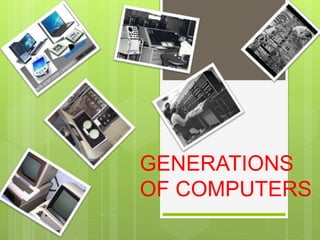
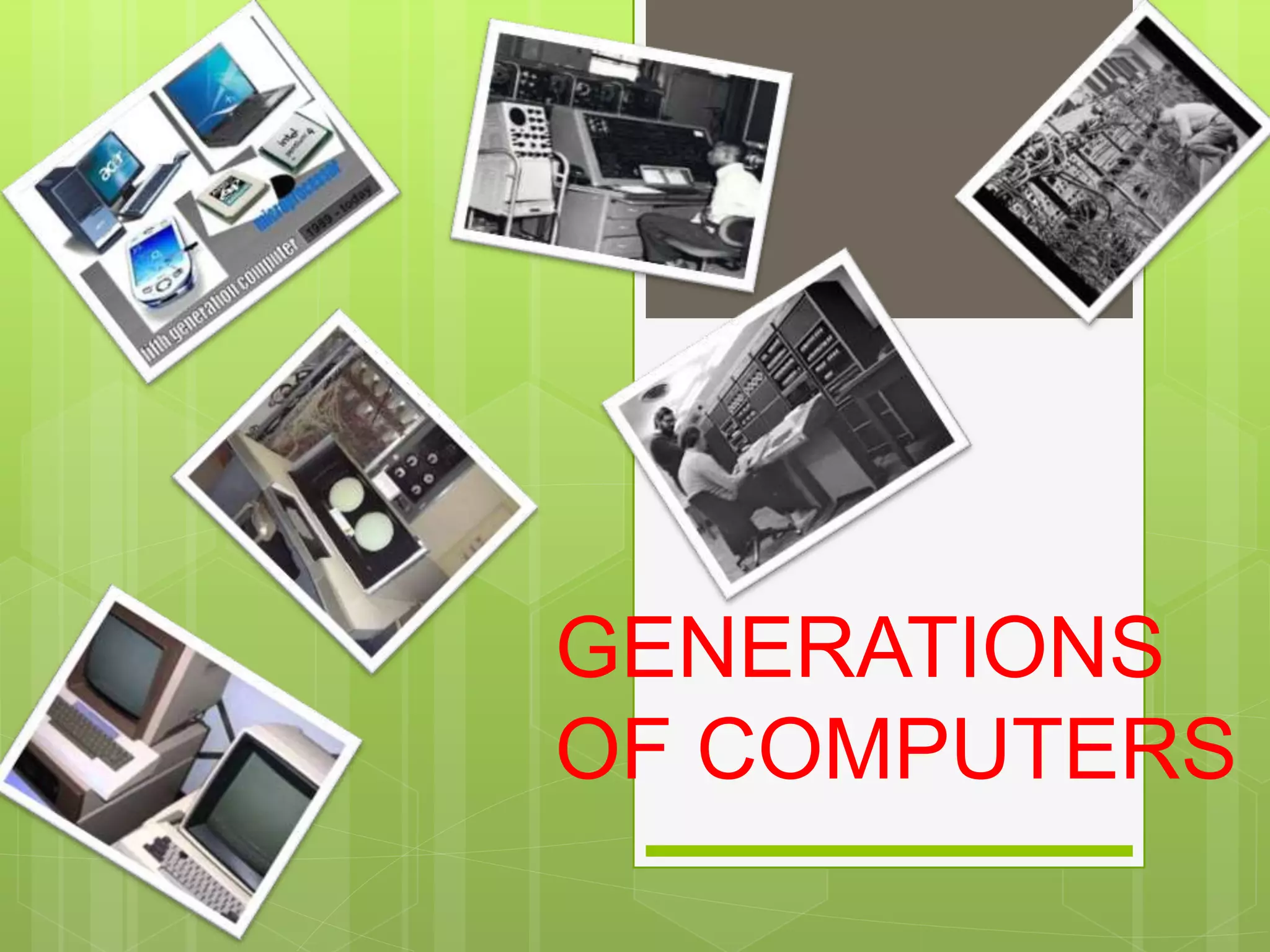
GENERATIONS
OF COMPUTERS
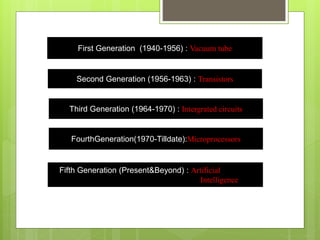
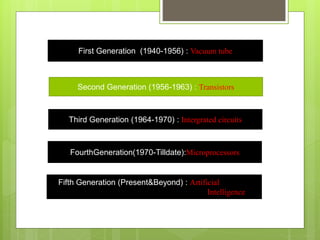
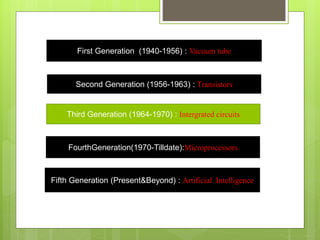
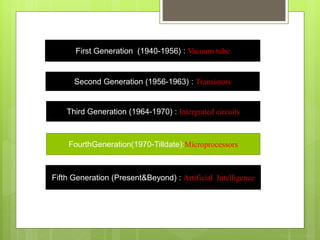
First Generation (1940-1956) : Vacuum tube
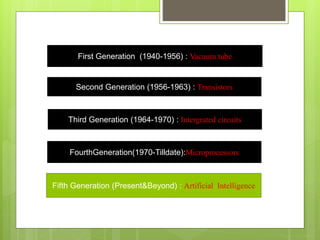
Fifth Generation (Present&Beyond) : Artificial
Intelligence
Second Generation (1956-1963) : Transistors
Third Generation (1964-1970) : Intergrated circuits
FourthGeneration(1970-Tilldate):Microprocessors
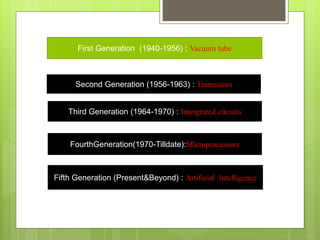
First Generation (1940-1956) : Vacuum tube
Fifth Generation (Present&Beyond) : Artificial Intelligence
Second Generation (1956-1963) : Transistors
Third Generation (1964-1970) : Intergrated circuits
FourthGeneration(1970-Tilldate):Microprocessors
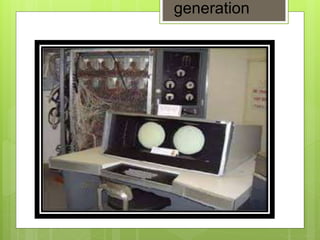
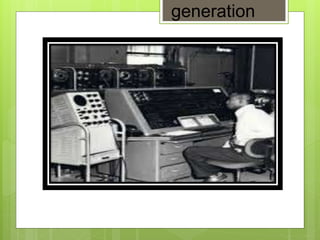
First generation computers were powered by vaccum
tubes. Magnetic drums were used as memory on which
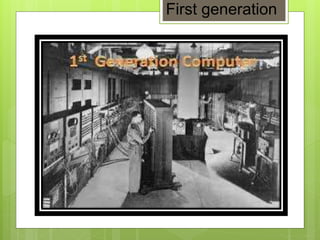
data and program were stored. They were extremely
large machines occuping huge rooms and consuming
vast amounts of energy. They relied on binary coded
language (0s&1s) for their operations. There was no
versatility and speed since they were able to solve only
one problem at a time. Instructions must be rewritten or
recompiled to run on different types of computers.
Input device : Punched cards and paper tapes
Output device : Printing
Examples: ENIAC , EDVAC and UNIVAC
Vacuum tubes
First generation
First Generation (1940-1956) : Vacuum tube
Fifth Generation (Present&Beyond) : Artificial
Intelligence
Second Generation (1956-1963) : Transistors
Third Generation (1964-1970) : Intergrated circuits
FourthGeneration(1970-Tilldate):Microprocessors
Second generation computer systems took advantage
of semiconductor technology which meant that
transisters replaced the vaccum tubes. This resuled in
reduced physical size, faster computing and greater
power. The transister was initially developed by Bell
laboratories a large US corporation. In second
generation computers magnetic disks as secondary
storage devices. Programming was done in assembly
language where mnemonics (ADD,SUB,…) were used
instead of binary languages such as COBOL and
FORTRAN also came into existence in this period.
Input device : Punched cards & Paper tapes
Outpt device : Printing
Examples: PDP-8,IBM1041 and 7090
Transisters
generation
First Generation (1940-1956) : Vacuum tube
Fifth Generation (Present&Beyond) : Artificial Intelligence
Second Generation (1956-1963) : Transistors
Third Generation (1964-1970) : Intergrated circuits
FourthGeneration(1970-Tilldate):Microprocessors
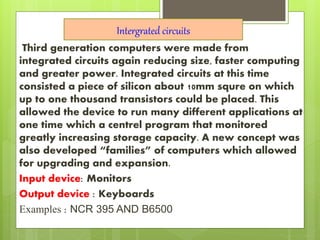
Third generation computers were made from
integrated circuits again reducing size, faster computing
and greater power. Integrated circuits at this time
consisted a piece of silicon about 10mm squre on which
up to one thousand transistors could be placed. This
allowed the device to run many different applications at
one time which a centrel program that monitored
greatly increasing storage capacity. A new concept was
also developed “families” of computers which allowed
for upgrading and expansion.
Input device: Monitors
Output device : Keyboards
Examples : NCR 395 AND B6500
Intergrated circuits
generation
First Generation (1940-1956) : Vacuum tube
Fifth Generation (Present&Beyond) : Artificial Intelligence
Second Generation (1956-1963) : Transistors
Third Generation (1964-1970) : Intergrated circuits
FourthGeneration(1970-Tilldate):Microprocessors
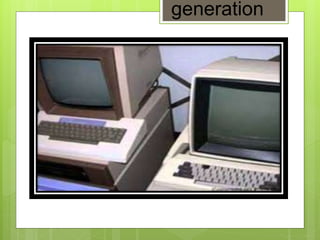
From integrated circuits to large scale integration
to very large scale integration this was the start of
the micriprocessor age. All the components of a
computer (central processing unit, memory and
input and output controls) was located on a
minuscule chip. The microprocessor used continued
to improve from the 4004, 8086, 80286 to the 80486, then
pentium, pentium 2, pentium 3 and now pentium 4.
Magnetic discs were improved greatly increasing
storage capacity. A new concept was also
developed. “families” of computers which allowed
for upgrading and expansion.
Input device : Monitors
Output device : Keyboards
Examples : NCR 395 and Apple II, Altair 8800 and CRAY-1.
Microprocessors
generation
First Generation (1940-1956) : Vacuum tube
Fifth Generation (Present&Beyond) : Artificial Intelligence
Second Generation (1956-1963) : Transistors
Third Generation (1964-1970) : Intergrated circuits
FourthGeneration(1970-Tilldate):Microprocessors
Reserch is going on to design a human like computer
capable of resoning and decision making. It should
learn from mistakes and prossess the skills of an
expert. The expert system is defined as a computer
information system that attempts to mimic the thought
process and resoning of experts in specific areas.
Super large scale integrated (SLSI) chips called Mega
chips will be employed. Today’s computers serial
processors Parallel processing should be incorporated
where several inteructions are processed at the same
time through the use of mutiple central processing
units. Simulation is done to reproduce human behavior
like thinking, speaking and reasoning processes
leading to Artifical Intelligence.
Artificial Intelligence
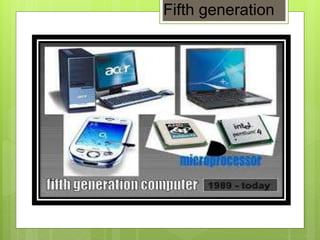
Fifth generation

Generations of computers

  • 1.
  • 2.
    First Generation (1940-1956): Vacuum tube Fifth Generation (Present&Beyond) : Artificial Intelligence Second Generation (1956-1963) : Transistors Third Generation (1964-1970) : Intergrated circuits FourthGeneration(1970-Tilldate):Microprocessors
  • 3.
    First Generation (1940-1956): Vacuum tube Fifth Generation (Present&Beyond) : Artificial Intelligence Second Generation (1956-1963) : Transistors Third Generation (1964-1970) : Intergrated circuits FourthGeneration(1970-Tilldate):Microprocessors
  • 4.
    First generation computerswere powered by vaccum tubes. Magnetic drums were used as memory on which data and program were stored. They were extremely large machines occuping huge rooms and consuming vast amounts of energy. They relied on binary coded language (0s&1s) for their operations. There was no versatility and speed since they were able to solve only one problem at a time. Instructions must be rewritten or recompiled to run on different types of computers. Input device : Punched cards and paper tapes Output device : Printing Examples: ENIAC , EDVAC and UNIVAC Vacuum tubes
  • 5.
  • 6.
    First Generation (1940-1956): Vacuum tube Fifth Generation (Present&Beyond) : Artificial Intelligence Second Generation (1956-1963) : Transistors Third Generation (1964-1970) : Intergrated circuits FourthGeneration(1970-Tilldate):Microprocessors
  • 7.
    Second generation computersystems took advantage of semiconductor technology which meant that transisters replaced the vaccum tubes. This resuled in reduced physical size, faster computing and greater power. The transister was initially developed by Bell laboratories a large US corporation. In second generation computers magnetic disks as secondary storage devices. Programming was done in assembly language where mnemonics (ADD,SUB,…) were used instead of binary languages such as COBOL and FORTRAN also came into existence in this period. Input device : Punched cards & Paper tapes Outpt device : Printing Examples: PDP-8,IBM1041 and 7090 Transisters
  • 8.
  • 9.
    First Generation (1940-1956): Vacuum tube Fifth Generation (Present&Beyond) : Artificial Intelligence Second Generation (1956-1963) : Transistors Third Generation (1964-1970) : Intergrated circuits FourthGeneration(1970-Tilldate):Microprocessors
  • 10.
    Third generation computerswere made from integrated circuits again reducing size, faster computing and greater power. Integrated circuits at this time consisted a piece of silicon about 10mm squre on which up to one thousand transistors could be placed. This allowed the device to run many different applications at one time which a centrel program that monitored greatly increasing storage capacity. A new concept was also developed “families” of computers which allowed for upgrading and expansion. Input device: Monitors Output device : Keyboards Examples : NCR 395 AND B6500 Intergrated circuits
  • 11.
  • 12.
    First Generation (1940-1956): Vacuum tube Fifth Generation (Present&Beyond) : Artificial Intelligence Second Generation (1956-1963) : Transistors Third Generation (1964-1970) : Intergrated circuits FourthGeneration(1970-Tilldate):Microprocessors
  • 13.
    From integrated circuitsto large scale integration to very large scale integration this was the start of the micriprocessor age. All the components of a computer (central processing unit, memory and input and output controls) was located on a minuscule chip. The microprocessor used continued to improve from the 4004, 8086, 80286 to the 80486, then pentium, pentium 2, pentium 3 and now pentium 4. Magnetic discs were improved greatly increasing storage capacity. A new concept was also developed. “families” of computers which allowed for upgrading and expansion. Input device : Monitors Output device : Keyboards Examples : NCR 395 and Apple II, Altair 8800 and CRAY-1. Microprocessors
  • 14.
  • 15.
    First Generation (1940-1956): Vacuum tube Fifth Generation (Present&Beyond) : Artificial Intelligence Second Generation (1956-1963) : Transistors Third Generation (1964-1970) : Intergrated circuits FourthGeneration(1970-Tilldate):Microprocessors
  • 16.
    Reserch is goingon to design a human like computer capable of resoning and decision making. It should learn from mistakes and prossess the skills of an expert. The expert system is defined as a computer information system that attempts to mimic the thought process and resoning of experts in specific areas. Super large scale integrated (SLSI) chips called Mega chips will be employed. Today’s computers serial processors Parallel processing should be incorporated where several inteructions are processed at the same time through the use of mutiple central processing units. Simulation is done to reproduce human behavior like thinking, speaking and reasoning processes leading to Artifical Intelligence. Artificial Intelligence
  • 17.

Editor's Notes

  • #18 GENERATION OF COMPUTERS