Assembly of repetitive DNA
          from genome survey
       sequencing: Lessons from
       grasses and applications to
           non-model systems
                         Kate L Hertweck (NESCent)
                       and J. Chris Pires (U of Missouri)


mobilebotanicalgardens.org
                                                            Sandwalk.blogspot.com
Genome sequencing, large genomes and evolution
●
     Genome sequencing is becoming a routine laboratory procedure.
●
     The first step in genome analysis is masking repetitive elements (REs),
     which may compromise a large portion of a genome.
●
     Digging through everyone's genomic junk sounds pretty fun!
●
     What determines genome size? Why and how?


Kate Hertweck, Repetitive DNA assembly
Genome sequencing, large genomes and evolution
●
     Genome sequencing is becoming a routine laboratory procedure.
●
     The first step in genome analysis is masking repetitive elements (REs),
     which may compromise a large portion of a genome.
●
     Digging through everyone's genomic junk sounds pretty fun!
●
     What determines genome size? Why and how?
●
     Methods in large genome de novo assembly of next-gen data are
     improving (Schatz et al 2010)
●
     Sanger sequencing in Fritillaria indicates highly divergent TEs
     (Ambrozova et al 2011)
●
     Low-coverage Illumina sequencing in barley identifies both genes and
     novel repeats (Wicker et al 2008)
●
     Estimation of genome size and TE content in maize and relatives is
     accurate with very short paired-end reads (Tenaillon et al 2011)


Kate Hertweck, Repetitive DNA assembly
Transposable elements are relevant to evolution
     ●
         Direct: TE movement can disrupt gene function
           ●
               Links between TEs and adaptation/speciation?
     ●
         Indirect: Increases in genome size
           ●
               Many historical hypotheses about relationships
                between genome size and life history (complexity,
                mean generation time,
                habitat/environment/climate, growth form)
           ●
               Physical-mechanical effects of nuclear size and
                mass
     ●
         How does TE proliferation affect plant diversification?


Kate Hertweck, Repetitive DNA assembly
Our data
   ●
        Illumina (80-120 bp single end), 6 taxa per lane
   ●
        GSS: Genome Survey Sequences
   ●
        Assembled plastomes, mtDNA genes, and nrDNA genes from less than less
          than 10% of the GSS data!
   ●
        Poaceae (family of grasses, model system)
            ●
                Medium-sized genomes
            ●
                well-annotated library of repeats
   ●
        Asparagales (order of petaloid monocots, non-model system)
            ●
                Very large genomes
            ●
                discovery of novel repeats


Kate Hertweck, Evolutionary effects of junk DNA
               Repetitive DNA assembly
Our data
   ●
        Illumina (80-120 bp single end), 6 taxa per lane
   ●
        GSS: Genome Survey Sequences
   ●
        Assembled plastomes, mtDNA genes, and nrDNA genes from less than less
          than 10% of the GSS data!
   ●
        Poaceae (family of grasses, model system)
            ●
                Medium-sized genomes
            ●
                well-annotated library of repeats
   ●
        Asparagales (order of petaloid monocots, non-model system)
            ●
                Very large genomes
            ●
                discovery of novel repeats


Kate Hertweck, Evolutionary effects of junk DNA
               Repetitive DNA assembly
Methodological approaches
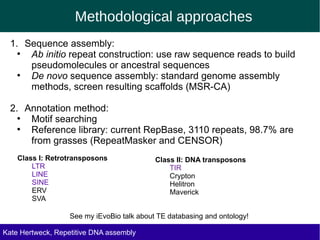
 1. Sequence assembly:
   ●
     Ab initio repeat construction: use raw sequence reads to build
     pseudomolecules or ancestral sequences
   ●
     De novo sequence assembly: standard genome assembly
     methods, screen resulting contigs (MSR-CA)


Kate Hertweck, Evolutionary effects of junk DNA
               Repetitive DNA assembly
Methodological approaches
  1. Sequence assembly:
    ●
      Ab initio repeat construction: use raw sequence reads to build
      pseudomolecules or ancestral sequences
    ●
      De novo sequence assembly: standard genome assembly
      methods, screen resulting scaffolds (MSR-CA)

  2. Annotation method:
    ●
      Motif searching
    ●
      Reference library: current RepBase, 3110 repeats, 98.7% are
      from grasses (RepeatMasker and CENSOR)


Kate Hertweck, Evolutionary effects of junk DNA
               Repetitive DNA assembly
Methodological approaches
  1. Sequence assembly:
    ●
      Ab initio repeat construction: use raw sequence reads to build
      pseudomolecules or ancestral sequences
    ●
      De novo sequence assembly: standard genome assembly
      methods, screen resulting scaffolds (MSR-CA)

  2. Annotation method:
    ●
      Motif searching
    ●
      Reference library: current RepBase, 3110 repeats, 98.7% are
      from grasses (RepeatMasker and CENSOR)
    Class I: Retrotransposons                 Class II: DNA transposons
        LTR                                       TIR
        LINE                                      Crypton
        SINE                                      Helitron
        ERV                                       Maverick
        SVA

                    See my iEvoBio talk about TE databasing and ontology!

Kate Hertweck, Evolutionary effects of junk DNA
               Repetitive DNA assembly
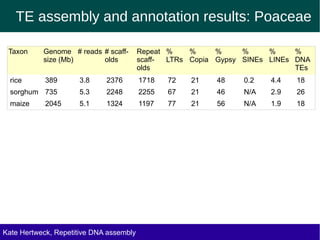
TE assembly and annotation results: Poaceae

 Taxon      Genome # reads # scaff-     Repeat %    %     %     %     %     %
            size (Mb)      olds         scaff- LTRs Copia Gypsy SINEs LINEs DNA
                                        olds                                TEs
  rice      389        3.8     2376      1718     72   21   48   0.2   4.4   18
  sorghum 735          5.3     2248      2255     67   21   46   N/A   2.9   26
  maize     2045       5.1     1324      1197     77   21   56   N/A   1.9   18


Kate Hertweck, Evolutionary effects of junk DNA
               Repetitive DNA assembly
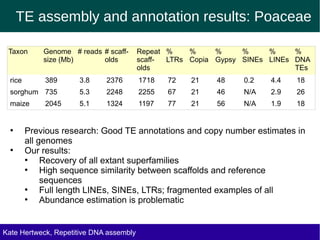
TE assembly and annotation results: Poaceae

 Taxon       Genome # reads # scaff-    Repeat %    %     %     %     %     %
             size (Mb)      olds        scaff- LTRs Copia Gypsy SINEs LINEs DNA
                                        olds                                TEs
  rice       389       3.8     2376      1718     72   21   48   0.2   4.4   18
  sorghum 735          5.3     2248      2255     67   21   46   N/A   2.9   26
  maize      2045      5.1     1324      1197     77   21   56   N/A   1.9   18


  ●
         Previous research: Good TE annotations and copy number estimates in
         all genomes
  ●
         Our results:
         ●
              Recovery of all extant superfamilies
         ●
              High sequence similarity between scaffolds and reference
              sequences
         ●
              Full length LINEs, SINEs, LTRs; fragmented examples of all
         ●
              Abundance estimation is problematic


Kate Hertweck, Evolutionary effects of junk DNA
               Repetitive DNA assembly
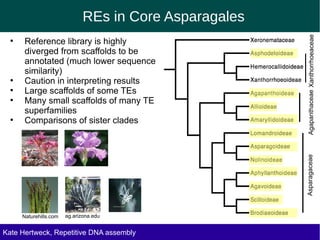
REs in Core Asparagales


                                                          Agapanthaceae Xanthorrhoeaceae
  ●
      Reference library is highly
      diverged from scaffolds to be
      annotated (much lower sequence
      similarity)
  ●
      Caution in interpreting results
  ●
      Large scaffolds of some TEs
  ●
      Many small scaffolds of many TE
      superfamilies
  ●
      Comparisons of sister clades


                                                         Asparagaceae
      Naturehills.com   ag.arizona.edu


Kate Hertweck, Evolutionary effects of junk DNA
               Repetitive DNA assembly
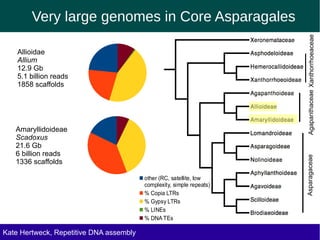
Very large genomes in Core Asparagales


                                                                         Agapanthaceae Xanthorrhoeaceae
    Allioidae
    Allium
    12.9 Gb
    5.1 billion reads
    1858 scaffolds


   Amaryllidoideae
   Scadoxus
   21.6 Gb
   6 billion reads


                                                                        Asparagaceae
   1336 scaffolds

                                          other (RC, satellite, low
                                          complexity, simple repeats)
                                          % Copia LTRs
                                          % Gypsy LTRs
                                          % LINEs
                                          % DNA TEs

Kate Hertweck, Evolutionary effects of junk DNA
               Repetitive DNA assembly
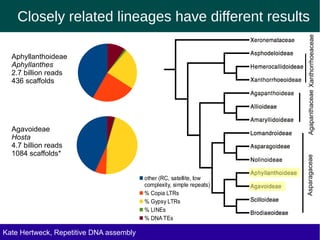
Closely related lineages have different results


                                                                         Agapanthaceae Xanthorrhoeaceae
  Aphyllanthoideae
  Aphyllanthes
  2.7 billion reads
  436 scaffolds


  Agavoideae
  Hosta
  4.7 billion reads
  1084 scaffolds*


                                                                        Asparagaceae
                                          other (RC, satellite, low
                                          complexity, simple repeats)
                                          % Copia LTRs
                                          % Gypsy LTRs
                                          % LINEs
                                          % DNA TEs

Kate Hertweck, Evolutionary effects of junk DNA
               Repetitive DNA assembly
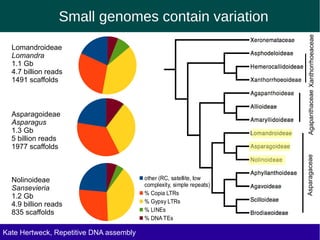
Small genomes contain variation


                                                                         Agapanthaceae Xanthorrhoeaceae
  Lomandroideae
  Lomandra
  1.1 Gb
  4.7 billion reads
  1491 scaffolds


  Asparagoideae
  Asparagus
  1.3 Gb
  5 billion reads
  1977 scaffolds


                                                                        Asparagaceae
  Nolinoideae                             other (RC, satellite, low
                                          complexity, simple repeats)
  Sansevieria
                                          % Copia LTRs
  1.2 Gb
                                          % Gypsy LTRs
  4.9 billion reads
  835 scaffolds                           % LINEs
                                          % DNA TEs

Kate Hertweck, Evolutionary effects of junk DNA
               Repetitive DNA assembly
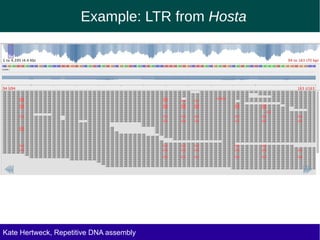
Example: LTR from Hosta


Kate Hertweck, Evolutionary effects of junk DNA
               Repetitive DNA assembly
So what?
     ●
          Assembly of consensus sequences of TEs from very low coverage
            sequence data, even without a close reference library
     ●
          Improve annotation (and assembly) by building a library of lineage-
            specific TEs
     ●
          Other parameters for genomic comparisons
            ●
                Abundance estimates
            ●
                Characterize genetic diversity within each element
     ●
          Comparative biology of TEs
            ●
                Does TE proliferation contribute to diversification or shifts in
                  rates of molecular evolution?
            ●
                Are there common patterns between TEs and life history trait
                  evolution?


Kate Hertweck, Evolutionary effects of junk DNA
               Repetitive DNA assembly
Acknowledgements

  J. Chris Pires lab (U of Missouri)
  Dustin Mayfield
  Pat Edger

  NESCent (National Evolutionary Synthesis Center)
  Allen Roderigo
  Karen Cranston

  www.nescent.org

  Twitter k8lh
  Google+ k8hertweck@gmail.com


Kate Hertweck, Evolutionary effects of junk DNA
               Repetitive DNA assembly
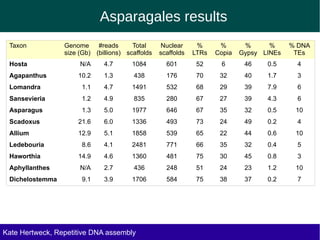
Asparagales results
 Taxon            Genome     #reads      Total     Nuclear      %      %       %      %     % DNA
                  size (Gb) (billions) scaffolds   scaffolds   LTRs   Copia   Gypsy LINEs    TEs
 Hosta                 N/A     4.7       1084        601        52     6       46    0.5      4
 Agapanthus           10.2     1.3       438         176        70     32      40    1.7      3
 Lomandra               1.1    4.7       1491        532        68     29      39    7.9      6
 Sansevieria            1.2    4.9       835         280        67     27      39    4.3      6
 Asparagus              1.3    5.0       1977        646        67     35      32    0.5     10
 Scadoxus             21.6     6.0       1336        493        73     24      49    0.2      4
 Allium               12.9     5.1       1858        539        65     22      44    0.6     10
 Ledebouria             8.6    4.1       2481        771        66     35      32    0.4      5
 Haworthia            14.9     4.6       1360        481        75     30      45    0.8      3
 Aphyllanthes          N/A     2.7       436         248        51     24      23    1.2     10
 Dichelostemma          9.1    3.9       1706        584        75     38      37    0.2      7


Kate Hertweck, Evolutionary effects of junk DNA
               Repetitive DNA assembly

Evolution 2012

  • 1.
    Assembly of repetitiveDNA from genome survey sequencing: Lessons from grasses and applications to non-model systems Kate L Hertweck (NESCent) and J. Chris Pires (U of Missouri) mobilebotanicalgardens.org Sandwalk.blogspot.com
  • 2.
    Genome sequencing, largegenomes and evolution ● Genome sequencing is becoming a routine laboratory procedure. ● The first step in genome analysis is masking repetitive elements (REs), which may compromise a large portion of a genome. ● Digging through everyone's genomic junk sounds pretty fun! ● What determines genome size? Why and how? Kate Hertweck, Repetitive DNA assembly
  • 3.
    Genome sequencing, largegenomes and evolution ● Genome sequencing is becoming a routine laboratory procedure. ● The first step in genome analysis is masking repetitive elements (REs), which may compromise a large portion of a genome. ● Digging through everyone's genomic junk sounds pretty fun! ● What determines genome size? Why and how? ● Methods in large genome de novo assembly of next-gen data are improving (Schatz et al 2010) ● Sanger sequencing in Fritillaria indicates highly divergent TEs (Ambrozova et al 2011) ● Low-coverage Illumina sequencing in barley identifies both genes and novel repeats (Wicker et al 2008) ● Estimation of genome size and TE content in maize and relatives is accurate with very short paired-end reads (Tenaillon et al 2011) Kate Hertweck, Repetitive DNA assembly
  • 4.
    Transposable elements arerelevant to evolution ● Direct: TE movement can disrupt gene function ● Links between TEs and adaptation/speciation? ● Indirect: Increases in genome size ● Many historical hypotheses about relationships between genome size and life history (complexity, mean generation time, habitat/environment/climate, growth form) ● Physical-mechanical effects of nuclear size and mass ● How does TE proliferation affect plant diversification? Kate Hertweck, Repetitive DNA assembly
  • 5.
    Our data ● Illumina (80-120 bp single end), 6 taxa per lane ● GSS: Genome Survey Sequences ● Assembled plastomes, mtDNA genes, and nrDNA genes from less than less than 10% of the GSS data! ● Poaceae (family of grasses, model system) ● Medium-sized genomes ● well-annotated library of repeats ● Asparagales (order of petaloid monocots, non-model system) ● Very large genomes ● discovery of novel repeats Kate Hertweck, Evolutionary effects of junk DNA Repetitive DNA assembly
  • 6.
    Our data ● Illumina (80-120 bp single end), 6 taxa per lane ● GSS: Genome Survey Sequences ● Assembled plastomes, mtDNA genes, and nrDNA genes from less than less than 10% of the GSS data! ● Poaceae (family of grasses, model system) ● Medium-sized genomes ● well-annotated library of repeats ● Asparagales (order of petaloid monocots, non-model system) ● Very large genomes ● discovery of novel repeats Kate Hertweck, Evolutionary effects of junk DNA Repetitive DNA assembly
  • 7.
    Methodological approaches 1.Sequence assembly: ● Ab initio repeat construction: use raw sequence reads to build pseudomolecules or ancestral sequences ● De novo sequence assembly: standard genome assembly methods, screen resulting contigs (MSR-CA) Kate Hertweck, Evolutionary effects of junk DNA Repetitive DNA assembly
  • 8.
    Methodological approaches 1. Sequence assembly: ● Ab initio repeat construction: use raw sequence reads to build pseudomolecules or ancestral sequences ● De novo sequence assembly: standard genome assembly methods, screen resulting scaffolds (MSR-CA) 2. Annotation method: ● Motif searching ● Reference library: current RepBase, 3110 repeats, 98.7% are from grasses (RepeatMasker and CENSOR) Kate Hertweck, Evolutionary effects of junk DNA Repetitive DNA assembly
  • 9.
    Methodological approaches 1. Sequence assembly: ● Ab initio repeat construction: use raw sequence reads to build pseudomolecules or ancestral sequences ● De novo sequence assembly: standard genome assembly methods, screen resulting scaffolds (MSR-CA) 2. Annotation method: ● Motif searching ● Reference library: current RepBase, 3110 repeats, 98.7% are from grasses (RepeatMasker and CENSOR) Class I: Retrotransposons Class II: DNA transposons LTR TIR LINE Crypton SINE Helitron ERV Maverick SVA See my iEvoBio talk about TE databasing and ontology! Kate Hertweck, Evolutionary effects of junk DNA Repetitive DNA assembly
  • 10.
    TE assembly andannotation results: Poaceae Taxon Genome # reads # scaff- Repeat % % % % % % size (Mb) olds scaff- LTRs Copia Gypsy SINEs LINEs DNA olds TEs rice 389 3.8 2376 1718 72 21 48 0.2 4.4 18 sorghum 735 5.3 2248 2255 67 21 46 N/A 2.9 26 maize 2045 5.1 1324 1197 77 21 56 N/A 1.9 18 Kate Hertweck, Evolutionary effects of junk DNA Repetitive DNA assembly
  • 11.
    TE assembly andannotation results: Poaceae Taxon Genome # reads # scaff- Repeat % % % % % % size (Mb) olds scaff- LTRs Copia Gypsy SINEs LINEs DNA olds TEs rice 389 3.8 2376 1718 72 21 48 0.2 4.4 18 sorghum 735 5.3 2248 2255 67 21 46 N/A 2.9 26 maize 2045 5.1 1324 1197 77 21 56 N/A 1.9 18 ● Previous research: Good TE annotations and copy number estimates in all genomes ● Our results: ● Recovery of all extant superfamilies ● High sequence similarity between scaffolds and reference sequences ● Full length LINEs, SINEs, LTRs; fragmented examples of all ● Abundance estimation is problematic Kate Hertweck, Evolutionary effects of junk DNA Repetitive DNA assembly
  • 12.
    REs in CoreAsparagales Agapanthaceae Xanthorrhoeaceae ● Reference library is highly diverged from scaffolds to be annotated (much lower sequence similarity) ● Caution in interpreting results ● Large scaffolds of some TEs ● Many small scaffolds of many TE superfamilies ● Comparisons of sister clades Asparagaceae Naturehills.com ag.arizona.edu Kate Hertweck, Evolutionary effects of junk DNA Repetitive DNA assembly
  • 13.
    Very large genomesin Core Asparagales Agapanthaceae Xanthorrhoeaceae Allioidae Allium 12.9 Gb 5.1 billion reads 1858 scaffolds Amaryllidoideae Scadoxus 21.6 Gb 6 billion reads Asparagaceae 1336 scaffolds other (RC, satellite, low complexity, simple repeats) % Copia LTRs % Gypsy LTRs % LINEs % DNA TEs Kate Hertweck, Evolutionary effects of junk DNA Repetitive DNA assembly
  • 14.
    Closely related lineageshave different results Agapanthaceae Xanthorrhoeaceae Aphyllanthoideae Aphyllanthes 2.7 billion reads 436 scaffolds Agavoideae Hosta 4.7 billion reads 1084 scaffolds* Asparagaceae other (RC, satellite, low complexity, simple repeats) % Copia LTRs % Gypsy LTRs % LINEs % DNA TEs Kate Hertweck, Evolutionary effects of junk DNA Repetitive DNA assembly
  • 15.
    Small genomes containvariation Agapanthaceae Xanthorrhoeaceae Lomandroideae Lomandra 1.1 Gb 4.7 billion reads 1491 scaffolds Asparagoideae Asparagus 1.3 Gb 5 billion reads 1977 scaffolds Asparagaceae Nolinoideae other (RC, satellite, low complexity, simple repeats) Sansevieria % Copia LTRs 1.2 Gb % Gypsy LTRs 4.9 billion reads 835 scaffolds % LINEs % DNA TEs Kate Hertweck, Evolutionary effects of junk DNA Repetitive DNA assembly
  • 16.
    Example: LTR fromHosta Kate Hertweck, Evolutionary effects of junk DNA Repetitive DNA assembly
  • 17.
    So what? ● Assembly of consensus sequences of TEs from very low coverage sequence data, even without a close reference library ● Improve annotation (and assembly) by building a library of lineage- specific TEs ● Other parameters for genomic comparisons ● Abundance estimates ● Characterize genetic diversity within each element ● Comparative biology of TEs ● Does TE proliferation contribute to diversification or shifts in rates of molecular evolution? ● Are there common patterns between TEs and life history trait evolution? Kate Hertweck, Evolutionary effects of junk DNA Repetitive DNA assembly
  • 18.
    Acknowledgements J.Chris Pires lab (U of Missouri) Dustin Mayfield Pat Edger NESCent (National Evolutionary Synthesis Center) Allen Roderigo Karen Cranston www.nescent.org Twitter k8lh Google+ k8hertweck@gmail.com Kate Hertweck, Evolutionary effects of junk DNA Repetitive DNA assembly
  • 19.
    Asparagales results Taxon Genome #reads Total Nuclear % % % % % DNA size (Gb) (billions) scaffolds scaffolds LTRs Copia Gypsy LINEs TEs Hosta N/A 4.7 1084 601 52 6 46 0.5 4 Agapanthus 10.2 1.3 438 176 70 32 40 1.7 3 Lomandra 1.1 4.7 1491 532 68 29 39 7.9 6 Sansevieria 1.2 4.9 835 280 67 27 39 4.3 6 Asparagus 1.3 5.0 1977 646 67 35 32 0.5 10 Scadoxus 21.6 6.0 1336 493 73 24 49 0.2 4 Allium 12.9 5.1 1858 539 65 22 44 0.6 10 Ledebouria 8.6 4.1 2481 771 66 35 32 0.4 5 Haworthia 14.9 4.6 1360 481 75 30 45 0.8 3 Aphyllanthes N/A 2.7 436 248 51 24 23 1.2 10 Dichelostemma 9.1 3.9 1706 584 75 38 37 0.2 7 Kate Hertweck, Evolutionary effects of junk DNA Repetitive DNA assembly