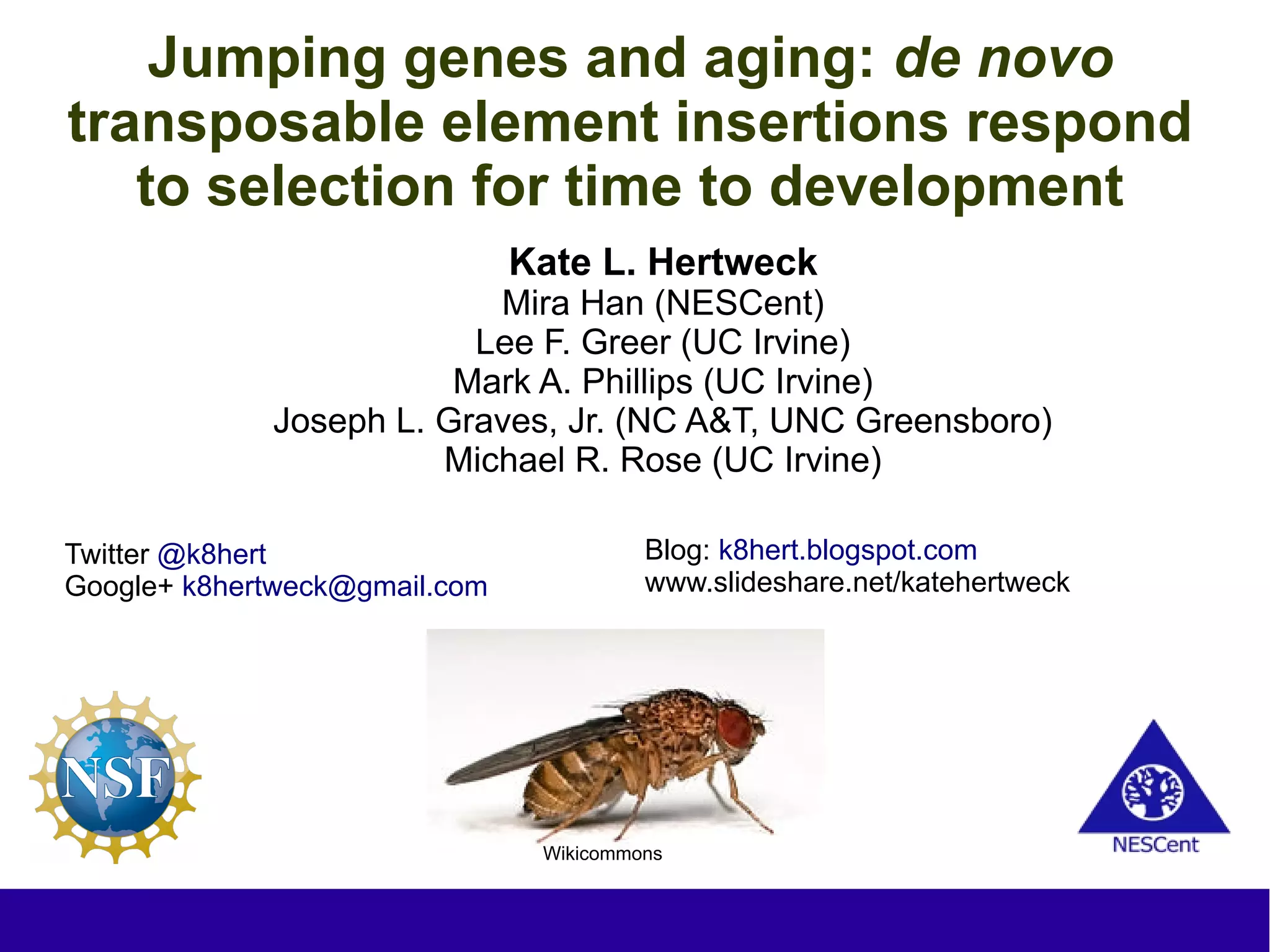
Jumping genes and aging: de novo
transposable element insertions respond
to selection for time to development
Kate L. Hertweck
Mira Han (NESCent)
Lee F. Greer (UC Irvine)
Mark A. Phillips (UC Irvine)
Joseph L. Graves, Jr. (NC A&T, UNC Greensboro)
Michael R. Rose (UC Irvine)
Twitter @k8hert
Google+ k8hertweck@gmail.com
Blog: k8hert.blogspot.com
www.slideshare.net/katehertweck
Wikicommons
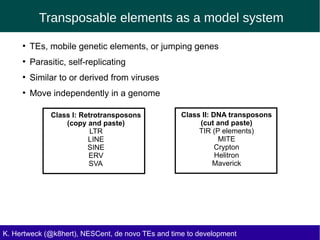
Transposable elements as a model system
K. Hertweck (@k8hert), NESCent, de novo TEs and time to development
●
TEs, mobile genetic elements, or jumping genes
●
Parasitic, self-replicating
●
Similar to or derived from viruses
●
Move independently in a genome
Class I: Retrotransposons
(copy and paste)
LTR
LINE
SINE
ERV
SVA
Class II: DNA transposons
(cut and paste)
TIR (P elements)
MITE
Crypton
Helitron
Maverick
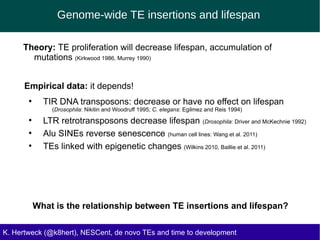
Genome-wide TE insertions and lifespan
Kate Hertweck, Genomic effects of repetitive DNAKate Hertweck, NESCent, Genomic effects of junk DNAK. Hertweck (@k8hert), NESCent, de novo TEs and time to development
Empirical data: it depends!
●
TIR DNA transposons: decrease or have no effect on lifespan
(Drosophila: Nikitin and Woodruff 1995; C. elegans: Egilmez and Reis 1994)
●
LTR retrotransposons decrease lifespan (Drosophila: Driver and McKechnie 1992)
●
Alu SINEs reverse senescence (human cell lines: Wang et al. 2011)
●
TEs linked with epigenetic changes (Wilkins 2010, Baillie et al. 2011)
Theory: TE proliferation will decrease lifespan, accumulation of
mutations (Kirkwood 1986, Murrey 1990)
What is the relationship between TE insertions and lifespan?
K. Hertweck (@k8hert), NESCent, de novo TEs and time to development
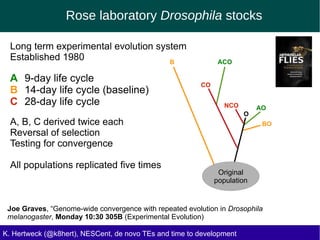
Rose laboratory Drosophila stocks
Long term experimental evolution system
Established 1980
A 9-day life cycle
B 14-day life cycle (baseline)
C 28-day life cycle
ACO
CO
BO
NCO AO
B
O
Original
population
A, B, C derived twice each
Reversal of selection
Testing for convergence
All populations replicated five times
Joe Graves, “Genome-wide convergence with repeated evolution in Drosophila
melanogaster, Monday 10:30 305B (Experimental Evolution)
Experimental data
K. Hertweck (@k8hert), NESCent, de novo TEs and time to development
●
Whole-genome resequencing (Illumina Hi-Seq)
120 females x six treatments x five replicates
●
Are there areas of significant differentiation in the genome?
Where? Hard vs. soft sweeps (Burke et al., 2010)?
SNP analysis: Popoolation2 (Kofler et al., 2011)
Known (ancestral) TE detection: Tlex (Fiston-Lavier et al. 2010)
Structural variant analysis: Delly (Rausch et al., 2012)
How do frequencies of known TE insertions respond to
selective pressures?
How does total TE load respond to selective pressures?
Bioinformatics approach
K. Hertweck (@k8hert), NESCent, de novo TEs and time to development
●
RelocaTE 1.0.4 (Robb et al. 2013)
●
Uses TSD sequence motifs (LTR and TIR) and reference genome
●
82 canonical sequences (Bergman, v.9.43) and Dmel v5
●
Filtered for read count >10 (custom)
●
PoPoolationTE 1.02 (Kofler et al. 2012)
●
Uses known insertions, reference genome, TE hierarchy
●
5200 insertions from annotation 5.55
●
Filtered for read count >10
●
Summarizing data
●
Total TE insertions identified (by order)
●
Total TE families (by order)
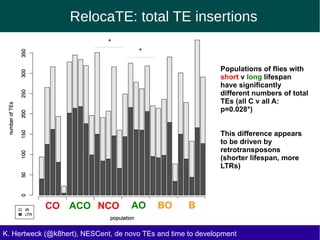
RelocaTE: total TE insertions
K. Hertweck (@k8hert), NESCent, de novo TEs and time to development
CO NCOACO AO BO B
*
*
Populations of flies with
short v long lifespan
have significantly
different numbers of total
TEs (all C v all A:
p=0.028*)
This difference appears
to be driven by
retrotransposons
(shorter lifespan, more
LTRs)
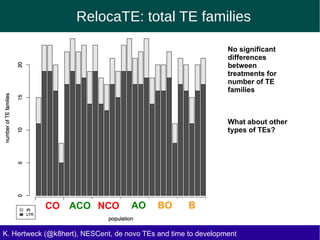
RelocaTE: total TE families
K. Hertweck (@k8hert), NESCent, de novo TEs and time to development
CO NCOACO AO BO B
No significant
differences
between
treatments for
number of TE
families
What about other
types of TEs?
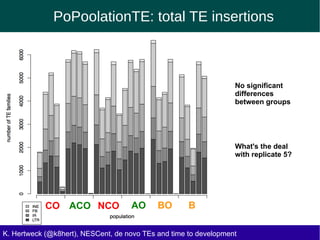
PoPoolationTE: total TE insertions
K. Hertweck (@k8hert), NESCent, de novo TEs and time to development
CO NCOACO AO BO B
No significant
differences
between groups
What's the deal
with replicate 5?
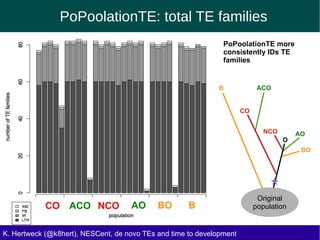
PoPoolationTE: total TE families
K. Hertweck (@k8hert), NESCent, de novo TEs and time to development
CO NCOACO AO BO B
PoPoolationTE more
consistently IDs TE
families
ACO
CO
BO
NCO AO
B
O
Original
population
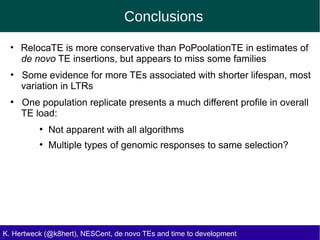
Conclusions
●
RelocaTE is more conservative than PoPoolationTE in estimates of
de novo TE insertions, but appears to miss some families
●
Some evidence for more TEs associated with shorter lifespan, most
variation in LTRs
●
One population replicate presents a much different profile in overall
TE load:
●
Not apparent with all algorithms
●
Multiple types of genomic responses to same selection?
K. Hertweck (@k8hert), NESCent, de novo TEs and time to development
Continuing work
K. Hertweck (@k8hert), NESCent, de novo TEs and time to development
●
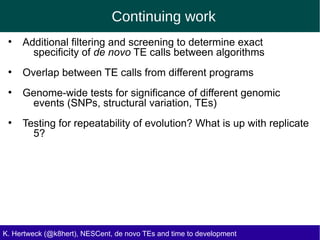
Additional filtering and screening to determine exact
specificity of de novo TE calls between algorithms
●
Overlap between TE calls from different programs
●
Genome-wide tests for significance of different genomic
events (SNPs, structural variation, TEs)
●
Testing for repeatability of evolution? What is up with replicate
5?
Acknowledgements
●
Fellow NESCent scientists (for abiding my gluttonous shared computer
cluster appetite)
●
Casey Bergman and Michael Nelson (U Manchester)
●
Joe Graves, “Genome-wide convergence with repeated evolution in
Drosophila melanogaster, Monday 10:30 305B (Experimental Evolution)
Blog:
k8hert.blogspot.com
www.slideshare.net/katehertweck
Twitter @k8hert
Google+ k8hertweck@gmail.com
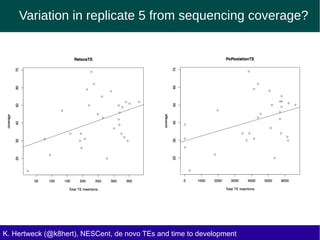
Variation in replicate 5 from sequencing coverage?
K. Hertweck (@k8hert), NESCent, de novo TEs and time to development

Hertweck Evolution 2014

  • 1.
    Jumping genes andaging: de novo transposable element insertions respond to selection for time to development Kate L. Hertweck Mira Han (NESCent) Lee F. Greer (UC Irvine) Mark A. Phillips (UC Irvine) Joseph L. Graves, Jr. (NC A&T, UNC Greensboro) Michael R. Rose (UC Irvine) Twitter @k8hert Google+ k8hertweck@gmail.com Blog: k8hert.blogspot.com www.slideshare.net/katehertweck Wikicommons
  • 2.
    Transposable elements asa model system K. Hertweck (@k8hert), NESCent, de novo TEs and time to development ● TEs, mobile genetic elements, or jumping genes ● Parasitic, self-replicating ● Similar to or derived from viruses ● Move independently in a genome Class I: Retrotransposons (copy and paste) LTR LINE SINE ERV SVA Class II: DNA transposons (cut and paste) TIR (P elements) MITE Crypton Helitron Maverick
  • 3.
    Genome-wide TE insertionsand lifespan Kate Hertweck, Genomic effects of repetitive DNAKate Hertweck, NESCent, Genomic effects of junk DNAK. Hertweck (@k8hert), NESCent, de novo TEs and time to development Empirical data: it depends! ● TIR DNA transposons: decrease or have no effect on lifespan (Drosophila: Nikitin and Woodruff 1995; C. elegans: Egilmez and Reis 1994) ● LTR retrotransposons decrease lifespan (Drosophila: Driver and McKechnie 1992) ● Alu SINEs reverse senescence (human cell lines: Wang et al. 2011) ● TEs linked with epigenetic changes (Wilkins 2010, Baillie et al. 2011) Theory: TE proliferation will decrease lifespan, accumulation of mutations (Kirkwood 1986, Murrey 1990) What is the relationship between TE insertions and lifespan?
  • 4.
    K. Hertweck (@k8hert),NESCent, de novo TEs and time to development Rose laboratory Drosophila stocks Long term experimental evolution system Established 1980 A 9-day life cycle B 14-day life cycle (baseline) C 28-day life cycle ACO CO BO NCO AO B O Original population A, B, C derived twice each Reversal of selection Testing for convergence All populations replicated five times Joe Graves, “Genome-wide convergence with repeated evolution in Drosophila melanogaster, Monday 10:30 305B (Experimental Evolution)
  • 5.
    Experimental data K. Hertweck(@k8hert), NESCent, de novo TEs and time to development ● Whole-genome resequencing (Illumina Hi-Seq) 120 females x six treatments x five replicates ● Are there areas of significant differentiation in the genome? Where? Hard vs. soft sweeps (Burke et al., 2010)? SNP analysis: Popoolation2 (Kofler et al., 2011) Known (ancestral) TE detection: Tlex (Fiston-Lavier et al. 2010) Structural variant analysis: Delly (Rausch et al., 2012) How do frequencies of known TE insertions respond to selective pressures? How does total TE load respond to selective pressures?
  • 6.
    Bioinformatics approach K. Hertweck(@k8hert), NESCent, de novo TEs and time to development ● RelocaTE 1.0.4 (Robb et al. 2013) ● Uses TSD sequence motifs (LTR and TIR) and reference genome ● 82 canonical sequences (Bergman, v.9.43) and Dmel v5 ● Filtered for read count >10 (custom) ● PoPoolationTE 1.02 (Kofler et al. 2012) ● Uses known insertions, reference genome, TE hierarchy ● 5200 insertions from annotation 5.55 ● Filtered for read count >10 ● Summarizing data ● Total TE insertions identified (by order) ● Total TE families (by order)
  • 7.
    RelocaTE: total TEinsertions K. Hertweck (@k8hert), NESCent, de novo TEs and time to development CO NCOACO AO BO B * * Populations of flies with short v long lifespan have significantly different numbers of total TEs (all C v all A: p=0.028*) This difference appears to be driven by retrotransposons (shorter lifespan, more LTRs)
  • 8.
    RelocaTE: total TEfamilies K. Hertweck (@k8hert), NESCent, de novo TEs and time to development CO NCOACO AO BO B No significant differences between treatments for number of TE families What about other types of TEs?
  • 9.
    PoPoolationTE: total TEinsertions K. Hertweck (@k8hert), NESCent, de novo TEs and time to development CO NCOACO AO BO B No significant differences between groups What's the deal with replicate 5?
  • 10.
    PoPoolationTE: total TEfamilies K. Hertweck (@k8hert), NESCent, de novo TEs and time to development CO NCOACO AO BO B PoPoolationTE more consistently IDs TE families ACO CO BO NCO AO B O Original population
  • 11.
    Conclusions ● RelocaTE is moreconservative than PoPoolationTE in estimates of de novo TE insertions, but appears to miss some families ● Some evidence for more TEs associated with shorter lifespan, most variation in LTRs ● One population replicate presents a much different profile in overall TE load: ● Not apparent with all algorithms ● Multiple types of genomic responses to same selection? K. Hertweck (@k8hert), NESCent, de novo TEs and time to development
  • 12.
    Continuing work K. Hertweck(@k8hert), NESCent, de novo TEs and time to development ● Additional filtering and screening to determine exact specificity of de novo TE calls between algorithms ● Overlap between TE calls from different programs ● Genome-wide tests for significance of different genomic events (SNPs, structural variation, TEs) ● Testing for repeatability of evolution? What is up with replicate 5?
  • 13.
    Acknowledgements ● Fellow NESCent scientists(for abiding my gluttonous shared computer cluster appetite) ● Casey Bergman and Michael Nelson (U Manchester) ● Joe Graves, “Genome-wide convergence with repeated evolution in Drosophila melanogaster, Monday 10:30 305B (Experimental Evolution) Blog: k8hert.blogspot.com www.slideshare.net/katehertweck Twitter @k8hert Google+ k8hertweck@gmail.com
  • 14.
    Variation in replicate5 from sequencing coverage? K. Hertweck (@k8hert), NESCent, de novo TEs and time to development