EVIDENCE BASED PRACTICE
Dr. Settepalli Jasmin Debora,
Professor Cum HOD,
Adult Health Nursing Department,
FNUR, SGTU
By the end of this Session, you will be able to:
• Differentiate Evidence based Practice, Quality improvement & Research
• Identify the steps of Evidence-Based Practice
• Formulate a well-built question using the four components of PICO
• Describe and use relevant evidence-based resources
• Critically appraise information and apply evidence related to questions
• Re-evaluate the evidence for effectiveness and efficacy as related to your patient or problem.
• Understand the use of Models of EBP
Before we could Start
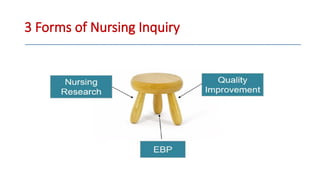
3 Forms of Nursing Inquiry
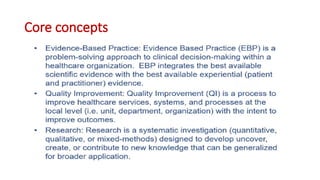
Core concepts
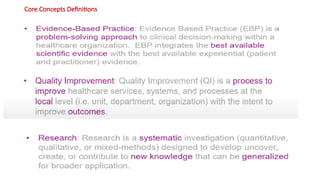
Core Concepts Definitions
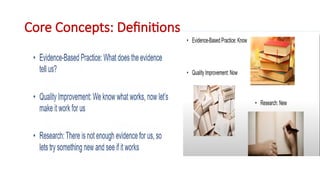
Core Concepts: Definitions
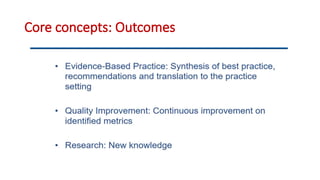
Core concepts: Outcomes
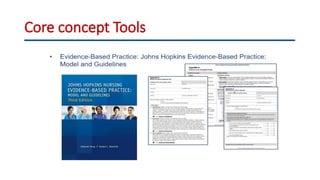
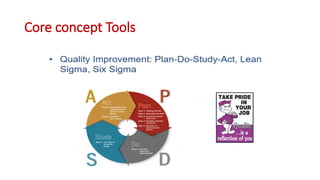
Core concept Tools
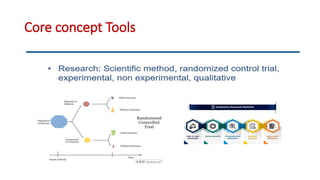
Core concept Tools
Core concept Tools
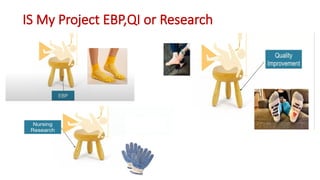
IS My Project EBP,QI or Research
Evidence Based practice
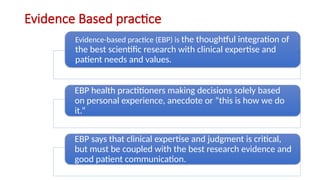
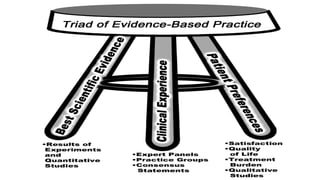
Evidence-based practice (EBP) is the thoughtful integration of
the best scientific research with clinical expertise and
patient needs and values.
EBP health practitioners making decisions solely based
on personal experience, anecdote or “this is how we do
it.”
EBP says that clinical expertise and judgment is critical,
but must be coupled with the best research evidence and
good patient communication.
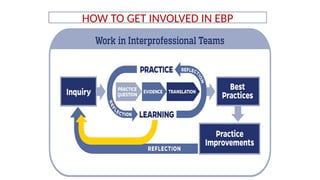
HOW TO GET INVOLVED IN EBP
EBP can help you find the best evidence quickly
Problem: Patient care questions remain unanswered.
• Studies have shown that the frequency of questions raised by clinicians ranges from .16 to
1.85 per patient seen. Due to lack of time, lack of information resources, and weak search
skills, clinicians are only seeking answers to 50% of those questions.
• EBP Solution: Evidence-based practice tools and methods make it faster and easier to find
the best evidence, especially at the point of care where it matters most. This means that
more questions can be answered, health care can become more evidence-based, and
outcomes potentially improved.
• A 2010 study indicated that there were over seventy-five
clinical trials and eleven systematic reviews published
every day in medicine.
• At ten minutes an article, it would take over fourteen
hours every day to read them all.
• EBP Solution: Systematic reviews, evidence-based
practice summaries, clinical practice guidelines, and
peer-reviewed article lists are all examples of EBP tools
that help to tame this flood of information by
summarizing the best information.
• Critical appraisal methods make it easier to look at
• an article and be able to quickly determine its strengths
and weaknesses and its use for patient care. A core
element of EBP is the focus on patient-oriented outcomes
such as death, disability, and discomfort rather than
disease-oriented outcomes such as lab results.
• EBP tools and methods can help you to easily separate
the best, clinically relevant and patient-oriented evidence
from the rest.
Problem: Healthcare literature, with clinically applicable findings, is published at a rate that is
impossible for individual clinicians to keep up with.
Problem: It can take more than a decade for clinical research to be fully
integrated into everyday practice.
• Even once evidence is widespread, providers still make decisions based
on habit rather than evidence.
• EBP Solution: By making good evidence easier to find and appraise, EBP
can reduce this delay and provide better support for changing care.
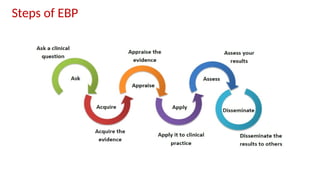
Steps of EBP
1.Ask
• Formulating the Question
1. Background Questions:ask about general knowledge and usually consist of two parts:
the root question (what, where, when, why, or how); and a specific disease or treatment.
What warming methods are used to treat hypothermia?
2. Foreground Questions:Complex and include specific information about patients,
interventions, and outcomes
What is a well-built question, and why is it important?
• Who is the patient, population, or problem?
• Is their medical or social history important?
• What characteristics of the patient matter?
• Are certain signs and symptoms relevant?
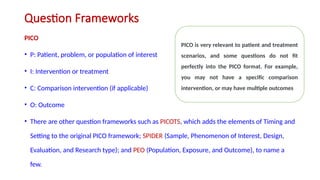
Question Frameworks
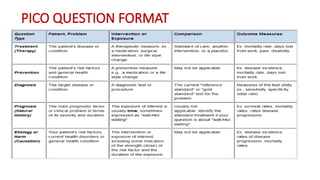
PICO
• P: Patient, problem, or population of interest
• I: Intervention or treatment
• C: Comparison intervention (if applicable)
• O: Outcome
• There are other question frameworks such as PICOTS, which adds the elements of Timing and
Setting to the original PICO framework; SPIDER (Sample, Phenomenon of Interest, Design,
Evaluation, and Research type); and PEO (Population, Exposure, and Outcome), to name a
few.
PICO is very relevant to patient and treatment
scenarios, and some questions do not fit
perfectly into the PICO format. For example,
you may not have a specific comparison
intervention, or may have multiple outcomes
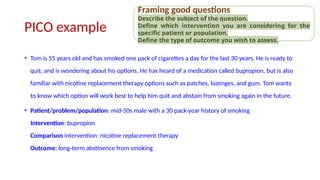
PICO example
• Tom is 55 years old and has smoked one pack of cigarettes a day for the last 30 years. He is ready to
quit, and is wondering about his options. He has heard of a medication called bupropion, but is also
familiar with nicotine replacement therapy options such as patches, lozenges, and gum. Tom wants
to know which option will work best to help him quit and abstain from smoking again in the future.
• Patient/problem/population: mid-50s male with a 30 pack-year history of smoking
Intervention: bupropion
Comparison intervention: nicotine replacement therapy
Outcome: long-term abstinence from smoking
Framing good questions
Describe the subject of the question.
Define which intervention you are considering for the
specific patient or population.
Define the type of outcome you wish to assess.
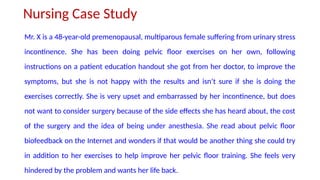
Nursing Case Study
Mr. X is a 48-year-old premenopausal, multiparous female suffering from urinary stress
incontinence. She has been doing pelvic floor exercises on her own, following
instructions on a patient education handout she got from her doctor, to improve the
symptoms, but she is not happy with the results and isn’t sure if she is doing the
exercises correctly. She is very upset and embarrassed by her incontinence, but does
not want to consider surgery because of the side effects she has heard about, the cost
of the surgery and the idea of being under anesthesia. She read about pelvic floor
biofeedback on the Internet and wonders if that would be another thing she could try
in addition to her exercises to help improve her pelvic floor training. She feels very
hindered by the problem and wants her life back.
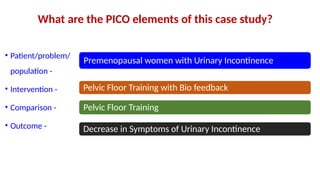
• Patient/problem/
population -
• Intervention -
• Comparison -
• Outcome -
Premenopausal women with Urinary Incontinence
Pelvic Floor Training with Bio feedback
Pelvic Floor Training
Decrease in Symptoms of Urinary Incontinence
What are the PICO elements of this case study?
Activity 2
• What would your clinical question be for this PICO scenario?
In a premenopausal female with urinary stress incontinence, does
pelvic floor training with biofeedback as compared to pelvic floor
training alone result in a decrease in symptoms of urinary
incontinence?
Step 2: Acquire Evidence
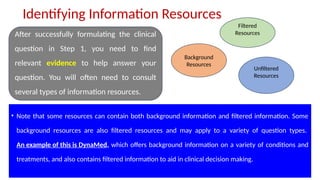
Identifying Information Resources
• Note that some resources can contain both background information and filtered information. Some
background resources are also filtered resources and may apply to a variety of question types.
An example of this is DynaMed, which offers background information on a variety of conditions and
treatments, and also contains filtered information to aid in clinical decision making.
After successfully formulating the clinical
question in Step 1, you need to find
relevant evidence to help answer your
question. You will often need to consult
several types of information resources.
Background
Resources
Filtered
Resources
Unfiltered
Resources
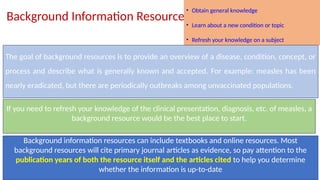
Background Information Resources
• Obtain general knowledge
• Learn about a new condition or topic
• Refresh your knowledge on a subject
The goal of background resources is to provide an overview of a disease, condition, concept, or
process and describe what is generally known and accepted. For example: measles has been
nearly eradicated, but there are periodically outbreaks among unvaccinated populations.
If you need to refresh your knowledge of the clinical presentation, diagnosis, etc. of measles, a
background resource would be the best place to start.
Background information resources can include textbooks and online resources. Most
background resources will cite primary journal articles as evidence, so pay attention to the
publication years of both the resource itself and the articles cited to help you determine
whether the information is up-to-date
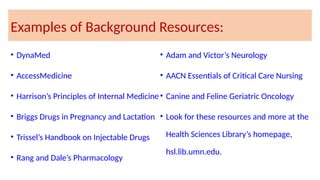
Examples of Background Resources:
• DynaMed
• AccessMedicine
• Harrison’s Principles of Internal Medicine
• Briggs Drugs in Pregnancy and Lactation
• Trissel’s Handbook on Injectable Drugs
• Rang and Dale’s Pharmacology
• Adam and Victor’s Neurology
• AACN Essentials of Critical Care Nursing
• Canine and Feline Geriatric Oncology
• Look for these resources and more at the
Health Sciences Library’s homepage,
hsl.lib.umn.edu.
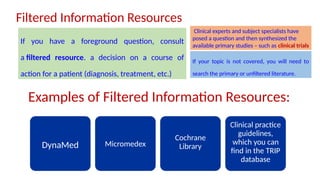
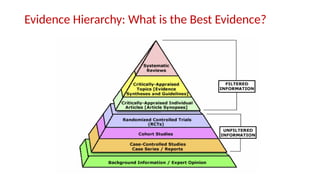
Examples of Filtered Information Resources:
DynaMed Micromedex
Cochrane
Library
Clinical practice
guidelines,
which you can
find in the TRIP
database
Filtered Information Resources
If you have a foreground question, consult
a filtered resource. a decision on a course of
action for a patient (diagnosis, treatment, etc.)
Clinical experts and subject specialists have
posed a question and then synthesized the
available primary studies – such as clinical trials
If your topic is not covered, you will need to
search the primary or unfiltered literature.
Unfiltered Information Resources
• If a filtered resource does not cover a topic, does not apply to
your patient, or you want to see what is new since the
filtered resources were last updated, you can turn
to unfiltered resources – often known as “primary literature.”
• When using primary literature, it is up to you to assess its
quality, validity and applicability to your patient. Likewise,
searching the primary literature can require more time and
expertise, which is why filtered resources are a good place to
get started. Every primary literature database is a little
different.
• PubMed
• CINAHL
• Embase
• PsycINFO
• Scopus
• Web of Science
Evidence Hierarchy: What is the Best Evidence?
Making Search Decisions
Does background information on your topic answer your question?
• For example, are you looking for presentation information, a differential diagnosis list, or
types of therapies? Try a background resource, such as Dyna Med, Clinical Key or Access
Medicine.
Are you trying to decide on the best course of action (for diagnosis, treatment, etc.) and want
to incorporate recent, reliable evidence into your decision?
• Consult a filtered resource, such as Dyna Med, Cochrane Library, or Micromedex.
Were you unable to find an answer to your question in a filtered resource, or want to find
new original research studies?
• Try an unfiltered resource, such as PubMed, PsycINFO, or CINAHL.
Search Terms
• When searching databases, you will need to determine which keywords to include
in your search to help find relevant information. When it comes to keywords,
simple is best. Search like a neanderthal and not like a novelist. Select one
keyword to describe the most important parts of your patient/problem and
intervention.
• Keyword selection is a skill that takes practice and repetition to develop. Be flexible
and gentle with yourself – you may need to try a few different times to get it right!
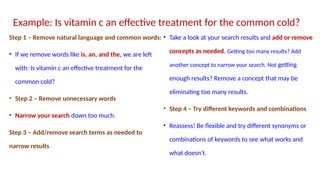
Step 1 – Remove natural language and common words:
• If we remove words like is, an, and the, we are left
with: Is vitamin c an effective treatment for the
common cold?
• Step 2 – Remove unnecessary words
• Narrow your search down too much.
Step 3 – Add/remove search terms as needed to
narrow results
• Take a look at your search results and add or remove
concepts as needed. Getting too many results? Add
another concept to narrow your search. Not getting
enough results? Remove a concept that may be
eliminating too many results.
• Step 4 – Try different keywords and combinations
• Reassess! Be flexible and try different synonyms or
combinations of keywords to see what works and
what doesn’t.
Example: Is vitamin c an effective treatment for the common cold?
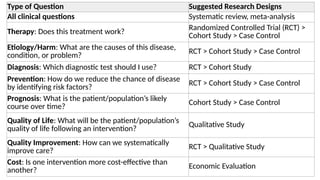
3.Appraising the Evidence
• Does this study address a clearly focused question?
• Does the study use valid methods to address this question?
• Are the valid results of this study important and applicable to my
patient, population, or problem?
Type of Question Suggested Research Designs
All clinical questions Systematic review, meta-analysis
Therapy: Does this treatment work? Randomized Controlled Trial (RCT) >
Cohort Study > Case Control
Etiology/Harm: What are the causes of this disease,
condition, or problem?
RCT > Cohort Study > Case Control
Diagnosis: Which diagnostic test should I use? RCT > Cohort Study
Prevention: How do we reduce the chance of disease
by identifying risk factors?
RCT > Cohort Study > Case Control
Prognosis: What is the patient/population’s likely
course over time?
Cohort Study > Case Control
Quality of Life: What will be the patient/population’s
quality of life following an intervention? Qualitative Study
Quality Improvement: How can we systematically
improve care?
RCT > Qualitative Study
Cost: Is one intervention more cost-effective than
another? Economic Evaluation
Definitions of Research Designs
• Systematic Reviews & Meta-Analyses
• Randomized Controlled Trials (RCT)
• Cohort Studies
• Case Control Studies
• Diagnostic Studies
• Economic Evaluation
• Qualitative Studies
Resources for Critical Appraisal
• Critical Appraisal Skills Programme (CASP) Checklists
• BMJ Best Practice Critical Appraisal Checklists
• Centre for Evidence-Based Medicine (CEBM) Critical Appraisal Tools
Step 4: Apply the Evidence
• Once you have determined that the study and its
results are valid, you need to decide if it applies to
your specific patient/population and situation.
Factors to consider include:
• Similarities between your
patient/problem/population and those in the
study;
• The needs and wishes of your patient or
population;
• The clinical significance of the results;
• And the availability of said interventions in your
practice or setting.
• Remember that EBP balances three elements: 1)
the latest, best evidence;
• 2) the patient or community’s values, needs, and
preferences; and
• 3) your expertise.
You may want to consider questions such as the following:
Diagnosis
Example application questions:
• Is the test affordable, accurate and available in my
practice or hospital?
• How likely is it that my patient has the disease if the
results are positive (i.e. positive predictive value or
post-test probability of a positive test)?
• How likely is it that my patient does not have the
disease if the results are negative (i.e. negative
predictive value or post-test probability of a negative
test)?
• Will the test results change my management
decisions (i.e. treatment plan)?
• What is the cost (financial and otherwise) and
relative value of alternate tests?
• Example of patient-oriented application questions:
• Will my patient be better off because of this test?
• Will the diagnosis impact patient-important
outcomes, e.g. quality of life, death, disability, cost,
etc?
Therapy/Intervention
Example application questions:
• Is my patient similar enough to those in the study that the results would be valid?
• According to the study results, how much would my patient benefit from the treatment?
• Were the results clinically significant (i.e. change is tangible and valuable to patients) or just
statistically significant?
• Example of patient-oriented application questions:
• What is the quality of life with this treatment as compared to others?
• Does the intervention reflect my patient’s or community’s needs, values, and preferences?
• Will my patient be able to adhere to the treatment requirements?
Harm
• Example application questions:
• Can the study results be applied to
my patient or population?
• How large is the risk identified in the
study?
• How does the risk of the intervention
compare with its potential benefits?
• Are there alternative interventions
with a lower risk of harm?
• How do the potential harms align
with the needs, values, and
preferences of your specific patient
or community?
Prognosis
• Example application questions:
• Is my patient similar to the patients
in the study group?
• How strong is the evidence behind
the prognostic factor?
• Are the results useful for counseling
your patient?
• What was the prognosis on related
outcomes (e.g. disability and quality
of life)?
Program/Quality Improvement
• Example application questions:
• Is the setting or population of the
article similar to your practice or
community?
• Will this change improve safety
concerns (e.g. protect patients
from medical errors)?
• Is this change or program effective
and efficient?
• Does this program align with the
community’s needs, values, and
preferences?
• Are there resources (money, staff,
training, etc.) to support new
programming?
Economic Evaluation
• Example application questions:
• Are the treatment benefits worth
the corresponding risks and costs?
• Will the costs be similar in your
setting?
• Will implementing this new
program or intervention result in
decreased resources to existing
services? What will be the
consequences of that decrease?
Nursing Case Study
• In the past case studies and activities you have:
• identified the PICO components of your patient scenario,
• formulated a clinical question,
• found an appropriate article to answer your question,
• and critically appraised the article.
• Now, it’s time to apply what you’ve learned to your patient.
Activity:
How does the evidence apply to the patient in your case study? Click
here to reveal an example answer.
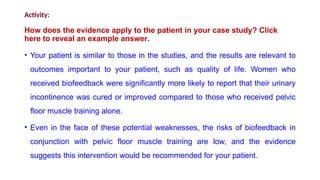
• Your patient is similar to those in the studies, and the results are relevant to
outcomes important to your patient, such as quality of life. Women who
received biofeedback were significantly more likely to report that their urinary
incontinence was cured or improved compared to those who received pelvic
floor muscle training alone.
• Even in the face of these potential weaknesses, the risks of biofeedback in
conjunction with pelvic floor muscle training are low, and the evidence
suggests this intervention would be recommended for your patient.
5. Assessing the Evidence
• By now, you have developed a clinical question, sought out research
to answer your question, critically assessed that research and applied
the findings to your patient or population. The process does not end
here though. Evidence-based practice is iterative, meaning that it
builds on itself, constantly being reshaped by new evidence and the
clinical expertise of those who practice it.
• The steps of evidence-based practice can be illustrated by a continuous evidence cycle. Once
you have applied your evidence to your situation, you should evaluate how well it worked.
This process often generates new clinical questions, prompting you to begin the cycle again.
• Ask yourself the following questions:
• What questions do you still have, and what new questions have arisen?
• What assessments should you use to gather evidence?
• Was the diagnosis or treatment successful?
• Is there new evidence on this topic?
• What was the patient’s or community’s response or attitude?
• What new information would help you make a better decision next time?
PICO QUESTION FORMAT
EBP Models
1.The Iowa Model of Evidence-Based Practice to Promote Quality Care: Developed by Marita G.
Titler and colleagues, this model provides a systematic approach to implementing EBP in
healthcare settings. It consists of seven steps:
(1) identification of the problem,
(2) review of the evidence,
(3) critical appraisal of the evidence,
(4) integration of the evidence,
(5) evaluation,
(6) dissemination, and
(7) implementation.
Stetler Model:
• The Stetler Model, developed by Cheryl A. Stetler, emphasizes the process of
translating research findings into practice. It consists of five stages:
(1) preparation,
(2) validation,
(3) comparative evaluation and decision making,
(4) translation/application, and
(5) evaluation.
Johns Hopkins Nursing EBP Model:
This model, developed by Deborah Dang and Judith Heale, is specifically
tailored for nurses and comprises seven steps:
(1) cultivating a spirit of inquiry,
(2) asking clinical questions in PICO(T) format,
(3) searching for and collecting evidence,
(4) critically appraising the evidence,
(5) integrating the evidence with clinical expertise and patient preferences,
(6) implementing practice changes based on evidence, and
(7) evaluating outcomes.
ACE Star Model of Knowledge
Transformation:
• The ACE Star Model, developed by Bernadette Mazurek Melnyk and Ellen Fineout-
Overholt, focuses on knowledge transformation and consists of five components:
(1) discovery and synthesis of evidence,
(2) evidence summary,
(3) translation into practice,
(4) integration and evaluation, and
(5) knowledge generation.
Translating Research Into Practice (TRIP)
Model:
• The TRIP Model, proposed by Rona F. Levin and Jacqueline Z. Bergman,
emphasizes the translation of research findings into clinical practice. It
consists of four stages:
(1) knowledge discovery,
(2) evidence summary,
(3) translation into guidelines and practice recommendations, and
(4) integration into practice.
EBP Nursing: Guidelines and Protocols
To find guidelines or protocols, use:
• AHRQ's National Guidelines Clearinghouse
• CINAHL’s Evidence-Based Care Sheets
• Cochrane Library's guidelines/protocols
Benefits of EBP in Nursing
• Promotes positive patient outcomes
• Reduces health care costs by preventing complications
• Contributes to the growth of the science of nursing
• Allows for incorporation of new technologies into health care practice
• Increases nurse autonomy and confidence in decision-making
• Ensures relevancy of nursing practice with new interventions and care protocols
• Provides scientifically supported research to help make well-informed decisions
• Fosters shared decision-making with patients in care planning
• Enhances critical thinking
• Encourages lifelong learning
Take aways
• In Step 1, you learned how to formulate a well-written question using
PICO.
• In Step 2, you learned how to identify relevant resources including
general or background resources, filtered and unfiltered resources.
• In Step 3, you learned how to critically appraise a resource.
• In Step 4 and Step 5 you learned the importance of applying the
evidence to a specific patient and reevaluating the evidence based on
additional information.

EVIDENCE BASED PRACTICE ,Evidence based Research

  • 1.
    EVIDENCE BASED PRACTICE Dr.Settepalli Jasmin Debora, Professor Cum HOD, Adult Health Nursing Department, FNUR, SGTU
  • 2.
    By the endof this Session, you will be able to: • Differentiate Evidence based Practice, Quality improvement & Research • Identify the steps of Evidence-Based Practice • Formulate a well-built question using the four components of PICO • Describe and use relevant evidence-based resources • Critically appraise information and apply evidence related to questions • Re-evaluate the evidence for effectiveness and efficacy as related to your patient or problem. • Understand the use of Models of EBP
  • 3.
  • 4.
    3 Forms ofNursing Inquiry
  • 5.
  • 6.
  • 7.
  • 8.
  • 9.
  • 10.
  • 11.
  • 12.
    IS My ProjectEBP,QI or Research
  • 13.
    Evidence Based practice Evidence-basedpractice (EBP) is the thoughtful integration of the best scientific research with clinical expertise and patient needs and values. EBP health practitioners making decisions solely based on personal experience, anecdote or “this is how we do it.” EBP says that clinical expertise and judgment is critical, but must be coupled with the best research evidence and good patient communication.
  • 15.
    HOW TO GETINVOLVED IN EBP
  • 16.
    EBP can helpyou find the best evidence quickly Problem: Patient care questions remain unanswered. • Studies have shown that the frequency of questions raised by clinicians ranges from .16 to 1.85 per patient seen. Due to lack of time, lack of information resources, and weak search skills, clinicians are only seeking answers to 50% of those questions. • EBP Solution: Evidence-based practice tools and methods make it faster and easier to find the best evidence, especially at the point of care where it matters most. This means that more questions can be answered, health care can become more evidence-based, and outcomes potentially improved.
  • 17.
    • A 2010study indicated that there were over seventy-five clinical trials and eleven systematic reviews published every day in medicine. • At ten minutes an article, it would take over fourteen hours every day to read them all. • EBP Solution: Systematic reviews, evidence-based practice summaries, clinical practice guidelines, and peer-reviewed article lists are all examples of EBP tools that help to tame this flood of information by summarizing the best information. • Critical appraisal methods make it easier to look at • an article and be able to quickly determine its strengths and weaknesses and its use for patient care. A core element of EBP is the focus on patient-oriented outcomes such as death, disability, and discomfort rather than disease-oriented outcomes such as lab results. • EBP tools and methods can help you to easily separate the best, clinically relevant and patient-oriented evidence from the rest. Problem: Healthcare literature, with clinically applicable findings, is published at a rate that is impossible for individual clinicians to keep up with.
  • 18.
    Problem: It cantake more than a decade for clinical research to be fully integrated into everyday practice. • Even once evidence is widespread, providers still make decisions based on habit rather than evidence. • EBP Solution: By making good evidence easier to find and appraise, EBP can reduce this delay and provide better support for changing care.
  • 19.
  • 20.
    1.Ask • Formulating theQuestion 1. Background Questions:ask about general knowledge and usually consist of two parts: the root question (what, where, when, why, or how); and a specific disease or treatment. What warming methods are used to treat hypothermia? 2. Foreground Questions:Complex and include specific information about patients, interventions, and outcomes
  • 21.
    What is awell-built question, and why is it important? • Who is the patient, population, or problem? • Is their medical or social history important? • What characteristics of the patient matter? • Are certain signs and symptoms relevant?
  • 22.
    Question Frameworks PICO • P:Patient, problem, or population of interest • I: Intervention or treatment • C: Comparison intervention (if applicable) • O: Outcome • There are other question frameworks such as PICOTS, which adds the elements of Timing and Setting to the original PICO framework; SPIDER (Sample, Phenomenon of Interest, Design, Evaluation, and Research type); and PEO (Population, Exposure, and Outcome), to name a few. PICO is very relevant to patient and treatment scenarios, and some questions do not fit perfectly into the PICO format. For example, you may not have a specific comparison intervention, or may have multiple outcomes
  • 23.
    PICO example • Tomis 55 years old and has smoked one pack of cigarettes a day for the last 30 years. He is ready to quit, and is wondering about his options. He has heard of a medication called bupropion, but is also familiar with nicotine replacement therapy options such as patches, lozenges, and gum. Tom wants to know which option will work best to help him quit and abstain from smoking again in the future. • Patient/problem/population: mid-50s male with a 30 pack-year history of smoking Intervention: bupropion Comparison intervention: nicotine replacement therapy Outcome: long-term abstinence from smoking Framing good questions Describe the subject of the question. Define which intervention you are considering for the specific patient or population. Define the type of outcome you wish to assess.
  • 24.
    Nursing Case Study Mr.X is a 48-year-old premenopausal, multiparous female suffering from urinary stress incontinence. She has been doing pelvic floor exercises on her own, following instructions on a patient education handout she got from her doctor, to improve the symptoms, but she is not happy with the results and isn’t sure if she is doing the exercises correctly. She is very upset and embarrassed by her incontinence, but does not want to consider surgery because of the side effects she has heard about, the cost of the surgery and the idea of being under anesthesia. She read about pelvic floor biofeedback on the Internet and wonders if that would be another thing she could try in addition to her exercises to help improve her pelvic floor training. She feels very hindered by the problem and wants her life back.
  • 25.
    • Patient/problem/ population - •Intervention - • Comparison - • Outcome - Premenopausal women with Urinary Incontinence Pelvic Floor Training with Bio feedback Pelvic Floor Training Decrease in Symptoms of Urinary Incontinence What are the PICO elements of this case study?
  • 26.
    Activity 2 • Whatwould your clinical question be for this PICO scenario? In a premenopausal female with urinary stress incontinence, does pelvic floor training with biofeedback as compared to pelvic floor training alone result in a decrease in symptoms of urinary incontinence?
  • 27.
  • 28.
    Identifying Information Resources •Note that some resources can contain both background information and filtered information. Some background resources are also filtered resources and may apply to a variety of question types. An example of this is DynaMed, which offers background information on a variety of conditions and treatments, and also contains filtered information to aid in clinical decision making. After successfully formulating the clinical question in Step 1, you need to find relevant evidence to help answer your question. You will often need to consult several types of information resources. Background Resources Filtered Resources Unfiltered Resources
  • 29.
    Background Information Resources •Obtain general knowledge • Learn about a new condition or topic • Refresh your knowledge on a subject The goal of background resources is to provide an overview of a disease, condition, concept, or process and describe what is generally known and accepted. For example: measles has been nearly eradicated, but there are periodically outbreaks among unvaccinated populations. If you need to refresh your knowledge of the clinical presentation, diagnosis, etc. of measles, a background resource would be the best place to start. Background information resources can include textbooks and online resources. Most background resources will cite primary journal articles as evidence, so pay attention to the publication years of both the resource itself and the articles cited to help you determine whether the information is up-to-date
  • 30.
    Examples of BackgroundResources: • DynaMed • AccessMedicine • Harrison’s Principles of Internal Medicine • Briggs Drugs in Pregnancy and Lactation • Trissel’s Handbook on Injectable Drugs • Rang and Dale’s Pharmacology • Adam and Victor’s Neurology • AACN Essentials of Critical Care Nursing • Canine and Feline Geriatric Oncology • Look for these resources and more at the Health Sciences Library’s homepage, hsl.lib.umn.edu.
  • 31.
    Examples of FilteredInformation Resources: DynaMed Micromedex Cochrane Library Clinical practice guidelines, which you can find in the TRIP database Filtered Information Resources If you have a foreground question, consult a filtered resource. a decision on a course of action for a patient (diagnosis, treatment, etc.) Clinical experts and subject specialists have posed a question and then synthesized the available primary studies – such as clinical trials If your topic is not covered, you will need to search the primary or unfiltered literature.
  • 32.
    Unfiltered Information Resources •If a filtered resource does not cover a topic, does not apply to your patient, or you want to see what is new since the filtered resources were last updated, you can turn to unfiltered resources – often known as “primary literature.” • When using primary literature, it is up to you to assess its quality, validity and applicability to your patient. Likewise, searching the primary literature can require more time and expertise, which is why filtered resources are a good place to get started. Every primary literature database is a little different. • PubMed • CINAHL • Embase • PsycINFO • Scopus • Web of Science
  • 33.
    Evidence Hierarchy: Whatis the Best Evidence?
  • 34.
    Making Search Decisions Doesbackground information on your topic answer your question? • For example, are you looking for presentation information, a differential diagnosis list, or types of therapies? Try a background resource, such as Dyna Med, Clinical Key or Access Medicine. Are you trying to decide on the best course of action (for diagnosis, treatment, etc.) and want to incorporate recent, reliable evidence into your decision? • Consult a filtered resource, such as Dyna Med, Cochrane Library, or Micromedex. Were you unable to find an answer to your question in a filtered resource, or want to find new original research studies? • Try an unfiltered resource, such as PubMed, PsycINFO, or CINAHL.
  • 35.
    Search Terms • Whensearching databases, you will need to determine which keywords to include in your search to help find relevant information. When it comes to keywords, simple is best. Search like a neanderthal and not like a novelist. Select one keyword to describe the most important parts of your patient/problem and intervention. • Keyword selection is a skill that takes practice and repetition to develop. Be flexible and gentle with yourself – you may need to try a few different times to get it right!
  • 36.
    Step 1 –Remove natural language and common words: • If we remove words like is, an, and the, we are left with: Is vitamin c an effective treatment for the common cold? • Step 2 – Remove unnecessary words • Narrow your search down too much. Step 3 – Add/remove search terms as needed to narrow results • Take a look at your search results and add or remove concepts as needed. Getting too many results? Add another concept to narrow your search. Not getting enough results? Remove a concept that may be eliminating too many results. • Step 4 – Try different keywords and combinations • Reassess! Be flexible and try different synonyms or combinations of keywords to see what works and what doesn’t. Example: Is vitamin c an effective treatment for the common cold?
  • 37.
    3.Appraising the Evidence •Does this study address a clearly focused question? • Does the study use valid methods to address this question? • Are the valid results of this study important and applicable to my patient, population, or problem?
  • 38.
    Type of QuestionSuggested Research Designs All clinical questions Systematic review, meta-analysis Therapy: Does this treatment work? Randomized Controlled Trial (RCT) > Cohort Study > Case Control Etiology/Harm: What are the causes of this disease, condition, or problem? RCT > Cohort Study > Case Control Diagnosis: Which diagnostic test should I use? RCT > Cohort Study Prevention: How do we reduce the chance of disease by identifying risk factors? RCT > Cohort Study > Case Control Prognosis: What is the patient/population’s likely course over time? Cohort Study > Case Control Quality of Life: What will be the patient/population’s quality of life following an intervention? Qualitative Study Quality Improvement: How can we systematically improve care? RCT > Qualitative Study Cost: Is one intervention more cost-effective than another? Economic Evaluation
  • 39.
    Definitions of ResearchDesigns • Systematic Reviews & Meta-Analyses • Randomized Controlled Trials (RCT) • Cohort Studies • Case Control Studies • Diagnostic Studies • Economic Evaluation • Qualitative Studies
  • 40.
    Resources for CriticalAppraisal • Critical Appraisal Skills Programme (CASP) Checklists • BMJ Best Practice Critical Appraisal Checklists • Centre for Evidence-Based Medicine (CEBM) Critical Appraisal Tools
  • 41.
    Step 4: Applythe Evidence • Once you have determined that the study and its results are valid, you need to decide if it applies to your specific patient/population and situation. Factors to consider include: • Similarities between your patient/problem/population and those in the study; • The needs and wishes of your patient or population; • The clinical significance of the results; • And the availability of said interventions in your practice or setting. • Remember that EBP balances three elements: 1) the latest, best evidence; • 2) the patient or community’s values, needs, and preferences; and • 3) your expertise.
  • 42.
    You may wantto consider questions such as the following: Diagnosis Example application questions: • Is the test affordable, accurate and available in my practice or hospital? • How likely is it that my patient has the disease if the results are positive (i.e. positive predictive value or post-test probability of a positive test)? • How likely is it that my patient does not have the disease if the results are negative (i.e. negative predictive value or post-test probability of a negative test)? • Will the test results change my management decisions (i.e. treatment plan)? • What is the cost (financial and otherwise) and relative value of alternate tests? • Example of patient-oriented application questions: • Will my patient be better off because of this test? • Will the diagnosis impact patient-important outcomes, e.g. quality of life, death, disability, cost, etc?
  • 43.
    Therapy/Intervention Example application questions: •Is my patient similar enough to those in the study that the results would be valid? • According to the study results, how much would my patient benefit from the treatment? • Were the results clinically significant (i.e. change is tangible and valuable to patients) or just statistically significant? • Example of patient-oriented application questions: • What is the quality of life with this treatment as compared to others? • Does the intervention reflect my patient’s or community’s needs, values, and preferences? • Will my patient be able to adhere to the treatment requirements?
  • 44.
    Harm • Example applicationquestions: • Can the study results be applied to my patient or population? • How large is the risk identified in the study? • How does the risk of the intervention compare with its potential benefits? • Are there alternative interventions with a lower risk of harm? • How do the potential harms align with the needs, values, and preferences of your specific patient or community? Prognosis • Example application questions: • Is my patient similar to the patients in the study group? • How strong is the evidence behind the prognostic factor? • Are the results useful for counseling your patient? • What was the prognosis on related outcomes (e.g. disability and quality of life)?
  • 45.
    Program/Quality Improvement • Exampleapplication questions: • Is the setting or population of the article similar to your practice or community? • Will this change improve safety concerns (e.g. protect patients from medical errors)? • Is this change or program effective and efficient? • Does this program align with the community’s needs, values, and preferences? • Are there resources (money, staff, training, etc.) to support new programming? Economic Evaluation • Example application questions: • Are the treatment benefits worth the corresponding risks and costs? • Will the costs be similar in your setting? • Will implementing this new program or intervention result in decreased resources to existing services? What will be the consequences of that decrease?
  • 46.
    Nursing Case Study •In the past case studies and activities you have: • identified the PICO components of your patient scenario, • formulated a clinical question, • found an appropriate article to answer your question, • and critically appraised the article. • Now, it’s time to apply what you’ve learned to your patient.
  • 47.
    Activity: How does theevidence apply to the patient in your case study? Click here to reveal an example answer. • Your patient is similar to those in the studies, and the results are relevant to outcomes important to your patient, such as quality of life. Women who received biofeedback were significantly more likely to report that their urinary incontinence was cured or improved compared to those who received pelvic floor muscle training alone. • Even in the face of these potential weaknesses, the risks of biofeedback in conjunction with pelvic floor muscle training are low, and the evidence suggests this intervention would be recommended for your patient.
  • 48.
    5. Assessing theEvidence • By now, you have developed a clinical question, sought out research to answer your question, critically assessed that research and applied the findings to your patient or population. The process does not end here though. Evidence-based practice is iterative, meaning that it builds on itself, constantly being reshaped by new evidence and the clinical expertise of those who practice it.
  • 49.
    • The stepsof evidence-based practice can be illustrated by a continuous evidence cycle. Once you have applied your evidence to your situation, you should evaluate how well it worked. This process often generates new clinical questions, prompting you to begin the cycle again. • Ask yourself the following questions: • What questions do you still have, and what new questions have arisen? • What assessments should you use to gather evidence? • Was the diagnosis or treatment successful? • Is there new evidence on this topic? • What was the patient’s or community’s response or attitude? • What new information would help you make a better decision next time?
  • 50.
  • 51.
    EBP Models 1.The IowaModel of Evidence-Based Practice to Promote Quality Care: Developed by Marita G. Titler and colleagues, this model provides a systematic approach to implementing EBP in healthcare settings. It consists of seven steps: (1) identification of the problem, (2) review of the evidence, (3) critical appraisal of the evidence, (4) integration of the evidence, (5) evaluation, (6) dissemination, and (7) implementation.
  • 52.
    Stetler Model: • TheStetler Model, developed by Cheryl A. Stetler, emphasizes the process of translating research findings into practice. It consists of five stages: (1) preparation, (2) validation, (3) comparative evaluation and decision making, (4) translation/application, and (5) evaluation.
  • 53.
    Johns Hopkins NursingEBP Model: This model, developed by Deborah Dang and Judith Heale, is specifically tailored for nurses and comprises seven steps: (1) cultivating a spirit of inquiry, (2) asking clinical questions in PICO(T) format, (3) searching for and collecting evidence, (4) critically appraising the evidence, (5) integrating the evidence with clinical expertise and patient preferences, (6) implementing practice changes based on evidence, and (7) evaluating outcomes.
  • 54.
    ACE Star Modelof Knowledge Transformation: • The ACE Star Model, developed by Bernadette Mazurek Melnyk and Ellen Fineout- Overholt, focuses on knowledge transformation and consists of five components: (1) discovery and synthesis of evidence, (2) evidence summary, (3) translation into practice, (4) integration and evaluation, and (5) knowledge generation.
  • 55.
    Translating Research IntoPractice (TRIP) Model: • The TRIP Model, proposed by Rona F. Levin and Jacqueline Z. Bergman, emphasizes the translation of research findings into clinical practice. It consists of four stages: (1) knowledge discovery, (2) evidence summary, (3) translation into guidelines and practice recommendations, and (4) integration into practice.
  • 56.
    EBP Nursing: Guidelinesand Protocols To find guidelines or protocols, use: • AHRQ's National Guidelines Clearinghouse • CINAHL’s Evidence-Based Care Sheets • Cochrane Library's guidelines/protocols
  • 57.
    Benefits of EBPin Nursing • Promotes positive patient outcomes • Reduces health care costs by preventing complications • Contributes to the growth of the science of nursing • Allows for incorporation of new technologies into health care practice • Increases nurse autonomy and confidence in decision-making • Ensures relevancy of nursing practice with new interventions and care protocols • Provides scientifically supported research to help make well-informed decisions • Fosters shared decision-making with patients in care planning • Enhances critical thinking • Encourages lifelong learning
  • 58.
    Take aways • InStep 1, you learned how to formulate a well-written question using PICO. • In Step 2, you learned how to identify relevant resources including general or background resources, filtered and unfiltered resources. • In Step 3, you learned how to critically appraise a resource. • In Step 4 and Step 5 you learned the importance of applying the evidence to a specific patient and reevaluating the evidence based on additional information.