EVIDENCE BASED MEDICINE
AN INTRODUCTION
25-7-2016
What EBM is not ?
• Something physicians have been doing for ages.
• “Cookbook” medicine.
• A tool for administrators and insurers.
• Restricted to randomized trials and systematic reviews.
• Opposed to patient centered medicine.
What is the need?
• Cost
• Delay of "bench-to-bedside" research
• Managing the primary literature
• Counter misleading marketing
• Dealing with conflicting results
Why EBM?
What is the need?
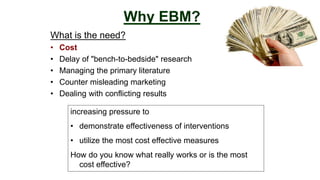
• Cost
• Delay of "bench-to-bedside" research
• Managing the primary literature
• Counter misleading marketing
• Dealing with conflicting results
Why EBM?
increasing pressure to
• demonstrate effectiveness of interventions
• utilize the most cost effective measures
How do you know what really works or is the most
cost effective?
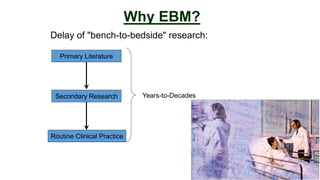
Delay of "bench-to-bedside" research:
Why EBM?
Secondary Research
Routine Clinical Practice
Primary Literature
Years-to-Decades
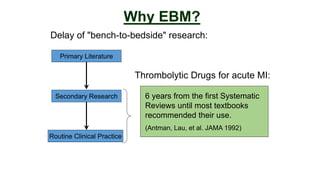
Delay of "bench-to-bedside" research:
Why EBM?
Secondary Research
Routine Clinical Practice
Primary Literature
Thrombolytic Drugs for acute MI:
6 years from the first Systematic
Reviews until most textbooks
recommended their use.
(Antman, Lau, et al. JAMA 1992)
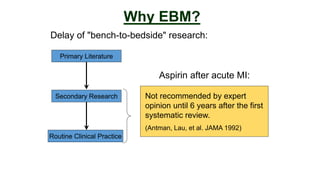
Delay of "bench-to-bedside" research:
Why EBM?
Secondary Research
Routine Clinical Practice
Primary Literature
Aspirin after acute MI:
Not recommended by expert
opinion until 6 years after the first
systematic review.
(Antman, Lau, et al. JAMA 1992)
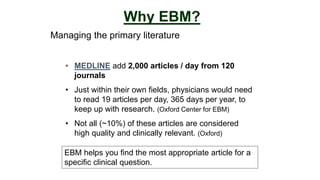
Managing the primary literature
Why EBM?
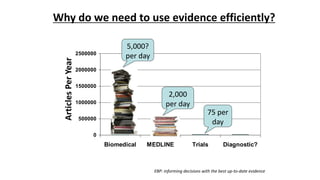
• MEDLINE add 2,000 articles / day from 120
journals
• Just within their own fields, physicians would need
to read 19 articles per day, 365 days per year, to
keep up with research. (Oxford Center for EBM)
• Not all (~10%) of these articles are considered
high quality and clinically relevant. (Oxford)
EBM helps you find the most appropriate article for a
specific clinical question.
0
500000
1000000
1500000
2000000
2500000
Biomedical MEDLINE Trials Diagnostic?
MedicalArticlesperYear
5,000?
per day
2,000
per day
75 per
day
ArticlesPerYear
Why do we need to use evidence efficiently?
EBP: informing decisions with the best up-to-date evidence
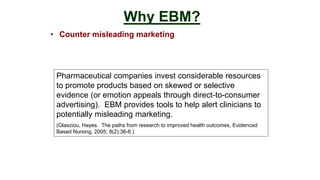
• Counter misleading marketing
Why EBM?
Pharmaceutical companies invest considerable resources
to promote products based on skewed or selective
evidence (or emotion appeals through direct-to-consumer
advertising). EBM provides tools to help alert clinicians to
potentially misleading marketing.
(Glasziou, Hayes. The paths from research to improved health outcomes, Evidenced
Based Nursing, 2005; 8(2):36-8.)
Dealing with conflicting results
Why EBM?
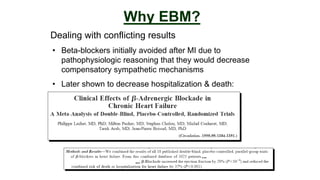
• Beta-blockers initially avoided after MI due to
pathophysiologic reasoning that they would decrease
compensatory sympathetic mechanisms
• Later shown to decrease hospitalization & death:
Dealing with conflicting results
Why EBM?
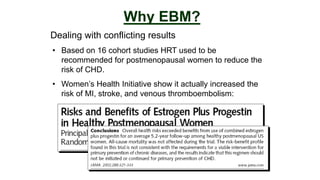
• Based on 16 cohort studies HRT used to be
recommended for postmenopausal women to reduce the
risk of CHD.
• Women’s Health Initiative show it actually increased the
risk of MI, stroke, and venous thromboembolism:
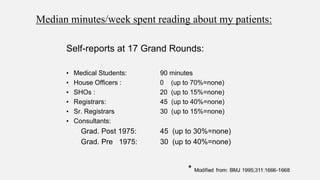
Median minutes/week spent reading about my patients:
Self-reports at 17 Grand Rounds:
• Medical Students: 90 minutes
• House Officers : 0 (up to 70%=none)
• SHOs : 20 (up to 15%=none)
• Registrars: 45 (up to 40%=none)
• Sr. Registrars 30 (up to 15%=none)
• Consultants:
• Grad. Post 1975: 45 (up to 30%=none)
• Grad. Pre 1975: 30 (up to 40%=none)
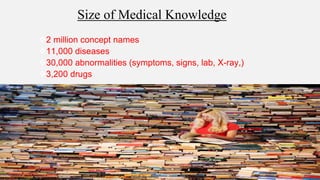
Size of Medical Knowledge
2 million concept names
11,000 diseases
30,000 abnormalities (symptoms, signs, lab, X-ray,)
3,200 drugs
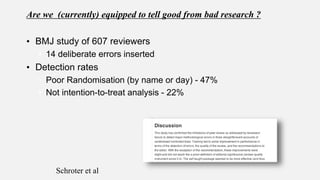
Are we (currently) equipped to tell good from bad research ?
• BMJ study of 607 reviewers
• 14 deliberate errors inserted
• Detection rates
• Poor Randomisation (by name or day) - 47%
• Not intention-to-treat analysis - 22%
Schroter et al
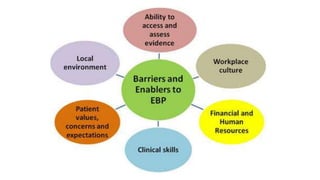
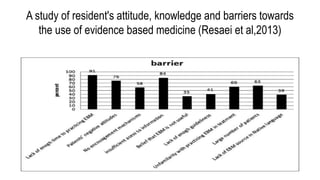
A study of resident's attitude, knowledge and barriers towards
the use of evidence based medicine (Resaei et al,2013)
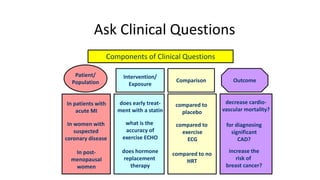
Ask Clinical Questions
Patient/
Population Outcome
Intervention/
Exposure
Comparison
Components of Clinical Questions
In patients with
acute MI
In post-
menopausal
women
In women with
suspected
coronary disease
does early treat-
ment with a statin
what is the
accuracy of
exercise ECHO
does hormone
replacement
therapy
compared to
placebo
compared to
exercise
ECG
compared to no
HRT
decrease cardio-
vascular mortality?
for diagnosing
significant
CAD?
increase the
risk of
breast cancer?
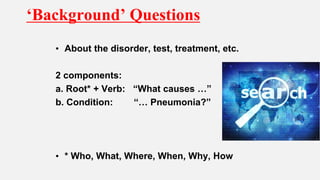
‘Background’ Questions
• About the disorder, test, treatment, etc.
2 components:
a. Root* + Verb: “What causes …”
b. Condition: “… Pneumonia?”
• * Who, What, Where, When, Why, How
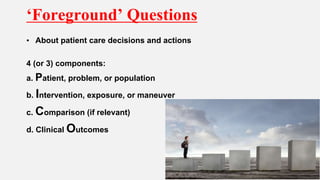
‘Foreground’ Questions
• About patient care decisions and actions
4 (or 3) components:
a. Patient, problem, or population
b. Intervention, exposure, or maneuver
c. Comparison (if relevant)
d. Clinical Outcomes
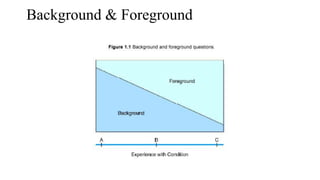
Background & Foreground
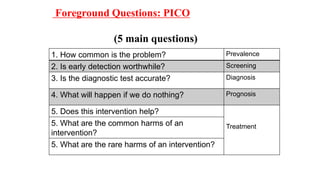
Foreground Questions: PICO
(5 main questions)
1. How common is the problem? Prevalence
2. Is early detection worthwhile? Screening
3. Is the diagnostic test accurate? Diagnosis
4. What will happen if we do nothing? Prognosis
5. Does this intervention help?
Treatment5. What are the common harms of an
intervention?
5. What are the rare harms of an intervention?
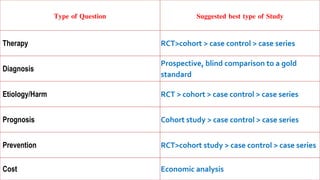
Type of Question Suggested best type of Study
Therapy RCT>cohort > case control > case series
Diagnosis
Prospective, blind comparison to a gold
standard
Etiology/Harm RCT > cohort > case control > case series
Prognosis Cohort study > case control > case series
Prevention RCT>cohort study > case control > case series
Cost Economic analysis
[1.]
Sources for Background Questions :
• Textbooks
• Handbooks
• Manuals
Background
Questions
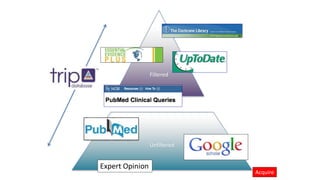
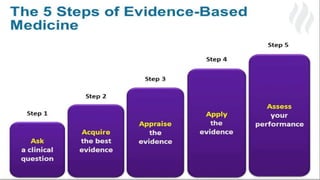
Acquire
Unfiltered
Expert Opinion
Filtered
Acquire
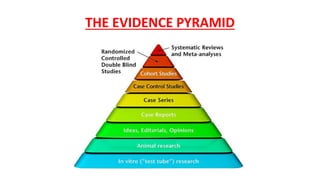
THE EVIDENCE PYRAMID
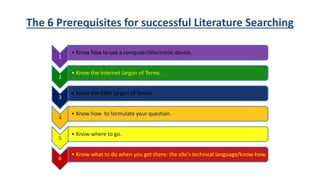
The 6 Prerequisites for successful Literature Searching
1
• Know how to use a computer/electronic device.
2
• Know the Internet Jargon of Terms.
3
• Know the EBM Jargon of Terms.
4
• Know how to formulate your question.
5
• Know where to go.
6
• Know what to do when you get there: the site’s technical language/know-how.
For
Whom?
Chairman Nursing
Manager
Resident
Clinical
DirectorQuality
Nurse
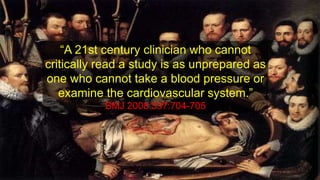
“A 21st century clinician who cannot
critically read a study is as unprepared as
one who cannot take a blood pressure or
examine the cardiovascular system.”
BMJ 2008:337:704-705
Ebm

Ebm

  • 2.
    EVIDENCE BASED MEDICINE ANINTRODUCTION 25-7-2016
  • 12.
    What EBM isnot ? • Something physicians have been doing for ages. • “Cookbook” medicine. • A tool for administrators and insurers. • Restricted to randomized trials and systematic reviews. • Opposed to patient centered medicine.
  • 13.
    What is theneed? • Cost • Delay of "bench-to-bedside" research • Managing the primary literature • Counter misleading marketing • Dealing with conflicting results Why EBM?
  • 14.
    What is theneed? • Cost • Delay of "bench-to-bedside" research • Managing the primary literature • Counter misleading marketing • Dealing with conflicting results Why EBM? increasing pressure to • demonstrate effectiveness of interventions • utilize the most cost effective measures How do you know what really works or is the most cost effective?
  • 15.
    Delay of "bench-to-bedside"research: Why EBM? Secondary Research Routine Clinical Practice Primary Literature Years-to-Decades
  • 16.
    Delay of "bench-to-bedside"research: Why EBM? Secondary Research Routine Clinical Practice Primary Literature Thrombolytic Drugs for acute MI: 6 years from the first Systematic Reviews until most textbooks recommended their use. (Antman, Lau, et al. JAMA 1992)
  • 17.
    Delay of "bench-to-bedside"research: Why EBM? Secondary Research Routine Clinical Practice Primary Literature Aspirin after acute MI: Not recommended by expert opinion until 6 years after the first systematic review. (Antman, Lau, et al. JAMA 1992)
  • 19.
    Managing the primaryliterature Why EBM? • MEDLINE add 2,000 articles / day from 120 journals • Just within their own fields, physicians would need to read 19 articles per day, 365 days per year, to keep up with research. (Oxford Center for EBM) • Not all (~10%) of these articles are considered high quality and clinically relevant. (Oxford) EBM helps you find the most appropriate article for a specific clinical question.
  • 20.
    0 500000 1000000 1500000 2000000 2500000 Biomedical MEDLINE TrialsDiagnostic? MedicalArticlesperYear 5,000? per day 2,000 per day 75 per day ArticlesPerYear Why do we need to use evidence efficiently? EBP: informing decisions with the best up-to-date evidence
  • 21.
    • Counter misleadingmarketing Why EBM? Pharmaceutical companies invest considerable resources to promote products based on skewed or selective evidence (or emotion appeals through direct-to-consumer advertising). EBM provides tools to help alert clinicians to potentially misleading marketing. (Glasziou, Hayes. The paths from research to improved health outcomes, Evidenced Based Nursing, 2005; 8(2):36-8.)
  • 22.
    Dealing with conflictingresults Why EBM? • Beta-blockers initially avoided after MI due to pathophysiologic reasoning that they would decrease compensatory sympathetic mechanisms • Later shown to decrease hospitalization & death:
  • 23.
    Dealing with conflictingresults Why EBM? • Based on 16 cohort studies HRT used to be recommended for postmenopausal women to reduce the risk of CHD. • Women’s Health Initiative show it actually increased the risk of MI, stroke, and venous thromboembolism:
  • 24.
    Median minutes/week spentreading about my patients: Self-reports at 17 Grand Rounds: • Medical Students: 90 minutes • House Officers : 0 (up to 70%=none) • SHOs : 20 (up to 15%=none) • Registrars: 45 (up to 40%=none) • Sr. Registrars 30 (up to 15%=none) • Consultants: • Grad. Post 1975: 45 (up to 30%=none) • Grad. Pre 1975: 30 (up to 40%=none)
  • 25.
    Size of MedicalKnowledge 2 million concept names 11,000 diseases 30,000 abnormalities (symptoms, signs, lab, X-ray,) 3,200 drugs
  • 26.
    Are we (currently)equipped to tell good from bad research ? • BMJ study of 607 reviewers • 14 deliberate errors inserted • Detection rates • Poor Randomisation (by name or day) - 47% • Not intention-to-treat analysis - 22% Schroter et al
  • 28.
    A study ofresident's attitude, knowledge and barriers towards the use of evidence based medicine (Resaei et al,2013)
  • 30.
    Ask Clinical Questions Patient/ PopulationOutcome Intervention/ Exposure Comparison Components of Clinical Questions In patients with acute MI In post- menopausal women In women with suspected coronary disease does early treat- ment with a statin what is the accuracy of exercise ECHO does hormone replacement therapy compared to placebo compared to exercise ECG compared to no HRT decrease cardio- vascular mortality? for diagnosing significant CAD? increase the risk of breast cancer?
  • 31.
    ‘Background’ Questions • Aboutthe disorder, test, treatment, etc. 2 components: a. Root* + Verb: “What causes …” b. Condition: “… Pneumonia?” • * Who, What, Where, When, Why, How
  • 32.
    ‘Foreground’ Questions • Aboutpatient care decisions and actions 4 (or 3) components: a. Patient, problem, or population b. Intervention, exposure, or maneuver c. Comparison (if relevant) d. Clinical Outcomes
  • 33.
  • 34.
    Foreground Questions: PICO (5main questions) 1. How common is the problem? Prevalence 2. Is early detection worthwhile? Screening 3. Is the diagnostic test accurate? Diagnosis 4. What will happen if we do nothing? Prognosis 5. Does this intervention help? Treatment5. What are the common harms of an intervention? 5. What are the rare harms of an intervention?
  • 35.
    Type of QuestionSuggested best type of Study Therapy RCT>cohort > case control > case series Diagnosis Prospective, blind comparison to a gold standard Etiology/Harm RCT > cohort > case control > case series Prognosis Cohort study > case control > case series Prevention RCT>cohort study > case control > case series Cost Economic analysis
  • 36.
    [1.] Sources for BackgroundQuestions : • Textbooks • Handbooks • Manuals Background Questions Acquire
  • 37.
  • 38.
  • 39.
    The 6 Prerequisitesfor successful Literature Searching 1 • Know how to use a computer/electronic device. 2 • Know the Internet Jargon of Terms. 3 • Know the EBM Jargon of Terms. 4 • Know how to formulate your question. 5 • Know where to go. 6 • Know what to do when you get there: the site’s technical language/know-how.
  • 40.
  • 41.
  • 42.
    “A 21st centuryclinician who cannot critically read a study is as unprepared as one who cannot take a blood pressure or examine the cardiovascular system.” BMJ 2008:337:704-705