Organisational
Improvement
Evidence Based Management and Agility Path
1© Advanced Product Delivery 2016
© 1993-2015 Scrum.org, All Rights Reserved 2
• @s_reindl simon.reindl@advancedproductdelivery.com
• uk.linkedin.com/in/simonreindl
• 20+ Years in the Software Development Profession
• 6+ Years Agile Training & Coaching
Director
Agenda
•Introduction
•Why – Motivation for change
•How – proven ideas for success
•Agility Path – the change framework
•Evidence Based Management – the
evaluation framework
•Discussion
© Advanced Product Delivery 2016 3
© Advanced Product Delivery 2016 4
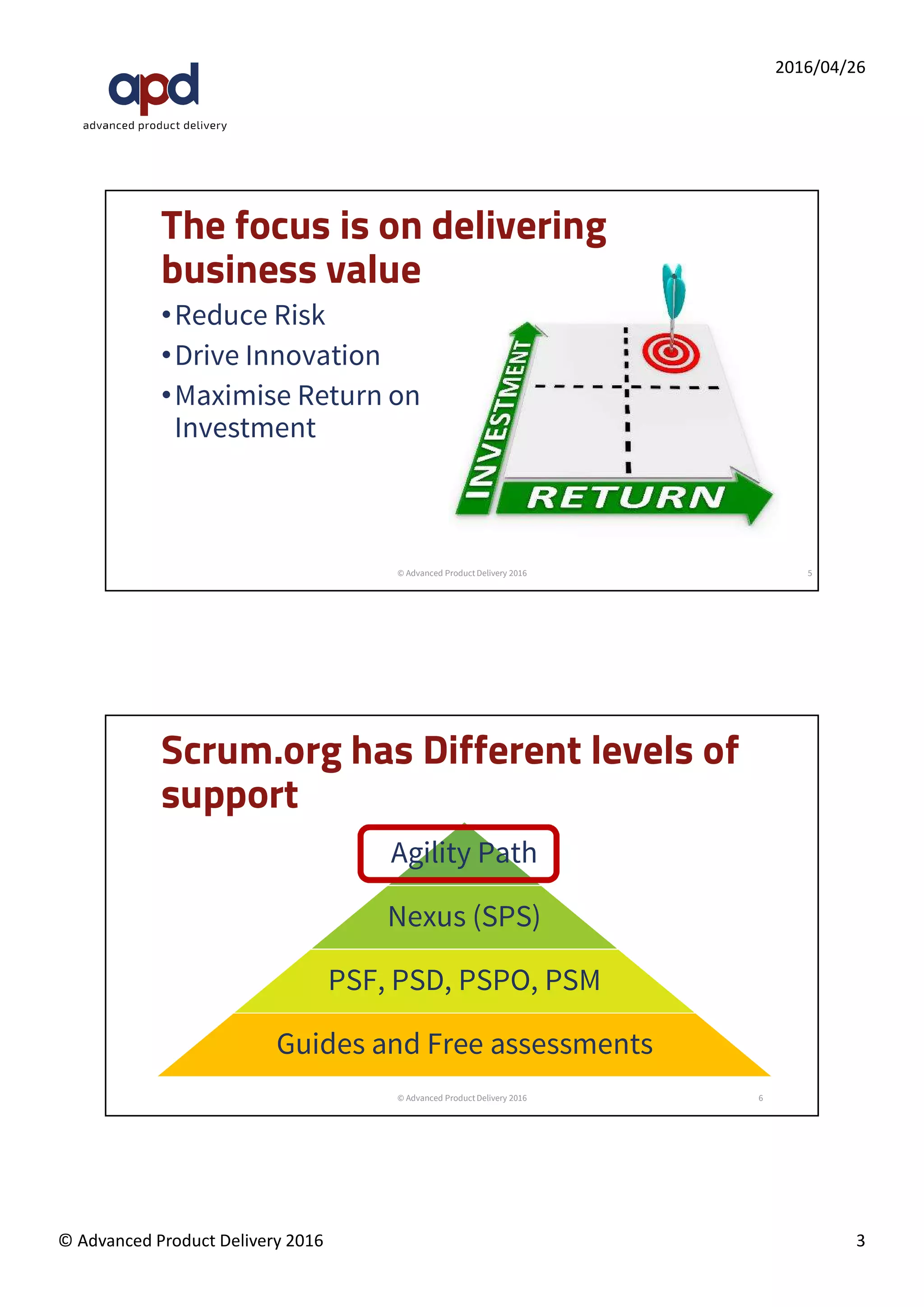
The focus is on delivering business
value
•Reduce Risk
•Drive Innovation
•Maximise Return on
Investment
5© Advanced Product Delivery 2016
Scrum.org has Different levels of
support
Agility Path
Nexus (SPS)
PSF, PSD, PSPO, PSM
Guides and Free assessments
© Advanced Product Delivery 2016 6
Motivations for change
•Business Need
•Top down desire
•Bottom up desire
•All the competitors are
•Current ways of working are not optimal
© Advanced Product Delivery 2016 7
Every Organisation has a
different context
Assumptions are the foundation of confusion
© Advanced Product Delivery 2016 8
© Advanced Product Delivery 2016 9
© 1993-2015 Scrum.org, All Rights Reserved
• Each organisation is unique
• There are many factors that
have helped create and sustain
your organisation
• People
• Countries
• Processes
• Business Domain
• Size
• Technology Stack
• Sum of experiences
We are all individuals
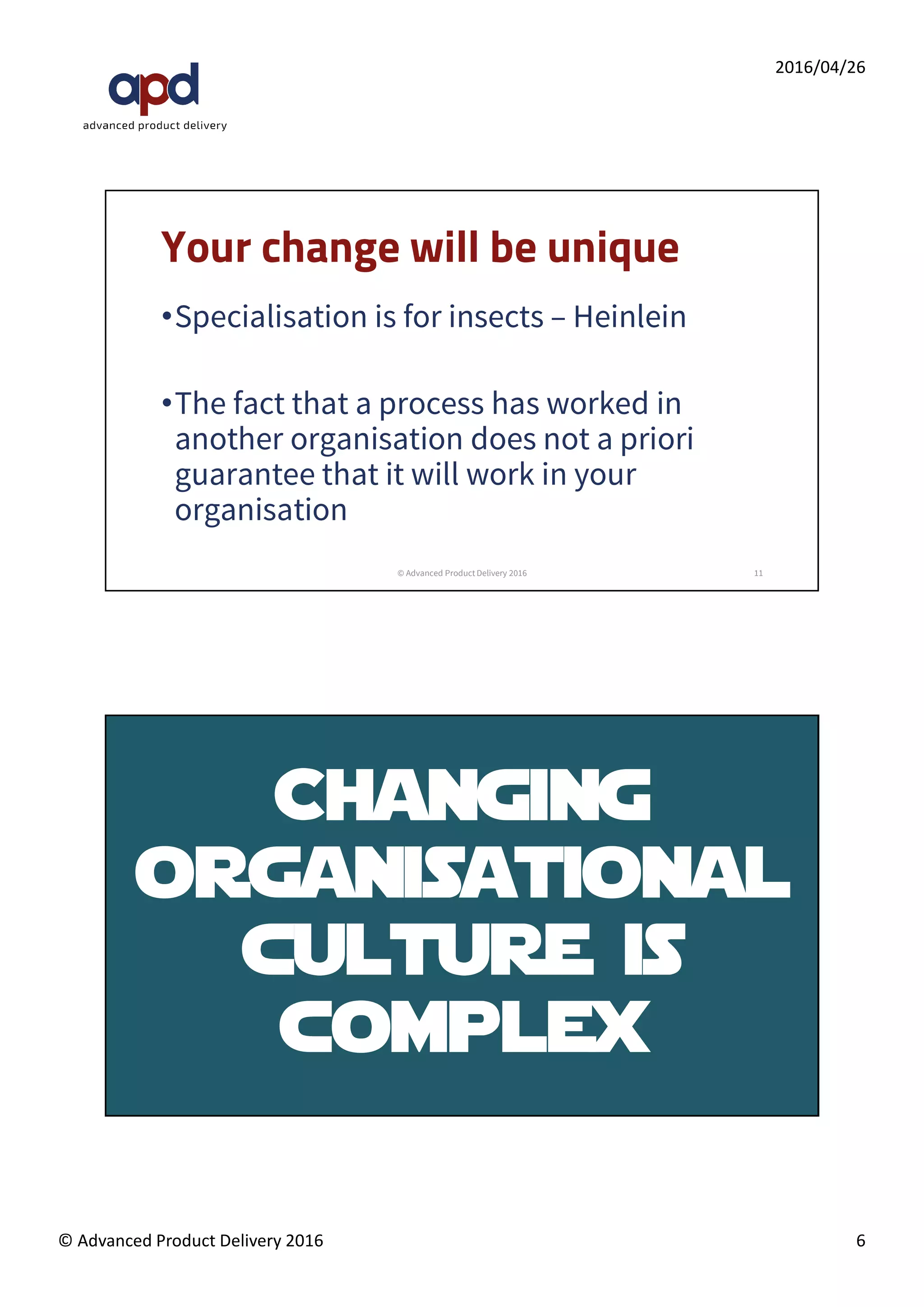
Your change will be unique
•Specialisation is for insects – Heinlein
•The fact that a process has worked in
another organisation does not a priori
guarantee that it will work in your
organisation
© Advanced Product Delivery 2016 11
Changing
organisational
culture is
complex
© 1993-2015 Scrum.org, All Rights Reserved 13
•Create a sense of Urgency
•Build a guiding coalition
•Form strategic vision & initiatives
•Enlist volunteers
•Enable by removing barriers
•Generate short term wins
•Sustain acceleration
•Institute change
http://www.kotterinternational.com/the-8-step-process-for-leading-change/
Kotter Change Model Steps
Change
14
Effectiveness
Denial
Anger
Despair Acceptance
Internalisation
New Normal
Rejection
© Advanced Product Delivery 2016
What’s in
it for me?
© Advanced Product Delivery 2016 15
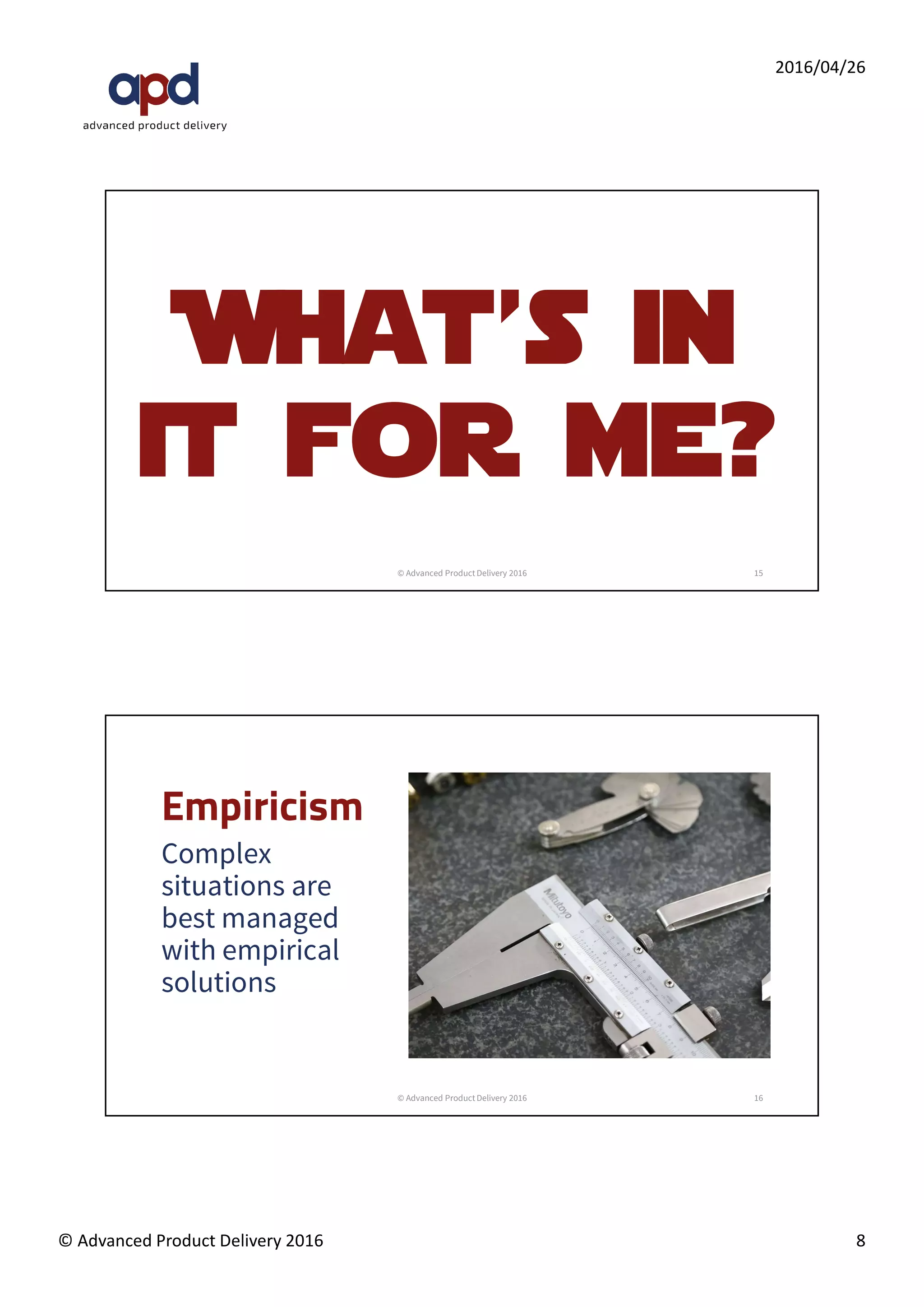
Empiricism
Complex
situations are
best managed
with empirical
solutions
© Advanced Product Delivery 2016 16
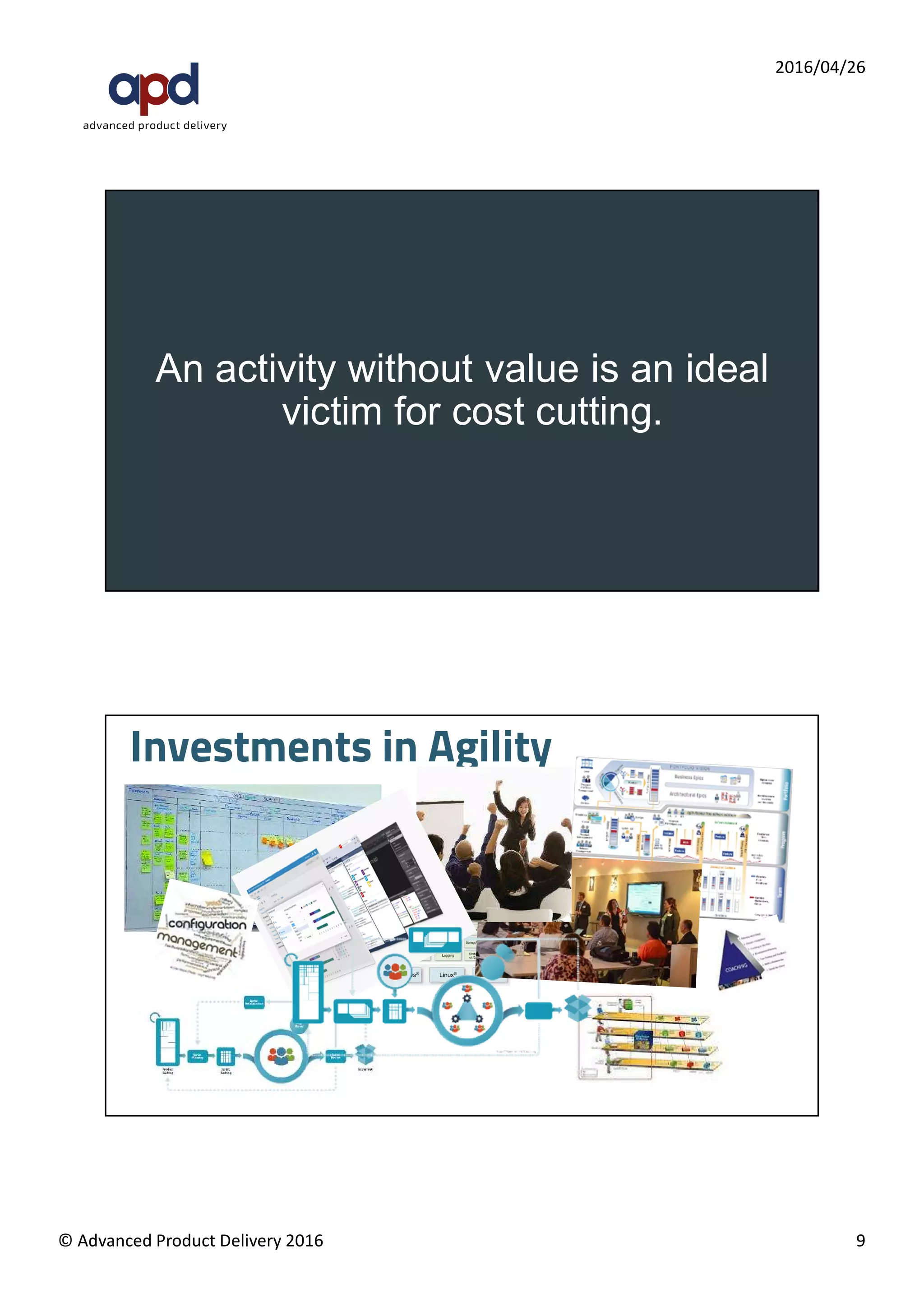
An activity without value is an ideal
victim for cost cutting.
Investments in Agility
Agility Path
Use Scrum to focus change
© Advanced Product Delivery 2016 19
© 1993-2015 Scrum.org, All Rights Reserved 20
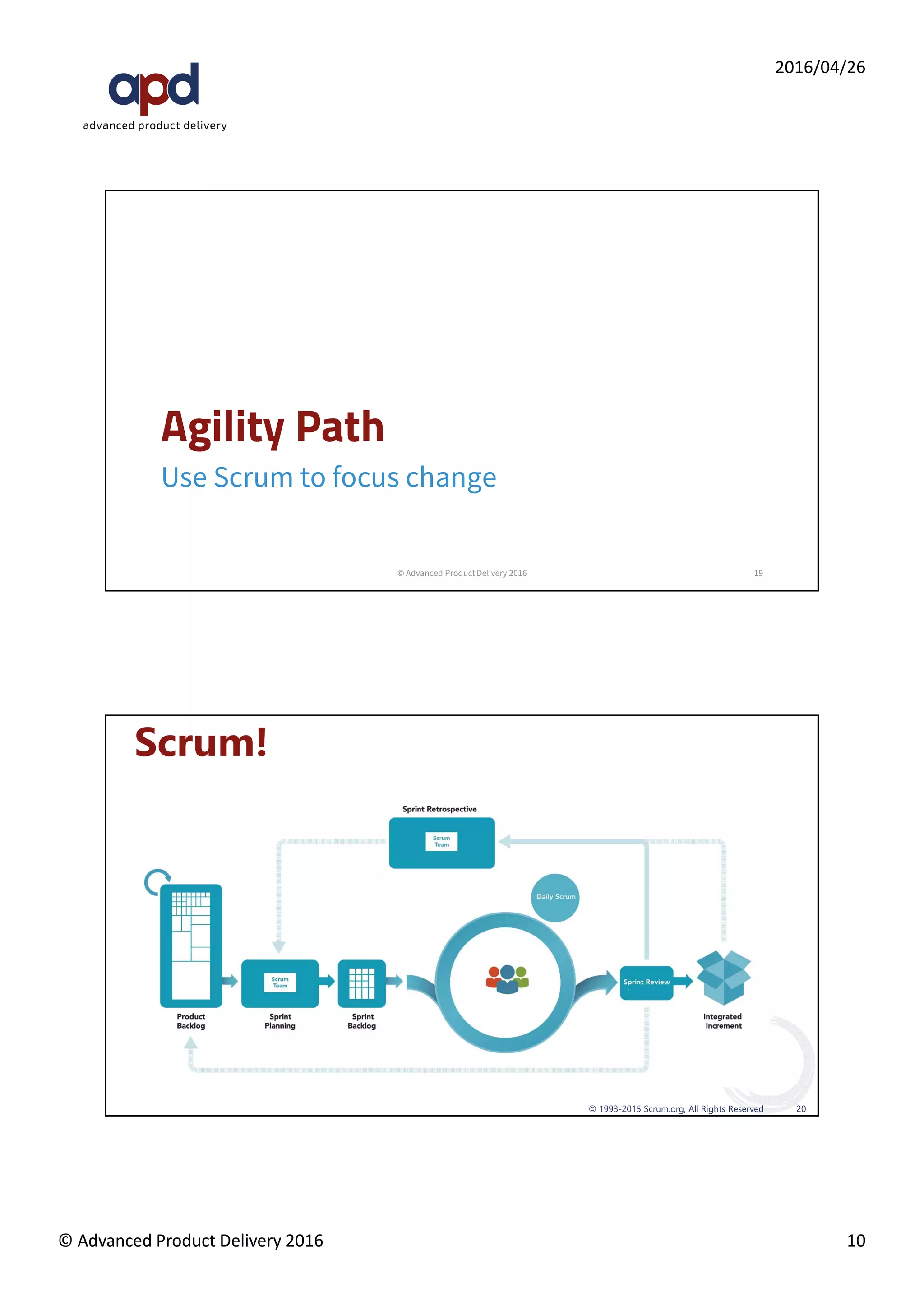
Scrum!
Scrum Roles, Artifacts, and Events
21
Roles
Product Owner
Development Team
Scrum Master
Note: All Events are timeboxed
Artifacts
Product Backlog
Sprint Backlog
The Increment
(of Working Software)
Events
The Sprint
Sprint Planning
Daily Scrum
Sprint Review
Sprint Retrospective
© Advanced Product Delivery 2016
Nexus Framework – Scaling Scrum
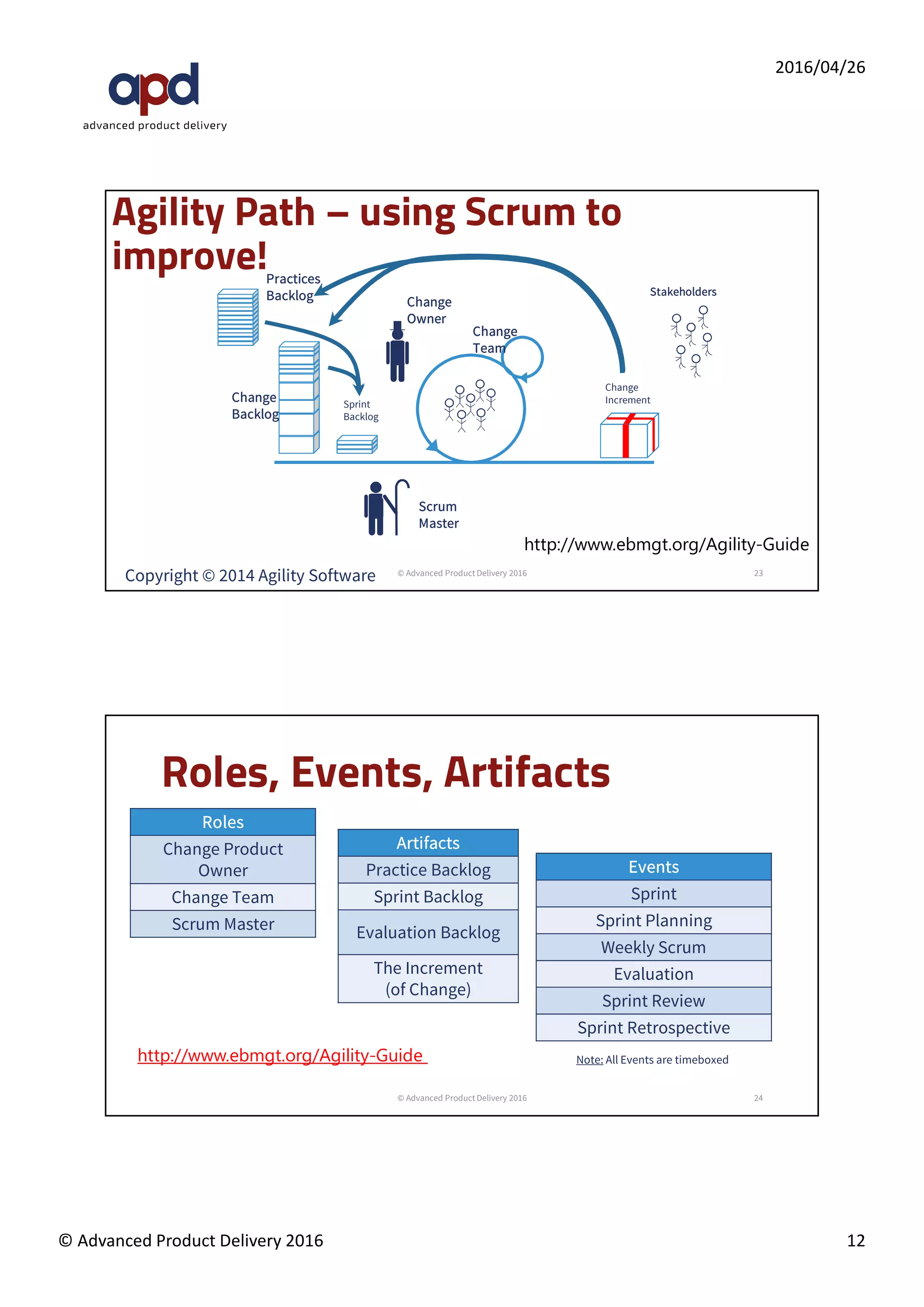
Agility Path – using Scrum to
improve!
Change
Owner
Scrum
Master
Change
Team
Change
Increment
Stakeholders
Sprint
Backlog
Change
Backlog
Practices
Backlog
Copyright © 2014 Agility Software
http://www.ebmgt.org/Agility-Guide
© Advanced Product Delivery 2016 23
Roles, Events, Artifacts
24
Roles
Change Product
Owner
Change Team
Scrum Master
Note: All Events are timeboxed
Artifacts
Practice Backlog
Sprint Backlog
Evaluation Backlog
The Increment
(of Change)
Events
Sprint
Sprint Planning
Weekly Scrum
Evaluation
Sprint Review
Sprint Retrospective
http://www.ebmgt.org/Agility-Guide
© Advanced Product Delivery 2016
© 1993-2015 Scrum.org, All Rights Reserved 25
• The purpose is to effect change within an organisation
• The role names reflect that
• Practice Backlog is the driving change log
• Evaluation Backlog is to cater for feedback from
observations
• Sprints are 1 month to effect change
• Scrums are weekly to allow change work to be
completed
• Weekly Scrum is 30 minutes maximum
• Evaluation occurs throughout the Sprint, prior to the
review
Did you notice some differences?
25
Iterative Incremental change to
manage risk
Plan
Do
Check
Act
• Make small adjustments
where they will bring the
most value
• Grow the things that work
• Stop the things that are
hurting progress
• Review regularly
• Maintain production
• Work collaboratively
© Advanced Product Delivery 2016 26
Agility Path - Any Comments or
observations
© Advanced Product Delivery 2016 27
Evidence Based Management
Empirical framework for Evaluating
organisations
© Advanced Product Delivery 2016 28
How will you measure
the effect of your
change actions?
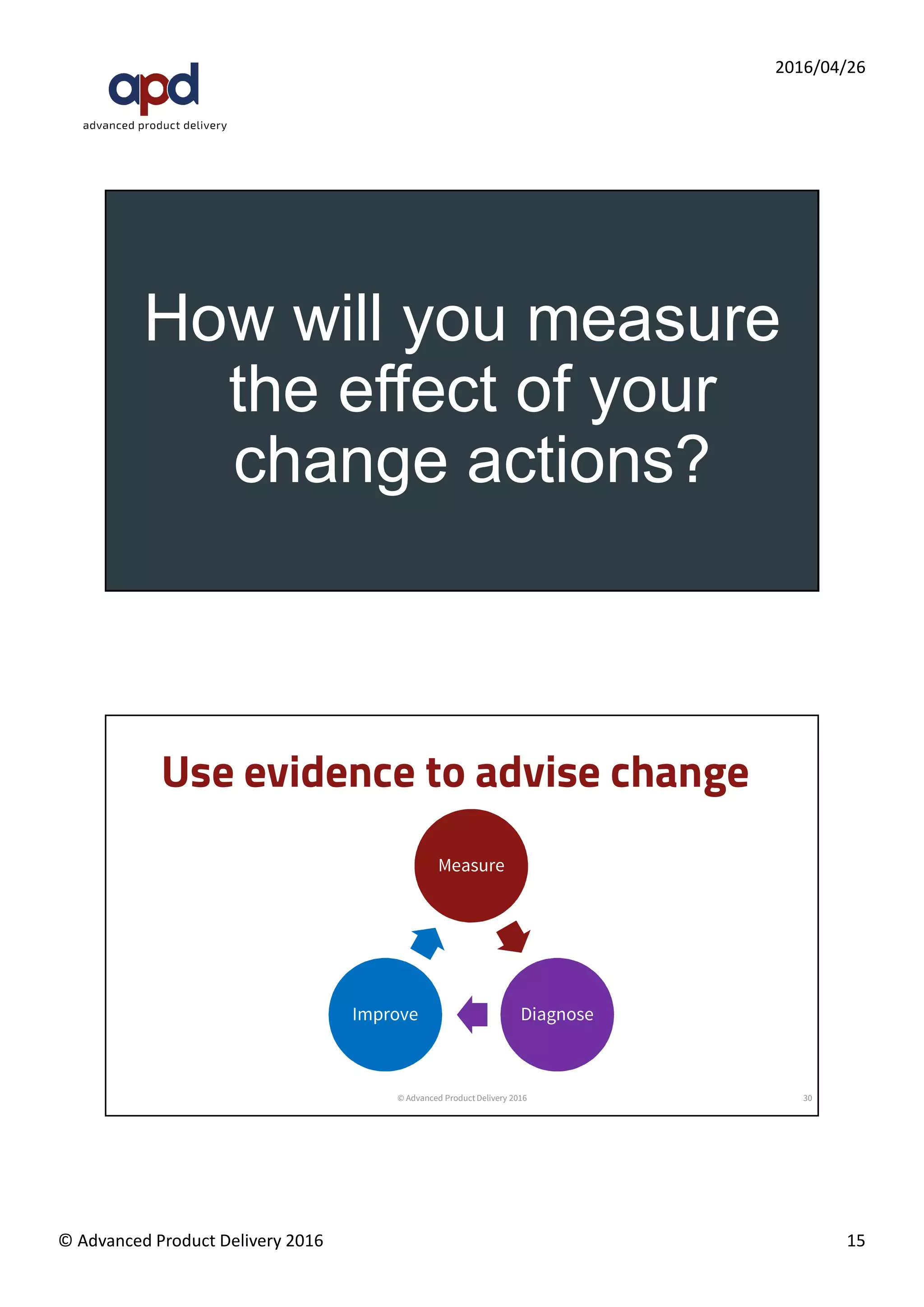
Use evidence to advise change
Measure
DiagnoseImprove
30© Advanced Product Delivery 2016
Common Sense
•Nothing kills rational thought like pressure
•Under pressure crazy ideas seem sound
•Objective, metric based discussions allow
ideas to be discussed and tested
© Advanced Product Delivery 2016 31
Evidence Based
Management
Scrum based
approach to
organisational
change based on
regular
measurements
© Advanced Product Delivery 2016 32
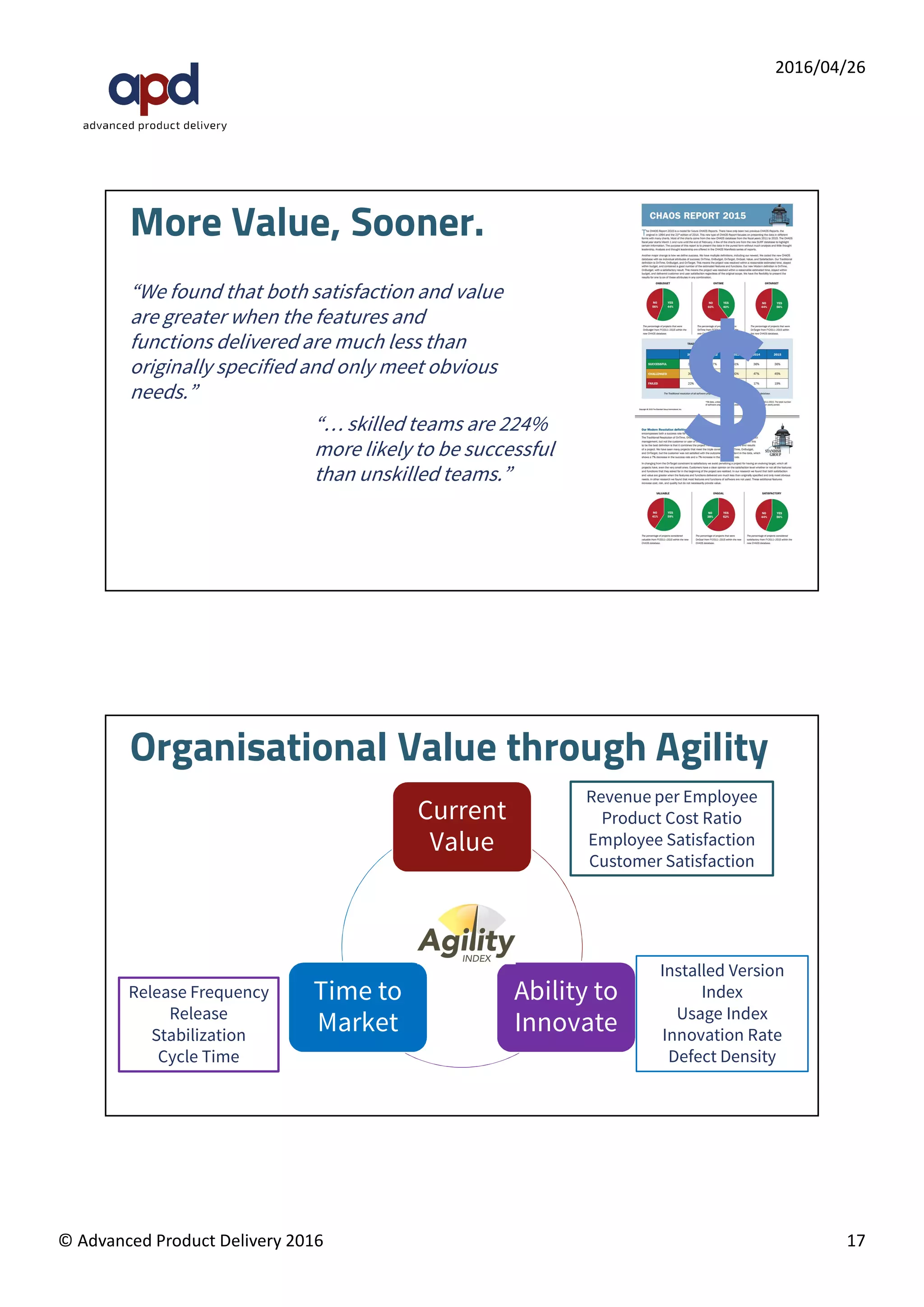
More Value, Sooner.
$
“We found that both satisfaction and value
are greater when the features and
functions delivered are much less than
originally specified and only meet obvious
needs.”
“… skilled teams are 224%
more likely to be successful
than unskilled teams.”
Organisational Value through Agility
Current
Value
Ability to
Innovate
Time to
Market
Revenue per Employee
Product Cost Ratio
Employee Satisfaction
Customer Satisfaction
Release Frequency
Release
Stabilization
Cycle Time
Installed Version
Index
Usage Index
Innovation Rate
Defect Density
Measure the value of the
organization
© Advanced Product Delivery 2016 37
Diagnose likely contributors.
Discover capabilities to build on.
© Advanced Product Delivery 2016 38
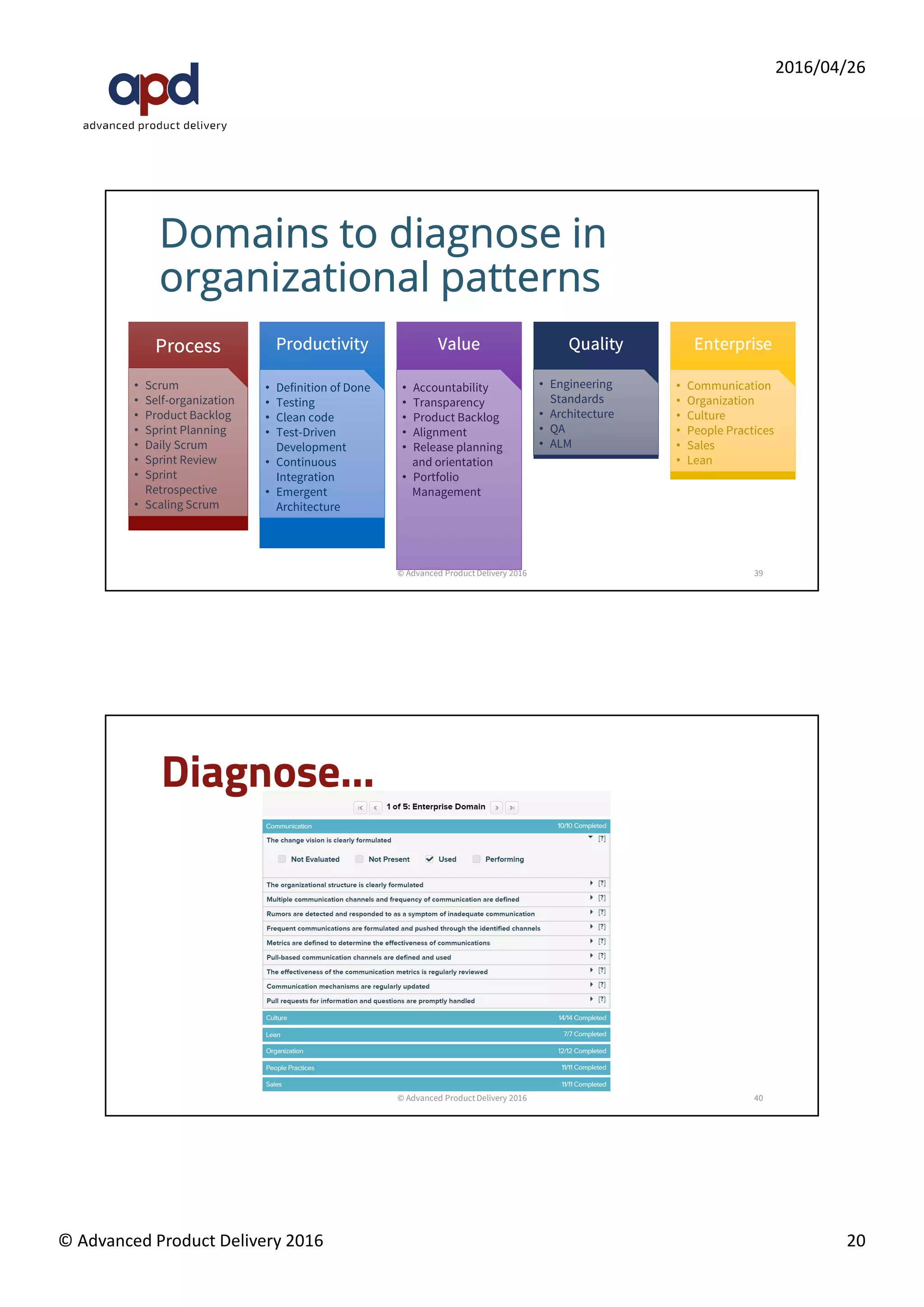
Domains to diagnose in
organizational patterns
Process Productivity Value Quality Enterprise
• Scrum
• Self-organization
• Product Backlog
• Sprint Planning
• Daily Scrum
• Sprint Review
• Sprint
Retrospective
• Scaling Scrum
• Definition of Done
• Testing
• Clean code
• Test-Driven
Development
• Continuous
Integration
• Emergent
Architecture
• Accountability
• Transparency
• Product Backlog
• Alignment
• Release planning
and orientation
• Portfolio
Management
• Engineering
Standards
• Architecture
• QA
• ALM
• Communication
• Organization
• Culture
• People Practices
• Sales
• Lean
© Advanced Product Delivery 2016 39
Diagnose…
© Advanced Product Delivery 2016 40
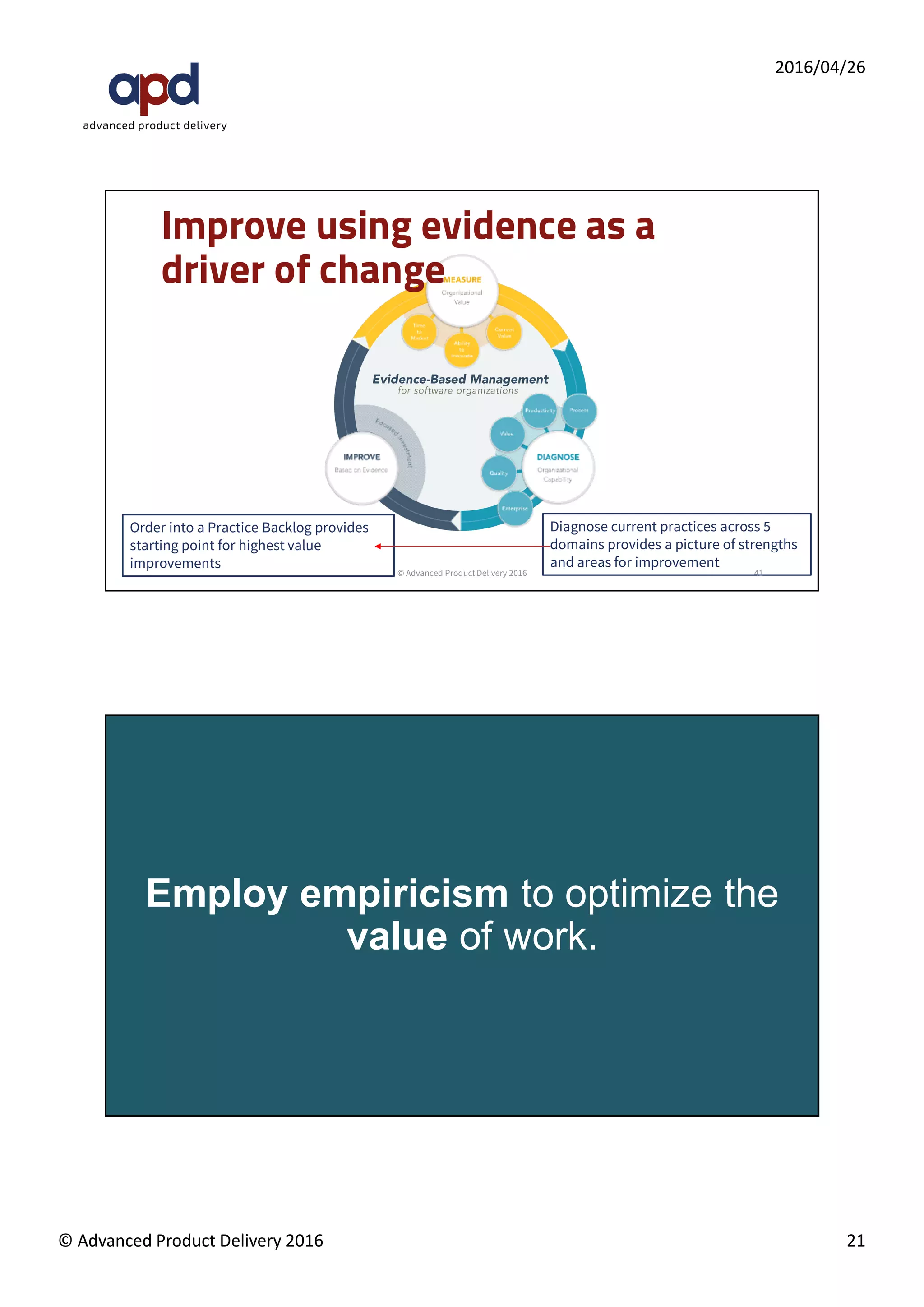
Improve using evidence as a driver
of change
Diagnose current practices across 5
domains provides a picture of strengths
and areas for improvement
Order into a Practice Backlog provides
starting point for highest value
improvements
© Advanced Product Delivery 2016 41
Employ empiricism to optimize the
value of work.
Value metrics used in a dashboard43
© Advanced Product Delivery 2016
Practice Domains for more detail
•Understanding the
practices across the
five domains
provides indications
of practices in use
•This provides the
data to guide
organisational
change decisions
44© Advanced Product Delivery 2016
Evidence-based Management
© Advanced Product Delivery 2016 45
Evidence through Agility Index Snapshot
• Measures an organizations value across 3 dimensions and aggregated
into one number, the Agility Index
• Weighted Index to track trends and ROI
© Advanced Product Delivery 2016 46
© 1993-2015 Scrum.org,
Evaluated through observation
of practices
0
10
20
30
40
50
60
70
80
90
100
Developer Lead Developer Project
Management
Por olio
Management
Product Manager Capability Manager
Baseline
Six month numbers
Target
Measure and Manage Trends
Organizational Patterns Knowledge Trends
Evaluated through assessments
© 1993-2015 Scrum.org, All Rights Reserved
Manage Trends in Value
EBM manages the VALUE you want
to deliver to the enterprise.
Maximize the return on investments
Reduce the risk of radical change
Drive innovation through agility
EBM – Any observations or
comments
© Advanced Product Delivery 2016 50
52
Recommended Resources
In Summary
•Iterative Incremental change has a higher
chance of enduring
•Agility Path is based on Scrum
•Evidence Based Management allows
visibility
•Engagement throughout the organisation
is key
© Advanced Product Delivery 2016 53
Scrum Day London
54
Discount Code for the London
Scrum User
SDLLSUGTEN gives a 10% discount
11 May 2016
http://www.scrumdaylondon.com/
© Advanced Product Delivery 2016
55
uk.linkedin.com/in/simonreindl
simon.reindl@advancedproductdelivery.com
@s_reindl
Thank You!
Thank You!

Evidence Based Management and Organisational Change

  • 1.
    Organisational Improvement Evidence Based Managementand Agility Path 1© Advanced Product Delivery 2016
  • 2.
    © 1993-2015 Scrum.org,All Rights Reserved 2 • @s_reindl simon.reindl@advancedproductdelivery.com • uk.linkedin.com/in/simonreindl • 20+ Years in the Software Development Profession • 6+ Years Agile Training & Coaching Director
  • 3.
    Agenda •Introduction •Why – Motivationfor change •How – proven ideas for success •Agility Path – the change framework •Evidence Based Management – the evaluation framework •Discussion © Advanced Product Delivery 2016 3
  • 4.
    © Advanced ProductDelivery 2016 4
  • 5.
    The focus ison delivering business value •Reduce Risk •Drive Innovation •Maximise Return on Investment 5© Advanced Product Delivery 2016
  • 6.
    Scrum.org has Differentlevels of support Agility Path Nexus (SPS) PSF, PSD, PSPO, PSM Guides and Free assessments © Advanced Product Delivery 2016 6
  • 7.
    Motivations for change •BusinessNeed •Top down desire •Bottom up desire •All the competitors are •Current ways of working are not optimal © Advanced Product Delivery 2016 7
  • 8.
    Every Organisation hasa different context Assumptions are the foundation of confusion © Advanced Product Delivery 2016 8
  • 9.
    © Advanced ProductDelivery 2016 9
  • 10.
    © 1993-2015 Scrum.org,All Rights Reserved • Each organisation is unique • There are many factors that have helped create and sustain your organisation • People • Countries • Processes • Business Domain • Size • Technology Stack • Sum of experiences We are all individuals
  • 11.
    Your change willbe unique •Specialisation is for insects – Heinlein •The fact that a process has worked in another organisation does not a priori guarantee that it will work in your organisation © Advanced Product Delivery 2016 11
  • 12.
  • 13.
    © 1993-2015 Scrum.org,All Rights Reserved 13 •Create a sense of Urgency •Build a guiding coalition •Form strategic vision & initiatives •Enlist volunteers •Enable by removing barriers •Generate short term wins •Sustain acceleration •Institute change http://www.kotterinternational.com/the-8-step-process-for-leading-change/ Kotter Change Model Steps
  • 14.
  • 15.
    What’s in it forme? © Advanced Product Delivery 2016 15
  • 16.
    Empiricism Complex situations are best managed withempirical solutions © Advanced Product Delivery 2016 16
  • 17.
    An activity withoutvalue is an ideal victim for cost cutting.
  • 18.
  • 19.
    Agility Path Use Scrumto focus change © Advanced Product Delivery 2016 19
  • 20.
    © 1993-2015 Scrum.org,All Rights Reserved 20 Scrum!
  • 21.
    Scrum Roles, Artifacts,and Events 21 Roles Product Owner Development Team Scrum Master Note: All Events are timeboxed Artifacts Product Backlog Sprint Backlog The Increment (of Working Software) Events The Sprint Sprint Planning Daily Scrum Sprint Review Sprint Retrospective © Advanced Product Delivery 2016
  • 22.
    Nexus Framework –Scaling Scrum
  • 23.
    Agility Path –using Scrum to improve! Change Owner Scrum Master Change Team Change Increment Stakeholders Sprint Backlog Change Backlog Practices Backlog Copyright © 2014 Agility Software http://www.ebmgt.org/Agility-Guide © Advanced Product Delivery 2016 23
  • 24.
    Roles, Events, Artifacts 24 Roles ChangeProduct Owner Change Team Scrum Master Note: All Events are timeboxed Artifacts Practice Backlog Sprint Backlog Evaluation Backlog The Increment (of Change) Events Sprint Sprint Planning Weekly Scrum Evaluation Sprint Review Sprint Retrospective http://www.ebmgt.org/Agility-Guide © Advanced Product Delivery 2016
  • 25.
    © 1993-2015 Scrum.org,All Rights Reserved 25 • The purpose is to effect change within an organisation • The role names reflect that • Practice Backlog is the driving change log • Evaluation Backlog is to cater for feedback from observations • Sprints are 1 month to effect change • Scrums are weekly to allow change work to be completed • Weekly Scrum is 30 minutes maximum • Evaluation occurs throughout the Sprint, prior to the review Did you notice some differences? 25
  • 26.
    Iterative Incremental changeto manage risk Plan Do Check Act • Make small adjustments where they will bring the most value • Grow the things that work • Stop the things that are hurting progress • Review regularly • Maintain production • Work collaboratively © Advanced Product Delivery 2016 26
  • 27.
    Agility Path -Any Comments or observations © Advanced Product Delivery 2016 27
  • 28.
    Evidence Based Management Empiricalframework for Evaluating organisations © Advanced Product Delivery 2016 28
  • 29.
    How will youmeasure the effect of your change actions?
  • 30.
    Use evidence toadvise change Measure DiagnoseImprove 30© Advanced Product Delivery 2016
  • 31.
    Common Sense •Nothing killsrational thought like pressure •Under pressure crazy ideas seem sound •Objective, metric based discussions allow ideas to be discussed and tested © Advanced Product Delivery 2016 31
  • 32.
    Evidence Based Management Scrum based approachto organisational change based on regular measurements © Advanced Product Delivery 2016 32
  • 33.
    More Value, Sooner. $ “Wefound that both satisfaction and value are greater when the features and functions delivered are much less than originally specified and only meet obvious needs.” “… skilled teams are 224% more likely to be successful than unskilled teams.”
  • 34.
    Organisational Value throughAgility Current Value Ability to Innovate Time to Market Revenue per Employee Product Cost Ratio Employee Satisfaction Customer Satisfaction Release Frequency Release Stabilization Cycle Time Installed Version Index Usage Index Innovation Rate Defect Density
  • 35.
    Measure the valueof the organization © Advanced Product Delivery 2016 37
  • 36.
    Diagnose likely contributors. Discovercapabilities to build on. © Advanced Product Delivery 2016 38
  • 37.
    Domains to diagnosein organizational patterns Process Productivity Value Quality Enterprise • Scrum • Self-organization • Product Backlog • Sprint Planning • Daily Scrum • Sprint Review • Sprint Retrospective • Scaling Scrum • Definition of Done • Testing • Clean code • Test-Driven Development • Continuous Integration • Emergent Architecture • Accountability • Transparency • Product Backlog • Alignment • Release planning and orientation • Portfolio Management • Engineering Standards • Architecture • QA • ALM • Communication • Organization • Culture • People Practices • Sales • Lean © Advanced Product Delivery 2016 39
  • 38.
  • 39.
    Improve using evidenceas a driver of change Diagnose current practices across 5 domains provides a picture of strengths and areas for improvement Order into a Practice Backlog provides starting point for highest value improvements © Advanced Product Delivery 2016 41
  • 40.
    Employ empiricism tooptimize the value of work.
  • 41.
    Value metrics usedin a dashboard43 © Advanced Product Delivery 2016
  • 42.
    Practice Domains formore detail •Understanding the practices across the five domains provides indications of practices in use •This provides the data to guide organisational change decisions 44© Advanced Product Delivery 2016
  • 43.
    Evidence-based Management © AdvancedProduct Delivery 2016 45
  • 44.
    Evidence through AgilityIndex Snapshot • Measures an organizations value across 3 dimensions and aggregated into one number, the Agility Index • Weighted Index to track trends and ROI © Advanced Product Delivery 2016 46
  • 45.
    © 1993-2015 Scrum.org, Evaluatedthrough observation of practices 0 10 20 30 40 50 60 70 80 90 100 Developer Lead Developer Project Management Por olio Management Product Manager Capability Manager Baseline Six month numbers Target Measure and Manage Trends Organizational Patterns Knowledge Trends Evaluated through assessments
  • 46.
    © 1993-2015 Scrum.org,All Rights Reserved Manage Trends in Value
  • 47.
    EBM manages theVALUE you want to deliver to the enterprise. Maximize the return on investments Reduce the risk of radical change Drive innovation through agility
  • 48.
    EBM – Anyobservations or comments © Advanced Product Delivery 2016 50
  • 49.
  • 50.
    In Summary •Iterative Incrementalchange has a higher chance of enduring •Agility Path is based on Scrum •Evidence Based Management allows visibility •Engagement throughout the organisation is key © Advanced Product Delivery 2016 53
  • 51.
    Scrum Day London 54 DiscountCode for the London Scrum User SDLLSUGTEN gives a 10% discount 11 May 2016 http://www.scrumdaylondon.com/ © Advanced Product Delivery 2016
  • 52.
  • 53.

Editor's Notes

  • #10 Where is the end point? How will you know you are there? How will you check your progress on the journey? How will you know you that the decisions you make are aligned with the vision?
  • #24 For a large class, do this as a “game” where contestants can either place a sticky or “call a friend” for help. You’ll have to keep it moving quickly! Also cover timeboxes: 1 hr/wk for Planning, 1 hr/wk for Review, 1 hr/wk for Retrospective, 1 hr/wk for PBL refining, 15 min. for Daily Scrum. Note that the Sprint is not a timebox; it is a fixed time, every time. (PSM: Scrum Guide combines planning and refining into a 2hr/week timebox.) Sticky notes for the Scrum Discovery activity. I use colored Post-Its for each category (don’t write the [text in square brackets]): Events Sprint Sprint Planning Sprint Review Sprint Retrospective Daily Scrum Refined [PBL] Roles Product Owner Scrum Master Development Team Stakeholders Artifacts Product Backlog Sprint Backlog Increment Scrum Principles Inspect Adapt Transparent Values Commitment Courage Focus Respect Openness (Write “Principles” in the “roof” of the 3 column house after these have been placed.) Attributes Ordered [PBL] “What” [PBL} “How”[SBL] Self-managed [Development Team] Cross-functional [Development Team] Adapts to Environment [Development Team] Owns ROI [Product Owner] Manages Process [Scrum Master] Definition of DONE [Development Team] State of Product [Sprint Review] State of Process [Sprint Retrospective] Potentially Shippable [Increment] 15 min [Daily Scrum]
  • #36 “trusted technology, services and revenue partner for video, internet and communications providers and device manufacturers.” Agility Index: Not a measure of success. We are not comparing agility index to point fingers across teams nor organizations. We are measuring for a way to improve.
  • #37 “trusted technology, services and revenue partner for video, internet and communications providers and device manufacturers.” Results and recommendations. Agility Index: Not a measure of success. We are not comparing agility index to point fingers across teams nor organizations. We are measuring for a way to improve.
  • #40 Examine practices are a good way to diagnose. Many investments that may provide more agility; New methodologies that offer agility; Is agility a fad? What value is IT contributing to the organization? Outcome: deliver increased value
  • #50 Many investments that may provide more agility; New methodologies that offer agility; Is agility a fad? What value is IT contributing to the organization? Outcome: deliver increased value
  • #57 Thank you! Next Webcast – ?????? What do you want to see covered on the next episode? Propose a topic at Scrum.org/Scrum-Pulse