PRODUCT DEVELOPMENT
IN THEORIES
Renny Wijayanti
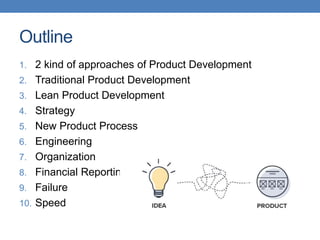
Outline
1. 2 kind of approaches of Product Development
2. Traditional Product Development
3. Lean Product Development
4. Strategy
5. New Product Process
6. Engineering
7. Organization
8. Financial Reporting
9. Failure
10. Speed
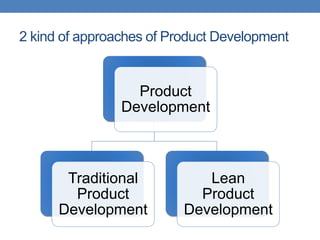
2 kind of approaches of Product Development
Product
Development
Traditional
Product
Development
Lean
Product
Development
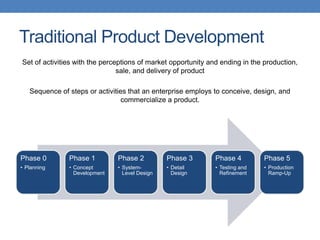
Traditional Product Development
Phase 0
• Planning
Phase 1
• Concept
Development
Phase 2
• System-
Level Design
Phase 3
• Detail
Design
Phase 4
• Testing and
Refinement
Phase 5
• Production
Ramp-Up
Set of activities with the perceptions of market opportunity and ending in the production,
sale, and delivery of product
Sequence of steps or activities that an enterprise employs to conceive, design, and
commercialize a product.
Lean Product Development
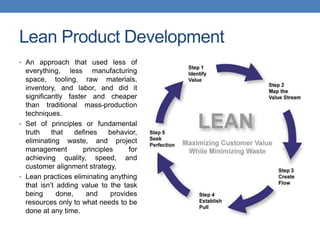
• An approach that used less of
everything, less manufacturing
space, tooling, raw materials,
inventory, and labor, and did it
significantly faster and cheaper
than traditional mass-production
techniques.
• Set of principles or fundamental
truth that defines behavior,
eliminating waste, and project
management principles for
achieving quality, speed, and
customer alignment strategy.
• Lean practices eliminating anything
that isn’t adding value to the task
being done, and provides
resources only to what needs to be
done at any time.
Strategy
Traditional Product Development Lean Product Development
• Business Plan
• Implementation-driven
• Business Model
• Hypothesis-driven
New Product Process
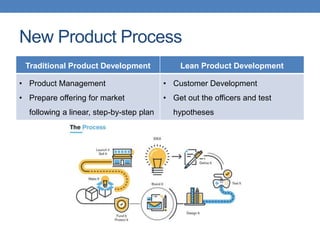
Traditional Product Development Lean Product Development
• Product Management
• Prepare offering for market
following a linear, step-by-step plan
• Customer Development
• Get out the officers and test
hypotheses
Engineering
Traditional Product Development Lean Product Development
• Waterfall development
• Build the product interactively, of
fully specify the product before
building the product
• Agile Development
• Build the product iterattively and
incrementally
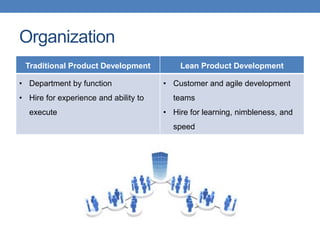
Organization
Traditional Product Development Lean Product Development
• Department by function
• Hire for experience and ability to
execute
• Customer and agile development
teams
• Hire for learning, nimbleness, and
speed
Financial Reporting
Traditional Product Development Lean Product Development
• Accounting
• Income statement, balance sheet,
cash flow statement
• Matrics that matters
• Customer acquisition cost, lifetime
customer value, churn, viralness
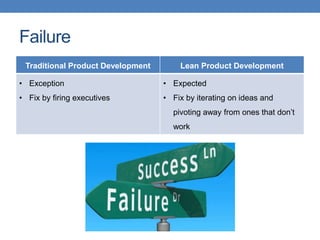
Failure
Traditional Product Development Lean Product Development
• Exception
• Fix by firing executives
• Expected
• Fix by iterating on ideas and
pivoting away from ones that don’t
work
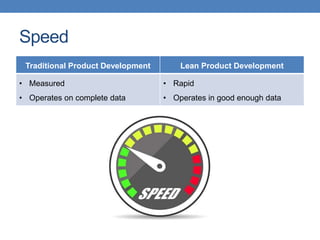
Speed
Traditional Product Development Lean Product Development
• Measured
• Operates on complete data
• Rapid
• Operates in good enough data
 Thank You 

Sharing product development in theories

  • 1.
  • 2.
    Outline 1. 2 kindof approaches of Product Development 2. Traditional Product Development 3. Lean Product Development 4. Strategy 5. New Product Process 6. Engineering 7. Organization 8. Financial Reporting 9. Failure 10. Speed
  • 3.
    2 kind ofapproaches of Product Development Product Development Traditional Product Development Lean Product Development
  • 4.
    Traditional Product Development Phase0 • Planning Phase 1 • Concept Development Phase 2 • System- Level Design Phase 3 • Detail Design Phase 4 • Testing and Refinement Phase 5 • Production Ramp-Up Set of activities with the perceptions of market opportunity and ending in the production, sale, and delivery of product Sequence of steps or activities that an enterprise employs to conceive, design, and commercialize a product.
  • 5.
    Lean Product Development •An approach that used less of everything, less manufacturing space, tooling, raw materials, inventory, and labor, and did it significantly faster and cheaper than traditional mass-production techniques. • Set of principles or fundamental truth that defines behavior, eliminating waste, and project management principles for achieving quality, speed, and customer alignment strategy. • Lean practices eliminating anything that isn’t adding value to the task being done, and provides resources only to what needs to be done at any time.
  • 6.
    Strategy Traditional Product DevelopmentLean Product Development • Business Plan • Implementation-driven • Business Model • Hypothesis-driven
  • 7.
    New Product Process TraditionalProduct Development Lean Product Development • Product Management • Prepare offering for market following a linear, step-by-step plan • Customer Development • Get out the officers and test hypotheses
  • 8.
    Engineering Traditional Product DevelopmentLean Product Development • Waterfall development • Build the product interactively, of fully specify the product before building the product • Agile Development • Build the product iterattively and incrementally
  • 9.
    Organization Traditional Product DevelopmentLean Product Development • Department by function • Hire for experience and ability to execute • Customer and agile development teams • Hire for learning, nimbleness, and speed
  • 10.
    Financial Reporting Traditional ProductDevelopment Lean Product Development • Accounting • Income statement, balance sheet, cash flow statement • Matrics that matters • Customer acquisition cost, lifetime customer value, churn, viralness
  • 11.
    Failure Traditional Product DevelopmentLean Product Development • Exception • Fix by firing executives • Expected • Fix by iterating on ideas and pivoting away from ones that don’t work
  • 12.
    Speed Traditional Product DevelopmentLean Product Development • Measured • Operates on complete data • Rapid • Operates in good enough data
  • 13.