Getting started with
Evidence-Based Management
Dublin, April 28th, 2016
Evidence-Based HR: is it ‘a thing’?
25 min EBMgt: What is it and why you you need it?
20 min A practical example
Agenda
Evidence based management:
What is it?
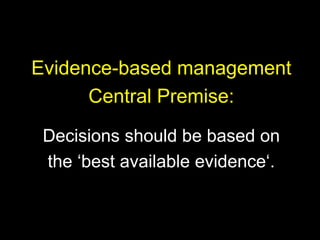
Evidence-based management
Central Premise:
Decisions should be based on
the ‘best available evidence‘.
Evidence?
information, facts or data
supporting (or contradicting)
a claim, assumption or hypothesis
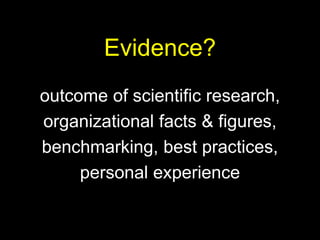
Evidence?
outcome of scientific research,
organizational facts & figures,
benchmarking, best practices,
personal experience
All managers and leaders base
their decisions on ‘evidence’
But…many managers pay
little or no attention to
the quality of the evidence
they base their decisions on
and use
too few sources of evidence
Trust me, 20 years of
management experience
Sources of evidence
problem solution
Practitioners
professional expertise
Organization
internal data
Stakeholders
values and concerns
Scientific literature
empirical studies
Ask
Acquire
Appraise
Aggregate
Apply
Assess
Evidence based practice:
Where does it come from?
McMaster University Medical School, Canada
Medicine: Founding fathers
David Sackett Gordon Guyatt
How it all started
1. Ask: translate a practical issue into an answerable question
2. Acquire: systematically search for and retrieve the evidence
3. Appraise: critically judge the trustworthiness of the evidence
4. Apply: incorporate the evidence into the decision-making process
5. Assess: evaluate the outcome of the decision taken
5 steps of EBmed
Evidence-Based Practice
1991 Medicine
1998 Education
2000 Social care, public policy
Nursing, Criminal justice,
Policing, Architecture, Conservation
2010 Management
Evidence-Based Practice
Evidence-based … whatever
=
the use of evidence from multiple
sources to increase the likelihood of a
favourable outcome
Focus on the decision making process
Think in terms of probability
In general: managers don’t like EBMgt
 Undermines formal authority
 They feel it constrains freedom to make
managerial decisions
 Speed valued and rewarded more than accuracy
 Feel they cannot use their own experience and
judgment (not true)
 Managers not necessarily rewarded for doing
what works (organizations rarely evaluate)
 THEY LOVE FADS & QUICK FIXES
Why don’t managers like EBMgt?
32
Evidence-Based Decision-Making
Why do we need it?
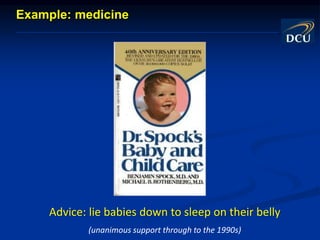
Advice: lie babies down to sleep on their belly
(unanimous support through to the 1990s)
Example: medicine
Nr of cot deaths (Holland)
Collateralized Debt Obligations > AAA
p = 0.12 (about 1 chance in 850) default in 5 years
Example: finance
Forecasted Actual
Forecasted and actual 5-year default rates for
AAA-rated CDO tranches
0.12%
28%
Scared straight
Example: policy / prevention
Example: HR management
1. Incompetent people benefit more from feedback than
highly competent people.
2. Task conflict improves work group performance while
relational conflict harms it.
3. Encouraging employees to participate in decision
making is more effective for improving organizational
performance than setting performance goals.
Likely or unlikely?
How evidence-based are HR managers?
 959 (US) + 626 (Dutch) HR professionals
 35 statements, based on an extensive body of evidence
 true / false / uncertain
HR Professionals' beliefs about effective human resource practices: correspondence
between research and practice, (Rynes et al, 2002, Sanders et al 2008)
Outcome: not better than random chance
Relying on only 1 source: bad idea!
problem solution
Practitioners
professional expertise
Organization
internal data
Stakeholders
values and concerns
Scientific literature
empirical studies
Ask
Acquire
Appraise
Aggregate
Apply
Assess
Discuss with your neighbor (1 min)
Over a 5 year period,
why is an orthopedic surgeon's
experience, as a rule, more trustworthy
than an change manager’s experience?
0
Developing expertise
1. A sufficiently regular, predictable environment
2. Numerous opportunities to practice
3. Receive accurate (objective) feedback
The management domain is not highly
favorable to expertise!
Learning from feedback is hard!
Bounded rationality
How your brain works
System 1
 Fast
 Intuitive, associative
 heuristics & biases
 emotional
System 2
 Lazy
 Slow
 Deliberate
 Rational
System 1: short cuts
System 1 or system 2?
10 seconds
System 1 or system 2?
 A bat and a ball cost $1.10 in total.
 The bat costs $1 more than the ball
 How much does the ball cost?
0
System 1: necessary to survive
95%
 Pattern recognition
 Overconfidence bias
 Halo effect
 False consensus effect
 Group think
 Self serving attribution bias
 Sunk cost fallacy
 Cognitive dissonance reduction
System 1: prone to cognitive errors
 Confirmation bias
 Authority bias
 Small numbers fallacy
 In-group bias
 Recall bias
 Anchoring bias
 Availability bias
 Pattern recognition
 Overconfidence bias
 Halo effect
 False consensus effect
 Group think
 Self serving attribution bias
 Sunk cost fallacy
 Cognitive dissonance reduction
System 1: prone to cognitive errors
 Confirmation bias
 Authority bias
 Small numbers fallacy
 In-group bias
 Recall bias
 Anchoring bias
 Availability bias
“I’ve been studying judgment for 45 years, and I’m no better
than when I started. I make extreme predictions. I’m over-
confident. I fall for every one of the biases.”
Practitioners
professional expertise
Organization
internal data
Stakeholders
values and concerns
Scientific literature
empirical studies
Ask
Acquire
Appraise
Aggregate
Apply
Assess
Four sources of evidence (not only 1)
The performance of
knowledge workers
A Practical Example
 550 beds
 3300 employees
 210 medical specialists
 225,000 admissions
 Top Clinical & Teaching hospital
Organization
2015: 7.2 2016: 6.3
How can we increase job satisfaction
and employee engagement?
Dear HR department,
Evidence-based approach, step 1: ASK
problem solution
Practitioners
professional expertise
Organization
internal data
Stakeholders
values and concerns
Scientific literature
empirical studies
Ask
Acquire
Appraise
Aggregate
Apply
Assess
 What is the problem?
 Why is this a problem: what are its organizational
consequences?
 How big: what is its impact on the organization when
nothing is done?
 Why does this problem exist, what is the assumed
major cause?
 What is the assumed causal mechanism? How does
the cause lead to the problem and its consequences?
Step 1: What is the problem?
problem & underlying cause
hidden assumptions
causal mechanism
Some terminology
A happy & engaged employee
is a productive employee
Fundamental assumption
 What is the evidence for this assumption?
 Where multiple sources consulted?
 How trustworthy is the evidence?
Step 2: What is the evidence?
Let’s have a look
Professional
experience and
judgment
Organizational data,
facts and figures
Stakeholders’ values
and concerns
Scientific
research
outcomes
Ask
Acquire
Appraise
Apply
Assess
problem solution
GREAT! NOW WHAT?
Outcome
Evidence-based managers,
please
Evidence-based managers,
please
Step 1: ASK
Translate a practical issue into an
answerable question
Population? Knowledge workers!
Whether nurses, lawyers, engineers, managers, or staff members,
nowadays most workers in organizations are highly dependent on
information and communication technology and are involved in
work that involves a high level of cognitive activity.
Question
“Which of the factors that are related to
the performance of knowledge workers
are most widely studied and what is
known of their effect?”
Step 2: ACQUIRE
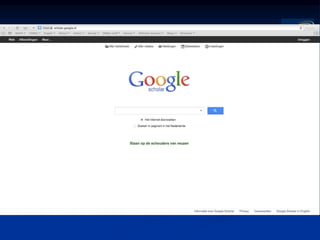
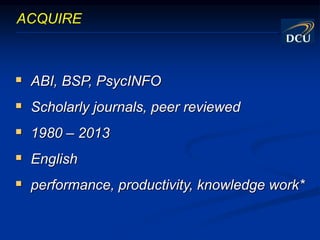
Search for the best available scientific evidence
 ABI, BSP, PsycINFO
 Scholarly journals, peer reviewed
 1980 – 2013
 English
 performance, productivity, knowledge work*
ACQUIRE
step 3: APPRAISE & AGGREGATE
Effect size?
Largest effect
1. Social cohesion .5 / .7
2. Perceived supervisory support .5
3. Information sharing / TM .5
4. Vision / goal clarity .5
5. Trust .3 / .6
step 3b: CROSS VALIDATE
Step 4: APPLY
Three examples
social cohesion supervisory
support
information
sharing
Social cohesion
Social cohesion
… a shared liking or team attraction
that includes bonds of friendship, caring,
closeness, and enjoyment of each
other’s company.
Social cohesion
Measuring social cohesion
Perceived supervisory support
…how employees feel the supervisor
helps them in times of need, praises
them for a job well done or recognizes
them for extra effort.
Perceived supervisory support
Measuring perc. sup. support
Information sharing
Information sharing?
…refers to how teams pool and access their
knowledge and expertise – which positively
affects decision making and team processes.
This has led to the idea of a team ‘Transactive
Memory System’ (TMS), which can be thought of
as a collective memory in a collective mind -
enabling a team to think and act together
Information sharing
Measuring information sharing
Outcome
The departments with the lowest performance
scored under average on most factors
Reactions
Who
knew?
Evidence-based … whatever
=
the use of evidence from multiple
sources to increase the likelihood of a
favourable outcome
Focus on the decision making process
Think in terms of probability
Multiple sources of evidence
problem solution
Practitioners
professional expertise
Organization
internal data
Stakeholders
values and concerns
Scientific literature
empirical studies
Ask
Acquire
Appraise
Aggregate
Apply
Assess
Postgraduate Course
Postgraduate Course
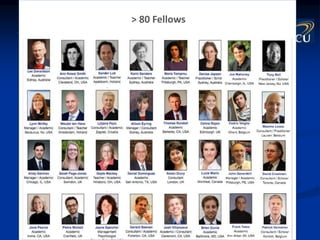
> 80 Fellows
CEBMa: what we do
 Promote (seminars, papers, blogs, tweets)
 Educate (universities & business schools)
 Train & coach (companies > projects)
 Support / REAs (companies)
 Support / 2nd opinion (BS detector)

Getting Started With Evidence-Based HR

Editor's Notes