Agile: Beyond Software 
Edwin Dando 
Consulting Manager
Edwin Dando 
+ Founder and MD of Clarus 
+ Now Manager for Assurity’s Education practice 
+ Helping re-wire how companies think 
+ Professional Scrum Trainer with Scrum.org 
+ Worlds first Agility Path™ Engagement Manager 
+ PMP, CSP, PST, EM 
Better education. By practitioners 
SLIDE | 2
Business context 
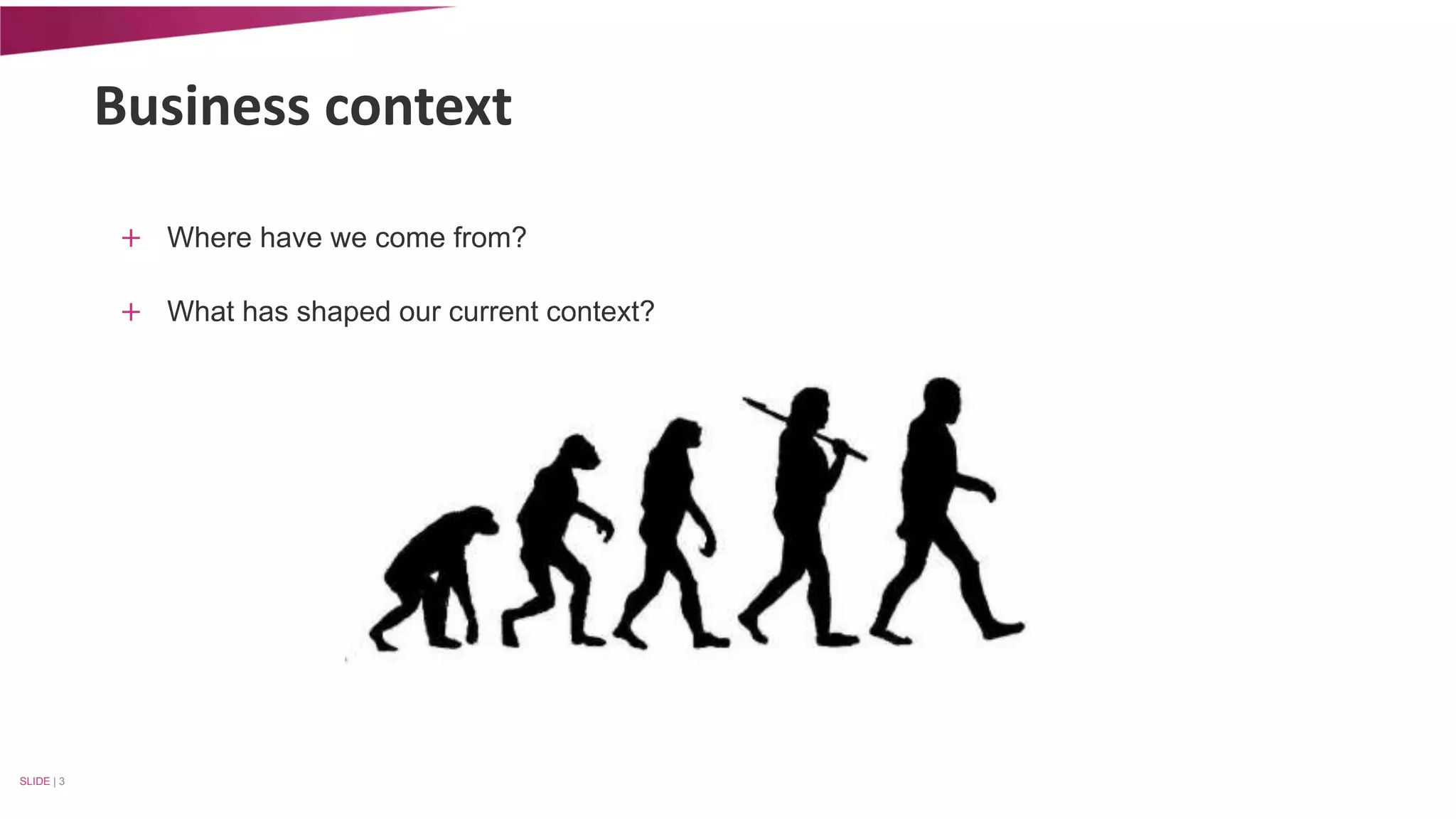
+ Where have we come from? 
+ What has shaped our current context? 
SLIDE | 3
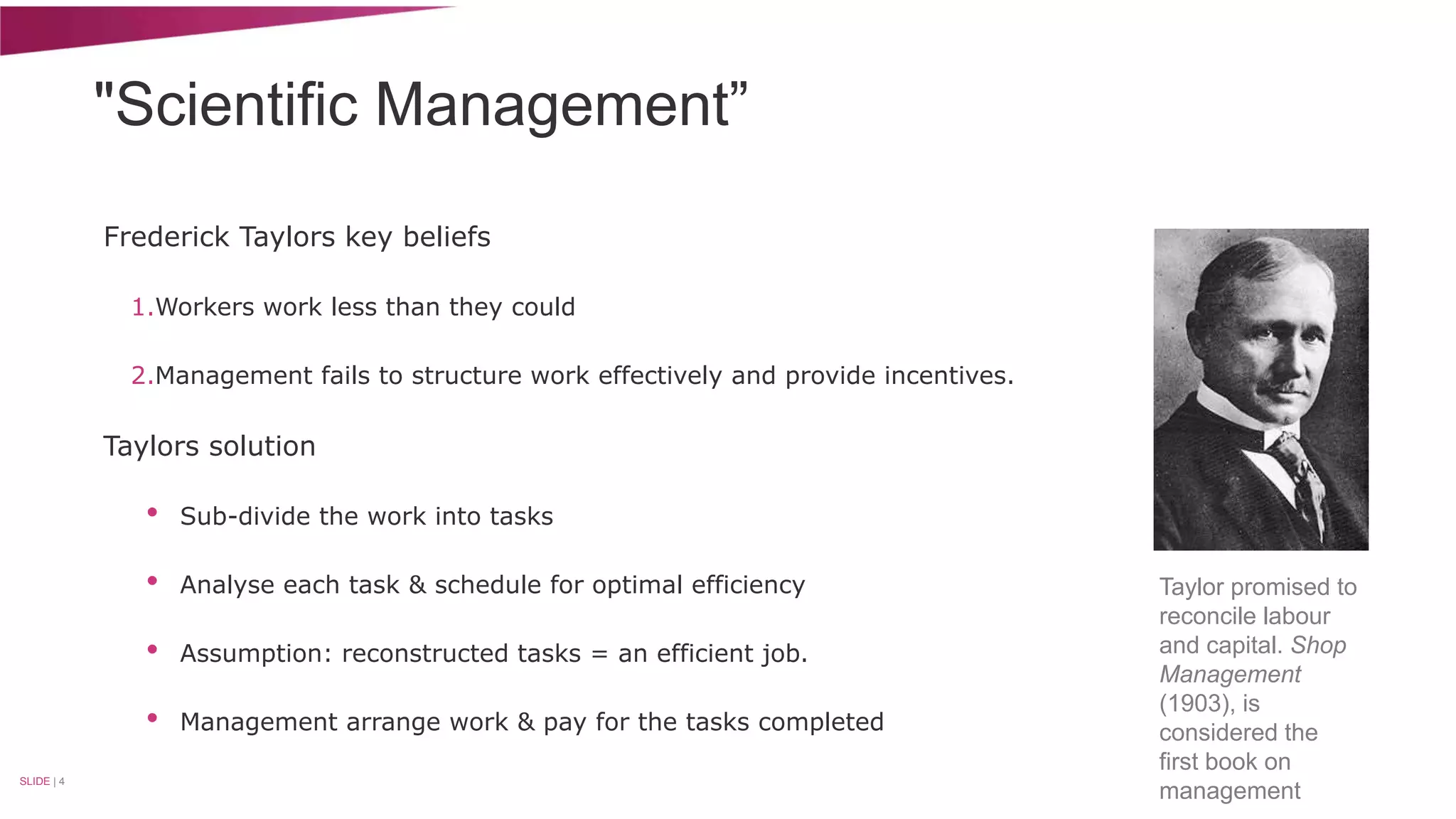
"Scientific Management” 
Frederick Taylors key beliefs 
1.Workers work less than they could 
2.Management fails to structure work effectively and provide incentives. 
Taylors solution 
• Sub-divide the work into tasks 
• Analyse each task & schedule for optimal efficiency 
• Assumption: reconstructed tasks = an efficient job. 
• Management arrange work & pay for the tasks completed 
SLIDE | 4 
Taylor promised to 
reconcile labour 
and capital. Shop 
Management 
(1903), is 
considered the 
first book on 
management
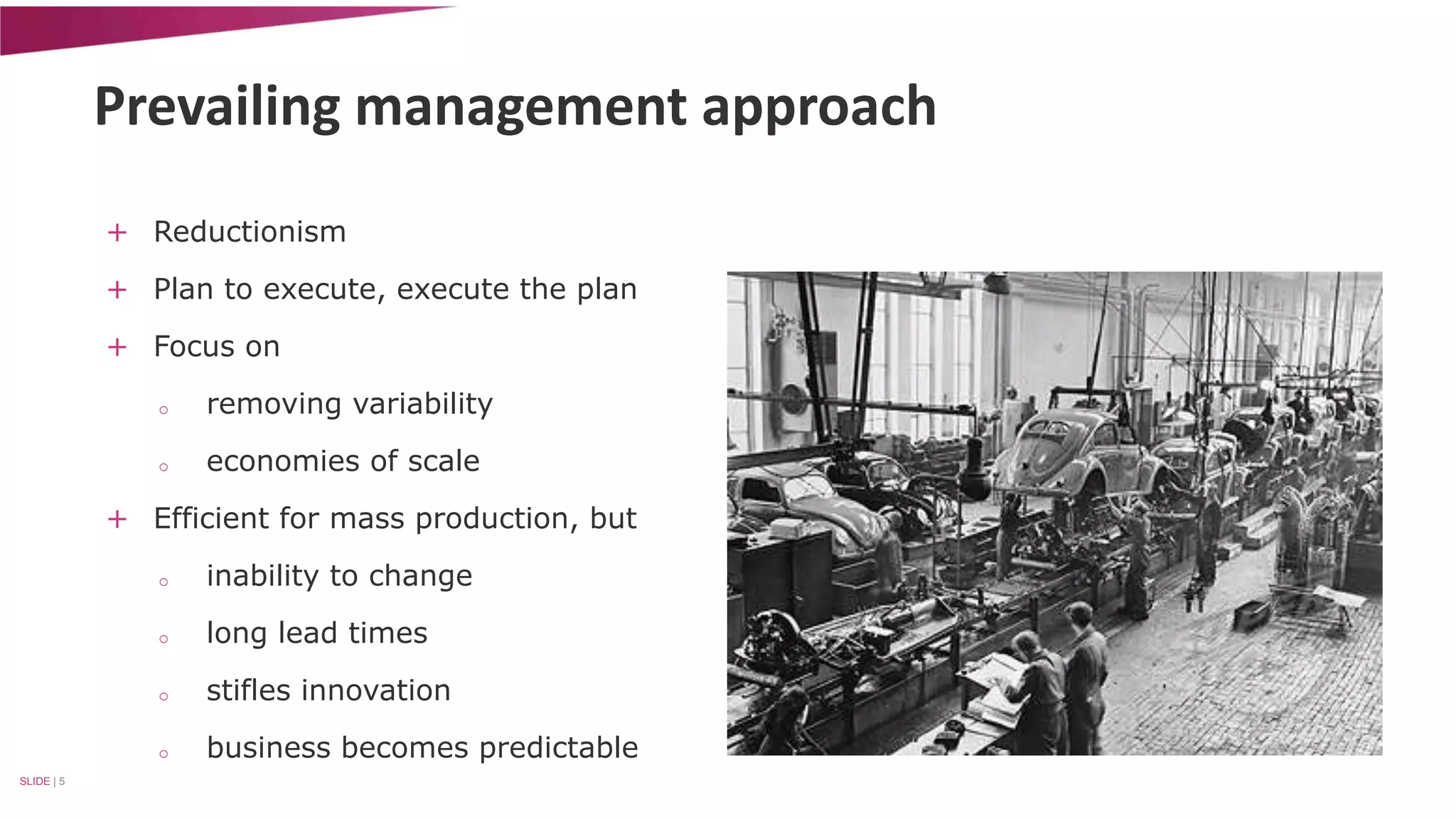
Prevailing management approach 
+ Reductionism 
+ Plan to execute, execute the plan 
+ Focus on 
o removing variability 
o economies of scale 
+ Efficient for mass production, but 
o inability to change 
o long lead times 
o stifles innovation 
o business becomes predictable 
SLIDE | 5
How well does this approach work on 2013? 
Why / why not? 
SLIDE | 6
Complex/adaptive systems thinking 
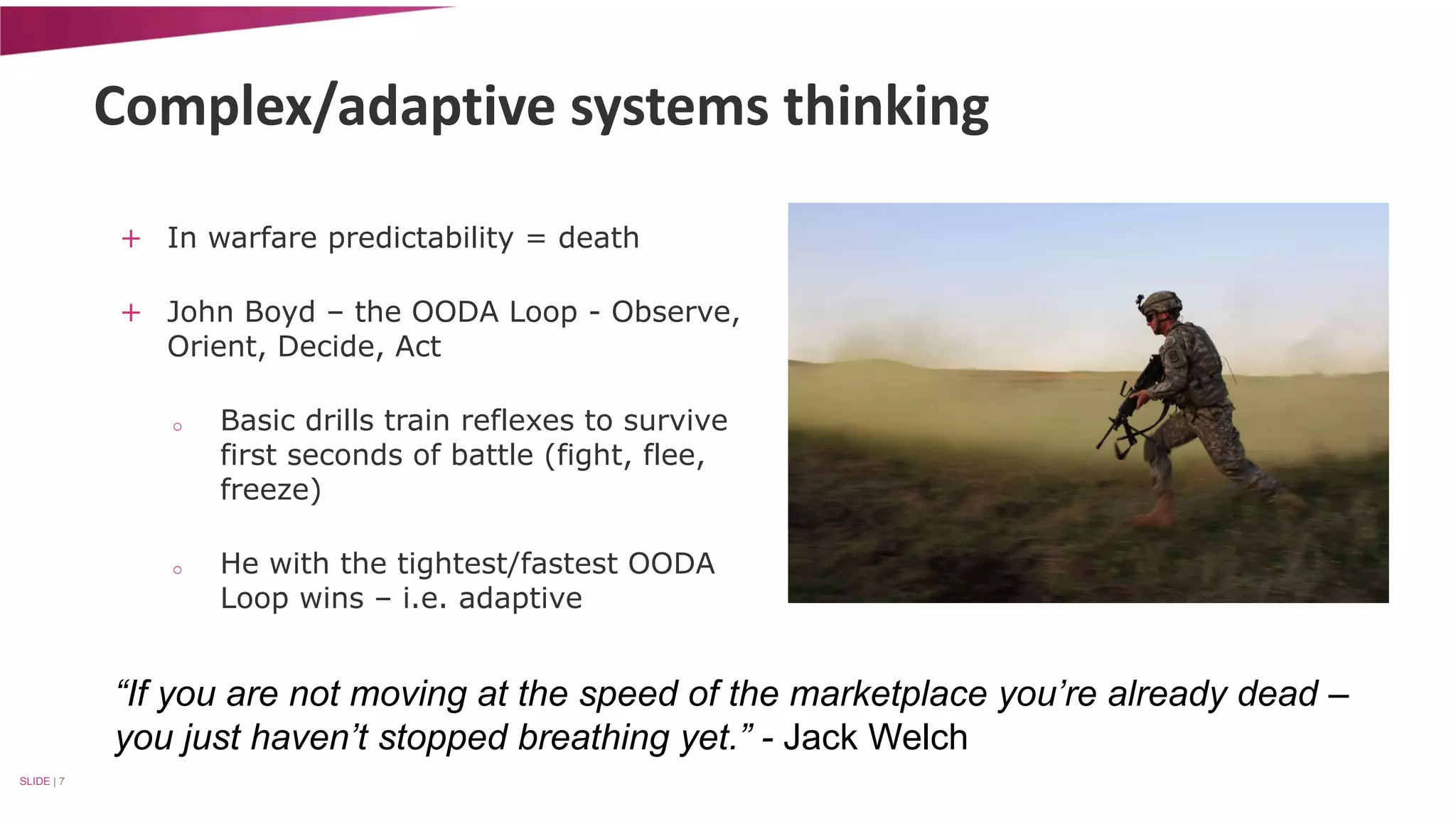
+ In warfare predictability = death 
+ John Boyd – the OODA Loop - Observe, 
Orient, Decide, Act 
o Basic drills train reflexes to survive 
first seconds of battle (fight, flee, 
freeze) 
o He with the tightest/fastest OODA 
Loop wins – i.e. adaptive 
SLIDE | 7 
“If you are not moving at the speed of the marketplace you’re already dead – 
you just haven’t stopped breathing yet.” - Jack Welch
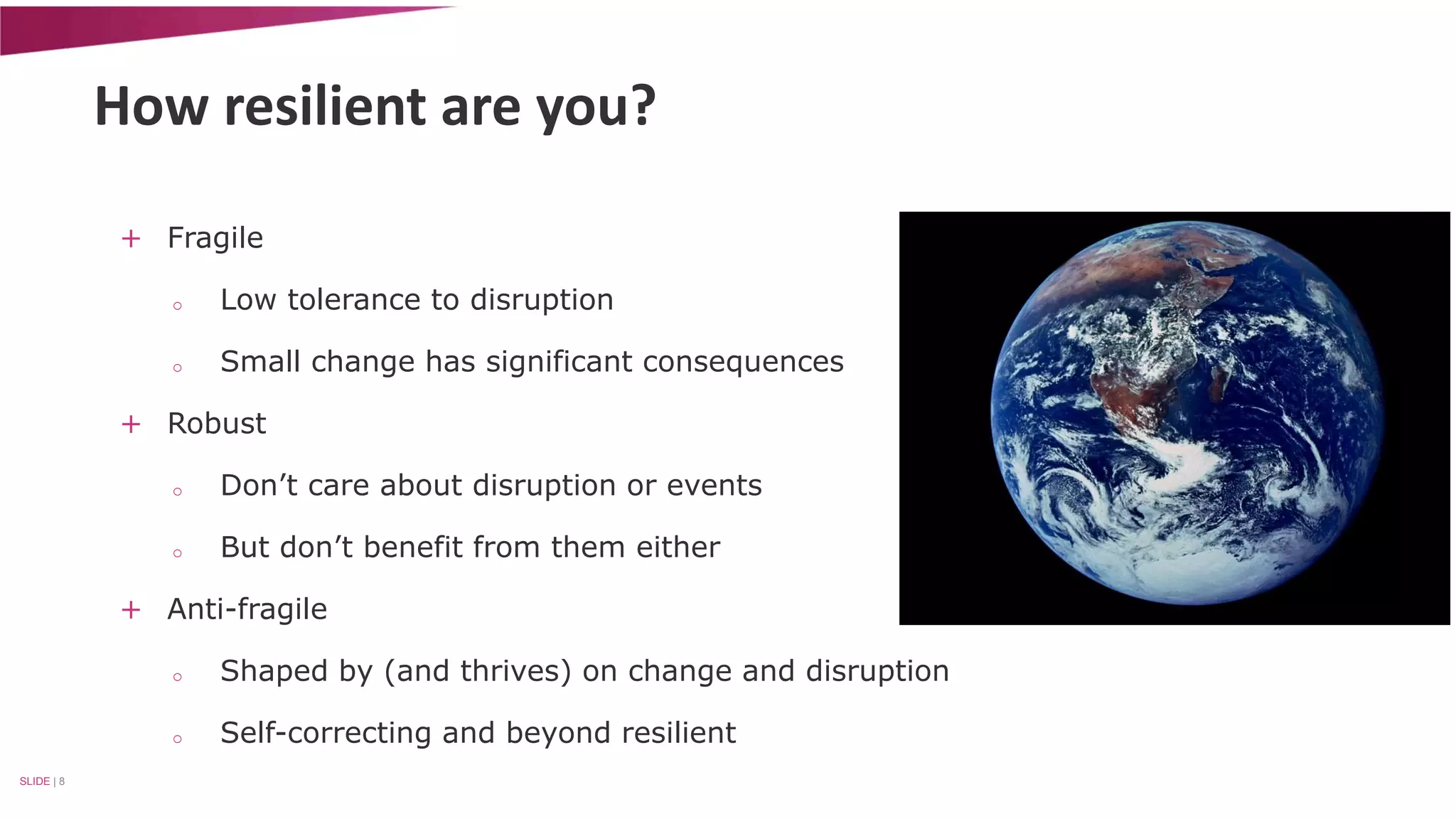
How resilient are you? 
+ Fragile 
o Low tolerance to disruption 
o Small change has significant consequences 
+ Robust 
o Don’t care about disruption or events 
o But don’t benefit from them either 
+ Anti-fragile 
o Shaped by (and thrives) on change and disruption 
o Self-correcting and beyond resilient 
SLIDE | 8
Scenario planning 
+ Consider a range of possible future business scenarios for your organisation 
+ 3-10 year horizon 
SLIDE | 9
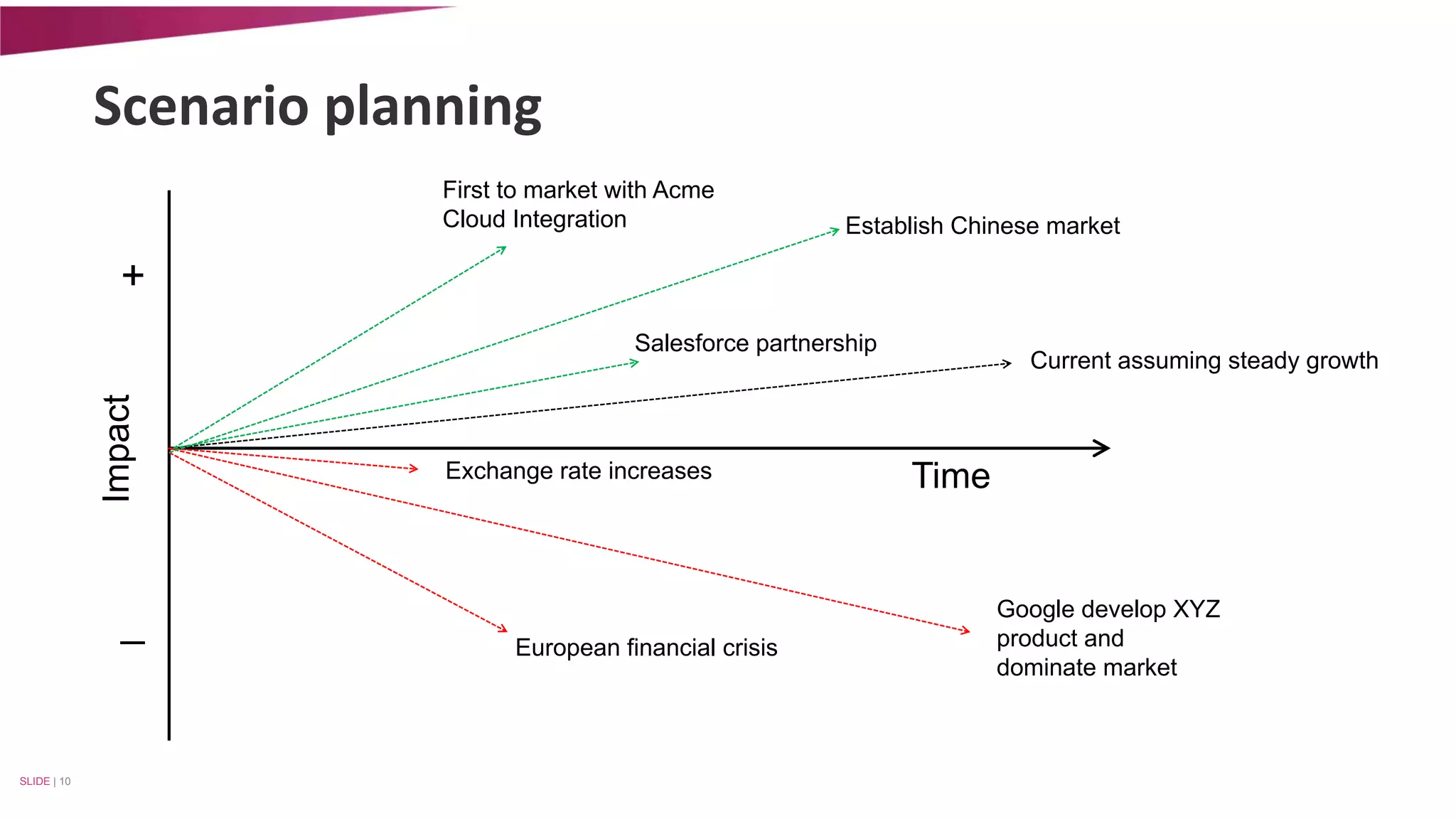
Scenario planning 
SLIDE | 10 
Impact 
Establish Chinese market 
Time 
+ 
_ 
Current assuming steady growth 
First to market with Acme 
Cloud Integration 
Google develop XYZ 
product and 
dominate market 
Salesforce partnership 
Exchange rate increases 
European financial crisis
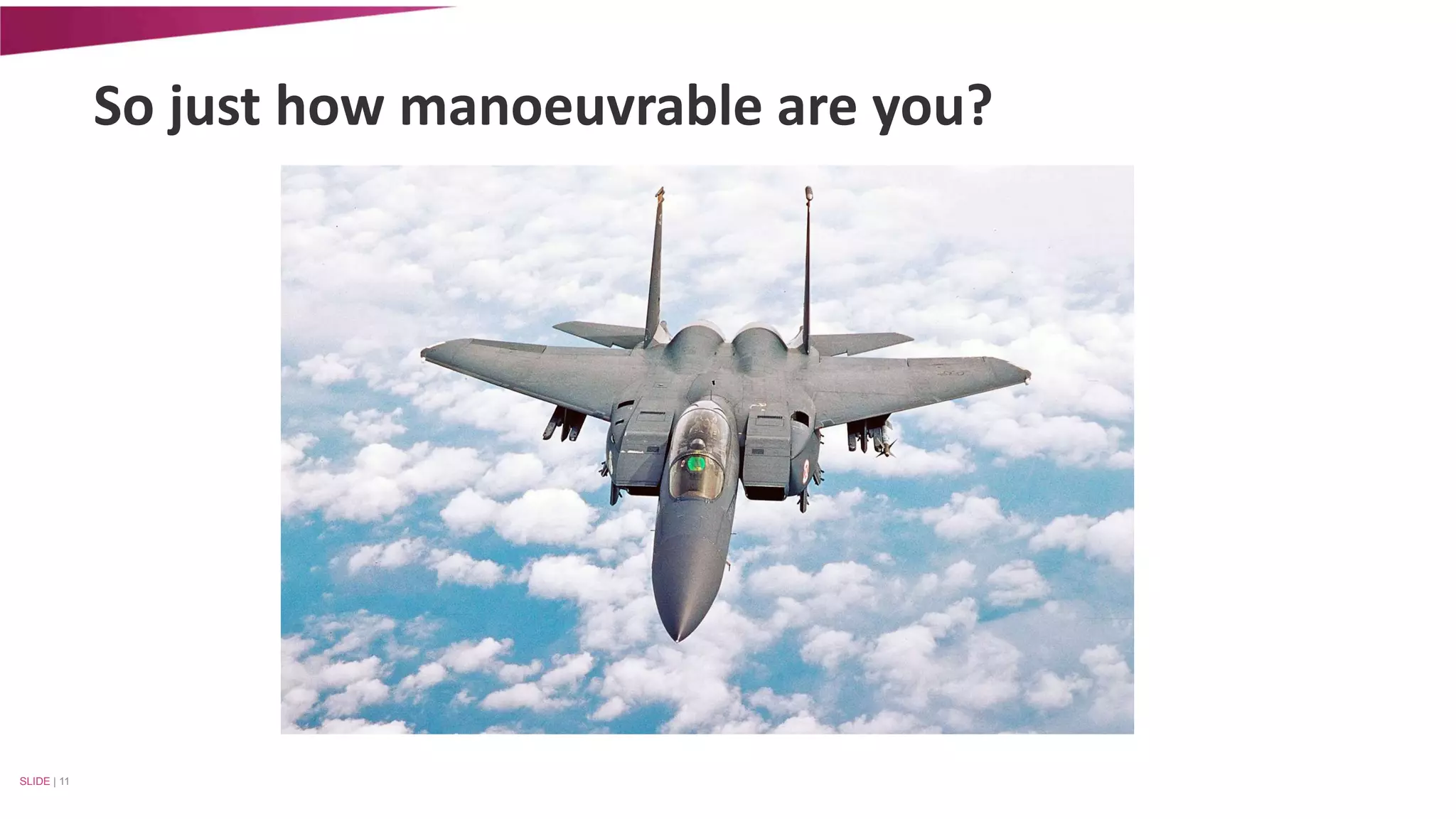
So just how manoeuvrable are you? 
SLIDE | 11
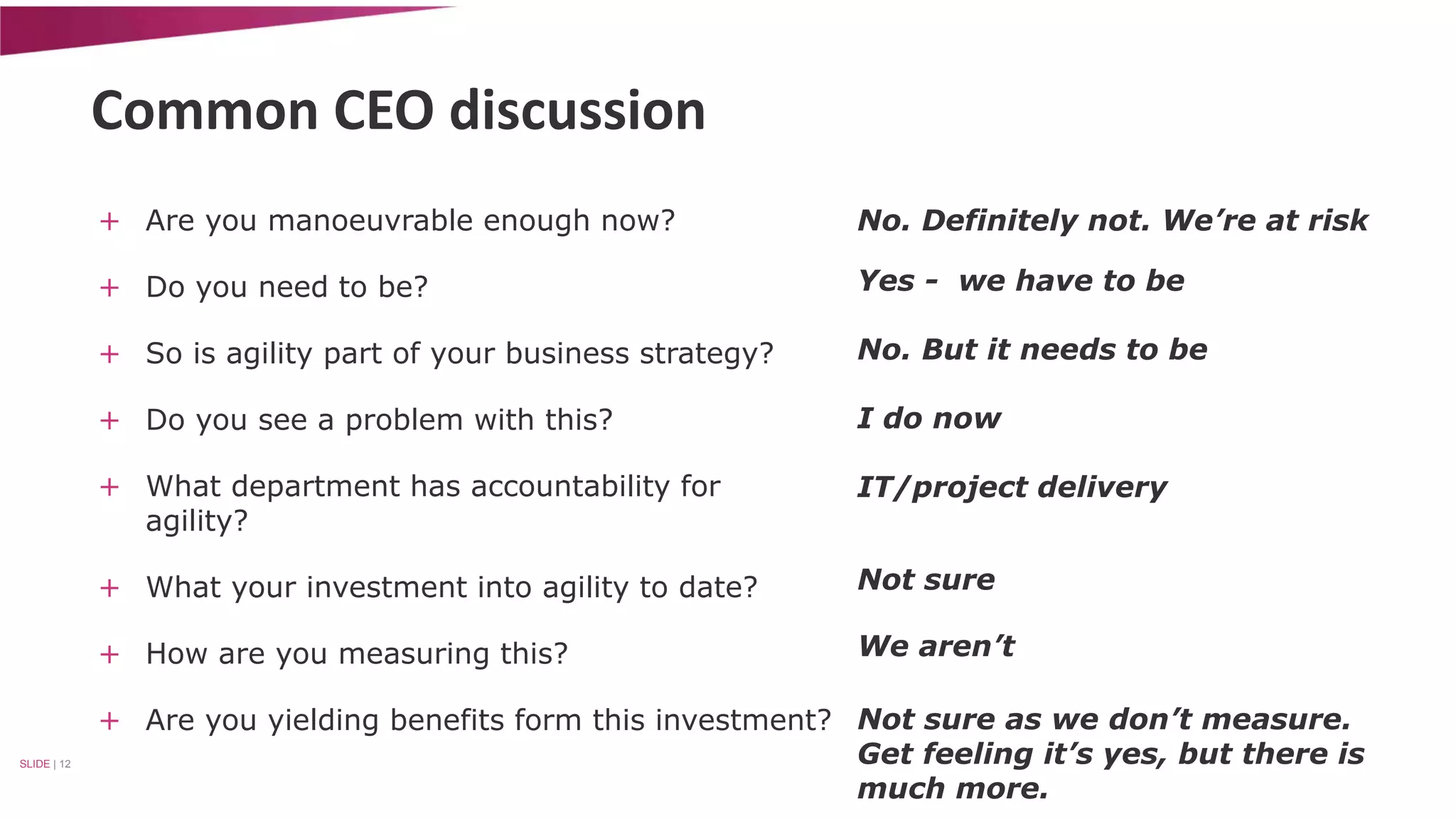
Common CEO discussion 
+ Are you manoeuvrable enough now? 
+ Do you need to be? 
+ So is agility part of your business strategy? 
+ Do you see a problem with this? 
+ What department has accountability for 
agility? 
+ What your investment into agility to date? 
+ How are you measuring this? 
+ Are you yielding benefits form this investment? 
SLIDE | 12 
No. Definitely not. We’re at risk 
Yes - we have to be 
No. But it needs to be 
I do now 
IT/project delivery 
Not sure 
We aren’t 
Not sure as we don’t measure. 
Get feeling it’s yes, but there is 
much more.
So just how manoeuvrable are you? 
SLIDE | 13
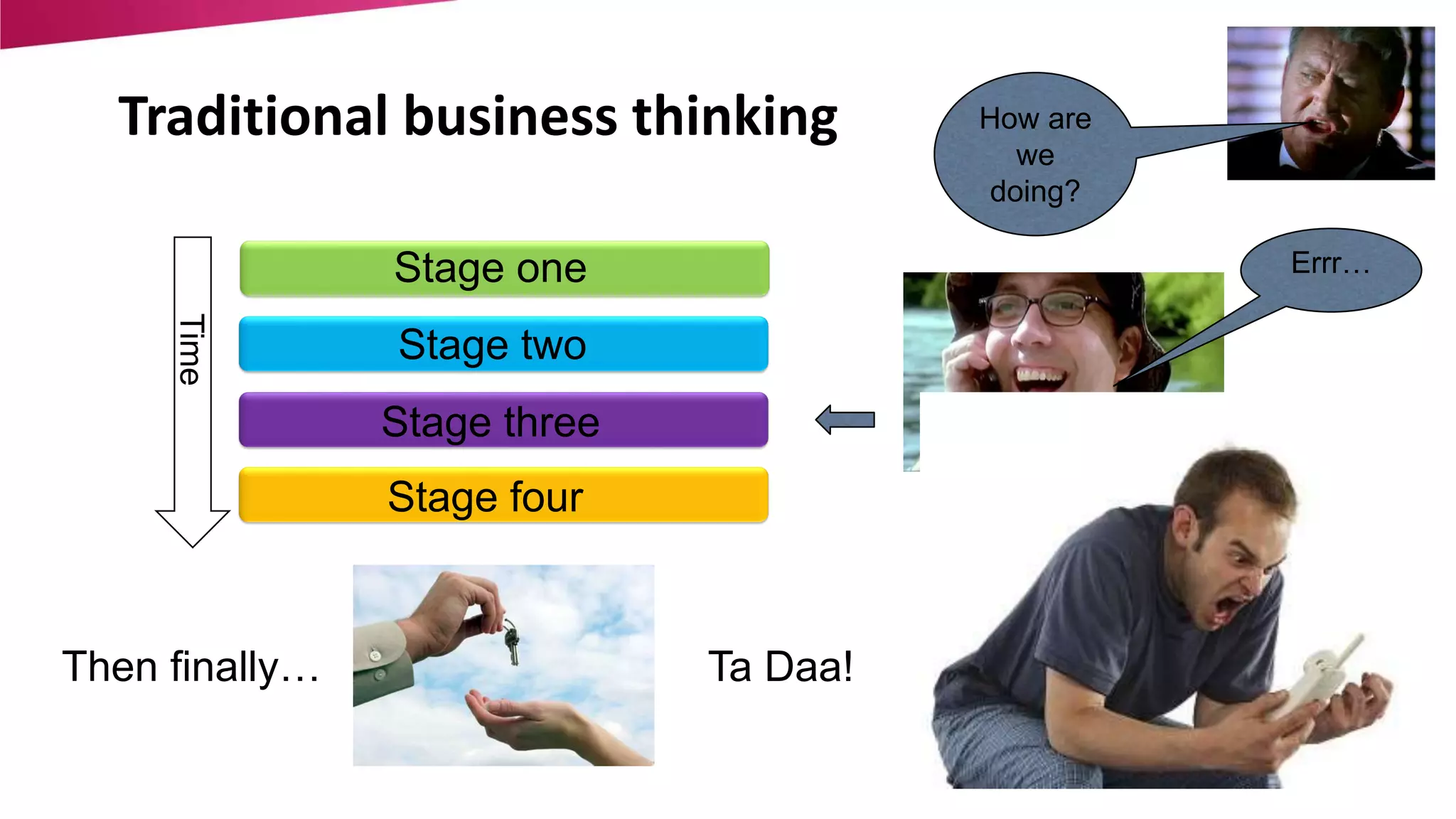
Traditional business thinking 
Time 
How are 
we 
doing? 
Stage one 
Stage two 
Stage three 
Stage four 
Errr… 
Then finally… Ta Daa!
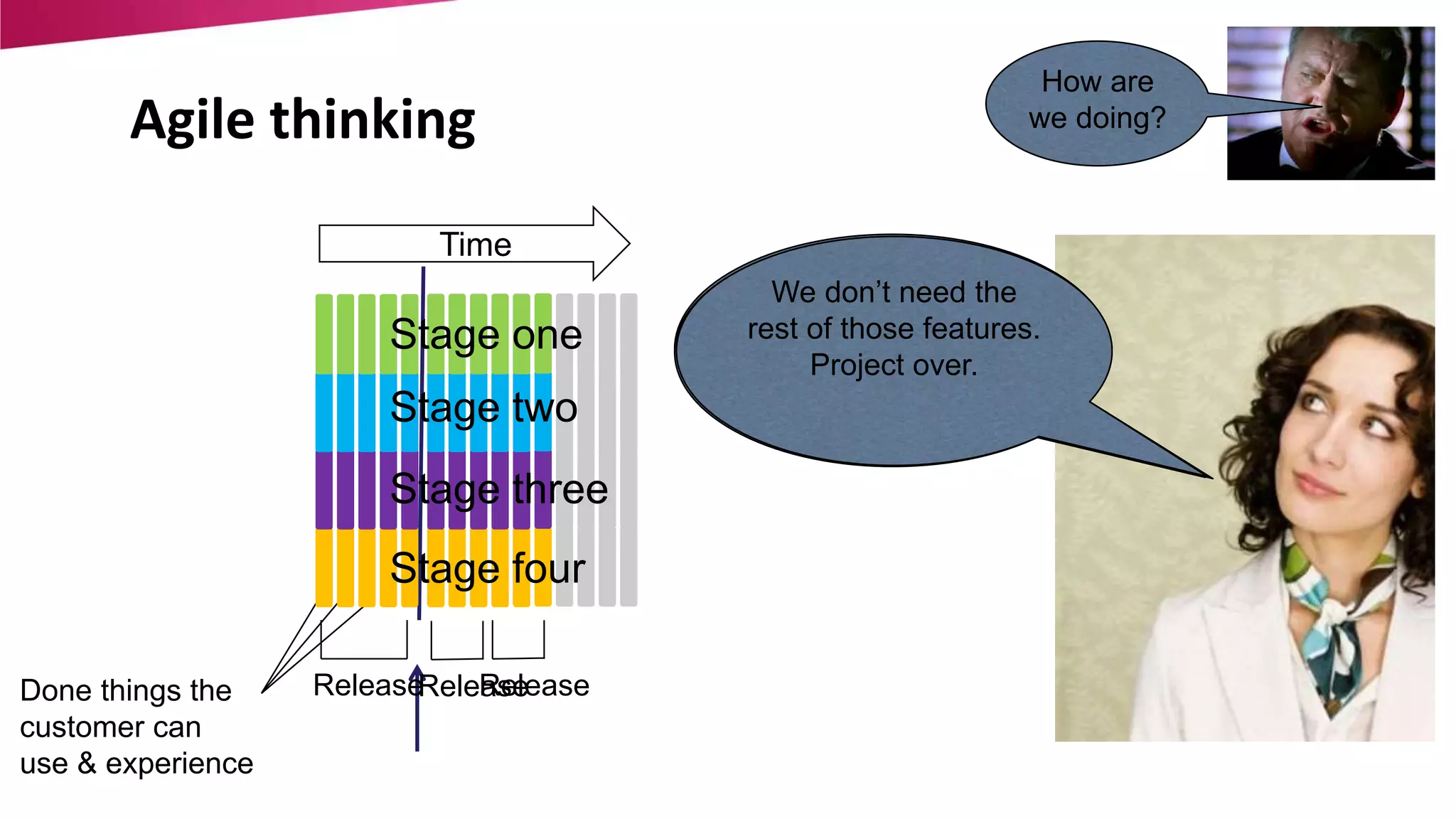
Agile thinking 
Time 
How are 
we doing? 
Done things the 
customer can 
use & experience 
The results show that 
We don’t need the 
rest of those features. 
They loved that! But if 
we could also do X 
then that would be 
5 things are 100% 
done and can be 
shipped. 10 things 
isn’t quite what 
customers wanted. 
Project over. 
We amazing! 
need to try 
something are not done 
else… 
Stage one 
Stage two 
Stage three 
Stage four 
ReleaseReleRaseelease 
Awesome! That went 
down well. It’s 
something our 
competitors don’t 
have.
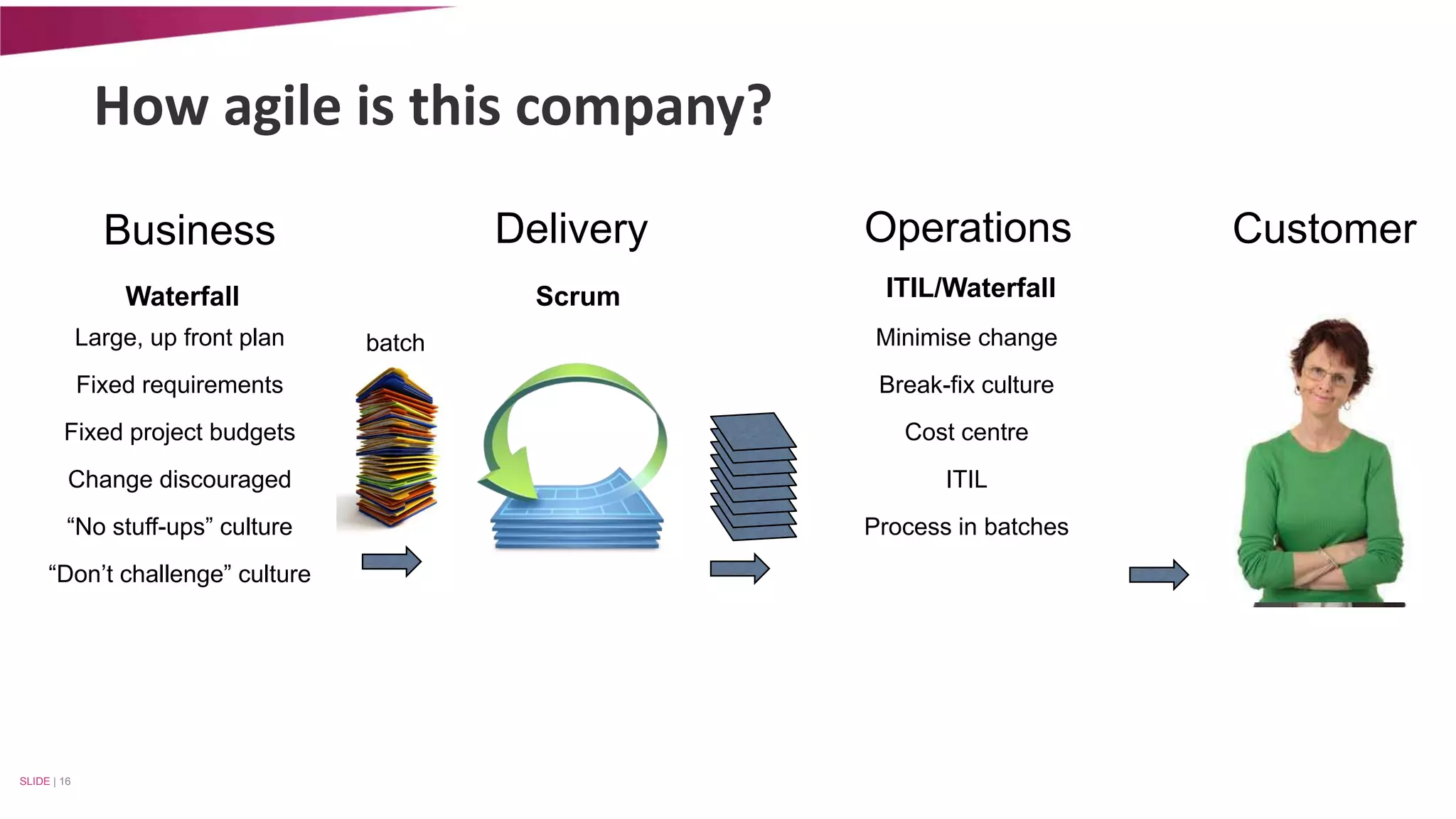
How agile is this company? 
SLIDE | 16 
Business Delivery Operations Customer 
Waterfall Scrum ITIL/Waterfall 
Large, up front plan 
Fixed requirements 
Fixed project budgets 
Change discouraged 
“No stuff-ups” culture 
“Don’t challenge” culture 
Minimise change 
Break-fix culture 
Cost centre 
ITIL 
Process in batches 
batch
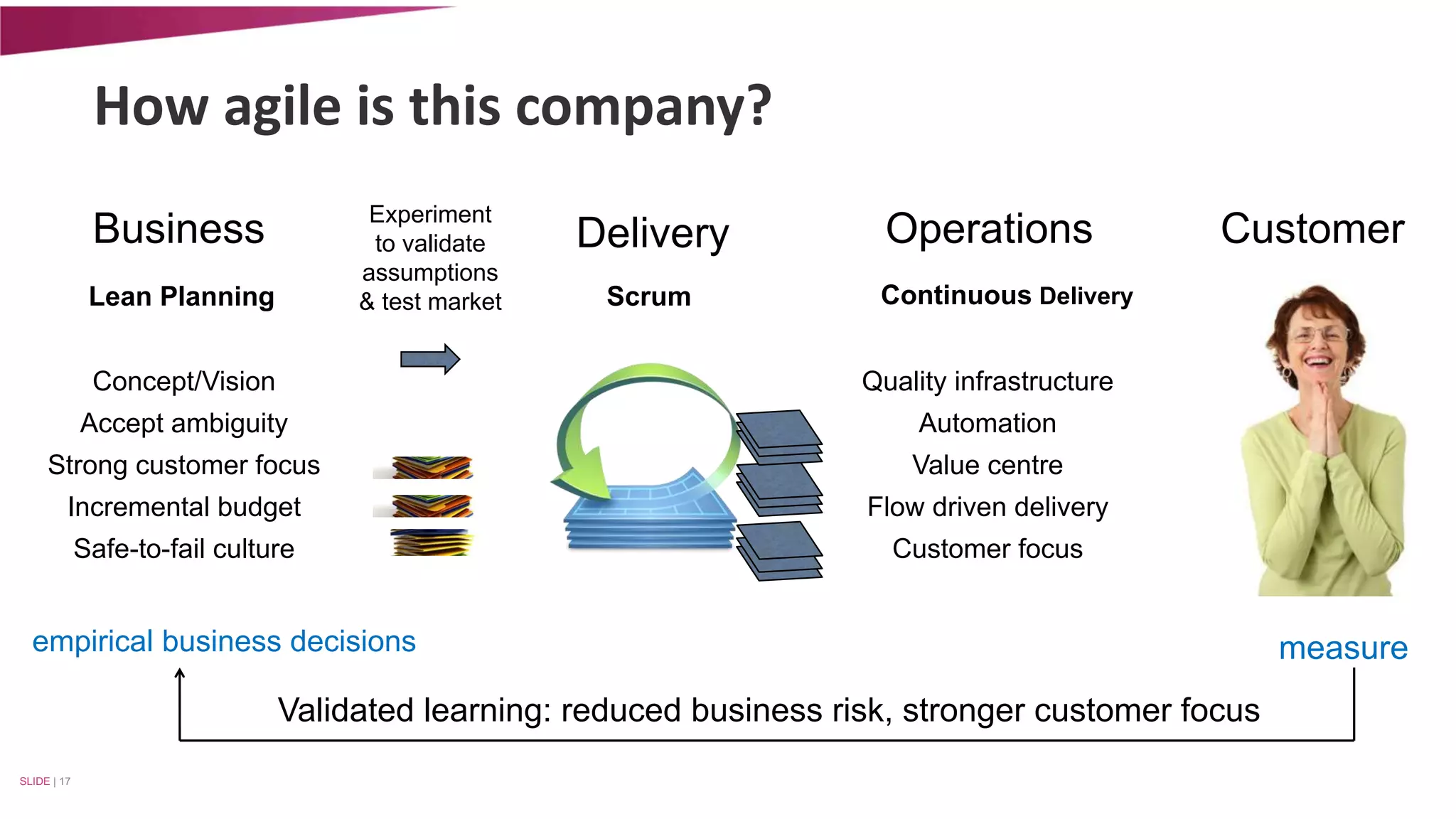
How agile is this company? 
empirical business decisions measure 
SLIDE | 17 
Business Delivery Operations Customer 
Lean Planning Scrum Continuous Delivery 
Concept/Vision 
Accept ambiguity 
Strong customer focus 
Incremental budget 
Safe-to-fail culture 
Quality infrastructure 
Automation 
Value centre 
Flow driven delivery 
Customer focus 
Experiment 
to validate 
assumptions 
& test market 
Validated learning: reduced business risk, stronger customer focus
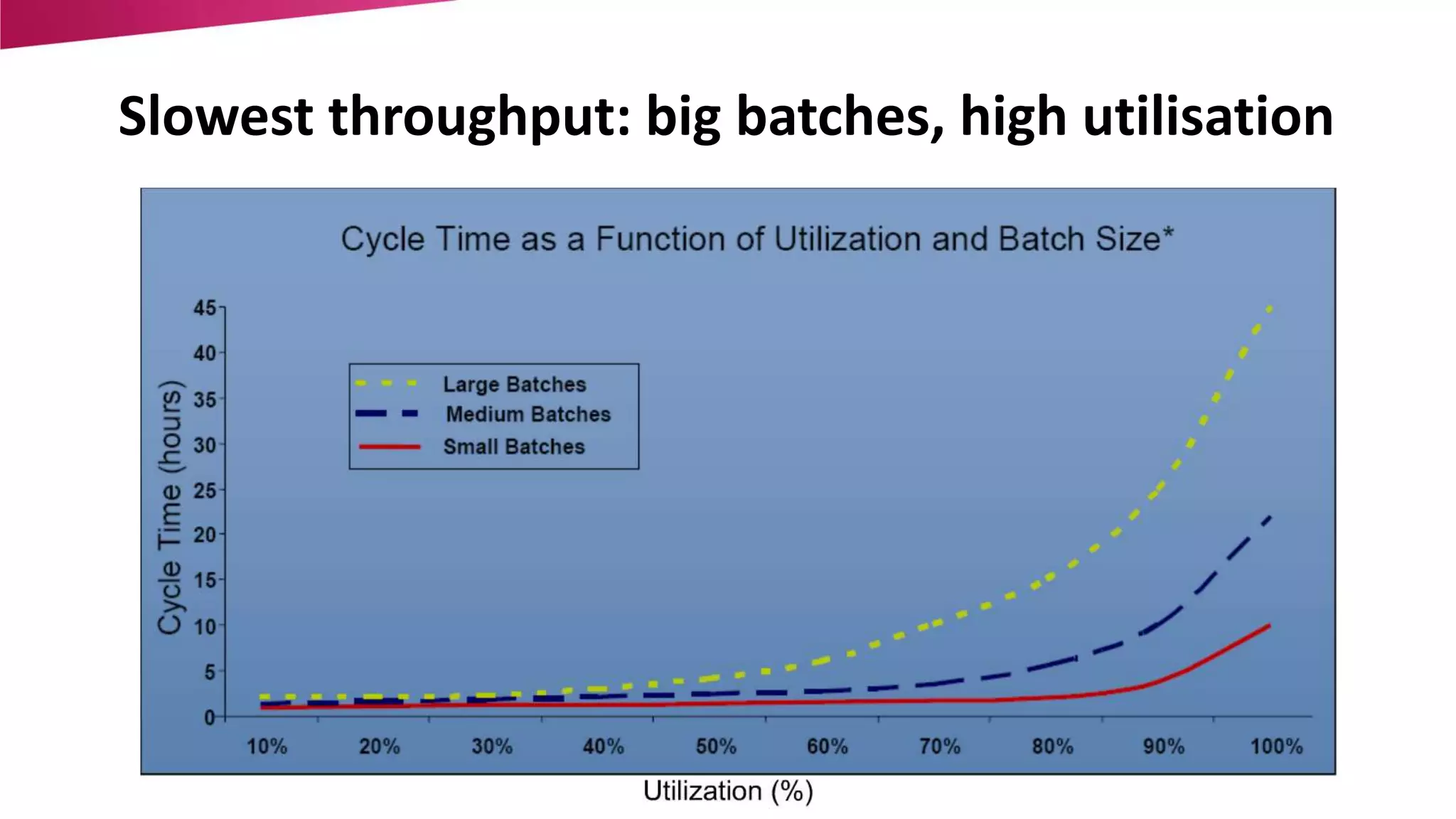
Slowest throughput: big batches, high utilisation
Everything is different in an agile business 
 Business cases & funding 
 How “the business” & IT work together 
 Sales and marketing 
 Governance and reporting 
 People management 
 Operations 
 Leadership 
 In other words, business transformation
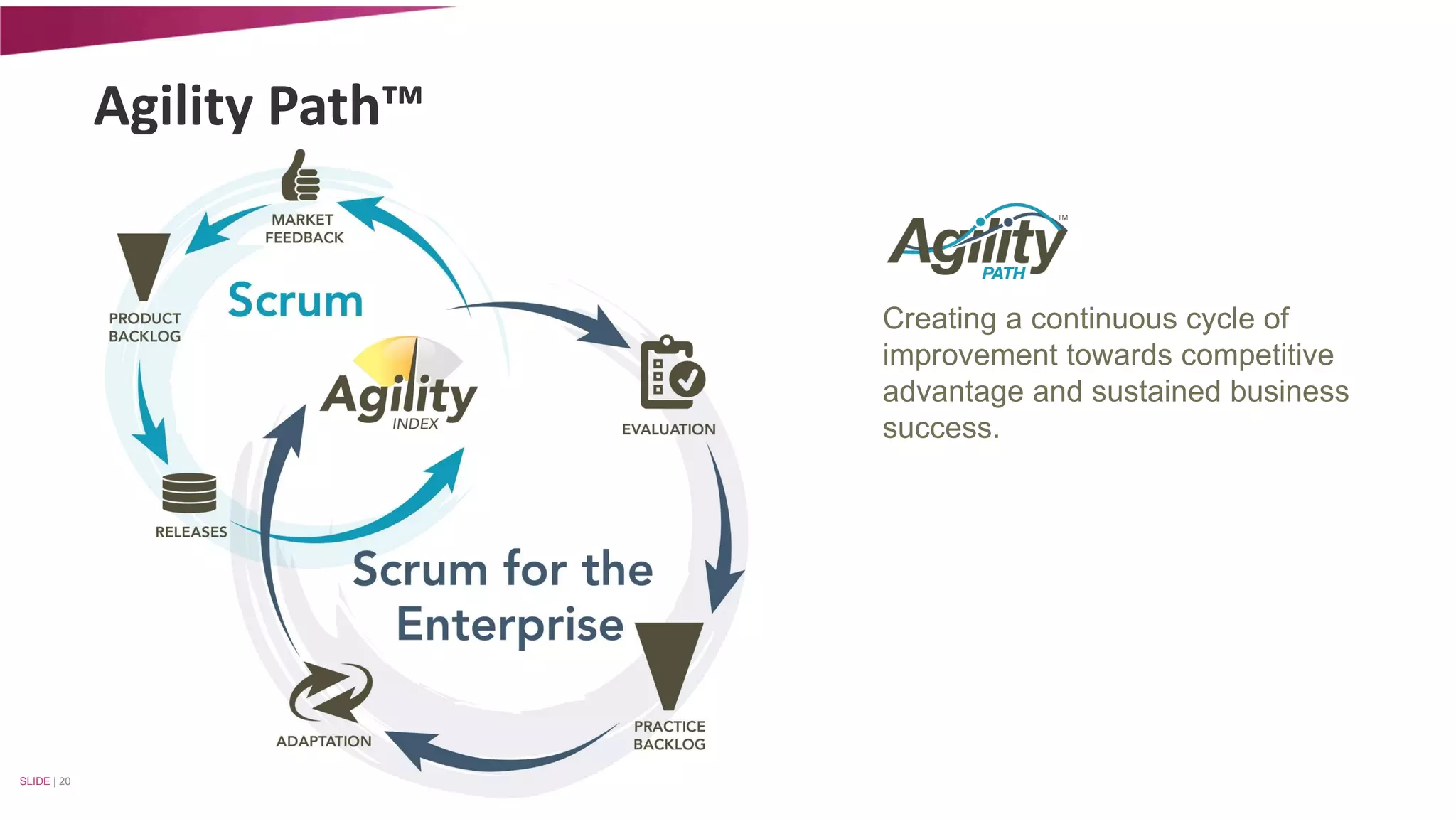
Agility Path™ 
SLIDE | 20 
Creating a continuous cycle of 
improvement towards competitive 
advantage and sustained business 
success.
Agility Path: Framework, Not Methodology 
+ A tool for continuous improvement towards organizational agility 
+ Engaged change team (exec level) iteratively deliver increments of change 
+ Based on Kotter’s change management model 
+ Constant measurement 
o Revenue per employee, customer satisfaction, staff satisfaction, innovation 
rate, feature time to market 
+ Not a prescriptive methodology: a framework for ongoing discovery 
SLIDE | 21
SLIDE | 22
Come talk to me 
Edwin Dando 
@edwindando 
edwin.dando@assurity.co.nz 
021 361 813 
SLIDE | 23

Agile: Beyond Software

  • 1.
    Agile: Beyond Software Edwin Dando Consulting Manager
  • 2.
    Edwin Dando +Founder and MD of Clarus + Now Manager for Assurity’s Education practice + Helping re-wire how companies think + Professional Scrum Trainer with Scrum.org + Worlds first Agility Path™ Engagement Manager + PMP, CSP, PST, EM Better education. By practitioners SLIDE | 2
  • 3.
    Business context +Where have we come from? + What has shaped our current context? SLIDE | 3
  • 4.
    "Scientific Management” FrederickTaylors key beliefs 1.Workers work less than they could 2.Management fails to structure work effectively and provide incentives. Taylors solution • Sub-divide the work into tasks • Analyse each task & schedule for optimal efficiency • Assumption: reconstructed tasks = an efficient job. • Management arrange work & pay for the tasks completed SLIDE | 4 Taylor promised to reconcile labour and capital. Shop Management (1903), is considered the first book on management
  • 5.
    Prevailing management approach + Reductionism + Plan to execute, execute the plan + Focus on o removing variability o economies of scale + Efficient for mass production, but o inability to change o long lead times o stifles innovation o business becomes predictable SLIDE | 5
  • 6.
    How well doesthis approach work on 2013? Why / why not? SLIDE | 6
  • 7.
    Complex/adaptive systems thinking + In warfare predictability = death + John Boyd – the OODA Loop - Observe, Orient, Decide, Act o Basic drills train reflexes to survive first seconds of battle (fight, flee, freeze) o He with the tightest/fastest OODA Loop wins – i.e. adaptive SLIDE | 7 “If you are not moving at the speed of the marketplace you’re already dead – you just haven’t stopped breathing yet.” - Jack Welch
  • 8.
    How resilient areyou? + Fragile o Low tolerance to disruption o Small change has significant consequences + Robust o Don’t care about disruption or events o But don’t benefit from them either + Anti-fragile o Shaped by (and thrives) on change and disruption o Self-correcting and beyond resilient SLIDE | 8
  • 9.
    Scenario planning +Consider a range of possible future business scenarios for your organisation + 3-10 year horizon SLIDE | 9
  • 10.
    Scenario planning SLIDE| 10 Impact Establish Chinese market Time + _ Current assuming steady growth First to market with Acme Cloud Integration Google develop XYZ product and dominate market Salesforce partnership Exchange rate increases European financial crisis
  • 11.
    So just howmanoeuvrable are you? SLIDE | 11
  • 12.
    Common CEO discussion + Are you manoeuvrable enough now? + Do you need to be? + So is agility part of your business strategy? + Do you see a problem with this? + What department has accountability for agility? + What your investment into agility to date? + How are you measuring this? + Are you yielding benefits form this investment? SLIDE | 12 No. Definitely not. We’re at risk Yes - we have to be No. But it needs to be I do now IT/project delivery Not sure We aren’t Not sure as we don’t measure. Get feeling it’s yes, but there is much more.
  • 13.
    So just howmanoeuvrable are you? SLIDE | 13
  • 14.
    Traditional business thinking Time How are we doing? Stage one Stage two Stage three Stage four Errr… Then finally… Ta Daa!
  • 15.
    Agile thinking Time How are we doing? Done things the customer can use & experience The results show that We don’t need the rest of those features. They loved that! But if we could also do X then that would be 5 things are 100% done and can be shipped. 10 things isn’t quite what customers wanted. Project over. We amazing! need to try something are not done else… Stage one Stage two Stage three Stage four ReleaseReleRaseelease Awesome! That went down well. It’s something our competitors don’t have.
  • 16.
    How agile isthis company? SLIDE | 16 Business Delivery Operations Customer Waterfall Scrum ITIL/Waterfall Large, up front plan Fixed requirements Fixed project budgets Change discouraged “No stuff-ups” culture “Don’t challenge” culture Minimise change Break-fix culture Cost centre ITIL Process in batches batch
  • 17.
    How agile isthis company? empirical business decisions measure SLIDE | 17 Business Delivery Operations Customer Lean Planning Scrum Continuous Delivery Concept/Vision Accept ambiguity Strong customer focus Incremental budget Safe-to-fail culture Quality infrastructure Automation Value centre Flow driven delivery Customer focus Experiment to validate assumptions & test market Validated learning: reduced business risk, stronger customer focus
  • 18.
    Slowest throughput: bigbatches, high utilisation
  • 19.
    Everything is differentin an agile business  Business cases & funding  How “the business” & IT work together  Sales and marketing  Governance and reporting  People management  Operations  Leadership  In other words, business transformation
  • 20.
    Agility Path™ SLIDE| 20 Creating a continuous cycle of improvement towards competitive advantage and sustained business success.
  • 21.
    Agility Path: Framework,Not Methodology + A tool for continuous improvement towards organizational agility + Engaged change team (exec level) iteratively deliver increments of change + Based on Kotter’s change management model + Constant measurement o Revenue per employee, customer satisfaction, staff satisfaction, innovation rate, feature time to market + Not a prescriptive methodology: a framework for ongoing discovery SLIDE | 21
  • 22.
  • 23.
    Come talk tome Edwin Dando @edwindando edwin.dando@assurity.co.nz 021 361 813 SLIDE | 23

Editor's Notes

  • #7 5 minute exercise then discuss whether this approach works or not. Answers will likely range from “no it doesn’t work” to “it has its place but doesn’t work for new product development”
  • #10 Get THEM to determine what sort of events, both positive and negative, their business may face in the short, medium and long term. Graph as per EM training Then ask them the next slide
  • #11 Get THEM to determine what sort of events, both positive and negative, their business may face in the short, medium and long term. Graph as per EM training Then ask them the next slide
  • #13 We want to get them to realise that in order to become agile they will need agility to be a strategic imperative with associated investment
  • #17 Agile is not about just software delivery. It is about flow through the business from concept to customer.
  • #18 Agile is not about just software delivery. It is about flow through the business from concept to customer.
  • #19 Why high utilisation and large batches kills cycle time, flow and agility. Discuss traffic systems. How easy is it to respond to an emergency (fire, ambulance) quickly when the traffic system is 100% utilised?