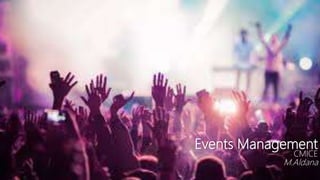


Events Management
CMICE
M.Aldana
What is an Event?
› An event is commonly understood as an
occurence; something that happens.
› Goldblatt (2002) defined special events as “a
unique moment in time celebrated with
ceremony and ritual to satisfy specific needs.”
• The word Event came from the
Latin word E-venire which means
outcome
Events on Two Perspectives
› A special event is a one-time or infrequently
occuring event outside normal programs or
activities of the sponsoring or organizing body;
or
• To the customer or guest, a special event is an
opportunity for leisure, social or cultural
experience outside the normal range of choices
or beyond everyday experience. – D. Getz
(1997)
History of Events
› Events can be traced back to early history, when
communities would gather for religious worship
and celebration.
History of Events
› As society started to create towns and social
systems, event venues became an intrinsic
dimension of the town planning process.
History of Events
› Romans cities often included arenas and
amphitheaters for shows and events, forums, or
marketplaces for trading and community events,
and shrines and churches for religious
celebration.
History of Events
› 18th and 19th centuries produced a wider range of
products and equipment, the commensurate
growth in world trade led to the development of
trade fairs and exhibitions.
History of Events
› The evolution of the events sector reflects the
social, political, economic, environmental and
technological growth of society. For these
reasons, the events sector will also change in the
future.
Characteristics of Events
› Are unique occurences that do not
happen very often
› Have a limited duration (happening
within hours or days at the most)
› Happen with a live audience in
attendance
› Require one or more groups to plan and
organize
› Are staged for a purpose
Characteristics of Events
› Often “once in a lifetime” experience for
participants.
› Generally expensive to stage
› Takes place in a short span of time
› Requires long and careful planning
› Generally takes place only once
› Carries a high level of risk – financially and by
safety
› A lot is at stake, including the event management
› (Van Der Wagen, 2007)
› To sum it, “Events are unique happenings that
bring people together for a purpose”
Events Management
› Event management is the application of project
management to the creation and development of
festivals, events and conferences.
Events Management
› Event management involves studying the
intricacies of the brand, identifying the target
audience, devising the event concept, planning
the logistics and coordinating the technical
aspects before actually launching the event.
Types of Events
› Accoring to purpose: (4 C’s)
– Celebrate
– Commune
– Convene
– Commerce
Celebrate
› Events bring together to celebrate life’s
milestones and accomplishments, and
to perform rituals or ceremonies as
required by religion, culture or society.
Commune
› Events bring people together to
commune and strengthen bonds of
friendship and restore relationships.
Convene
› Events bring together to convene, that
is to share and pass on knowledge
among peers and colleagues.
Commerce
› Events bring people together for
commerce – to market and promote
product offerings.
Type of Events
› According to number of participants:
– This may range from limited board meetings to wide-
scale conventions with thousands of delegates.
Type of Events
› According to frequency:
– Can be monthly, quarterly, semestral, annual, biennial,
or on a need to basis.
Size of Events
› Minor Events
– Most events fall in this category – meetings parties,
celebrations award ceremonies, sporting finals and
may other community and social events fit into this
category.
– Examples: 18th Birthday, Angelite of the Year, CHM
days
Size of Events
› Major Events
– These events attract significant local interest and large
numbers of participants, as well as generating
significant tourism revenue.
– Examples: Bench Universe Fashion Show, Miss Earth
Size of Events
› Hallmark Events
– Are designed to increase the appeal of a specific
tourism destination or region.
– Examples: Carnaval in Rio de Janeiro, Panagbenga in
Baguio
Size of Events
› Mega-events
– The largest events and are generally targeted at
international markets.
– Examples: Olympic Games, World Cup Finals,
Superbowl
Size of Events
Other Types of Events
› Sporting
› Entertainment, arts, cultural festivals
› Commercial, marketing and
promotional events
› Meetings, conventions and exhibitions
› Family events
› Fundraising
› Miscellaneous events
Types of Events
Types of Events
Event Team
› An event manager is generally supported
by a team which grows exponentially as
the event draws near.
› The manager typically works with a
number of contractors (venue managers,
stage managers, lighting, audio & video
companies, entertainers, security
companies, catering companies, printers,
etc
Event Team
› the team that researches, plans,
designs, coordinates and evaluates an
event.
› “a pulsing organization” (Toffler, 1980)
Career in the Events Industry
› We've all been an event planner at one point in our
lives-- from planning a birthday party to organizing
a company outing. Indeed, planning an event can
be tiring and stressful, yet can also be as rewarding
as any other profession, especially if you are able
to lay out your plans very well. The secret of a
successful activity or event does not lie on how big
the budget is or where the venue is. Everything is
all about proper and careful planning.
The Philippine Events Industry
› In the Philippines, event management is still a
young but rapidly rising industry. Most event
management industries trace their roots in the
advertising and PR industries, hospitality, tourism,
exhibits and exposition, and marketing.
The Philippine Events Industry
› Many event planners/managers/coordinators
learned to manage events as part of their job.
› Many of those who focus on weddings and
birthdays, learned the business by planning their
own events first.
The Philippine Events Industry
› The development of the Philippine convention industry became official
government policy in 1976, a milestone year that marked the
establishment of Southeast Asia’s first full-fledged convention center,
the Philippine International Convention Center (PICC) and the creation
of the Philippine Convention Bureau (PCB) as a government corporation
dedicated to the promotion of Philippines as a meetings and
convention destination.
The Philippine Events Industry
› That same year, the Philippines
successfully played host to the
International Monetary Fund - World
Bank Joint Conference that signaled
the entry of the Philippines into the
world conventions market. › Since then, the Philippines has
hosted some of the biggest and most
important international and regional
meetings, conferences, conventions,
congresses, and events that have
made its capital city, Manila, one of
the acknowledged “Convention
Cities” of the world.
The Philippine Events Industry
› The Philippine Convention Bureau
(PCB) was later reorganized in 1987
to become the Philippine Convention
and Visitors Corporation, now known
as Tourism Promotions Board (TPB),
in response to market developments
which embraced the new, more
specialized, and quality-oriented
Incentive Travel Industry.
The Philippine Events Industry
› In recent years, the meetings, conventions, and
incentive travel industry evolved into an even
wider representation of several specialized sector
of tourism to encompass exhibition and events.
The convention industry now became known by
the acronym: MICE, which stands for Meetings,
Incentives, Conventions and Exhibitions/Events.
The Philippine Events Industry
› As Asia’s pioneer in conventions, the Philippines
can easily host an international event with
expertise and creative approaches.
M.I.C.E.
MICE
› MICE represents four event subfields – Meetings,
Incentives, Conferences and Conventions, and Exhibitions.
Meeting › A meeting is a gathering of 10 or more
individuals for a minimum of four
hours in a contracted venue.
› Meetings are often exclusive and
formal.
› Ex. Annual general meetings, board
meetings, management meetings
Incentives
› Incentives are events used to promote
particular actions among a specific group of
people.
› Incentive travel is a global management tool
that utilizes travel experience to increase the
performance of an organization in achieving
its goals.
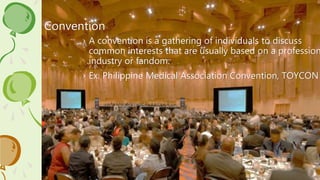
Convention
› A convention is a gathering of individuals to discuss
common interests that are usually based on a profession
industry or fandom.
› Ex. Philippine Medical Association Convention, TOYCON
Conferences
› Conference comes from the Latin word confer
meaning bring together.
› It is another big meeting of various sectors of an
industry that can last for several days with hundreds or
thousands of participants.
Exhibition
› An exhibition is an organized presentation, display,
or demonstration of particular items.
› The purpose is to attract new customers, maintain
and renew ties with valued clients, launch new
products and services through live presentation, and
to enhance the corporate profile and image of the
organizer or sponsor.

Lesson 1 cmice

  • 1.
  • 3.
    What is anEvent? › An event is commonly understood as an occurence; something that happens. › Goldblatt (2002) defined special events as “a unique moment in time celebrated with ceremony and ritual to satisfy specific needs.” • The word Event came from the Latin word E-venire which means outcome
  • 4.
    Events on TwoPerspectives › A special event is a one-time or infrequently occuring event outside normal programs or activities of the sponsoring or organizing body; or • To the customer or guest, a special event is an opportunity for leisure, social or cultural experience outside the normal range of choices or beyond everyday experience. – D. Getz (1997)
  • 5.
    History of Events ›Events can be traced back to early history, when communities would gather for religious worship and celebration.
  • 6.
    History of Events ›As society started to create towns and social systems, event venues became an intrinsic dimension of the town planning process.
  • 7.
    History of Events ›Romans cities often included arenas and amphitheaters for shows and events, forums, or marketplaces for trading and community events, and shrines and churches for religious celebration.
  • 8.
    History of Events ›18th and 19th centuries produced a wider range of products and equipment, the commensurate growth in world trade led to the development of trade fairs and exhibitions.
  • 9.
    History of Events ›The evolution of the events sector reflects the social, political, economic, environmental and technological growth of society. For these reasons, the events sector will also change in the future.
  • 10.
    Characteristics of Events ›Are unique occurences that do not happen very often › Have a limited duration (happening within hours or days at the most) › Happen with a live audience in attendance › Require one or more groups to plan and organize › Are staged for a purpose
  • 11.
    Characteristics of Events ›Often “once in a lifetime” experience for participants. › Generally expensive to stage › Takes place in a short span of time › Requires long and careful planning › Generally takes place only once › Carries a high level of risk – financially and by safety › A lot is at stake, including the event management › (Van Der Wagen, 2007)
  • 12.
    › To sumit, “Events are unique happenings that bring people together for a purpose”
  • 13.
    Events Management › Eventmanagement is the application of project management to the creation and development of festivals, events and conferences.
  • 14.
    Events Management › Eventmanagement involves studying the intricacies of the brand, identifying the target audience, devising the event concept, planning the logistics and coordinating the technical aspects before actually launching the event.
  • 15.
    Types of Events ›Accoring to purpose: (4 C’s) – Celebrate – Commune – Convene – Commerce
  • 16.
    Celebrate › Events bringtogether to celebrate life’s milestones and accomplishments, and to perform rituals or ceremonies as required by religion, culture or society.
  • 17.
    Commune › Events bringpeople together to commune and strengthen bonds of friendship and restore relationships.
  • 18.
    Convene › Events bringtogether to convene, that is to share and pass on knowledge among peers and colleagues.
  • 19.
    Commerce › Events bringpeople together for commerce – to market and promote product offerings.
  • 20.
    Type of Events ›According to number of participants: – This may range from limited board meetings to wide- scale conventions with thousands of delegates.
  • 21.
    Type of Events ›According to frequency: – Can be monthly, quarterly, semestral, annual, biennial, or on a need to basis.
  • 22.
    Size of Events ›Minor Events – Most events fall in this category – meetings parties, celebrations award ceremonies, sporting finals and may other community and social events fit into this category. – Examples: 18th Birthday, Angelite of the Year, CHM days
  • 23.
    Size of Events ›Major Events – These events attract significant local interest and large numbers of participants, as well as generating significant tourism revenue. – Examples: Bench Universe Fashion Show, Miss Earth
  • 24.
    Size of Events ›Hallmark Events – Are designed to increase the appeal of a specific tourism destination or region. – Examples: Carnaval in Rio de Janeiro, Panagbenga in Baguio
  • 25.
    Size of Events ›Mega-events – The largest events and are generally targeted at international markets. – Examples: Olympic Games, World Cup Finals, Superbowl
  • 26.
  • 27.
    Other Types ofEvents › Sporting › Entertainment, arts, cultural festivals › Commercial, marketing and promotional events › Meetings, conventions and exhibitions › Family events › Fundraising › Miscellaneous events
  • 28.
  • 29.
  • 30.
    Event Team › Anevent manager is generally supported by a team which grows exponentially as the event draws near. › The manager typically works with a number of contractors (venue managers, stage managers, lighting, audio & video companies, entertainers, security companies, catering companies, printers, etc
  • 31.
    Event Team › theteam that researches, plans, designs, coordinates and evaluates an event. › “a pulsing organization” (Toffler, 1980)
  • 32.
    Career in theEvents Industry › We've all been an event planner at one point in our lives-- from planning a birthday party to organizing a company outing. Indeed, planning an event can be tiring and stressful, yet can also be as rewarding as any other profession, especially if you are able to lay out your plans very well. The secret of a successful activity or event does not lie on how big the budget is or where the venue is. Everything is all about proper and careful planning.
  • 33.
    The Philippine EventsIndustry › In the Philippines, event management is still a young but rapidly rising industry. Most event management industries trace their roots in the advertising and PR industries, hospitality, tourism, exhibits and exposition, and marketing.
  • 34.
    The Philippine EventsIndustry › Many event planners/managers/coordinators learned to manage events as part of their job. › Many of those who focus on weddings and birthdays, learned the business by planning their own events first.
  • 35.
    The Philippine EventsIndustry › The development of the Philippine convention industry became official government policy in 1976, a milestone year that marked the establishment of Southeast Asia’s first full-fledged convention center, the Philippine International Convention Center (PICC) and the creation of the Philippine Convention Bureau (PCB) as a government corporation dedicated to the promotion of Philippines as a meetings and convention destination.
  • 36.
    The Philippine EventsIndustry › That same year, the Philippines successfully played host to the International Monetary Fund - World Bank Joint Conference that signaled the entry of the Philippines into the world conventions market. › Since then, the Philippines has hosted some of the biggest and most important international and regional meetings, conferences, conventions, congresses, and events that have made its capital city, Manila, one of the acknowledged “Convention Cities” of the world.
  • 37.
    The Philippine EventsIndustry › The Philippine Convention Bureau (PCB) was later reorganized in 1987 to become the Philippine Convention and Visitors Corporation, now known as Tourism Promotions Board (TPB), in response to market developments which embraced the new, more specialized, and quality-oriented Incentive Travel Industry.
  • 38.
    The Philippine EventsIndustry › In recent years, the meetings, conventions, and incentive travel industry evolved into an even wider representation of several specialized sector of tourism to encompass exhibition and events. The convention industry now became known by the acronym: MICE, which stands for Meetings, Incentives, Conventions and Exhibitions/Events.
  • 39.
    The Philippine EventsIndustry › As Asia’s pioneer in conventions, the Philippines can easily host an international event with expertise and creative approaches.
  • 40.
  • 41.
    MICE › MICE representsfour event subfields – Meetings, Incentives, Conferences and Conventions, and Exhibitions.
  • 42.
    Meeting › Ameeting is a gathering of 10 or more individuals for a minimum of four hours in a contracted venue. › Meetings are often exclusive and formal. › Ex. Annual general meetings, board meetings, management meetings
  • 43.
    Incentives › Incentives areevents used to promote particular actions among a specific group of people. › Incentive travel is a global management tool that utilizes travel experience to increase the performance of an organization in achieving its goals.
  • 44.
    Convention › A conventionis a gathering of individuals to discuss common interests that are usually based on a profession industry or fandom. › Ex. Philippine Medical Association Convention, TOYCON
  • 45.
    Conferences › Conference comesfrom the Latin word confer meaning bring together. › It is another big meeting of various sectors of an industry that can last for several days with hundreds or thousands of participants.
  • 46.
    Exhibition › An exhibitionis an organized presentation, display, or demonstration of particular items. › The purpose is to attract new customers, maintain and renew ties with valued clients, launch new products and services through live presentation, and to enhance the corporate profile and image of the organizer or sponsor.