CHAPTER 3
The Market for Events and
The Event Stakeholder
 
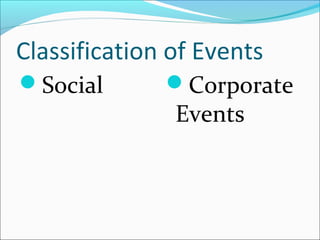
Classification of Events
Social Corporate 
Events
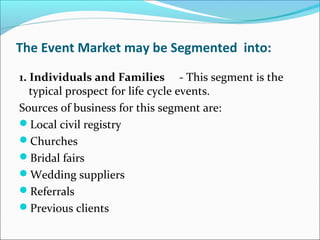
The Event Market may be Segmented into:
1. Individuals and Families - This segment is the 
typical prospect for life cycle events.
Sources of business for this segment are:
Local civil registry
Churches
Bridal fairs
Wedding suppliers
Referrals
Previous clients
2. Organizations - This segment is typical prospect for
events to convene and events for commerce – or
commonly referred to as corporate events.
This is the market for meetings, seminars,
conference, conventions, product launches, bazaars,
selling events, sales promotion activities, office
parties, incentive trips, and recreational activities.
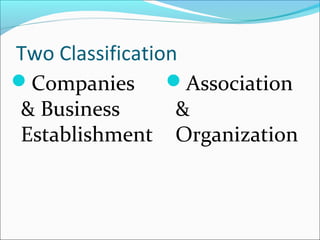
Two Classification
Companies
& Business
Establishment
Association
&
Organization
Two classifications:
a. Companies and Business Establishments may
have events as part of their operating calendar (as in
the case of annual meetings or quarterly sales rallies),
or in response to the demand of their products (for
product launches and promotional activities).
b. Associations are organizations of people that have a
common interest or purpose (abbey,2003)
Three Categories
1. Trade Associations - made up of individuals and
corporations that operate within an industry, or are
bound by similar business concerns.
2. Professional Association - formed by individuals
in a common or affiliated profession.
3. Non-Profit Organizations - include social,
military, educational, religious, and fraternal groups
or SMERFs.
Events Stakeholders
Event Stakeholders are individuals and groups who have some
forms of interest in the event. Such interest may be financial,
emotional, political, social or any form of personal involvement
in the event.
 The Host - this is the group of people or person who is giving
the event.
-The host may be the originator or champion of
the idea to gather people together for a particular occasion; the
main celebrator; or the financing all the expenses for the event.
-The host is the client- the group or person whom
you are to get direction from.
-The host is also a partner with whom the event
manager works to ensure a successful event.
Cont…
The Guests - These are people attending the
event; they are variously called audience,
participants, attendees, or visitors.
The Event Committee - This refers to the
group involved in the planning and execution of an
event.
-This can be an ad hoc group
of the host’s organization, a team of volunteers, the
host’s staff, plus, the event manager’s own team.
Cont…
The Financer - This is the money man - the
one who foots the bill.
- He or she may or may not be
involved in the planning and execution of the event,
but he/she is out to make sure that he/she gets a
reasonable return on his/her investment.
The Supplier - The event manager works
with other companies that will bring the event
concept into reality.
-These companies also stake their
time, resources, and reputation on the event.
Cont…
The External - These includes other external
entities to the host or the event manager, but have
financial, emotional, political, social or personal
interest in the event.

Chapter 3 The Market for Events and The Event Stakeholder

  • 1.
    CHAPTER 3 The Marketfor Events and The Event Stakeholder  
  • 2.
  • 3.
    The Event Marketmay be Segmented into: 1. Individuals and Families - This segment is the  typical prospect for life cycle events. Sources of business for this segment are: Local civil registry Churches Bridal fairs Wedding suppliers Referrals Previous clients
  • 4.
    2. Organizations -This segment is typical prospect for events to convene and events for commerce – or commonly referred to as corporate events. This is the market for meetings, seminars, conference, conventions, product launches, bazaars, selling events, sales promotion activities, office parties, incentive trips, and recreational activities.
  • 5.
  • 6.
    Two classifications: a. Companiesand Business Establishments may have events as part of their operating calendar (as in the case of annual meetings or quarterly sales rallies), or in response to the demand of their products (for product launches and promotional activities). b. Associations are organizations of people that have a common interest or purpose (abbey,2003)
  • 7.
    Three Categories 1. TradeAssociations - made up of individuals and corporations that operate within an industry, or are bound by similar business concerns. 2. Professional Association - formed by individuals in a common or affiliated profession. 3. Non-Profit Organizations - include social, military, educational, religious, and fraternal groups or SMERFs.
  • 8.
    Events Stakeholders Event Stakeholdersare individuals and groups who have some forms of interest in the event. Such interest may be financial, emotional, political, social or any form of personal involvement in the event.  The Host - this is the group of people or person who is giving the event. -The host may be the originator or champion of the idea to gather people together for a particular occasion; the main celebrator; or the financing all the expenses for the event. -The host is the client- the group or person whom you are to get direction from. -The host is also a partner with whom the event manager works to ensure a successful event.
  • 9.
    Cont… The Guests -These are people attending the event; they are variously called audience, participants, attendees, or visitors. The Event Committee - This refers to the group involved in the planning and execution of an event. -This can be an ad hoc group of the host’s organization, a team of volunteers, the host’s staff, plus, the event manager’s own team.
  • 10.
    Cont… The Financer -This is the money man - the one who foots the bill. - He or she may or may not be involved in the planning and execution of the event, but he/she is out to make sure that he/she gets a reasonable return on his/her investment. The Supplier - The event manager works with other companies that will bring the event concept into reality. -These companies also stake their time, resources, and reputation on the event.
  • 11.
    Cont… The External -These includes other external entities to the host or the event manager, but have financial, emotional, political, social or personal interest in the event.