FOOD COSTING AND PRICING
MODULE 2
Prepared by:
Prof. Rowena R. De Leon
ENT 106: Pricing & Costing
LESSON 2
Prepared by:
Prof. Rowena R. De Leon
ENT 106: Pricing & Costing
WEIGHTS AND MEASURES
Prof. Rowena R. De Leon
ENT 106: Pricing & Costing
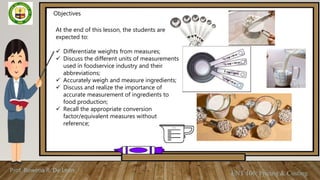
Objectives
At the end of this lesson, the students are
expected to:
 Differentiate weights from measures;
 Discuss the different units of measurements
used in foodservice industry and their
abbreviations;
 Accurately weigh and measure ingredients;
 Discuss and realize the importance of
accurate measurement of ingredients to
food production;
 Recall the appropriate conversion
factor/equivalent measures without
reference;
Prof. Rowena R. De Leon
ENT 106: Pricing & Costing
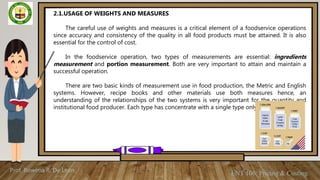
2.1.USAGE OF WEIGHTS AND MEASURES
The careful use of weights and measures is a critical element of a foodservice operations
since accuracy and consistency of the quality in all food products must be attained. It is also
essential for the control of cost.
In the foodservice operation, two types of measurements are essential: ingredients
measurement and portion measurement. Both are very important to attain and maintain a
successful operation.
There are two basic kinds of measurement use in food production, the Metric and English
systems. However, recipe books and other materials use both measures hence, an
understanding of the relationships of the two systems is very important for the quantity and
institutional food producer. Each type has concentrate with a single type only.
Prof. Rowena R. De Leon
ENT 106: Pricing & Costing
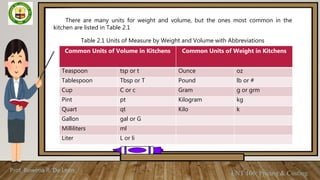
Table 2.1 Units of Measure by Weight and Volume with Abbreviations
There are many units for weight and volume, but the ones most common in the
kitchen are listed in Table 2.1
Common Units of Volume in Kitchens Common Units of Weight in Kitchens
Teaspoon tsp or t Ounce oz
Tablespoon Tbsp or T Pound lb or #
Cup C or c Gram g or grm
Pint pt Kilogram kg
Quart qt Kilo k
Gallon gal or G
Milliliters ml
Liter L or li
Prof. Rowena R. De Leon
ENT 106: Pricing & Costing
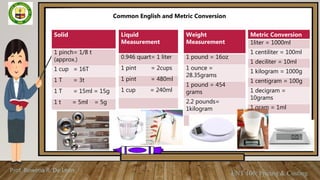
Common English and Metric Conversion
Solid
1 pinch= 1/8 t
(approx.)
1 cup = 16T
1 T = 3t
1 T = 15ml = 15g
1 t = 5ml = 5g
Weight
Measurement
1 pound = 16oz
1 ounce =
28.35grams
1 pound = 454
grams
2.2 pounds=
1kilogram
Liquid
Measurement
0.946 quart= 1 liter
1 pint = 2cups
1 pint = 480ml
1 cup = 240ml
Metric Conversion
1liter = 1000ml
1 centiliter = 100ml
1 deciliter = 10ml
1 kilogram = 1000g
1 centigram = 100g
1 decigram =
10grams
1 gram = 1ml
Prof. Rowena R. De Leon
ENT 106: Pricing & Costing
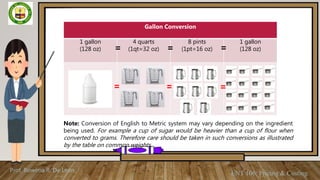
Note: Conversion of English to Metric system may vary depending on the ingredient
being used. For example a cup of sugar would be heavier than a cup of flour when
converted to grams. Therefore care should be taken in such conversions as illustrated
by the table on common weights.
Gallon Conversion
1 gallon
(128 oz)
4 quarts
(1qt=32 oz)
8 pints
(1pt=16 oz)
1 gallon
(128 oz)
=
=
=
=
= =
Prof. Rowena R. De Leon
ENT 106: Pricing & Costing
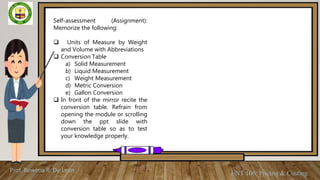
Self-assessment (Assignment):
Memorize the following:
 Units of Measure by Weight
and Volume with Abbreviations
 Conversion Table
a) Solid Measurement
b) Liquid Measurement
c) Weight Measurement
d) Metric Conversion
e) Gallon Conversion
 In front of the mirror recite the
conversion table. Refrain from
opening the module or scrolling
down the ppt slide with
conversion table so as to test
your knowledge properly.
Prof. Rowena R. De Leon
ENT 106: Pricing & Costing
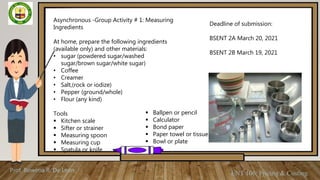
Asynchronous -Group Activity # 1: Measuring
Ingredients
At home, prepare the following ingredients
(available only) and other materials:
• sugar (powdered sugar/washed
sugar/brown sugar/white sugar)
• Coffee
• Creamer
• Salt,(rock or iodize)
• Pepper (ground/whole)
• Flour (any kind)
Tools
 Kitchen scale
 Sifter or strainer
 Measuring spoon
 Measuring cup
 Spatula or knife
 Ballpen or pencil
 Calculator
 Bond paper
 Paper towel or tissue
 Bowl or plate
Deadline of submission:
BSENT 2A March 20, 2021
BSENT 2B March 19, 2021
Prof. Rowena R. De Leon
ENT 106: Pricing & Costing
Prof. Rowena R. De Leon
ENT 106: Pricing & Costing
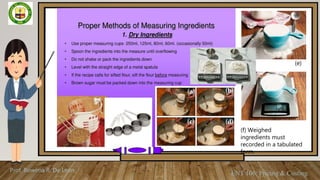
(e)
(f) Weighed
ingredients must
recorded in a tabulated
form.
Prof. Rowena R. De Leon
ENT 106: Pricing & Costing
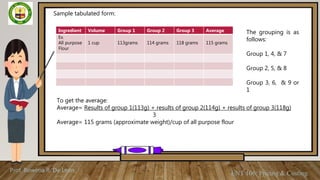
Sample tabulated form:
Ingredient Volume Group 1 Group 2 Group 3 Average
Ex.
All purpose
Flour
1 cup 113grams 114 grams 118 grams 115 grams
To get the average:
Average= Results of group 1(113g) + results of group 2(114g) + results of group 3(118g)
3
Average= 115 grams (approximate weight)/cup of all purpose flour
The grouping is as
follows:
Group 1, 4, & 7
Group 2, 5, & 8
Group 3, 6, & 9 or
1
THE END
Prof. Rowena R. De Leon
ENT 106: Pricing & Costing

Module 2 lesson 2 weights and measures

  • 1.
    FOOD COSTING ANDPRICING MODULE 2 Prepared by: Prof. Rowena R. De Leon ENT 106: Pricing & Costing
  • 2.
    LESSON 2 Prepared by: Prof.Rowena R. De Leon ENT 106: Pricing & Costing WEIGHTS AND MEASURES
  • 3.
    Prof. Rowena R.De Leon ENT 106: Pricing & Costing Objectives At the end of this lesson, the students are expected to:  Differentiate weights from measures;  Discuss the different units of measurements used in foodservice industry and their abbreviations;  Accurately weigh and measure ingredients;  Discuss and realize the importance of accurate measurement of ingredients to food production;  Recall the appropriate conversion factor/equivalent measures without reference;
  • 4.
    Prof. Rowena R.De Leon ENT 106: Pricing & Costing 2.1.USAGE OF WEIGHTS AND MEASURES The careful use of weights and measures is a critical element of a foodservice operations since accuracy and consistency of the quality in all food products must be attained. It is also essential for the control of cost. In the foodservice operation, two types of measurements are essential: ingredients measurement and portion measurement. Both are very important to attain and maintain a successful operation. There are two basic kinds of measurement use in food production, the Metric and English systems. However, recipe books and other materials use both measures hence, an understanding of the relationships of the two systems is very important for the quantity and institutional food producer. Each type has concentrate with a single type only.
  • 5.
    Prof. Rowena R.De Leon ENT 106: Pricing & Costing Table 2.1 Units of Measure by Weight and Volume with Abbreviations There are many units for weight and volume, but the ones most common in the kitchen are listed in Table 2.1 Common Units of Volume in Kitchens Common Units of Weight in Kitchens Teaspoon tsp or t Ounce oz Tablespoon Tbsp or T Pound lb or # Cup C or c Gram g or grm Pint pt Kilogram kg Quart qt Kilo k Gallon gal or G Milliliters ml Liter L or li
  • 6.
    Prof. Rowena R.De Leon ENT 106: Pricing & Costing Common English and Metric Conversion Solid 1 pinch= 1/8 t (approx.) 1 cup = 16T 1 T = 3t 1 T = 15ml = 15g 1 t = 5ml = 5g Weight Measurement 1 pound = 16oz 1 ounce = 28.35grams 1 pound = 454 grams 2.2 pounds= 1kilogram Liquid Measurement 0.946 quart= 1 liter 1 pint = 2cups 1 pint = 480ml 1 cup = 240ml Metric Conversion 1liter = 1000ml 1 centiliter = 100ml 1 deciliter = 10ml 1 kilogram = 1000g 1 centigram = 100g 1 decigram = 10grams 1 gram = 1ml
  • 7.
    Prof. Rowena R.De Leon ENT 106: Pricing & Costing Note: Conversion of English to Metric system may vary depending on the ingredient being used. For example a cup of sugar would be heavier than a cup of flour when converted to grams. Therefore care should be taken in such conversions as illustrated by the table on common weights. Gallon Conversion 1 gallon (128 oz) 4 quarts (1qt=32 oz) 8 pints (1pt=16 oz) 1 gallon (128 oz) = = = = = =
  • 8.
    Prof. Rowena R.De Leon ENT 106: Pricing & Costing Self-assessment (Assignment): Memorize the following:  Units of Measure by Weight and Volume with Abbreviations  Conversion Table a) Solid Measurement b) Liquid Measurement c) Weight Measurement d) Metric Conversion e) Gallon Conversion  In front of the mirror recite the conversion table. Refrain from opening the module or scrolling down the ppt slide with conversion table so as to test your knowledge properly.
  • 9.
    Prof. Rowena R.De Leon ENT 106: Pricing & Costing Asynchronous -Group Activity # 1: Measuring Ingredients At home, prepare the following ingredients (available only) and other materials: • sugar (powdered sugar/washed sugar/brown sugar/white sugar) • Coffee • Creamer • Salt,(rock or iodize) • Pepper (ground/whole) • Flour (any kind) Tools  Kitchen scale  Sifter or strainer  Measuring spoon  Measuring cup  Spatula or knife  Ballpen or pencil  Calculator  Bond paper  Paper towel or tissue  Bowl or plate Deadline of submission: BSENT 2A March 20, 2021 BSENT 2B March 19, 2021
  • 10.
    Prof. Rowena R.De Leon ENT 106: Pricing & Costing
  • 11.
    Prof. Rowena R.De Leon ENT 106: Pricing & Costing (e) (f) Weighed ingredients must recorded in a tabulated form.
  • 12.
    Prof. Rowena R.De Leon ENT 106: Pricing & Costing Sample tabulated form: Ingredient Volume Group 1 Group 2 Group 3 Average Ex. All purpose Flour 1 cup 113grams 114 grams 118 grams 115 grams To get the average: Average= Results of group 1(113g) + results of group 2(114g) + results of group 3(118g) 3 Average= 115 grams (approximate weight)/cup of all purpose flour The grouping is as follows: Group 1, 4, & 7 Group 2, 5, & 8 Group 3, 6, & 9 or 1
  • 13.
    THE END Prof. RowenaR. De Leon ENT 106: Pricing & Costing