Creating theCreating the
Event PlanEvent Plan
HEVENTSCON
From Professional Event Coordination by J.
Silvers , Event Management for Tourism, Sports,
Business and MICE by M. Disimulacion
Presented by Mervyn Maico D. Aldana, Faculty
CHTM
Creating the Event Concept
Event coordination is all about “the list”.
To create that list, you as the professional event
manager, must define the purpose of the event and
analyze all the desires, demands, assumptions, and
constraints involved to determine the products, materials,
services, activities and suppliers to be included in the
event project.
Event Concepts
Event concepts can be described in three tents – Intent
(purpose), Extent (scope), and Content (program).
This conceptualization is transformed into the event plan
through project management techniques such as scope
definition and project planning.
Event Concepts
Scope definition is derived from identified need,
request, or requirement for the event, the product
(event) analysis, and the feasibility analysis.
The output of this becomes the project deliverables
and is then used to shape the project plan that specifies
the structure and scheduling of the tasks required to
deliver the event.
Concept
Design
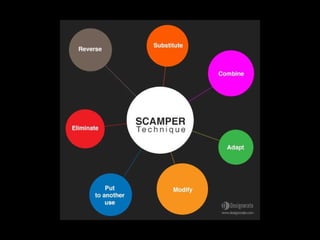
SCAMPER TECHNIQUE
Developed by Bob Eberle, SCAMPER is an acronym that
spells out seven ways to create a new idea.
http://www.designorate.com/a-guide-to-the-scamper-
technique-for-creative-thinking/
SCAMPER TECHNIQUE
S – Substitute
C – Combine
A – Adapt
M – Modify
P – Put to Another Use
E – Eliminate
R - Reverse
Building Blocks
Building Blocks Method emphasizes the content of your
event.
Vertical and Horizontal – helps you expand or contract
the scope of your event.
Vertical
The vertical technique is useful when creating events with
specialized products and services targeting a specific
market, function or industry.
Horizontal
The horizontal technique is applicable when you want to
cover a wide variety of products, services and industries.
Research
Scan magazines and google words related to the event
you have in mind,
The internet offers a database of almost every imaginable
topic.
Look for event concepts as well as to fine-tune an idea.
Attend events to get more ideas.
Ask around.
Take notes.
Repeatable Event Concept
Coming up with your final concept may take a lot of time
and effort, but it will be worth it.
Remember, you only need one great concept to start
your successful event management career.
You can lucratively run the same event every year, with
minor changes, to adapt to client needs and audience
interest.
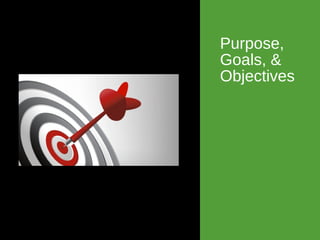
Purpose,
Goals, &
Objectives
You must determine expectations so that you can define
the scope and specifications that result in an event that
satisfies the customer’s needs and desires.
It is critical that you work with your client to specify the
goals and objectives for the event and to put them in a
prioritized hierarchy.
Setting Objectives
Goals turned into objectives provide you with direction.
Event objectives come from two points of views:
ne is from the clients, the other is from the organizers.
bjectives measure performance. They also convert a
corporate vision into specific targets that are
quantifiable, measurable and deadline driven.
Types of Objectives
Strategic
hese objectives focus on improving “competitive vitality
and future business position.”
Financial
hese are directed towards improving financial
performance.
Goals vs. Objectives
Goals are broad; objectives are narrow
Goals are general intentions; objectives are precise
Goals are intangible; objectives are tangible
Goals are abstract; objectives are concrete
Goals cannot be validated as is; objectives can be
validated
Common Event Goals
To generate revenues
To increase profits
To create or increase awareness
To introduce a new product, service or organization
To develop new customers
To conduct competitive intelligence
To generate ideas
To seek out new distributors, dealers or members
To test the market
To enhance company image and reputation
To build brand equity
To create long-term relationships
To raise funds
To generate memberships
To conduct training
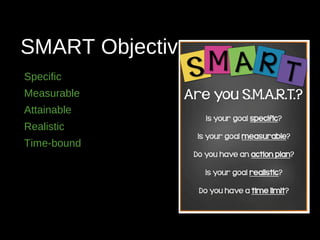
SMART Objectives
Specific
Measurable
Attainable
Realistic
Time-bound
SMART Objectives
Examples of SMART Objectives
ring in xx more exhibitors to join the forthcoming
celebrity bazaar in December 2017.
ign up a company to sponsor xx round-trip coach
tickets, Singapore-Manila-Singapore for speakers flying
in for the Tourism and Hospitality Conference at a five-
star hotel in Metro Manila.
ncrease sales by xx percent by participating in two
major trade shows this year.
SMARTER Objectives
Exciting
Rewarding
Needs
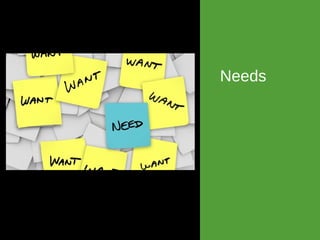
Identifying Needs
Need is a complex term.
Example: You do not buy an airline ticket because
you need an airline ticket, you need it be in Cebu for a
meeting.
Defining needs is a critical component of the ability to
deliver a successful event. Needs, however, are not
always apparent or fully considered.
Needs Assessment
Why – the purpose of the event is the foundation that
drives all other decisions about its scope and the event
elements.
Who – the audience or guest profile and volume
Where and When – provide logistical parameters as well
as creative opportunities
How and How Much – specify how much in the way of
resources will be required and how the resources will be
allocated
Customers
Know your customers.
There will be clients, users (guests and attendees), and
numerous other stakeholders and influencers to consider.
Each will have an impact on the event elements.
Create a customer profile, include demographics,
lifestyle, and age stage, purchase stimulus, and the
benefits sought. The profile will reveal needs and desires
that should be factored into the event element analysis
and plan.
Customers
You may look at generational differences, cultural
differences of customers.
Planning can also encompass things such as scheduling
(holidays, holy days, protocol etc.); dietary needs and
restrictions; the environment (color, personal space,
symbols, emblems) ; and etiquette issues (dress codes,
gestures, interaction) etc.
Capabilities
The capabilities you must consider include your ability to
handle the event in its proposed scope and context,
availability of products and services, and the features of
the event site.
Each event context will have its own set of parameters
and a specialized body of knowledge.
You need to be completely honest with yourself and your
client about your ability to deliver the event required and
desired.
Competition
Considering the competition includes a determination of
what will be competing with your event for the time,
money, and emotional investment of the attendees or
guests.
Resources
Analyzing Resources
Once needs are identified and prioritized goals and
objectives established, you must blend creativity with
practicality.
You must identify the resources and any obstacles to
determine the practicality of the project and the potential
for success.
Resources include time, money, personnel,
information, space, and service availability.
Analyzing Resources
Management is allocating, directing, and controlling
resources to achieve objectives.
A feasibility analysis shows the viability of achieving
success – the outcome envisioned by the client – by
defining the event elements and requirements and putting
them into the context of the reality of available resources.
The professional event manager must balance the
NEED with the HAVE, making sure that what must be
done can be done with the resources available for the
event project.
Time
Of all the resources, time is the one resource that is finite.
When you run out of time, you have run out of time. You
cannot beg, borrow or steal more.
Money
Monetary resources must be allocated carefully. It is
important to remember that everything will cost
something.
Nothing is free.
The more limited the budget, the more focused you must
be on the event goals, but a quality event does not
depend on a large budget.
Personnel
Your human resources may include full-time or part-time,
casual or temporary labor, and/or volunteers.
You must assess the quality and capabilities of
volunteers and other labor resources.
Space
Virtually everything needed to make the event come to
life will have spatial requirements.
The event plan should include a site plan for spatial
needs.
Suppliers
Not all products and services are available or affordable
in all parts of the world.
You must know what you can and cannot reasonably
obtain in your area and through your supplier resources.
If suitable products, services, technologies or providers
are not available or affordable, alternate options must be
developed or planned activities must be adjusted.
Trends
Customized Activities
here is a growing interest in activities that allow
participants to pick and choose.
Innovative Concepts
oncepts such as anime, online gaming contests, indie
film festivals have entered mass consciousness.

Lesson 5 event concept

  • 1.
    Creating theCreating the EventPlanEvent Plan HEVENTSCON From Professional Event Coordination by J. Silvers , Event Management for Tourism, Sports, Business and MICE by M. Disimulacion Presented by Mervyn Maico D. Aldana, Faculty CHTM
  • 2.
    Creating the EventConcept Event coordination is all about “the list”. To create that list, you as the professional event manager, must define the purpose of the event and analyze all the desires, demands, assumptions, and constraints involved to determine the products, materials, services, activities and suppliers to be included in the event project.
  • 3.
    Event Concepts Event conceptscan be described in three tents – Intent (purpose), Extent (scope), and Content (program). This conceptualization is transformed into the event plan through project management techniques such as scope definition and project planning.
  • 4.
    Event Concepts Scope definitionis derived from identified need, request, or requirement for the event, the product (event) analysis, and the feasibility analysis. The output of this becomes the project deliverables and is then used to shape the project plan that specifies the structure and scheduling of the tasks required to deliver the event.
  • 5.
  • 6.
    SCAMPER TECHNIQUE Developed byBob Eberle, SCAMPER is an acronym that spells out seven ways to create a new idea. http://www.designorate.com/a-guide-to-the-scamper- technique-for-creative-thinking/
  • 7.
    SCAMPER TECHNIQUE S –Substitute C – Combine A – Adapt M – Modify P – Put to Another Use E – Eliminate R - Reverse
  • 9.
    Building Blocks Building BlocksMethod emphasizes the content of your event. Vertical and Horizontal – helps you expand or contract the scope of your event.
  • 10.
    Vertical The vertical techniqueis useful when creating events with specialized products and services targeting a specific market, function or industry.
  • 11.
    Horizontal The horizontal techniqueis applicable when you want to cover a wide variety of products, services and industries.
  • 12.
    Research Scan magazines andgoogle words related to the event you have in mind, The internet offers a database of almost every imaginable topic. Look for event concepts as well as to fine-tune an idea. Attend events to get more ideas. Ask around. Take notes.
  • 13.
    Repeatable Event Concept Comingup with your final concept may take a lot of time and effort, but it will be worth it. Remember, you only need one great concept to start your successful event management career. You can lucratively run the same event every year, with minor changes, to adapt to client needs and audience interest.
  • 14.
  • 15.
    You must determineexpectations so that you can define the scope and specifications that result in an event that satisfies the customer’s needs and desires. It is critical that you work with your client to specify the goals and objectives for the event and to put them in a prioritized hierarchy.
  • 16.
    Setting Objectives Goals turnedinto objectives provide you with direction. Event objectives come from two points of views: ne is from the clients, the other is from the organizers. bjectives measure performance. They also convert a corporate vision into specific targets that are quantifiable, measurable and deadline driven.
  • 17.
    Types of Objectives Strategic heseobjectives focus on improving “competitive vitality and future business position.” Financial hese are directed towards improving financial performance.
  • 18.
    Goals vs. Objectives Goalsare broad; objectives are narrow Goals are general intentions; objectives are precise Goals are intangible; objectives are tangible Goals are abstract; objectives are concrete Goals cannot be validated as is; objectives can be validated
  • 19.
    Common Event Goals Togenerate revenues To increase profits To create or increase awareness To introduce a new product, service or organization To develop new customers To conduct competitive intelligence To generate ideas To seek out new distributors, dealers or members To test the market To enhance company image and reputation To build brand equity To create long-term relationships To raise funds To generate memberships To conduct training
  • 20.
  • 21.
    SMART Objectives Examples ofSMART Objectives ring in xx more exhibitors to join the forthcoming celebrity bazaar in December 2017. ign up a company to sponsor xx round-trip coach tickets, Singapore-Manila-Singapore for speakers flying in for the Tourism and Hospitality Conference at a five- star hotel in Metro Manila. ncrease sales by xx percent by participating in two major trade shows this year.
  • 22.
  • 23.
  • 24.
    Identifying Needs Need isa complex term. Example: You do not buy an airline ticket because you need an airline ticket, you need it be in Cebu for a meeting. Defining needs is a critical component of the ability to deliver a successful event. Needs, however, are not always apparent or fully considered.
  • 25.
    Needs Assessment Why –the purpose of the event is the foundation that drives all other decisions about its scope and the event elements. Who – the audience or guest profile and volume Where and When – provide logistical parameters as well as creative opportunities How and How Much – specify how much in the way of resources will be required and how the resources will be allocated
  • 26.
    Customers Know your customers. Therewill be clients, users (guests and attendees), and numerous other stakeholders and influencers to consider. Each will have an impact on the event elements. Create a customer profile, include demographics, lifestyle, and age stage, purchase stimulus, and the benefits sought. The profile will reveal needs and desires that should be factored into the event element analysis and plan.
  • 27.
    Customers You may lookat generational differences, cultural differences of customers. Planning can also encompass things such as scheduling (holidays, holy days, protocol etc.); dietary needs and restrictions; the environment (color, personal space, symbols, emblems) ; and etiquette issues (dress codes, gestures, interaction) etc.
  • 28.
    Capabilities The capabilities youmust consider include your ability to handle the event in its proposed scope and context, availability of products and services, and the features of the event site. Each event context will have its own set of parameters and a specialized body of knowledge. You need to be completely honest with yourself and your client about your ability to deliver the event required and desired.
  • 29.
    Competition Considering the competitionincludes a determination of what will be competing with your event for the time, money, and emotional investment of the attendees or guests.
  • 30.
  • 31.
    Analyzing Resources Once needsare identified and prioritized goals and objectives established, you must blend creativity with practicality. You must identify the resources and any obstacles to determine the practicality of the project and the potential for success. Resources include time, money, personnel, information, space, and service availability.
  • 32.
    Analyzing Resources Management isallocating, directing, and controlling resources to achieve objectives. A feasibility analysis shows the viability of achieving success – the outcome envisioned by the client – by defining the event elements and requirements and putting them into the context of the reality of available resources. The professional event manager must balance the NEED with the HAVE, making sure that what must be done can be done with the resources available for the event project.
  • 33.
    Time Of all theresources, time is the one resource that is finite. When you run out of time, you have run out of time. You cannot beg, borrow or steal more.
  • 34.
    Money Monetary resources mustbe allocated carefully. It is important to remember that everything will cost something. Nothing is free. The more limited the budget, the more focused you must be on the event goals, but a quality event does not depend on a large budget.
  • 35.
    Personnel Your human resourcesmay include full-time or part-time, casual or temporary labor, and/or volunteers. You must assess the quality and capabilities of volunteers and other labor resources.
  • 36.
    Space Virtually everything neededto make the event come to life will have spatial requirements. The event plan should include a site plan for spatial needs.
  • 37.
    Suppliers Not all productsand services are available or affordable in all parts of the world. You must know what you can and cannot reasonably obtain in your area and through your supplier resources. If suitable products, services, technologies or providers are not available or affordable, alternate options must be developed or planned activities must be adjusted.
  • 38.
    Trends Customized Activities here isa growing interest in activities that allow participants to pick and choose. Innovative Concepts oncepts such as anime, online gaming contests, indie film festivals have entered mass consciousness.