Evaluation Question 1:
In what way does your media
product use, develop or
challenge forms and
conventions of real media
products?
By Jacob Chisnall
Channel 4 Documentary
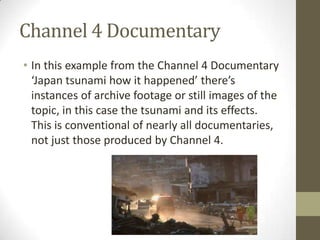
• In this example from the Channel 4 Documentary
‘Japan tsunami how it happened’ there’s
instances of archive footage or still images of the
topic, in this case the tsunami and its effects.
This is conventional of nearly all documentaries,
not just those produced by Channel 4.
Channel 4 Documentary
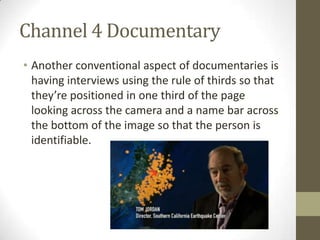
• Another conventional aspect of documentaries is
having interviews using the rule of thirds so that
they’re positioned in one third of the page
looking across the camera and a name bar across
the bottom of the image so that the person is
identifiable.
Channel 4 Documentary
• Finally, another code and convention typical of
documentaries is to have an authoritative, all-
knowing voice over and repeated music in the
background, which often relates to the mood or
the topic being discussed.
Channel 4 Print Adverts
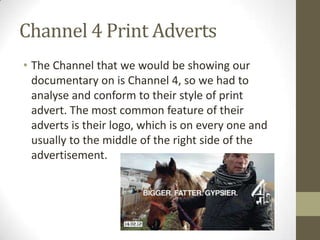
• The Channel that we would be showing our
documentary on is Channel 4, so we had to
analyse and conform to their style of print
advert. The most common feature of their
adverts is their logo, which is on every one and
usually to the middle of the right side of the
advertisement.
Channel 4 Print Adverts
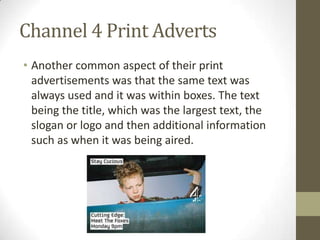
• Another common aspect of their print
advertisements was that the same text was
always used and it was within boxes. The text
being the title, which was the largest text, the
slogan or logo and then additional information
such as when it was being aired.
Channel 4 Print Adverts
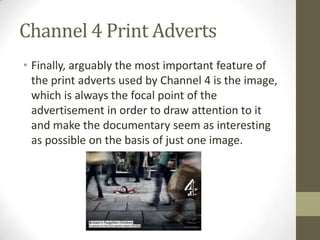
• Finally, arguably the most important feature of
the print adverts used by Channel 4 is the image,
which is always the focal point of the
advertisement in order to draw attention to it
and make the documentary seem as interesting
as possible on the basis of just one image.
Documentary Radio Adverts
• Radio adverts are relatively uncommon for
documentaries, but when they are made they
usually try to be as similar as the documentary in
the sense of using the same music from the
documentary, snippets of the documentary to
interest the listener and the same voice over and
tag line.
Our Documentary
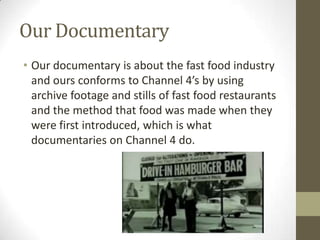
• Our documentary is about the fast food industry
and ours conforms to Channel 4’s by using
archive footage and stills of fast food restaurants
and the method that food was made when they
were first introduced, which is what
documentaries on Channel 4 do.
Our Documentary
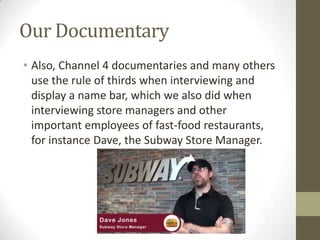
• Also, Channel 4 documentaries and many others
use the rule of thirds when interviewing and
display a name bar, which we also did when
interviewing store managers and other
important employees of fast-food restaurants,
for instance Dave, the Subway Store Manager.
Our Documentary
• Finally, to further conform to the typical aspects
of documentaries that Channel 4 had set, we
used a voice over that had good pronunciation
and an authoritative sound and repeatedly used
Fast Food Song by the Fast Food Rockers because
it was related to our topic of documentary.
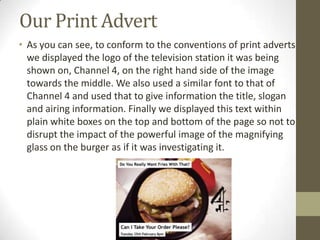
Our Print Advert
• As you can see, to conform to the conventions of print adverts
we displayed the logo of the television station it was being
shown on, Channel 4, on the right hand side of the image
towards the middle. We also used a similar font to that of
Channel 4 and used that to give information the title, slogan
and airing information. Finally we displayed this text within
plain white boxes on the top and bottom of the page so not to
disrupt the impact of the powerful image of the magnifying
glass on the burger as if it was investigating it.
Our Radio Advert
• To match the style of radio adverts of other
documentaries we used the same song from the
documentary (Fast Food Rockers – Fast Food
Song) and the same voice over to talk about the
documentary as well as say the slogan and state
the information regarding when it was going to
be aired and where.

Evaluation Question 1

  • 1.
    Evaluation Question 1: Inwhat way does your media product use, develop or challenge forms and conventions of real media products? By Jacob Chisnall
  • 2.
    Channel 4 Documentary •In this example from the Channel 4 Documentary ‘Japan tsunami how it happened’ there’s instances of archive footage or still images of the topic, in this case the tsunami and its effects. This is conventional of nearly all documentaries, not just those produced by Channel 4.
  • 3.
    Channel 4 Documentary •Another conventional aspect of documentaries is having interviews using the rule of thirds so that they’re positioned in one third of the page looking across the camera and a name bar across the bottom of the image so that the person is identifiable.
  • 4.
    Channel 4 Documentary •Finally, another code and convention typical of documentaries is to have an authoritative, all- knowing voice over and repeated music in the background, which often relates to the mood or the topic being discussed.
  • 5.
    Channel 4 PrintAdverts • The Channel that we would be showing our documentary on is Channel 4, so we had to analyse and conform to their style of print advert. The most common feature of their adverts is their logo, which is on every one and usually to the middle of the right side of the advertisement.
  • 6.
    Channel 4 PrintAdverts • Another common aspect of their print advertisements was that the same text was always used and it was within boxes. The text being the title, which was the largest text, the slogan or logo and then additional information such as when it was being aired.
  • 7.
    Channel 4 PrintAdverts • Finally, arguably the most important feature of the print adverts used by Channel 4 is the image, which is always the focal point of the advertisement in order to draw attention to it and make the documentary seem as interesting as possible on the basis of just one image.
  • 8.
    Documentary Radio Adverts •Radio adverts are relatively uncommon for documentaries, but when they are made they usually try to be as similar as the documentary in the sense of using the same music from the documentary, snippets of the documentary to interest the listener and the same voice over and tag line.
  • 9.
    Our Documentary • Ourdocumentary is about the fast food industry and ours conforms to Channel 4’s by using archive footage and stills of fast food restaurants and the method that food was made when they were first introduced, which is what documentaries on Channel 4 do.
  • 10.
    Our Documentary • Also,Channel 4 documentaries and many others use the rule of thirds when interviewing and display a name bar, which we also did when interviewing store managers and other important employees of fast-food restaurants, for instance Dave, the Subway Store Manager.
  • 11.
    Our Documentary • Finally,to further conform to the typical aspects of documentaries that Channel 4 had set, we used a voice over that had good pronunciation and an authoritative sound and repeatedly used Fast Food Song by the Fast Food Rockers because it was related to our topic of documentary.
  • 12.
    Our Print Advert •As you can see, to conform to the conventions of print adverts we displayed the logo of the television station it was being shown on, Channel 4, on the right hand side of the image towards the middle. We also used a similar font to that of Channel 4 and used that to give information the title, slogan and airing information. Finally we displayed this text within plain white boxes on the top and bottom of the page so not to disrupt the impact of the powerful image of the magnifying glass on the burger as if it was investigating it.
  • 13.
    Our Radio Advert •To match the style of radio adverts of other documentaries we used the same song from the documentary (Fast Food Rockers – Fast Food Song) and the same voice over to talk about the documentary as well as say the slogan and state the information regarding when it was going to be aired and where.