
“Preparation and Evaluation
Ointment”
SUDHANSHU SAGAR
(Student at M Pharm MET Faculty of
Pharmacy MORADABAD)
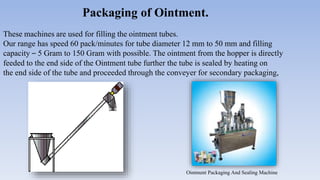
Packaging of Ointment.
These machines are used for filling the ointment tubes.
Our range has speed 60 pack/minutes for tube diameter 12 mm to 50 mm and filling
capacity – 5 Gram to 150 Gram with possible. The ointment from the hopper is directly
feeded to the end side of the Ointment tube further the tube is sealed by heating on
the end side of the tube and proceeded through the conveyer for secondary packaging,
Ointment Packaging And Sealing Machine
 EVALUATION PARAMETERS
OF OINTMENT
PHYSICAL METHODS
1.Test of Rate of Absorption
In diadermic ointments, drug moves deeper in the skin tissues and finally into the
systemic circulation. Such ointments should be evaluated for the rate of absorption of
drugs. The ointment should be applied over a definite area of skin by rubbing. At regular
interval of times, serum and urine samples should be analyzed for the quantity of drug
absorbed. The amount of drug absorbed per unit time should be more.
2.Test of Non-irritancy
The bases used for formulation of ointment may causes allergic reactions. Patch test is
used for evaluation of non-irritancy. 24 human volunteers are selected for this test.
Observation of type of pharmacological action is noted. No visible reaction or erythema
or intense erythema with edema and vesicular erosion should occur. A good ointment
base should show no visible reaction.
3.Test of Rate of Penetration
Onset and duration of action of drug is mainly affected by rate of penetration of a
semisolid dosage form. Weighed quantity of the ointment should be applied over a
definite area of skin for a definite period of time. Then the preparation left over is
collected and weighed. The difference between the initial and the final weights of
the preparation gives the amount of preparation penetrated through the skin and
this when divided by area and time period of the application gives the rate of
penetration of the preparation. Flow-through diffusion cell or micro-dialysis method
is used for estimation of rate of penetration of the preparation. Animal and human
skin of definite area should be collected and tied to the holder present in a diffusion
cell. The diffusion cell is placed in a fluid bath. Measured quantity of the preparation
is applied over the skin and the amount of drug passed into the fluid is measured at
regular interval of time by analysing the aliquots of the fluid using a
spectrophotometer.
4.Test of Rate of Drug Release
Internal surface of test tube is coated with the preparation as a thin layer. Saline or serum is
poured into the test tube. After a certain period of time, the saline is analyzed for the quantity
of the drug. The amount of drug when divided by the time periods gives the rate of drug
release.
5.Test of Rheological Properties
Viscosity is one of the important parameter of semisolid preparation. It should be such that
the product can be easily removed from the container and easily applied to the skin. Cone
and plate viscometer or Brookfield viscometer is used to determine the viscosity of the
preparation.
6.Test of Content Uniformity
The net weight of the content of ten filled ointments containers is determined. The result
should match each other and with the labeled quantity. This test is also called minimum fill
test.
MICROBIOLOGICAL METHODS
1) Test of Microbial Content Micro-organism like pseudomonas aeruginosa and
staphylococcus aureus may contaminate the preparation and finally infect the skin.
So ointments should be tested for the absence of such micro-organisms. Solution of
different samples of the preparation are made, Each sample is inoculated into
separate volume of 0.5ml of rabbit's plasma under aseptic condition and incubated
at 37 C for 1-4 hours. No formation of the clot in the incubated mass indicates the
absence of the microorganism.
2) Test of Preservative Efficacy Pour plate technique is used to determined the
number of micro-organisms present in the preparation. Solution of different samples
of the preparation are made and mixed with Tryptone Azolectin (TAT) broth
separately. All cultures of the micro-organisms are added into each mixture, under
aseptic conditions. All mixtures are incubated. The number of micro-organisms in
each sample are counted on 7th , 14th , 21st and 28th days of inoculation. Microbial
Limits On 14th day, the number of vegetative cells should not be more than 0.1% of
initial concentration. On 28th day, the number of organism should be below or equal
to initial concentration.
Quality Assurance
Pharmaceutical quality assurance may be defined as the sum of all activities and
responsibilities required to ensure that the medicine that reaches the patient is safe,
effective, and acceptable to the patient.
1. Quality assurance is a wide-ranging concept covering all matters that individually
or collectively influence the quality of a product.
2. Quality assurance (QA) is essential for ensuring that pharmaceutical products are
manufactured to a safe and consistent standard.
3. QA is the heart of quality check.
4. QA planned the systematic actions that are established to ensure that the
performed data are generated, documented, and recorded in compliance with
Good Clinical Practice and applicable regulatory requirements.
5. QA = QC +GMP / OTHER QUALITY SYSTEM
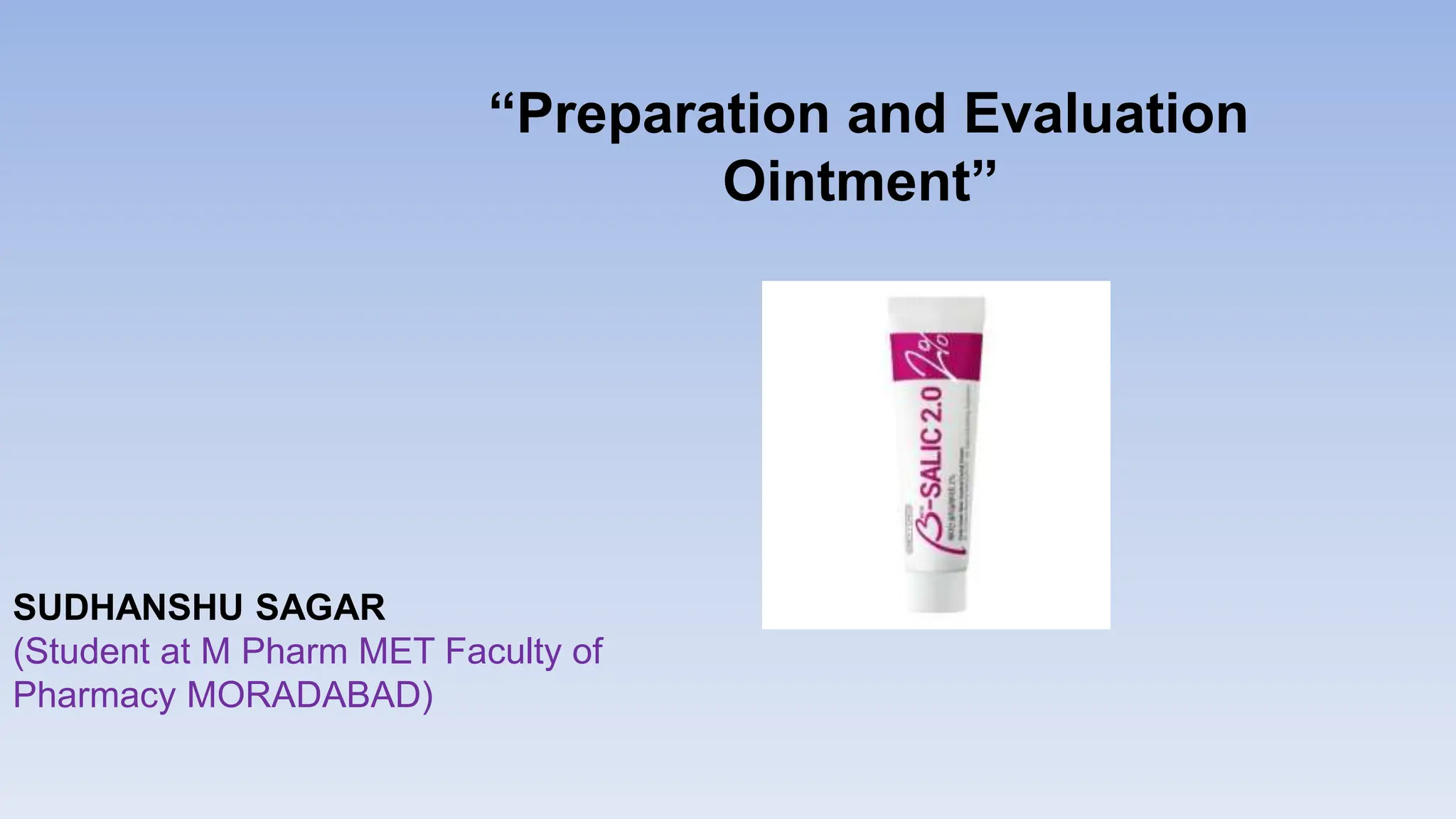
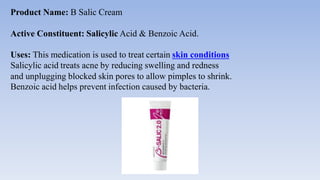
Product Name: B Salic Cream
Active Constituent: Salicylic Acid & Benzoic Acid.
Uses: This medication is used to treat certain skin conditions
Salicylic acid treats acne by reducing swelling and redness
and unplugging blocked skin pores to allow pimples to shrink.
Benzoic acid helps prevent infection caused by bacteria.
Preparation and Evaluation Ointment.pptx

Preparation and Evaluation Ointment.pptx

  • 1.
    “Preparation and Evaluation Ointment” SUDHANSHUSAGAR (Student at M Pharm MET Faculty of Pharmacy MORADABAD)
  • 15.
    Packaging of Ointment. Thesemachines are used for filling the ointment tubes. Our range has speed 60 pack/minutes for tube diameter 12 mm to 50 mm and filling capacity – 5 Gram to 150 Gram with possible. The ointment from the hopper is directly feeded to the end side of the Ointment tube further the tube is sealed by heating on the end side of the tube and proceeded through the conveyer for secondary packaging, Ointment Packaging And Sealing Machine
  • 17.
     EVALUATION PARAMETERS OFOINTMENT PHYSICAL METHODS 1.Test of Rate of Absorption In diadermic ointments, drug moves deeper in the skin tissues and finally into the systemic circulation. Such ointments should be evaluated for the rate of absorption of drugs. The ointment should be applied over a definite area of skin by rubbing. At regular interval of times, serum and urine samples should be analyzed for the quantity of drug absorbed. The amount of drug absorbed per unit time should be more. 2.Test of Non-irritancy The bases used for formulation of ointment may causes allergic reactions. Patch test is used for evaluation of non-irritancy. 24 human volunteers are selected for this test. Observation of type of pharmacological action is noted. No visible reaction or erythema or intense erythema with edema and vesicular erosion should occur. A good ointment base should show no visible reaction.
  • 18.
    3.Test of Rateof Penetration Onset and duration of action of drug is mainly affected by rate of penetration of a semisolid dosage form. Weighed quantity of the ointment should be applied over a definite area of skin for a definite period of time. Then the preparation left over is collected and weighed. The difference between the initial and the final weights of the preparation gives the amount of preparation penetrated through the skin and this when divided by area and time period of the application gives the rate of penetration of the preparation. Flow-through diffusion cell or micro-dialysis method is used for estimation of rate of penetration of the preparation. Animal and human skin of definite area should be collected and tied to the holder present in a diffusion cell. The diffusion cell is placed in a fluid bath. Measured quantity of the preparation is applied over the skin and the amount of drug passed into the fluid is measured at regular interval of time by analysing the aliquots of the fluid using a spectrophotometer.
  • 19.
    4.Test of Rateof Drug Release Internal surface of test tube is coated with the preparation as a thin layer. Saline or serum is poured into the test tube. After a certain period of time, the saline is analyzed for the quantity of the drug. The amount of drug when divided by the time periods gives the rate of drug release. 5.Test of Rheological Properties Viscosity is one of the important parameter of semisolid preparation. It should be such that the product can be easily removed from the container and easily applied to the skin. Cone and plate viscometer or Brookfield viscometer is used to determine the viscosity of the preparation. 6.Test of Content Uniformity The net weight of the content of ten filled ointments containers is determined. The result should match each other and with the labeled quantity. This test is also called minimum fill test.
  • 20.
    MICROBIOLOGICAL METHODS 1) Testof Microbial Content Micro-organism like pseudomonas aeruginosa and staphylococcus aureus may contaminate the preparation and finally infect the skin. So ointments should be tested for the absence of such micro-organisms. Solution of different samples of the preparation are made, Each sample is inoculated into separate volume of 0.5ml of rabbit's plasma under aseptic condition and incubated at 37 C for 1-4 hours. No formation of the clot in the incubated mass indicates the absence of the microorganism. 2) Test of Preservative Efficacy Pour plate technique is used to determined the number of micro-organisms present in the preparation. Solution of different samples of the preparation are made and mixed with Tryptone Azolectin (TAT) broth separately. All cultures of the micro-organisms are added into each mixture, under aseptic conditions. All mixtures are incubated. The number of micro-organisms in each sample are counted on 7th , 14th , 21st and 28th days of inoculation. Microbial Limits On 14th day, the number of vegetative cells should not be more than 0.1% of initial concentration. On 28th day, the number of organism should be below or equal to initial concentration.
  • 21.
    Quality Assurance Pharmaceutical qualityassurance may be defined as the sum of all activities and responsibilities required to ensure that the medicine that reaches the patient is safe, effective, and acceptable to the patient. 1. Quality assurance is a wide-ranging concept covering all matters that individually or collectively influence the quality of a product. 2. Quality assurance (QA) is essential for ensuring that pharmaceutical products are manufactured to a safe and consistent standard. 3. QA is the heart of quality check. 4. QA planned the systematic actions that are established to ensure that the performed data are generated, documented, and recorded in compliance with Good Clinical Practice and applicable regulatory requirements. 5. QA = QC +GMP / OTHER QUALITY SYSTEM
  • 22.
    Product Name: BSalic Cream Active Constituent: Salicylic Acid & Benzoic Acid. Uses: This medication is used to treat certain skin conditions Salicylic acid treats acne by reducing swelling and redness and unplugging blocked skin pores to allow pimples to shrink. Benzoic acid helps prevent infection caused by bacteria.