Presented by:
Neha Kumar (A029)
Rashi Kapur (A039)
Sonal Rajadhyax (A050)
Tarannoom Rahmani (A053)
Yuvraj Tandon (A059)
NMIMS, PT-MBA, 2nd Year, 2013
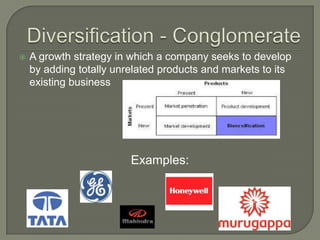
 A growth strategy in which a company seeks to develop
by adding totally unrelated products and markets to its
existing business
Examples:
 ITC was incorporated on August 24, 1910 under the name Imperial Tobacco Company of India
Limited. The Company now stands rechristened ‘ITC Limited’
 Market capitalisation of US $ 45 billion
 Turnover of US $ 7 billion
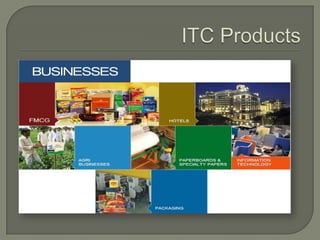
 Operates in: FMCG, Hotels, Paperboards & Specialty Papers, Packaging, Agri-Business, and
Information Technology
 The only enterprise in the world, of comparable dimensions to be carbon-positive, water-
positive, and solid waste recycling positive
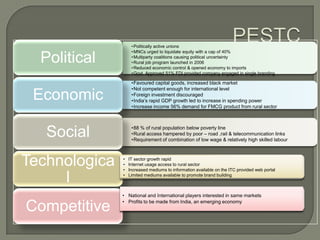
•Politically active unions
•MNCs urged to liquidate equity with a cap of 40%
•Multiparty coalitions causing political uncertainty
•Rural job program launched in 2006
•Reduced economic control & opened economy to imports
•Govt. Approved 51% FDI provided company engaged in single branding
Political
•Favoured capital goods, increased black market
•Not competent enough for international level
•Foreign investment discouraged
•India’s rapid GDP growth led to increase in spending power
•Increase income 56% demand for FMCG product from rural sector
Economic
•88 % of rural population below poverty line
•Rural access hampered by poor – road ,rail & telecommunication links
•Requirement of combination of low wage & relatively high skilled labour
Social
Technologica
l
Competitive
• National and International players interested in same markets
• Profits to be made from India, an emerging economy
• IT sector growth rapid
• Internet usage access to rural sector
• Increased mediums to information available on the ITC provided web portal
• Limited mediums available to promote brand building
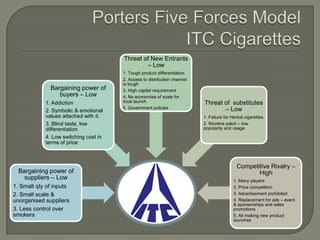
Bargaining power of
suppliers – Low
1. Small qty of inputs
2. Small scale &
unorganised suppliers
3. Less control over
smokers
Bargaining power of
buyers – Low
1. Addiction
2. Symbolic & emotional
values attached with it.
3. Blind taste, low
differentiation
4. Low switching cost in
terms of price
Threat of New Entrants
– Low
1. Tough product differentiation
2. Access to distribution channel
is tough
3. High capital requirement
4. No economies of scale for
local launch
5. Government policies
Threat of substitutes
– Low
1. Failure for Herbal cigarettes
2. Nicotine patch – low
popularity and usage
Competitive Rivalry –
High
1. Many players
2. Price competition
3. Advertisement prohibited
4. Replacement for ads – event
& sponsorships and sales
promotions
5. All making new product
launches
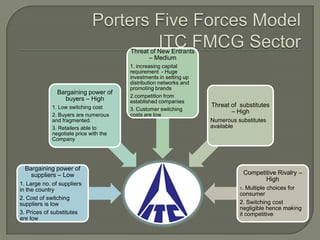
Bargaining power of
suppliers – Low
1. Large no. of suppliers
in the country
2. Cost of switching
suppliers is low
3. Prices of substitutes
are low
Bargaining power of
buyers – High
1. Low switching cost
2. Buyers are numerous
and fragmented.
3. Retailers able to
negotiate price with the
Company
Threat of New Entrants
– Medium
1. increasing capital
requirement - Huge
investments in setting up
distribution networks and
promoting brands
2.competition from
established companies
3. Customer switching
costs are low
Threat of substitutes
– High
Numerous substitutes
available
Competitive Rivalry –
High
1. Multiple choices for
consumer
2. Switching cost
negligible hence making
it competitive
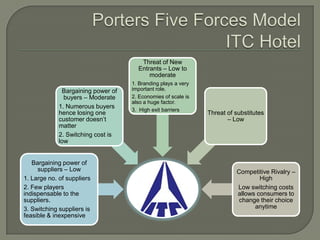
Bargaining power of
suppliers – Low
1. Large no. of suppliers
2. Few players
indispensable to the
suppliers.
3. Switching suppliers is
feasible & inexpensive
Bargaining power of
buyers – Moderate
1. Numerous buyers
hence losing one
customer doesn’t
matter
2. Switching cost is
low
Threat of New
Entrants – Low to
moderate
1. Branding plays a very
important role.
2. Economies of scale is
also a huge factor.
3. High exit barriers
Threat of substitutes
– Low
Competitive Rivalry –
High
Low switching costs
allows consumers to
change their choice
anytime
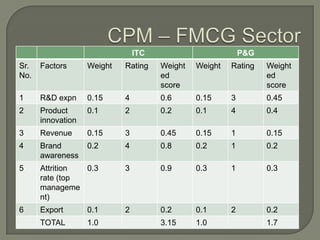
ITC P&G
Sr.
No.
Factors Weight Rating Weight
ed
score
Weight Rating Weight
ed
score
1 R&D expn 0.15 4 0.6 0.15 3 0.45
2 Product
innovation
0.1 2 0.2 0.1 4 0.4
3 Revenue 0.15 3 0.45 0.15 1 0.15
4 Brand
awareness
0.2 4 0.8 0.2 1 0.2
5 Attrition
rate (top
manageme
nt)
0.3 3 0.9 0.3 1 0.3
6 Export 0.1 2 0.2 0.1 2 0.2
TOTAL 1.0 3.15 1.0 1.7
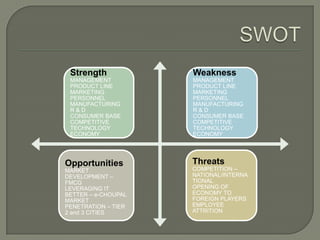
Strength
MANAGEMENT
PRODUCT LINE
MARKETING
PERSONNEL
MANUFACTURING
R & D
CONSUMER BASE
COMPETITIVE
TECHNOLOGY
ECONOMY
Weakness
MANAGEMENT
PRODUCT LINE
MARKETING
PERSONNEL
MANUFACTURING
R & D
CONSUMER BASE
COMPETITIVE
TECHNOLOGY
ECONOMY
Opportunities
MARKET
DEVELOPMENT –
FMCG
LEVERAGING IT
BETTER – e-CHOUPAL
MARKET
PENETRATION – TIER
2 and 3 CITIES
Threats
COMPETITION –
NATIONAL/INTERNA
TIONAL
OPENING OF
ECONOMY TO
FOREIGN PLAYERS
EMPLOYEE
ATTRITION
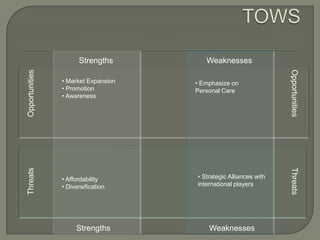
Strengths Weaknesses
WeaknessesStrengths
Opportunities
ThreatsOpportunities
Threats
• Market Expansion
• Promotion
• Awareness
• Strategic Alliances with
international players
• Emphasize on
Personal Care
• Affordability
• Diversification
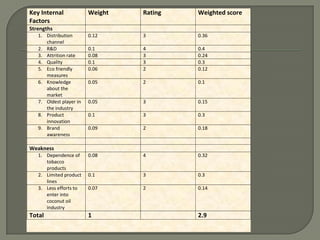
Key Internal
Factors
Weight Rating Weighted score
Strengths
1. Distribution
channel
0.12 3 0.36
2. R&D 0.1 4 0.4
3. Attrition rate 0.08 3 0.24
4. Quality 0.1 3 0.3
5. Eco friendly
measures
0.06 2 0.12
6. Knowledge
about the
market
0.05 2 0.1
7. Oldest player in
the industry
0.05 3 0.15
8. Product
innovation
0.1 3 0.3
9. Brand
awareness
0.09 2 0.18
Weakness
1. Dependence of
tobacco
products
0.08 4 0.32
2. Limited product
lines
0.1 3 0.3
3. Less efforts to
enter into
coconut oil
industry
0.07 2 0.14
Total 1 2.9
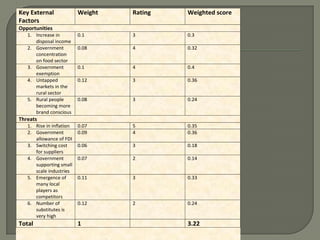
Key External
Factors
Weight Rating Weighted score
Opportunities
1. Increase in
disposal income
0.1 3 0.3
2. Government
concentration
on food sector
0.08 4 0.32
3. Government
exemption
0.1 4 0.4
4. Untapped
markets in the
rural sector
0.12 3 0.36
5. Rural people
becoming more
brand conscious
0.08 3 0.24
Threats
1. Rise in inflation 0.07 5 0.35
2. Government
allowance of FDI
0.09 4 0.36
3. Switching cost
for suppliers
0.06 3 0.18
4. Government
supporting small
scale industries
0.07 2 0.14
5. Emergence of
many local
players as
competitors
0.11 3 0.33
6. Number of
substitutes is
very high
0.12 2 0.24
Total 1 3.22
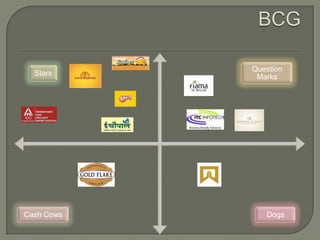
Stars
Question
Marks
Cash Cows Dogs
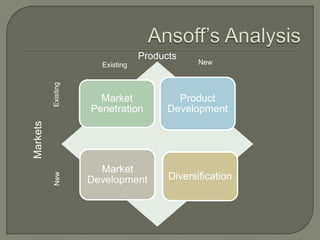
Market
Penetration
Product
Development
Market
Development Diversification
Products
NewExisting
NewExisting
Markets
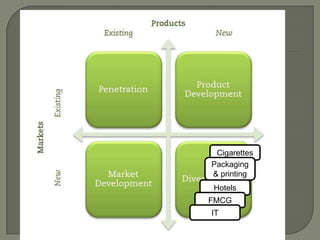
Cigarettes
Packaging
& printing
Hotels
FMCG
IT
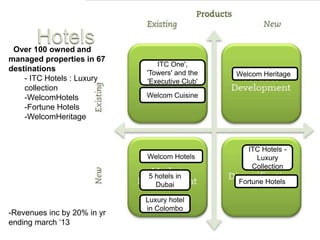
ITC Hotels -
Luxury
Collection
5 hotels in
Dubai
Luxury hotel
in Colombo
Welcom Hotels
Fortune Hotels
Welcom Heritage
ITC One',
'Towers' and the
'Executive Club'
Welcom Cuisine
- Over 100 owned and
managed properties in 67
destinations
- ITC Hotels : Luxury
collection
-WelcomHotels
-Fortune Hotels
-WelcomHeritage
-Revenues inc by 20% in yr
ending march ‘13
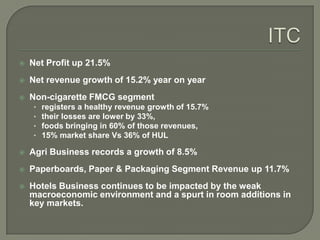
 Net Profit up 21.5%
 Net revenue growth of 15.2% year on year
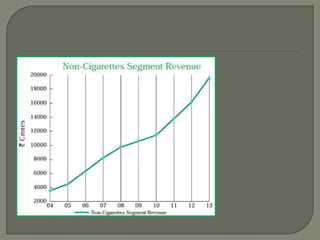
 Non-cigarette FMCG segment
• registers a healthy revenue growth of 15.7%
• their losses are lower by 33%,
• foods bringing in 60% of those revenues,
• 15% market share Vs 36% of HUL
 Agri Business records a growth of 8.5%
 Paperboards, Paper & Packaging Segment Revenue up 11.7%
 Hotels Business continues to be impacted by the weak
macroeconomic environment and a spurt in room additions in
key markets.
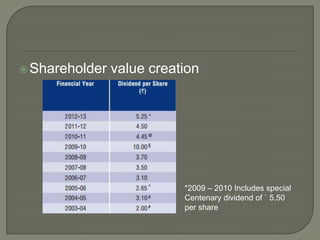
Shareholder value creation
*2009 – 2010 Includes special
Centenary dividend of ` 5.50
per share
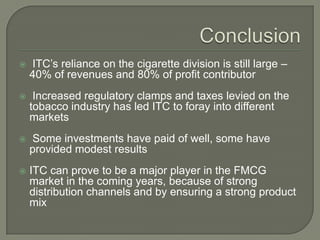
 ITC’s reliance on the cigarette division is still large –
40% of revenues and 80% of profit contributor
 Increased regulatory clamps and taxes levied on the
tobacco industry has led ITC to foray into different
markets
 Some investments have paid of well, some have
provided modest results
 ITC can prove to be a major player in the FMCG
market in the coming years, because of strong
distribution channels and by ensuring a strong product
mix
 Further investment into ITC Infotech to expand its
range of operations
 Possible collaboration with the Govt. w.r.t agricultural
initiatives
 Investments in more R&D w.r.t the FMCG market
 Expand market base – urban and rural
 Implement backward integration in the agricultural
sector to ensure products pass from farmer to the end
consumer reducing prices of its FMCG products
Conglomerate Diversification - ITC, Strategy formulation, 2013

Conglomerate Diversification - ITC, Strategy formulation, 2013

  • 1.
    Presented by: Neha Kumar(A029) Rashi Kapur (A039) Sonal Rajadhyax (A050) Tarannoom Rahmani (A053) Yuvraj Tandon (A059) NMIMS, PT-MBA, 2nd Year, 2013
  • 2.
     A growthstrategy in which a company seeks to develop by adding totally unrelated products and markets to its existing business Examples:
  • 3.
     ITC wasincorporated on August 24, 1910 under the name Imperial Tobacco Company of India Limited. The Company now stands rechristened ‘ITC Limited’  Market capitalisation of US $ 45 billion  Turnover of US $ 7 billion  Operates in: FMCG, Hotels, Paperboards & Specialty Papers, Packaging, Agri-Business, and Information Technology  The only enterprise in the world, of comparable dimensions to be carbon-positive, water- positive, and solid waste recycling positive
  • 6.
    •Politically active unions •MNCsurged to liquidate equity with a cap of 40% •Multiparty coalitions causing political uncertainty •Rural job program launched in 2006 •Reduced economic control & opened economy to imports •Govt. Approved 51% FDI provided company engaged in single branding Political •Favoured capital goods, increased black market •Not competent enough for international level •Foreign investment discouraged •India’s rapid GDP growth led to increase in spending power •Increase income 56% demand for FMCG product from rural sector Economic •88 % of rural population below poverty line •Rural access hampered by poor – road ,rail & telecommunication links •Requirement of combination of low wage & relatively high skilled labour Social Technologica l Competitive • National and International players interested in same markets • Profits to be made from India, an emerging economy • IT sector growth rapid • Internet usage access to rural sector • Increased mediums to information available on the ITC provided web portal • Limited mediums available to promote brand building
  • 7.
    Bargaining power of suppliers– Low 1. Small qty of inputs 2. Small scale & unorganised suppliers 3. Less control over smokers Bargaining power of buyers – Low 1. Addiction 2. Symbolic & emotional values attached with it. 3. Blind taste, low differentiation 4. Low switching cost in terms of price Threat of New Entrants – Low 1. Tough product differentiation 2. Access to distribution channel is tough 3. High capital requirement 4. No economies of scale for local launch 5. Government policies Threat of substitutes – Low 1. Failure for Herbal cigarettes 2. Nicotine patch – low popularity and usage Competitive Rivalry – High 1. Many players 2. Price competition 3. Advertisement prohibited 4. Replacement for ads – event & sponsorships and sales promotions 5. All making new product launches
  • 8.
    Bargaining power of suppliers– Low 1. Large no. of suppliers in the country 2. Cost of switching suppliers is low 3. Prices of substitutes are low Bargaining power of buyers – High 1. Low switching cost 2. Buyers are numerous and fragmented. 3. Retailers able to negotiate price with the Company Threat of New Entrants – Medium 1. increasing capital requirement - Huge investments in setting up distribution networks and promoting brands 2.competition from established companies 3. Customer switching costs are low Threat of substitutes – High Numerous substitutes available Competitive Rivalry – High 1. Multiple choices for consumer 2. Switching cost negligible hence making it competitive
  • 9.
    Bargaining power of suppliers– Low 1. Large no. of suppliers 2. Few players indispensable to the suppliers. 3. Switching suppliers is feasible & inexpensive Bargaining power of buyers – Moderate 1. Numerous buyers hence losing one customer doesn’t matter 2. Switching cost is low Threat of New Entrants – Low to moderate 1. Branding plays a very important role. 2. Economies of scale is also a huge factor. 3. High exit barriers Threat of substitutes – Low Competitive Rivalry – High Low switching costs allows consumers to change their choice anytime
  • 10.
    ITC P&G Sr. No. Factors WeightRating Weight ed score Weight Rating Weight ed score 1 R&D expn 0.15 4 0.6 0.15 3 0.45 2 Product innovation 0.1 2 0.2 0.1 4 0.4 3 Revenue 0.15 3 0.45 0.15 1 0.15 4 Brand awareness 0.2 4 0.8 0.2 1 0.2 5 Attrition rate (top manageme nt) 0.3 3 0.9 0.3 1 0.3 6 Export 0.1 2 0.2 0.1 2 0.2 TOTAL 1.0 3.15 1.0 1.7
  • 11.
    Strength MANAGEMENT PRODUCT LINE MARKETING PERSONNEL MANUFACTURING R &D CONSUMER BASE COMPETITIVE TECHNOLOGY ECONOMY Weakness MANAGEMENT PRODUCT LINE MARKETING PERSONNEL MANUFACTURING R & D CONSUMER BASE COMPETITIVE TECHNOLOGY ECONOMY Opportunities MARKET DEVELOPMENT – FMCG LEVERAGING IT BETTER – e-CHOUPAL MARKET PENETRATION – TIER 2 and 3 CITIES Threats COMPETITION – NATIONAL/INTERNA TIONAL OPENING OF ECONOMY TO FOREIGN PLAYERS EMPLOYEE ATTRITION
  • 12.
    Strengths Weaknesses WeaknessesStrengths Opportunities ThreatsOpportunities Threats • MarketExpansion • Promotion • Awareness • Strategic Alliances with international players • Emphasize on Personal Care • Affordability • Diversification
  • 13.
    Key Internal Factors Weight RatingWeighted score Strengths 1. Distribution channel 0.12 3 0.36 2. R&D 0.1 4 0.4 3. Attrition rate 0.08 3 0.24 4. Quality 0.1 3 0.3 5. Eco friendly measures 0.06 2 0.12 6. Knowledge about the market 0.05 2 0.1 7. Oldest player in the industry 0.05 3 0.15 8. Product innovation 0.1 3 0.3 9. Brand awareness 0.09 2 0.18 Weakness 1. Dependence of tobacco products 0.08 4 0.32 2. Limited product lines 0.1 3 0.3 3. Less efforts to enter into coconut oil industry 0.07 2 0.14 Total 1 2.9
  • 14.
    Key External Factors Weight RatingWeighted score Opportunities 1. Increase in disposal income 0.1 3 0.3 2. Government concentration on food sector 0.08 4 0.32 3. Government exemption 0.1 4 0.4 4. Untapped markets in the rural sector 0.12 3 0.36 5. Rural people becoming more brand conscious 0.08 3 0.24 Threats 1. Rise in inflation 0.07 5 0.35 2. Government allowance of FDI 0.09 4 0.36 3. Switching cost for suppliers 0.06 3 0.18 4. Government supporting small scale industries 0.07 2 0.14 5. Emergence of many local players as competitors 0.11 3 0.33 6. Number of substitutes is very high 0.12 2 0.24 Total 1 3.22
  • 16.
  • 17.
  • 18.
  • 19.
    ITC Hotels - Luxury Collection 5hotels in Dubai Luxury hotel in Colombo Welcom Hotels Fortune Hotels Welcom Heritage ITC One', 'Towers' and the 'Executive Club' Welcom Cuisine - Over 100 owned and managed properties in 67 destinations - ITC Hotels : Luxury collection -WelcomHotels -Fortune Hotels -WelcomHeritage -Revenues inc by 20% in yr ending march ‘13
  • 20.
     Net Profitup 21.5%  Net revenue growth of 15.2% year on year  Non-cigarette FMCG segment • registers a healthy revenue growth of 15.7% • their losses are lower by 33%, • foods bringing in 60% of those revenues, • 15% market share Vs 36% of HUL  Agri Business records a growth of 8.5%  Paperboards, Paper & Packaging Segment Revenue up 11.7%  Hotels Business continues to be impacted by the weak macroeconomic environment and a spurt in room additions in key markets.
  • 22.
    Shareholder value creation *2009– 2010 Includes special Centenary dividend of ` 5.50 per share
  • 23.
     ITC’s relianceon the cigarette division is still large – 40% of revenues and 80% of profit contributor  Increased regulatory clamps and taxes levied on the tobacco industry has led ITC to foray into different markets  Some investments have paid of well, some have provided modest results  ITC can prove to be a major player in the FMCG market in the coming years, because of strong distribution channels and by ensuring a strong product mix
  • 24.
     Further investmentinto ITC Infotech to expand its range of operations  Possible collaboration with the Govt. w.r.t agricultural initiatives  Investments in more R&D w.r.t the FMCG market  Expand market base – urban and rural  Implement backward integration in the agricultural sector to ensure products pass from farmer to the end consumer reducing prices of its FMCG products