






Choice Theory/Reality
Therapy
Randy Wilhelm
Choice Theory/Reality Therapy
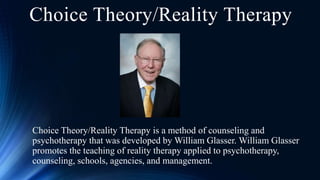
Choice Theory/Reality Therapy is a method of counseling and
psychotherapy that was developed by William Glasser. William Glasser
promotes the teaching of reality therapy applied to psychotherapy,
counseling, schools, agencies, and management.
Choice Theory/Reality Therapy
Beginnings
• Psychoanalytic-Behavior
• G.L. Harrington
• Unhappiness
• Relationships
*Responsibility is the ability to fulfill one’s needs, and to
do so in a way that does not deprive others of the ability
to fulfill their needs.
Concepts
• Humanistic-Existential Theory
• Therapist is the Teacher, Client is the
Student *Choice Theory is Taught to Clients
• Multi-Cultural
*Dreams are not explored or mentioned. Time spent on
dreams is time wasted.
Choice Theory/Reality Therapy
Glasser states, “Therapy is not perfect.
Psychiatrists make mistakes by admitting it
and learning something from it.”
Glasser believes, “that the current accepted concept
that clients are the victims of mental illness caused by
neurochemical imbalance over which they have no
control is wrong…The brain is not defective, its
chemistry is normal for the behaviors clients choose.”
*Verbs are used, not nouns or adjectives.
*Medications are ineffective.
Choice Theory/Reality Therapy
Ventura School of the Girls
Glasser stated, “No matter how lonely and isolated
someone may be, if the therapist adheres to the
present and points to a hopeful future and, expands
initial involvement into a series of involvements as
soon as possible, great changes can take place.”
*Maria
External Control
Glasser, “The simple operational premise of the external
control psychology the world uses is: Punish the people who
are doing wrong, so they will do what we say is right; then
reward them, so they keep doing what we want them to do.
This premise dominates the thinking of most people on Earth.”
Choice Theory/Reality Therapy
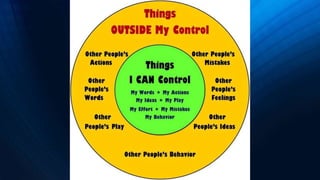
Internal Control
The reason internal control psychology can make us happy is
this: If we understand the principles of internal control, we
will stop trying to control others and recognize we can only
control our own behavior. This shift in thinking will help
people meet their basic human needs in more direct, healthy,
and adaptive ways.
Choice Theory/Reality Therapy
Building the Relationship
• Supporting
• Encouraging
• Listening
• Accepting
• Trusting
• Respecting
• Negotiating Differences
Choice Theory/Reality Therapy
Hurts the Relationship
• Criticizing
• Blaming
• Complaining
• Nagging
• Threatening
• Punishing
• Bribing or rewarding to control
Choice Theory/Reality Therapy
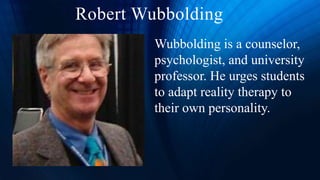
Robert Wubbolding
Wubbolding is a counselor,
psychologist, and university
professor. He urges students
to adapt reality therapy to
their own personality.
Plans are encouraged to be:
SAMIC
• Simple
• Attainable
• Measurable
• Immediate
• Controlled
• Committed
• Continuous
Choice Theory/Reality Therapy
WDEP
• The procedures of reality therapy are summarized in the
WDEP system
• Helping clients, students, employees define and clarify their
wants (W),
• Examining their total behavior: feelings, effective or
ineffective self-talk, and especially their actions (D).
• A searching and even at times uncomfortable self-evaluation
(E)
• Culminating in specific and attainable positive plans (P) for
improvement
Wants
What do you want?
What do you want instead of the problem?
What is your picture of a quality life, relationship,
etc?
What do your family/friends want for you?
What do you want from counselling?
Doing
What are you doing? (acting, thinking, feeling,
physiology)
When you act this way, what are you thinking?
When you think/act this way, how are you feeling?
How do your thoughts/actions affect your health?
Evaluate
Is what you are doing, helping you get what you
want?
Is it taking you in the direction you want to go?
Is what you want achievable?
Does it help you to look at it in that way?
How hard are you prepared to work at this?
Is your current level of commitment working in your
favor?
Is it a helpful plan?
Plan
What are you prepared to do/think differently that will
take you in the direction you want to go?
Are you clear about what you are going to do?
Is it achievable?
How will you know you have done it?
Can you start doing it immediately?
Is it in your control?
Are you committed to doing it?
Choice Theory/Reality Therapy
Promotes
• Problem-solving skills
• Self-evaluation
• Mutual respect
• Cooperation and collaboration
Five Basic Needs
•Survival
•Love and Belonging
•Power or Achievement
•Freedom or Independence
•Fun
“Choice Theory is the Train Track and Reality Therapy is the Train.”
Choice Theory/Reality Therapy
https://www.youtube.com/watch?v=CUvF
eyGxaaU
A Bully’s Perspective
PTSD
Post-Traumatic Stress Disorder
PTSD involves:
• Exposure to actual or threatened death, serious injury, or sexual violence
• Presence of intrusion symptoms associated with traumatic event(s),
beginning after the traumatic event(s)
• Persistent avoidance in stimuli associated with the traumatic event(s),
beginning after the traumatic event(s) occurred
• Negative alterations in cognitions and mood associated with the traumatic
event(s) beginning or worsening after the traumatic event(s) occurred
• Marked alterations in arousal and reactivity associated with the traumatic
event(s), beginning or worsening after the traumatic event(s) occurred
(DSM-V)
PTSD
PTSD
Significant Problems of PTSD:
• Having problems with memory
• Having a distorted sense of blame
• Being in a cycle of negative emotions
• Feeling detached, disconnected or isolated from
others
• Somatic symptoms (heat sensations, shortness of
breath, etc.)
(DSM-V)
PTSD
Other Factors:
• Females are at higher risk
• Increased suicide risk
• 80% more likely to have other mental illness
involved
• Traumatic Brain Injury can cause mis-diagnosis
• Karen’s onset from culture shock and often co-
morbid *Bi-polar Disorder
(DSM-V)
Conclusion
Glasser, “When therapy seems finished there is often a problem of
when and how to bring it to a close. Although termination is always
difficult because of the involvement, as the patient grows stronger he
is able to make more permanent involvements to replace the
therapist. The therapist must take the initiative if the patient hesitates,
but usually termination just happens. To quote G.L. Harrington,
when I asked him when he believes a patient is ready to have therapy
terminated, ‘When, after a long period of treatment, he begins to talk
about how much more he needs a new car and how much less he
needs you,’.”
Diagnostic and Statistical Manual of Mental Disorders: DSM-5. (2013). (5th ed.). (pp. 271-280). Arlington,VA: American
PsychiatricAssociation
Glasser, W.(2000) Counseling with Choice Theory The New Reality Therapy. (1st ed.). (pp. 22-26). New York. Harper.
Glasser, W. (1990) Reality Therapy A new Approach to Psychiatry. (1st ed.). (pp. 80-82, 153). New York. Perennial
Library.
Glasser, W. & Wubbolding, R. Reality Therapy. Retrieved on October 19, 2018, from
http://www.cengage.com/resource_uploads/downloads/0495097144_81298.pdf
Hale, J. V., & Sindlinger, J. (2017). Re-Envisioning Reflective Supervision: A Choice Theory/Reality Therapy
Application Using Reflecting Teams. International Journal of Choice Theory & Reality Therapy, 37(1), 56–
65
Mason, C. P., & Dye, L. (2017). ATTENDING to BASIC NEEDS: IMPLEMENTING REALITY THERAPY IN
SCHOOL COUNSELING PROGRAMS to ENHANCE ACADEMIC ACHIEVEMENT and CAREER
DECISION-MAKING SKILLS. International Journal of Choice Theory & Reality Therapy, 37(1), 46–
55.
PTSD, N. (2016). Types of PTSD. Psych Central. Retrieved on October 29, 2018, from
https://psychcentral,com/lib/types-of-ptsd/
Sommers-Flanagan, J. & Sommers-Flanagan, R. (2015). Counseling and psychotherapy theories in context and
practice: Skills, strategies, and techniques (2nd ed.). (pp. 301-330). Hoboken, NJ: John Wiley & Sons, Inc.
References

Choice Theory/Reality Therapy/PTSD

  • 1.
  • 2.
    Choice Theory/Reality Therapy ChoiceTheory/Reality Therapy is a method of counseling and psychotherapy that was developed by William Glasser. William Glasser promotes the teaching of reality therapy applied to psychotherapy, counseling, schools, agencies, and management.
  • 3.
    Choice Theory/Reality Therapy Beginnings •Psychoanalytic-Behavior • G.L. Harrington • Unhappiness • Relationships *Responsibility is the ability to fulfill one’s needs, and to do so in a way that does not deprive others of the ability to fulfill their needs.
  • 4.
    Concepts • Humanistic-Existential Theory •Therapist is the Teacher, Client is the Student *Choice Theory is Taught to Clients • Multi-Cultural *Dreams are not explored or mentioned. Time spent on dreams is time wasted. Choice Theory/Reality Therapy
  • 5.
    Choice Theory/Reality Therapy Glasserstates, “Therapy is not perfect. Psychiatrists make mistakes by admitting it and learning something from it.”
  • 6.
    Glasser believes, “thatthe current accepted concept that clients are the victims of mental illness caused by neurochemical imbalance over which they have no control is wrong…The brain is not defective, its chemistry is normal for the behaviors clients choose.” *Verbs are used, not nouns or adjectives. *Medications are ineffective. Choice Theory/Reality Therapy
  • 7.
    Choice Theory/Reality Therapy VenturaSchool of the Girls Glasser stated, “No matter how lonely and isolated someone may be, if the therapist adheres to the present and points to a hopeful future and, expands initial involvement into a series of involvements as soon as possible, great changes can take place.” *Maria
  • 8.
    External Control Glasser, “Thesimple operational premise of the external control psychology the world uses is: Punish the people who are doing wrong, so they will do what we say is right; then reward them, so they keep doing what we want them to do. This premise dominates the thinking of most people on Earth.” Choice Theory/Reality Therapy
  • 9.
    Internal Control The reasoninternal control psychology can make us happy is this: If we understand the principles of internal control, we will stop trying to control others and recognize we can only control our own behavior. This shift in thinking will help people meet their basic human needs in more direct, healthy, and adaptive ways. Choice Theory/Reality Therapy
  • 10.
    Building the Relationship •Supporting • Encouraging • Listening • Accepting • Trusting • Respecting • Negotiating Differences Choice Theory/Reality Therapy
  • 11.
    Hurts the Relationship •Criticizing • Blaming • Complaining • Nagging • Threatening • Punishing • Bribing or rewarding to control Choice Theory/Reality Therapy
  • 13.
    Robert Wubbolding Wubbolding isa counselor, psychologist, and university professor. He urges students to adapt reality therapy to their own personality.
  • 14.
    Plans are encouragedto be: SAMIC • Simple • Attainable • Measurable • Immediate • Controlled • Committed • Continuous Choice Theory/Reality Therapy
  • 15.
    WDEP • The proceduresof reality therapy are summarized in the WDEP system • Helping clients, students, employees define and clarify their wants (W), • Examining their total behavior: feelings, effective or ineffective self-talk, and especially their actions (D). • A searching and even at times uncomfortable self-evaluation (E) • Culminating in specific and attainable positive plans (P) for improvement
  • 16.
    Wants What do youwant? What do you want instead of the problem? What is your picture of a quality life, relationship, etc? What do your family/friends want for you? What do you want from counselling? Doing What are you doing? (acting, thinking, feeling, physiology) When you act this way, what are you thinking? When you think/act this way, how are you feeling? How do your thoughts/actions affect your health? Evaluate Is what you are doing, helping you get what you want? Is it taking you in the direction you want to go? Is what you want achievable? Does it help you to look at it in that way? How hard are you prepared to work at this? Is your current level of commitment working in your favor? Is it a helpful plan? Plan What are you prepared to do/think differently that will take you in the direction you want to go? Are you clear about what you are going to do? Is it achievable? How will you know you have done it? Can you start doing it immediately? Is it in your control? Are you committed to doing it?
  • 17.
    Choice Theory/Reality Therapy Promotes •Problem-solving skills • Self-evaluation • Mutual respect • Cooperation and collaboration
  • 18.
    Five Basic Needs •Survival •Loveand Belonging •Power or Achievement •Freedom or Independence •Fun “Choice Theory is the Train Track and Reality Therapy is the Train.” Choice Theory/Reality Therapy
  • 19.
  • 21.
  • 22.
    PTSD involves: • Exposureto actual or threatened death, serious injury, or sexual violence • Presence of intrusion symptoms associated with traumatic event(s), beginning after the traumatic event(s) • Persistent avoidance in stimuli associated with the traumatic event(s), beginning after the traumatic event(s) occurred • Negative alterations in cognitions and mood associated with the traumatic event(s) beginning or worsening after the traumatic event(s) occurred • Marked alterations in arousal and reactivity associated with the traumatic event(s), beginning or worsening after the traumatic event(s) occurred (DSM-V) PTSD
  • 23.
    PTSD Significant Problems ofPTSD: • Having problems with memory • Having a distorted sense of blame • Being in a cycle of negative emotions • Feeling detached, disconnected or isolated from others • Somatic symptoms (heat sensations, shortness of breath, etc.) (DSM-V)
  • 24.
    PTSD Other Factors: • Femalesare at higher risk • Increased suicide risk • 80% more likely to have other mental illness involved • Traumatic Brain Injury can cause mis-diagnosis • Karen’s onset from culture shock and often co- morbid *Bi-polar Disorder (DSM-V)
  • 26.
    Conclusion Glasser, “When therapyseems finished there is often a problem of when and how to bring it to a close. Although termination is always difficult because of the involvement, as the patient grows stronger he is able to make more permanent involvements to replace the therapist. The therapist must take the initiative if the patient hesitates, but usually termination just happens. To quote G.L. Harrington, when I asked him when he believes a patient is ready to have therapy terminated, ‘When, after a long period of treatment, he begins to talk about how much more he needs a new car and how much less he needs you,’.”
  • 27.
    Diagnostic and StatisticalManual of Mental Disorders: DSM-5. (2013). (5th ed.). (pp. 271-280). Arlington,VA: American PsychiatricAssociation Glasser, W.(2000) Counseling with Choice Theory The New Reality Therapy. (1st ed.). (pp. 22-26). New York. Harper. Glasser, W. (1990) Reality Therapy A new Approach to Psychiatry. (1st ed.). (pp. 80-82, 153). New York. Perennial Library. Glasser, W. & Wubbolding, R. Reality Therapy. Retrieved on October 19, 2018, from http://www.cengage.com/resource_uploads/downloads/0495097144_81298.pdf Hale, J. V., & Sindlinger, J. (2017). Re-Envisioning Reflective Supervision: A Choice Theory/Reality Therapy Application Using Reflecting Teams. International Journal of Choice Theory & Reality Therapy, 37(1), 56– 65 Mason, C. P., & Dye, L. (2017). ATTENDING to BASIC NEEDS: IMPLEMENTING REALITY THERAPY IN SCHOOL COUNSELING PROGRAMS to ENHANCE ACADEMIC ACHIEVEMENT and CAREER DECISION-MAKING SKILLS. International Journal of Choice Theory & Reality Therapy, 37(1), 46– 55. PTSD, N. (2016). Types of PTSD. Psych Central. Retrieved on October 29, 2018, from https://psychcentral,com/lib/types-of-ptsd/ Sommers-Flanagan, J. & Sommers-Flanagan, R. (2015). Counseling and psychotherapy theories in context and practice: Skills, strategies, and techniques (2nd ed.). (pp. 301-330). Hoboken, NJ: John Wiley & Sons, Inc. References