Euthanasia
Devashree Tidke
Introduction
• The word "euthanasia" comes straight out of the
Greek -- "eu", goodly or well +
"thanatos", death = the good death.
• Also known as mercy killing
• It refers to the practice of intentionally ending a
life in order to relieve pain and suffering.
Forms of Euthanasia
• Passive euthanasia means acceleration of death
by letting the patient die naturally.
• Active euthanasia - Intentionally causing a
person's death by performing an action such as by
giving a lethal injection. Legal in Netherlands,
Belgium etc. It may Voluntary or non-Voluntary
• Assisted suicide – the suffering person dies with
another person’s help. Legal in Washington, New
Mexico etc.
Euthanasia in India
• Passive Euthanasia is legal in India.
As per the law was passed by the Supreme Court
of India in 2011 as a means to legally withdraw
life support in patients who are in a permanent
vegetative state.
• Active Euthanasia which includes the
administration of lethal compounds for the
purpose of ending life, is still illegal in India, and
in most countries.
Aruna Shanbaug case
• Aruna, nurse at KEM hospital, Mumbai was
sexually assaulted by ward boy in 1973.
• The assault lead to irreparable brain damage and
cortically blind leaving her brain dead.
• On 24 January 2011, the Supreme
Court responded to the plea for euthanasia filed
by Aruna's friend journalist Pinki Virani.
Aruna Shanbaug case
• But the plea was turned down 7 March 2011 on
the ground that Pinki had no right to file such a
plea and also active euthanasia is illegal.
• Aruna had been in vegetative state for last 41
years, still alive.
• One good thing that happened : the Court has
laid down guidelines for euthanasia in extreme
cases of terminally ill patients.
Guidelines
• A decision to be taken by the parents or the spouse or
other close relatives ; close friend or doctors attending
the patient.
• Decision requires approval from the High Court
concerned.
• When such an application is filled the Chief Justice of the
High Court should forthwith constitute a Bench of at
least two Judges who should decide to grant approval or
not.
• A committee of three reputed doctors examine the
patient.
• After hearing the parties(relatives, doctors, judges), the
High Court can give its verdict.
Pros
• Frees up medical funds and
facilities to help other
people.
• It provides a way to relieve
extreme pain.
Pros
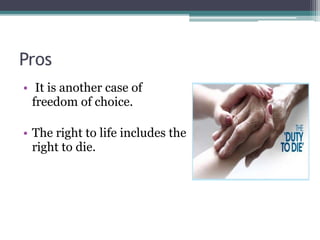
• It is another case of
freedom of choice.
• The right to life includes the
right to die.
Cons
• Euthanasia devalues human
life.
• Euthanasia can become a
means of health care cost
containment.
• Doctors should not be
involved in directly causing
death.
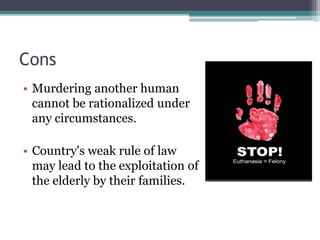
Cons
• Murdering another human
cannot be rationalized under
any circumstances.
• Country's weak rule of law
may lead to the exploitation of
the elderly by their families.
Recent advances in euthanasia law
• The decision on legalizing active euthanasia is
still underway.
• 16 July 2014, the Supreme Court issued notice to
all states and Union territories on a plea for
legalizing euthanasia resulting in a nationwide
debate.
• The decision would be taken by the national
consensus.
Conclusion
Legalizing euthanasia may help terminally ill
patients to die smooth death but may be
misused for committing suicide or murder if
strict safeguards are not applied.
Thank you.

Euthanasia

  • 1.
  • 2.
    Introduction • The word"euthanasia" comes straight out of the Greek -- "eu", goodly or well + "thanatos", death = the good death. • Also known as mercy killing • It refers to the practice of intentionally ending a life in order to relieve pain and suffering.
  • 3.
    Forms of Euthanasia •Passive euthanasia means acceleration of death by letting the patient die naturally. • Active euthanasia - Intentionally causing a person's death by performing an action such as by giving a lethal injection. Legal in Netherlands, Belgium etc. It may Voluntary or non-Voluntary • Assisted suicide – the suffering person dies with another person’s help. Legal in Washington, New Mexico etc.
  • 4.
    Euthanasia in India •Passive Euthanasia is legal in India. As per the law was passed by the Supreme Court of India in 2011 as a means to legally withdraw life support in patients who are in a permanent vegetative state. • Active Euthanasia which includes the administration of lethal compounds for the purpose of ending life, is still illegal in India, and in most countries.
  • 5.
    Aruna Shanbaug case •Aruna, nurse at KEM hospital, Mumbai was sexually assaulted by ward boy in 1973. • The assault lead to irreparable brain damage and cortically blind leaving her brain dead. • On 24 January 2011, the Supreme Court responded to the plea for euthanasia filed by Aruna's friend journalist Pinki Virani.
  • 6.
    Aruna Shanbaug case •But the plea was turned down 7 March 2011 on the ground that Pinki had no right to file such a plea and also active euthanasia is illegal. • Aruna had been in vegetative state for last 41 years, still alive. • One good thing that happened : the Court has laid down guidelines for euthanasia in extreme cases of terminally ill patients.
  • 7.
    Guidelines • A decisionto be taken by the parents or the spouse or other close relatives ; close friend or doctors attending the patient. • Decision requires approval from the High Court concerned. • When such an application is filled the Chief Justice of the High Court should forthwith constitute a Bench of at least two Judges who should decide to grant approval or not. • A committee of three reputed doctors examine the patient. • After hearing the parties(relatives, doctors, judges), the High Court can give its verdict.
  • 8.
    Pros • Frees upmedical funds and facilities to help other people. • It provides a way to relieve extreme pain.
  • 9.
    Pros • It isanother case of freedom of choice. • The right to life includes the right to die.
  • 10.
    Cons • Euthanasia devalueshuman life. • Euthanasia can become a means of health care cost containment. • Doctors should not be involved in directly causing death.
  • 11.
    Cons • Murdering anotherhuman cannot be rationalized under any circumstances. • Country's weak rule of law may lead to the exploitation of the elderly by their families.
  • 12.
    Recent advances ineuthanasia law • The decision on legalizing active euthanasia is still underway. • 16 July 2014, the Supreme Court issued notice to all states and Union territories on a plea for legalizing euthanasia resulting in a nationwide debate. • The decision would be taken by the national consensus.
  • 13.
    Conclusion Legalizing euthanasia mayhelp terminally ill patients to die smooth death but may be misused for committing suicide or murder if strict safeguards are not applied.
  • 14.

Editor's Notes

  • #3 Detail introduction please!!!