Euthanasia:
• The painless killing of a patient suffering from an incurable
and painful disease or in an irreversible coma.
• Mercy killing to prevent a prolonged and painful death.
• From the Greek “ευθανασία” meaning “good death”.
• It is also known as:
- Physician Assisted Suicide
- Physician Aid in Dying
- Mercy Killing
- Imposed Death
It is currently illegal in most locations.
Karen’s Story:
Our friend Karen has been personally affected by the illegalization of
euthanasia. Growing up, her father had been her protector, her teacher, her
guiding light, her truest friend. Together, they had the classic “daddy-
daughter” relationship. She regarded her father with the utmost respect; he
was her hero. He taught her the patience to learn how to ride a bike, the
courage to make friends, and the self confidence to trust herself. He provided
his daughter with lessons and advice that she would never forget.
Unfortunately, their time together was much shorter than it should have been.
Her father had been diagnosed with cancer. As time progressed, his condition
steadily worsened. He was clearly not the same person that he had once been;
his personality and physique had become unrecognizable. Karen could do
nothing but stand by and watch her hero’s life slowly slip away. He was
undoubtedly suffering. Her mother, with the power of attorney, selfishly
refused to let her husband die in peace. She believed that he should fight for
his life. The suffering continued. Before long, both of her father’s legs had
been amputated and his condition had become vegetative. He continued to
suffer. After what seemed like an eternity for him, Karen’s father passed on
March 25, 2011. Had euthanasia been legal in Illinois, her father would not
have had to suffer the way he did and peace would have been an option
for him.
Types of Euthanasia:
• Voluntary- The person wants to die and says so. This
includes:
- refusing medical treatment
- asking for medical treatment to be
stopped
- asking for life support to be switched off
- refusing to eat
• Non-Voluntary- The person cannot make a decision or
cannot make their wishes known. This includes:
- coma patients
- child and infant patients
- severely brain damaged patients
- senile patients
Types of Euthanasia (cont.):
• Involuntary- The person wants to live but is killed anyway. This includes:
- patient being refused a life sustaining treatment
- drugs being too costly
- a limited supply of organs for a transplant
- patient being on a long waiting list
• Active- the medical professionals, or another person, deliberately do
something that causes the patient to die.
• Passive- the patient dies because the medical professionals either don't
do something necessary to keep the patient alive, or when they stop
doing something that is keeping the patient alive. This includes:
- switching off life-support machines
- disconnecting the feeding tube - not
carrying out a life-extending operation
- not giving the patient life-extending drugs
Euthanasia in the Media:
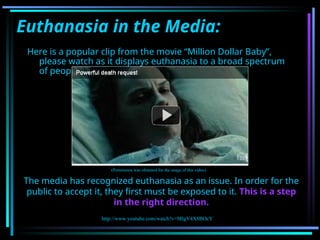
Here is a popular clip from the movie “Million Dollar Baby”,
please watch as it displays euthanasia to a broad spectrum
of people.
http://www.youtube.com/watch?v=MIgV4X8BOcY
The media has recognized euthanasia as an issue. In order for the
public to accept it, they first must be exposed to it. This is a step
in the right direction.
(Permission was obtained for the usage of this video)
Importance of Euthanasia:
• “As human beings, we are endowed with the freedom of choice, and we
cannot shuffle off our responsibility upon the shoulders of God or nature. We
must shoulder it ourselves. It is our responsibility.” - Arnold J. Toynbee
• If we are free to make the our own choices of how to live, we should also be
able to make our own choices of how to die. The power belongs to the
patient.
• Debilitating illnesses, such as cancer, are currently on the rise. The more
people diagnosed with these illnesses directly correlates to the number of
people faced with the euthanasia issue.
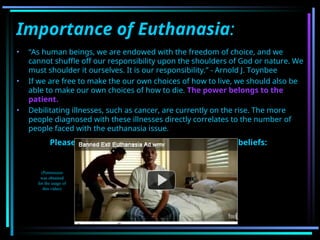
Please watch this video as it demonstrates our beliefs:
(Permission
was obtained
for the usage of
this video)
Legal Euthanasia outside of the US:
Assisted suicide is currently legal in the Netherlands,
Belgium, and Luxembourg.
Legal Euthanasia within the US:
Assisted suicide is currently legal in the states of Oregon,
Washington, and Montana.
The Netherlands:
• In 1984 the Dutch Supreme Court ruled voluntary euthanasia
was acceptable, provided doctors followed strict guidelines.
• In the fall 2000, the Dutch parliament voted to formally
legalize the practice, making the Netherlands the first nation
in the world to do so.
Belgium:
• The Belgian parliament legalized euthanasia in late
September 2002.
• It became the second country in the world to legalize
euthanasia.
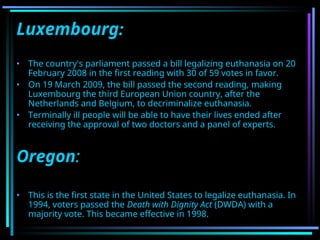
Luxembourg:
• The country's parliament passed a bill legalizing euthanasia on 20
February 2008 in the first reading with 30 of 59 votes in favor.
• On 19 March 2009, the bill passed the second reading, making
Luxembourg the third European Union country, after the
Netherlands and Belgium, to decriminalize euthanasia.
• Terminally ill people will be able to have their lives ended after
receiving the approval of two doctors and a panel of experts.
Oregon:
• This is the first state in the United States to legalize euthanasia. In
1994, voters passed the Death with Dignity Act (DWDA) with a
majority vote. This became effective in 1998.
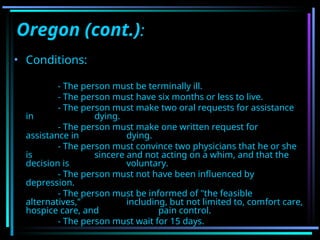
Oregon (cont.):
• Conditions:
- The person must be terminally ill.
- The person must have six months or less to live.
- The person must make two oral requests for assistance
in dying.
- The person must make one written request for
assistance in dying.
- The person must convince two physicians that he or she
is sincere and not acting on a whim, and that the
decision is voluntary.
- The person must not have been influenced by
depression.
- The person must be informed of "the feasible
alternatives," including, but not limited to, comfort care,
hospice care, and pain control.
- The person must wait for 15 days.
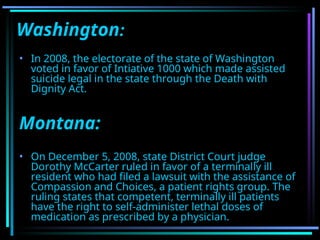
Washington:
• In 2008, the electorate of the state of Washington
voted in favor of Intiative 1000 which made assisted
suicide legal in the state through the Death with
Dignity Act.
Montana:
• On December 5, 2008, state District Court judge
Dorothy McCarter ruled in favor of a terminally ill
resident who had filed a lawsuit with the assistance of
Compassion and Choices, a patient rights group. The
ruling states that competent, terminally ill patients
have the right to self-administer lethal doses of
medication as prescribed by a physician.
We want Illinois to join this
list.
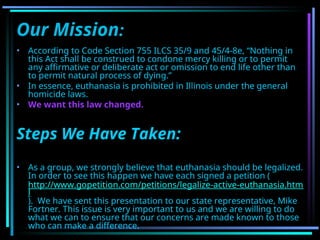
Our Mission:
• According to Code Section 755 ILCS 35/9 and 45/4-8e, “Nothing in
this Act shall be construed to condone mercy killing or to permit
any affirmative or deliberate act or omission to end life other than
to permit natural process of dying.”
• In essence, euthanasia is prohibited in Illinois under the general
homicide laws.
• We want this law changed.
Steps We Have Taken:
• As a group, we strongly believe that euthanasia should be legalized.
In order to see this happen we have each signed a petition (
http://www.gopetition.com/petitions/legalize-active-euthanasia.htm
l
). We have sent this presentation to our state representative, Mike
Fortner. This issue is very important to us and we are willing to do
what we can to ensure that our concerns are made known to those
who can make a difference.
This is a video that we have prepared
regarding our stance on euthanasia.
http://www.youtube.com/watch?v=TyEf8WZ4djc
Thank you for your time and consideration of
our proposal.

Ending the suffering.This presentation is about suicide

  • 2.
    Euthanasia: • The painlesskilling of a patient suffering from an incurable and painful disease or in an irreversible coma. • Mercy killing to prevent a prolonged and painful death. • From the Greek “ευθανασία” meaning “good death”. • It is also known as: - Physician Assisted Suicide - Physician Aid in Dying - Mercy Killing - Imposed Death It is currently illegal in most locations.
  • 3.
    Karen’s Story: Our friendKaren has been personally affected by the illegalization of euthanasia. Growing up, her father had been her protector, her teacher, her guiding light, her truest friend. Together, they had the classic “daddy- daughter” relationship. She regarded her father with the utmost respect; he was her hero. He taught her the patience to learn how to ride a bike, the courage to make friends, and the self confidence to trust herself. He provided his daughter with lessons and advice that she would never forget. Unfortunately, their time together was much shorter than it should have been. Her father had been diagnosed with cancer. As time progressed, his condition steadily worsened. He was clearly not the same person that he had once been; his personality and physique had become unrecognizable. Karen could do nothing but stand by and watch her hero’s life slowly slip away. He was undoubtedly suffering. Her mother, with the power of attorney, selfishly refused to let her husband die in peace. She believed that he should fight for his life. The suffering continued. Before long, both of her father’s legs had been amputated and his condition had become vegetative. He continued to suffer. After what seemed like an eternity for him, Karen’s father passed on March 25, 2011. Had euthanasia been legal in Illinois, her father would not have had to suffer the way he did and peace would have been an option for him.
  • 4.
    Types of Euthanasia: •Voluntary- The person wants to die and says so. This includes: - refusing medical treatment - asking for medical treatment to be stopped - asking for life support to be switched off - refusing to eat • Non-Voluntary- The person cannot make a decision or cannot make their wishes known. This includes: - coma patients - child and infant patients - severely brain damaged patients - senile patients
  • 5.
    Types of Euthanasia(cont.): • Involuntary- The person wants to live but is killed anyway. This includes: - patient being refused a life sustaining treatment - drugs being too costly - a limited supply of organs for a transplant - patient being on a long waiting list • Active- the medical professionals, or another person, deliberately do something that causes the patient to die. • Passive- the patient dies because the medical professionals either don't do something necessary to keep the patient alive, or when they stop doing something that is keeping the patient alive. This includes: - switching off life-support machines - disconnecting the feeding tube - not carrying out a life-extending operation - not giving the patient life-extending drugs
  • 6.
    Euthanasia in theMedia: Here is a popular clip from the movie “Million Dollar Baby”, please watch as it displays euthanasia to a broad spectrum of people. http://www.youtube.com/watch?v=MIgV4X8BOcY The media has recognized euthanasia as an issue. In order for the public to accept it, they first must be exposed to it. This is a step in the right direction. (Permission was obtained for the usage of this video)
  • 7.
    Importance of Euthanasia: •“As human beings, we are endowed with the freedom of choice, and we cannot shuffle off our responsibility upon the shoulders of God or nature. We must shoulder it ourselves. It is our responsibility.” - Arnold J. Toynbee • If we are free to make the our own choices of how to live, we should also be able to make our own choices of how to die. The power belongs to the patient. • Debilitating illnesses, such as cancer, are currently on the rise. The more people diagnosed with these illnesses directly correlates to the number of people faced with the euthanasia issue. Please watch this video as it demonstrates our beliefs: (Permission was obtained for the usage of this video)
  • 8.
    Legal Euthanasia outsideof the US: Assisted suicide is currently legal in the Netherlands, Belgium, and Luxembourg. Legal Euthanasia within the US: Assisted suicide is currently legal in the states of Oregon, Washington, and Montana.
  • 9.
    The Netherlands: • In1984 the Dutch Supreme Court ruled voluntary euthanasia was acceptable, provided doctors followed strict guidelines. • In the fall 2000, the Dutch parliament voted to formally legalize the practice, making the Netherlands the first nation in the world to do so. Belgium: • The Belgian parliament legalized euthanasia in late September 2002. • It became the second country in the world to legalize euthanasia.
  • 10.
    Luxembourg: • The country'sparliament passed a bill legalizing euthanasia on 20 February 2008 in the first reading with 30 of 59 votes in favor. • On 19 March 2009, the bill passed the second reading, making Luxembourg the third European Union country, after the Netherlands and Belgium, to decriminalize euthanasia. • Terminally ill people will be able to have their lives ended after receiving the approval of two doctors and a panel of experts. Oregon: • This is the first state in the United States to legalize euthanasia. In 1994, voters passed the Death with Dignity Act (DWDA) with a majority vote. This became effective in 1998.
  • 11.
    Oregon (cont.): • Conditions: -The person must be terminally ill. - The person must have six months or less to live. - The person must make two oral requests for assistance in dying. - The person must make one written request for assistance in dying. - The person must convince two physicians that he or she is sincere and not acting on a whim, and that the decision is voluntary. - The person must not have been influenced by depression. - The person must be informed of "the feasible alternatives," including, but not limited to, comfort care, hospice care, and pain control. - The person must wait for 15 days.
  • 12.
    Washington: • In 2008,the electorate of the state of Washington voted in favor of Intiative 1000 which made assisted suicide legal in the state through the Death with Dignity Act. Montana: • On December 5, 2008, state District Court judge Dorothy McCarter ruled in favor of a terminally ill resident who had filed a lawsuit with the assistance of Compassion and Choices, a patient rights group. The ruling states that competent, terminally ill patients have the right to self-administer lethal doses of medication as prescribed by a physician.
  • 13.
    We want Illinoisto join this list.
  • 14.
    Our Mission: • Accordingto Code Section 755 ILCS 35/9 and 45/4-8e, “Nothing in this Act shall be construed to condone mercy killing or to permit any affirmative or deliberate act or omission to end life other than to permit natural process of dying.” • In essence, euthanasia is prohibited in Illinois under the general homicide laws. • We want this law changed. Steps We Have Taken: • As a group, we strongly believe that euthanasia should be legalized. In order to see this happen we have each signed a petition ( http://www.gopetition.com/petitions/legalize-active-euthanasia.htm l ). We have sent this presentation to our state representative, Mike Fortner. This issue is very important to us and we are willing to do what we can to ensure that our concerns are made known to those who can make a difference.
  • 15.
    This is avideo that we have prepared regarding our stance on euthanasia. http://www.youtube.com/watch?v=TyEf8WZ4djc Thank you for your time and consideration of our proposal.