EUROBOND


    M. Rizwan Qamar
BOND


   A debt instrument
   Issued for a period of more than
    one year
   For the purpose of raising capital
    The Federal government, states,
    cities, corporations, and many other
    types of institutions sell bonds.
EUROBOND
   A bond issued and traded outside
    the country whose currency it is
    denominated in, and outside the
    regulations of a single country;
    usually a bond issued by a non-
    European for sale in Europe
   It is also called global bond
Eurobond Rules


   Trading
   Payment
   Listing
   Taxation
Eurobond Structure

   The structure of a Eurobonds consists in its terms and
    conditions, which are printed on the actual bond.

   The Face

   The Reverse

   The coupons
Types of Eurobonds


   Straight Fixed
   VRNs
   Long term Bonds
   Medium term Bonds
   Convertibles
Advantages of Eurobonds


   Considerable market capacity
   Diversifying sources of borrowings
   Source for long-term investment
    resources
   Access to a broad investor base
   Establishing a credit history
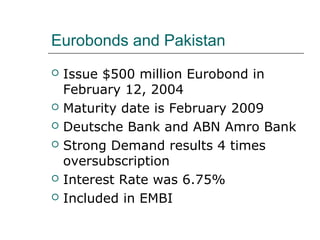
Eurobonds and Pakistan
   Issue $500 million Eurobond in
    February 12, 2004
   Maturity date is February 2009
   Deutsche Bank and ABN Amro Bank
   Strong Demand results 4 times
    oversubscription
   Interest Rate was 6.75%
   Included in EMBI
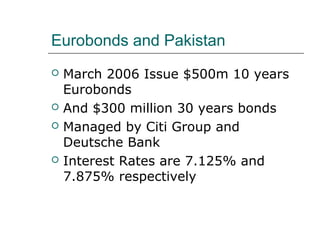
Eurobonds and Pakistan
   March 2006 Issue $500m 10 years
    Eurobonds
   And $300 million 30 years bonds
   Managed by Citi Group and
    Deutsche Bank
   Interest Rates are 7.125% and
    7.875% respectively
THANK YOU

Euro Bonds

  • 1.
    EUROBOND M. Rizwan Qamar
  • 2.
    BOND  A debt instrument  Issued for a period of more than one year  For the purpose of raising capital  The Federal government, states, cities, corporations, and many other types of institutions sell bonds.
  • 3.
    EUROBOND  A bond issued and traded outside the country whose currency it is denominated in, and outside the regulations of a single country; usually a bond issued by a non- European for sale in Europe  It is also called global bond
  • 4.
    Eurobond Rules  Trading  Payment  Listing  Taxation
  • 5.
    Eurobond Structure  The structure of a Eurobonds consists in its terms and conditions, which are printed on the actual bond.  The Face  The Reverse  The coupons
  • 6.
    Types of Eurobonds  Straight Fixed  VRNs  Long term Bonds  Medium term Bonds  Convertibles
  • 7.
    Advantages of Eurobonds  Considerable market capacity  Diversifying sources of borrowings  Source for long-term investment resources  Access to a broad investor base  Establishing a credit history
  • 8.
    Eurobonds and Pakistan  Issue $500 million Eurobond in February 12, 2004  Maturity date is February 2009  Deutsche Bank and ABN Amro Bank  Strong Demand results 4 times oversubscription  Interest Rate was 6.75%  Included in EMBI
  • 9.
    Eurobonds and Pakistan  March 2006 Issue $500m 10 years Eurobonds  And $300 million 30 years bonds  Managed by Citi Group and Deutsche Bank  Interest Rates are 7.125% and 7.875% respectively
  • 10.