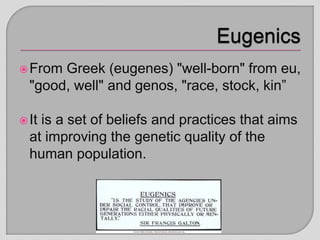
From Greek (eugenes) "well-born" from eu,
"good, well" and genos, "race, stock, kin”
It is a set of beliefs and practices that aims
at improving the genetic quality of the
human population.
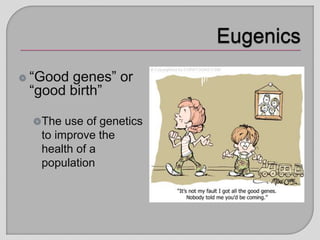
“Good genes” or
“good birth”
The use of genetics
to improve the
health of a
population
 “The best men must have intercourse with the
best women as frequently as possible, and
the opposite is true of the very inferior.”
 Proposed the establishment of a fixed lottery
in which each person was assigned a
“marriage number” corresponding to a
quantitative assessment of their fitness
 He believed this system would lead to a
predictable improvement of the human race.
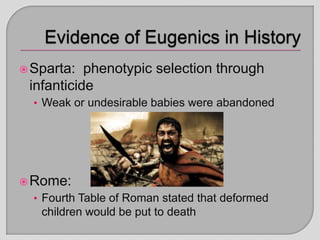
Sparta: phenotypic selection through
infanticide
• Weak or undesirable babies were abandoned
Rome:
• Fourth Table of Roman stated that deformed
children would be put to death
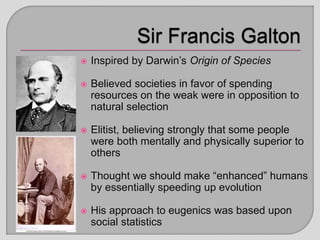
 Inspired by Darwin’s Origin of Species
 Believed societies in favor of spending
resources on the weak were in opposition to
natural selection
 Elitist, believing strongly that some people
were both mentally and physically superior to
others
 Thought we should make “enhanced” humans
by essentially speeding up evolution
 His approach to eugenics was based upon
social statistics
Positive eugenics (Francis Galton):
Encourage people with “good genes” to
have more children
Negative selection: Don’t allow “bad
genes” to be reproduced
Forced sterilization or abortion
Marriage restrictions
“Euthanasia”
 Practiced negative and positive eugenics
• Forced sterilization, euthanasia
• Awarded Aryan women for having many children with Aryan
men
 Some argued that the Holocaust was "a vast dysgenic
program to rid Europe of highly intelligent challengers to the
existing Christian domination by a numerically and politically
minuscule minority.” ~Seymour W. Itzkoff
Alexander Graham Bell recommended
deaf individuals not be allowed to marry
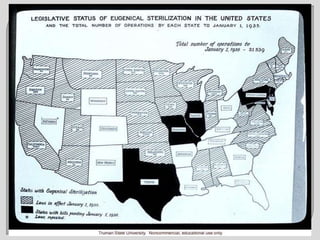
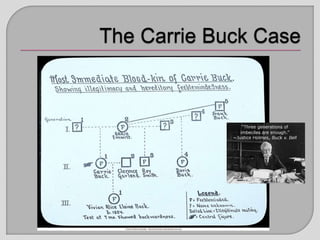
Thirty states adopted legislation to perform
forced sterilization on those deemed
“mentally unfit.”
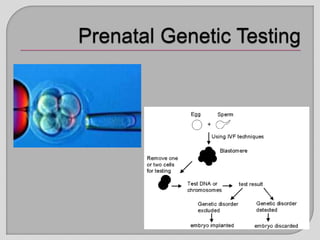
Genetic testing
Prenatal genetic testing
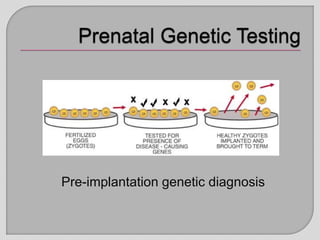
Pre-implantation genetic diagnosis
Genetic counseling for prospective parents
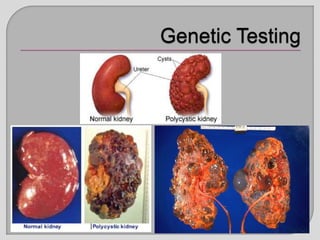
Predictive testing: Polycystic kidney
disease
Fluid-filled sacs grow on kidneys, possibly other
organs
Autosomal dominant (50% chance if one parent is
affected)
Onset: 30 to 40 years, possibly earlier/later
No cure available; life-prolonging treatment
possible (dialysis or kidney transplantation)
“An informative and supportive dialogue regarding a
known, potential, or unsuspected genetic condition.”
Manic-depressive illness (Kay Redfield Jamison)
“To whom is the genetic counselor responsible?
The patient or married couple alone? Other family
members? Future generations who may suffer
increasing numbers of persons with genetic
defects?” Ruth Macklin, “Moral Issues in Human
Genetics: Counseling or Control?”
Cystic fibrosis
Recessive (25% chance if both parents are
carriers)
Life expectancy: 30 years
Carrier test available to pregnant couples or those
planning to become pregnant
Pre-implantation genetic diagnosis
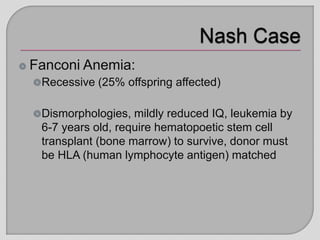
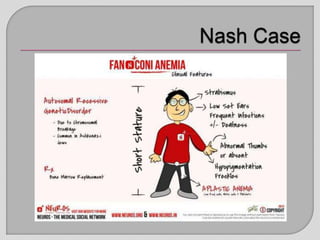
Fanconi Anemia:
Recessive (25% offspring affected)
Dismorphologies, mildly reduced IQ, leukemia by
6-7 years old, require hematopoetic stem cell
transplant (bone marrow) to survive, donor must
be HLA (human lymphocyte antigen) matched
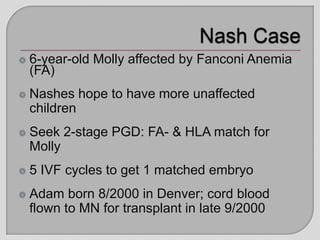
6-year-old Molly affected by Fanconi Anemia
(FA)
Nashes hope to have more unaffected
children
Seek 2-stage PGD: FA- & HLA match for
Molly
5 IVF cycles to get 1 matched embryo
Adam born 8/2000 in Denver; cord blood
flown to MN for transplant in late 9/2000
We are the Ethics Review Board for General Hospital, a
local public hospital. The Review Board has to
determine a policy for the hospital regarding whether
PGD should be permitted for the following purposes:
to help two CF carriers avoid passing on the disease;
to help a couple produce umbilical cord cells for an
existing child with Fanconi’s anemia;
to help a couple select the sex of their child for “family
balancing”;
To help a short couple produce a taller child.

Eugenics

  • 2.
    From Greek (eugenes)"well-born" from eu, "good, well" and genos, "race, stock, kin” It is a set of beliefs and practices that aims at improving the genetic quality of the human population.
  • 3.
    “Good genes” or “goodbirth” The use of genetics to improve the health of a population
  • 4.
     “The bestmen must have intercourse with the best women as frequently as possible, and the opposite is true of the very inferior.”  Proposed the establishment of a fixed lottery in which each person was assigned a “marriage number” corresponding to a quantitative assessment of their fitness  He believed this system would lead to a predictable improvement of the human race.
  • 5.
    Sparta: phenotypic selectionthrough infanticide • Weak or undesirable babies were abandoned Rome: • Fourth Table of Roman stated that deformed children would be put to death
  • 6.
     Inspired byDarwin’s Origin of Species  Believed societies in favor of spending resources on the weak were in opposition to natural selection  Elitist, believing strongly that some people were both mentally and physically superior to others  Thought we should make “enhanced” humans by essentially speeding up evolution  His approach to eugenics was based upon social statistics
  • 7.
    Positive eugenics (FrancisGalton): Encourage people with “good genes” to have more children Negative selection: Don’t allow “bad genes” to be reproduced Forced sterilization or abortion Marriage restrictions “Euthanasia”
  • 8.
     Practiced negativeand positive eugenics • Forced sterilization, euthanasia • Awarded Aryan women for having many children with Aryan men  Some argued that the Holocaust was "a vast dysgenic program to rid Europe of highly intelligent challengers to the existing Christian domination by a numerically and politically minuscule minority.” ~Seymour W. Itzkoff
  • 9.
    Alexander Graham Bellrecommended deaf individuals not be allowed to marry Thirty states adopted legislation to perform forced sterilization on those deemed “mentally unfit.”
  • 12.
    Genetic testing Prenatal genetictesting Pre-implantation genetic diagnosis Genetic counseling for prospective parents
  • 14.
    Predictive testing: Polycystickidney disease Fluid-filled sacs grow on kidneys, possibly other organs Autosomal dominant (50% chance if one parent is affected) Onset: 30 to 40 years, possibly earlier/later No cure available; life-prolonging treatment possible (dialysis or kidney transplantation)
  • 15.
    “An informative andsupportive dialogue regarding a known, potential, or unsuspected genetic condition.” Manic-depressive illness (Kay Redfield Jamison) “To whom is the genetic counselor responsible? The patient or married couple alone? Other family members? Future generations who may suffer increasing numbers of persons with genetic defects?” Ruth Macklin, “Moral Issues in Human Genetics: Counseling or Control?”
  • 16.
    Cystic fibrosis Recessive (25%chance if both parents are carriers) Life expectancy: 30 years Carrier test available to pregnant couples or those planning to become pregnant
  • 17.
  • 19.
    Fanconi Anemia: Recessive (25%offspring affected) Dismorphologies, mildly reduced IQ, leukemia by 6-7 years old, require hematopoetic stem cell transplant (bone marrow) to survive, donor must be HLA (human lymphocyte antigen) matched
  • 21.
    6-year-old Molly affectedby Fanconi Anemia (FA) Nashes hope to have more unaffected children Seek 2-stage PGD: FA- & HLA match for Molly 5 IVF cycles to get 1 matched embryo Adam born 8/2000 in Denver; cord blood flown to MN for transplant in late 9/2000
  • 22.
    We are theEthics Review Board for General Hospital, a local public hospital. The Review Board has to determine a policy for the hospital regarding whether PGD should be permitted for the following purposes: to help two CF carriers avoid passing on the disease; to help a couple produce umbilical cord cells for an existing child with Fanconi’s anemia; to help a couple select the sex of their child for “family balancing”; To help a short couple produce a taller child.