The Ethical Implications of 
Preimplantation Genetic 
Diagnosis (PGD) 
"The great challenge to mankind today is not 
only how to create, but to know when to stop 
creating." 
Lord Emmanuel Jacobvitz, 
former chief rabbi of Britain 
Elizabeth Kersten 
June 4, 2008
What is PGD? 
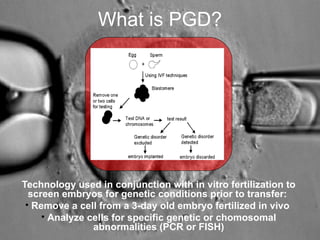
Technology used in conjunction with in vitro fertilization to 
screen embryos for genetic conditions prior to transfer: 
• Remove a cell from a 3-day old embryo fertilized in vivo 
• Analyze cells for specific genetic or chomosomal 
abnormalities (PCR or FISH)
What is PGD? 
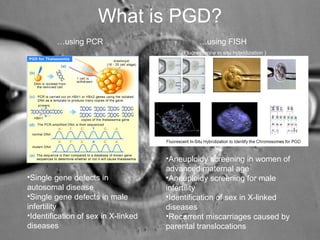
…using PCR 
…using FISH 
(Fluorescence in situ hybridization ) 
•Single gene defects in autosomal disease 
•Single gene defects in male infertility 
•Identification of sex in X-linked diseases 
•Aneuploidy screening in women of advanced maternal age 
•Aneuploidy screening for male infertility 
•Identification of sex in X-linked diseases 
•Recurrent miscarriages caused by parental translocations
History of PGD 
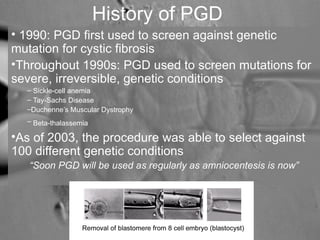
• 1990: PGD first used to screen against genetic 
mutation for cystic fibrosis 
•Throughout 1990s: PGD used to screen mutations for 
severe, irreversible, genetic conditions 
– Sickle-cell anemia 
– Tay-Sachs Disease 
–Duchenne’s Muscular Dystrophy 
– Beta-thalassemia 
•As of 2003, the procedure was able to select against 
100 different genetic conditions 
“Soon PGD will be used as regularly as amniocentesis is now”
PGD Uses 
Traditionally: 
• Single gene disorders 
• Chromosomal structural abnormalities 
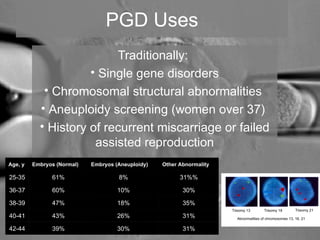
• Aneuploidy screening (women over 37) 
• History of recurrent miscarriage or failed 
assisted reproduction 
42-44 39% 30% 31% 
40-41 43% 26% 31% 
38-39 47% 18% 35% 
36-37 60% 10% 30% 
25-35 61% 8% 31%% 
Age, y Embryos (Normal) Embryos (Aneuploidy) Other Abnormality
PGD Benefits 
PGD is preferable to alternatives for 
Mendelian disorders: 
• Don’t have children 
• Use donor gametes 
• Conceive prenatal testing 
if positive may abort 
When scaled up to society level, “This will 
represent a significant reduction of physical 
and emotional stress related to care for an 
affected family member and a significant 
reduction of medical expenses to society” 
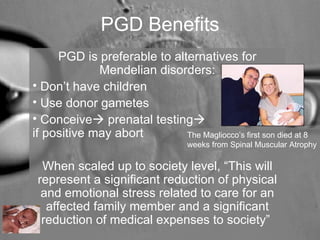
The Magliocco’s first son died at 8 
weeks from Spinal Muscular Atrophy
The of PGD 
Objections on the grounds of need to create 
and select embryos, then discard those not 
selected 
•Embryo is a life no PGD 
•Embryo is a potential life deserving of 
respect only PGD for medical purposes 
Objections on grounds of selection itself 
•Deontological: reproduction as a gift 
•Consequentialist: PGD will lead to eugenic 
world of designer children
Further Concerns… 
• Reminiscent of Eugenics 
• Increased inequality 
“…while wealthy parents are able to select traits for happiness, 
creativity and physical talents, disorders such as obesity, heart 
disease, alcoholism and mental illness will be left to "drift 
randomly among the families of the underclass.” 
• Restriction, rather than extension, of choice 
• Disability discrimination claim 
“…the danger lies in how this testing could promote further 
stigmatization of and discrimination against people with "genetic 
impairments" or their parents. Indeed, testing could entrench a culture 
of prevention and perfectionism and promote a culture of intolerance.”
Avoidance of late-onset diseases 
Proponents: 
• Enables avoidance of horrible condition 
•Time of onset is not morally significant 
• Case stronger for this than susceptibility 
Concerns: 
•Treatment may be developed 
in the interim 
•Ability of affected parent to raise the child 
•Age of onset, seriousness of disorder must 
be considered 
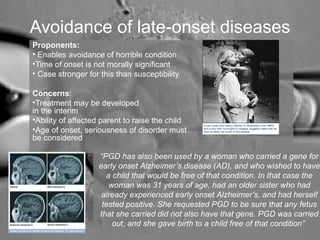
“PGD has also been used by a woman who carried a gene for 
early onset Alzheimer’s disease (AD), and who wished to have 
a child that would be free of that condition. In that case the 
woman was 31 years of age, had an older sister who had 
already experienced early onset Alzheimer’s, and had herself 
tested positive. She requested PGD to be sure that any fetus 
that she carried did not also have that gene. PGD was carried 
out, and she gave birth to a child free of that condition”
Susceptibility conditions 
(diseases with variable or incomplete 
penetrance) 
Concerns: 
• Similar to late-onset, but harder 
case because of lower penetrance 
• Many potentially treatable 
– BRCA1 and BRCA2 mutations 
–Hereditary non-polyposis colorectal 
cancer, etc. 
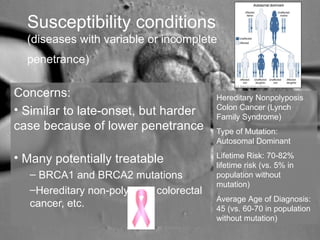
Hereditary Nonpolyposis 
Colon Cancer (Lynch 
Family Syndrome) 
Type of Mutation: 
Autosomal Dominant 
Lifetime Risk: 70-82% 
lifetime risk (vs. 5% in 
population without 
mutation) 
Average Age of Diagnosis: 
45 (vs. 60-70 in population 
without mutation)
Tissue-typing to save the life 
of another child 
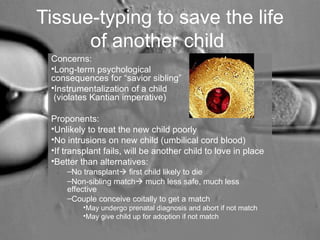
Concerns: 
•Long-term psychological 
consequences for “savior sibling” 
•Instrumentalization of a child 
(violates Kantian imperative) 
Proponents: 
•Unlikely to treat the new child poorly 
•No intrusions on new child (umbilical cord blood) 
•If transplant fails, will be another child to love in place 
•Better than alternatives: 
–No transplant first child likely to die 
–Non-sibling match much less safe, much less 
effective 
–Couple conceive coitally to get a match 
•May undergo prenatal diagnosis and abort if not match 
•May give child up for adoption if not match
Non-medical sex selection 
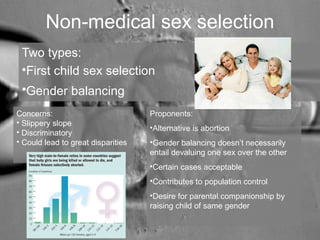
Two types: 
•First child sex selection 
•Gender balancing 
Concerns: 
• Slippery slope 
• Discriminatory 
• Could lead to great disparities 
Proponents: 
•Alternative is abortion 
•Gender balancing doesn’t necessarily 
entail devaluing one sex over the other 
•Certain cases acceptable 
•Contributes to population control 
•Desire for parental companionship by 
raising child of same gender
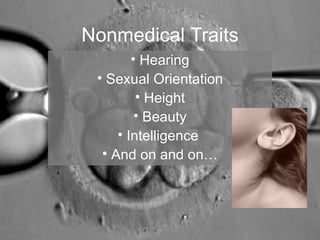
Nonmedical Traits 
• Hearing 
• Sexual Orientation 
• Height 
• Beauty 
• Intelligence 
• And on and on…
Where to Draw the Line? 
• Avoidance of Late-Onset Diseases 
• Susceptibility Conditions 
• Tissue-typing to Save Life of Other Child 
• Non-medical Sex Selection 
• Other non-medical traits
References 
•Cohen, Eric. The Ethics of Embryonic Sex-Selection Treatments. NPR. ( http://www.npr.org/templates/story/story.php?storyId=6654622) 
• Duke Law and Technology Review. Customizing Conception: A Survey of PGD and the Resulting Social, Ethical, and Legal Dilemmas. ( http://www.law.duke.edu/journals/dltr/articles/2002dltr0012.html) 
• International Center for Technology Assessment: Pre-Implantation Genetic Dianosis: Ethical Guidelines for Responsible Regulation ( http://www.icta.org/doc/pgd%20guidelines.pdf) 
•Krahn, Timothy. Where are we going with PGD? CMAJ. ( http://www.cmaj.ca/cgi/content/full/176/10/1445) 
• Marik, JJ. Preimplantation Genetic Diagnosis. EMedicine. ( http://www.emedicine.com/MED/topic3520.htm) 
• Palca, Joe. Screening Embryos for Disease. NPR. ( http://www.npr.org/templates/story/story.php?storyId=6653837) 
• Robertson, John A. Extending PGD: The Ethical Debate. Human Reproduction. ( http://humrep.oxfordjournals.org/cgi/content/full/18/3/465) 
• Shahine, Lora and Aaron Caughey. Preimplantation Genetic Diagnosis: The Earliest Form of Prenatal Diagnosis. Gynecologic and Obstetric Investigation. (http:// content.karger.com/ProdukteDB/produkte.asp?Aktion=ShowPDF&ArtikelNr=83483&Ausgabe=230650&ProduktNr=223845&filename=83483.pdf) 
•Silber, Sherman. PGD. The Infertility Center of St. Louis. ( http://www.infertile.com/infertility-treatments/pgd.htm)

Elizabeth

  • 1.
    The Ethical Implicationsof Preimplantation Genetic Diagnosis (PGD) "The great challenge to mankind today is not only how to create, but to know when to stop creating." Lord Emmanuel Jacobvitz, former chief rabbi of Britain Elizabeth Kersten June 4, 2008
  • 2.
    What is PGD? Technology used in conjunction with in vitro fertilization to screen embryos for genetic conditions prior to transfer: • Remove a cell from a 3-day old embryo fertilized in vivo • Analyze cells for specific genetic or chomosomal abnormalities (PCR or FISH)
  • 3.
    What is PGD? …using PCR …using FISH (Fluorescence in situ hybridization ) •Single gene defects in autosomal disease •Single gene defects in male infertility •Identification of sex in X-linked diseases •Aneuploidy screening in women of advanced maternal age •Aneuploidy screening for male infertility •Identification of sex in X-linked diseases •Recurrent miscarriages caused by parental translocations
  • 4.
    History of PGD • 1990: PGD first used to screen against genetic mutation for cystic fibrosis •Throughout 1990s: PGD used to screen mutations for severe, irreversible, genetic conditions – Sickle-cell anemia – Tay-Sachs Disease –Duchenne’s Muscular Dystrophy – Beta-thalassemia •As of 2003, the procedure was able to select against 100 different genetic conditions “Soon PGD will be used as regularly as amniocentesis is now”
  • 5.
    PGD Uses Traditionally: • Single gene disorders • Chromosomal structural abnormalities • Aneuploidy screening (women over 37) • History of recurrent miscarriage or failed assisted reproduction 42-44 39% 30% 31% 40-41 43% 26% 31% 38-39 47% 18% 35% 36-37 60% 10% 30% 25-35 61% 8% 31%% Age, y Embryos (Normal) Embryos (Aneuploidy) Other Abnormality
  • 6.
    PGD Benefits PGDis preferable to alternatives for Mendelian disorders: • Don’t have children • Use donor gametes • Conceive prenatal testing if positive may abort When scaled up to society level, “This will represent a significant reduction of physical and emotional stress related to care for an affected family member and a significant reduction of medical expenses to society” The Magliocco’s first son died at 8 weeks from Spinal Muscular Atrophy
  • 7.
    The of PGD Objections on the grounds of need to create and select embryos, then discard those not selected •Embryo is a life no PGD •Embryo is a potential life deserving of respect only PGD for medical purposes Objections on grounds of selection itself •Deontological: reproduction as a gift •Consequentialist: PGD will lead to eugenic world of designer children
  • 8.
    Further Concerns… •Reminiscent of Eugenics • Increased inequality “…while wealthy parents are able to select traits for happiness, creativity and physical talents, disorders such as obesity, heart disease, alcoholism and mental illness will be left to "drift randomly among the families of the underclass.” • Restriction, rather than extension, of choice • Disability discrimination claim “…the danger lies in how this testing could promote further stigmatization of and discrimination against people with "genetic impairments" or their parents. Indeed, testing could entrench a culture of prevention and perfectionism and promote a culture of intolerance.”
  • 9.
    Avoidance of late-onsetdiseases Proponents: • Enables avoidance of horrible condition •Time of onset is not morally significant • Case stronger for this than susceptibility Concerns: •Treatment may be developed in the interim •Ability of affected parent to raise the child •Age of onset, seriousness of disorder must be considered “PGD has also been used by a woman who carried a gene for early onset Alzheimer’s disease (AD), and who wished to have a child that would be free of that condition. In that case the woman was 31 years of age, had an older sister who had already experienced early onset Alzheimer’s, and had herself tested positive. She requested PGD to be sure that any fetus that she carried did not also have that gene. PGD was carried out, and she gave birth to a child free of that condition”
  • 10.
    Susceptibility conditions (diseaseswith variable or incomplete penetrance) Concerns: • Similar to late-onset, but harder case because of lower penetrance • Many potentially treatable – BRCA1 and BRCA2 mutations –Hereditary non-polyposis colorectal cancer, etc. Hereditary Nonpolyposis Colon Cancer (Lynch Family Syndrome) Type of Mutation: Autosomal Dominant Lifetime Risk: 70-82% lifetime risk (vs. 5% in population without mutation) Average Age of Diagnosis: 45 (vs. 60-70 in population without mutation)
  • 11.
    Tissue-typing to savethe life of another child Concerns: •Long-term psychological consequences for “savior sibling” •Instrumentalization of a child (violates Kantian imperative) Proponents: •Unlikely to treat the new child poorly •No intrusions on new child (umbilical cord blood) •If transplant fails, will be another child to love in place •Better than alternatives: –No transplant first child likely to die –Non-sibling match much less safe, much less effective –Couple conceive coitally to get a match •May undergo prenatal diagnosis and abort if not match •May give child up for adoption if not match
  • 12.
    Non-medical sex selection Two types: •First child sex selection •Gender balancing Concerns: • Slippery slope • Discriminatory • Could lead to great disparities Proponents: •Alternative is abortion •Gender balancing doesn’t necessarily entail devaluing one sex over the other •Certain cases acceptable •Contributes to population control •Desire for parental companionship by raising child of same gender
  • 13.
    Nonmedical Traits •Hearing • Sexual Orientation • Height • Beauty • Intelligence • And on and on…
  • 14.
    Where to Drawthe Line? • Avoidance of Late-Onset Diseases • Susceptibility Conditions • Tissue-typing to Save Life of Other Child • Non-medical Sex Selection • Other non-medical traits
  • 15.
    References •Cohen, Eric.The Ethics of Embryonic Sex-Selection Treatments. NPR. ( http://www.npr.org/templates/story/story.php?storyId=6654622) • Duke Law and Technology Review. Customizing Conception: A Survey of PGD and the Resulting Social, Ethical, and Legal Dilemmas. ( http://www.law.duke.edu/journals/dltr/articles/2002dltr0012.html) • International Center for Technology Assessment: Pre-Implantation Genetic Dianosis: Ethical Guidelines for Responsible Regulation ( http://www.icta.org/doc/pgd%20guidelines.pdf) •Krahn, Timothy. Where are we going with PGD? CMAJ. ( http://www.cmaj.ca/cgi/content/full/176/10/1445) • Marik, JJ. Preimplantation Genetic Diagnosis. EMedicine. ( http://www.emedicine.com/MED/topic3520.htm) • Palca, Joe. Screening Embryos for Disease. NPR. ( http://www.npr.org/templates/story/story.php?storyId=6653837) • Robertson, John A. Extending PGD: The Ethical Debate. Human Reproduction. ( http://humrep.oxfordjournals.org/cgi/content/full/18/3/465) • Shahine, Lora and Aaron Caughey. Preimplantation Genetic Diagnosis: The Earliest Form of Prenatal Diagnosis. Gynecologic and Obstetric Investigation. (http:// content.karger.com/ProdukteDB/produkte.asp?Aktion=ShowPDF&ArtikelNr=83483&Ausgabe=230650&ProduktNr=223845&filename=83483.pdf) •Silber, Sherman. PGD. The Infertility Center of St. Louis. ( http://www.infertile.com/infertility-treatments/pgd.htm)