ETM 551 Lecture 5 -Concept
Generation.ppt
1
Product Design & Development
Concept Generation
ETM 551 Lecture 5 -Concept
Generation.ppt
2
Concept Generation Example:
Power Nailer
• What existing solution concepts, if any,
could be successfully adapted for this
application?
• What new concepts might satisfy the
established needs and specifications?
• What methods can be used to facilitate the
concept generation process?
ETM 551 Lecture 5 -Concept
Generation.ppt
3
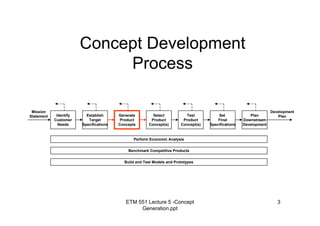
Concept Development
Process
Perform Economic Analysis
Benchmark Competitive Products
Build and Test Models and Prototypes
Identify
Customer
Needs
Establish
Target
Specifications
Generate
Product
Concepts
Select
Product
Concept(s)
Set
Final
Specifications
Plan
Downstream
Development
Mission
Statement Test
Product
Concept(s)
Development
Plan
4
The Activity of Concept Generation
• A good concept is sometimes poorly
implemented in subsequent development
phases, but a poor concept can rarely be
manipulated to achieve commercial success.
• Concept generation typically consumes less
than 5% budget and 15% of the development
time
• Because the concept genaration activity is not
costly, there is no excuse for lack of diligence
and care in executing asound concept
generation method.
ETM 551 Lecture 5 -Concept
Generation.ppt
5
Preliminary questions
After identifying customer needs and
establishing target product specifications, the
team should ask:
• What existing solutions could be adapted for this
application?
• What new concepts might satisfy these needs
and specifications?
• What methods can be used to facilitate concept
generation process?
ETM 551 Lecture 5 -Concept
Generation.ppt
6
Concept generation activity
• Structured approaches reduce the
likelihood of costly problems
– Common dysfunctions during concept
generation:
– Consideration of only one or two alternatives, often
proposed by the most assertive members of the team.
– Failure to consider carefully the usefulness of concepts
employed by other firms in related and unrelated
products.
– Involvement of only one or two people in the process,
resulting in lack of confidence and commitment by other
team members.
– Ineffective integration of promising partial solutions.
– Failure to consider entire categories of solutions.
ETM 551 Lecture 5 -Concept
Generation.ppt
7
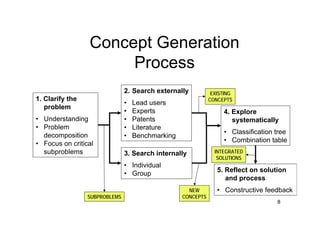
A Five-Step Method
• Step 1: Clarify the Problem
• Step 2: Search Externally
• Step 3: Search Internally
• Step 4: Explore Systematically
• Step 5: Reflect on the Results and the
Process
8
Concept Generation
Process
1. Clarify the
problem
• Understanding
• Problem
decomposition
• Focus on critical
subproblems 3. Search internally
• Individual
• Group
2. Search externally
• Lead users
• Experts
• Patents
• Literature
• Benchmarking
4. Explore
systematically
• Classification tree
• Combination table
5. Reflect on solution
and process
• Constructive feedback
SUBPROBLEMS
NEW
CONCEPTS
EXISTING
CONCEPTS
INTEGRATED
SOLUTIONS
ETM 551 Lecture 5 -Concept
Generation.ppt
9
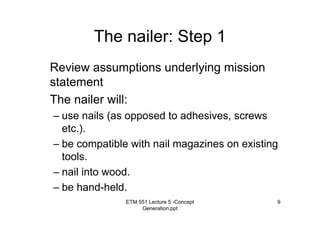
The nailer: Step 1
Review assumptions underlying mission
statement
The nailer will:
– use nails (as opposed to adhesives, screws
etc.).
– be compatible with nail magazines on existing
tools.
– nail into wood.
– be hand-held.
ETM 551 Lecture 5 -Concept
Generation.ppt
10
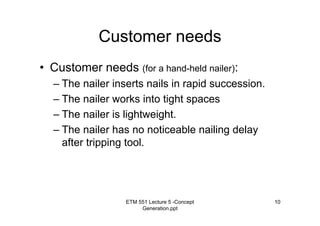
Customer needs
• Customer needs (for a hand-held nailer):
– The nailer inserts nails in rapid succession.
– The nailer works into tight spaces
– The nailer is lightweight.
– The nailer has no noticeable nailing delay
after tripping tool.
ETM 551 Lecture 5 -Concept
Generation.ppt
11
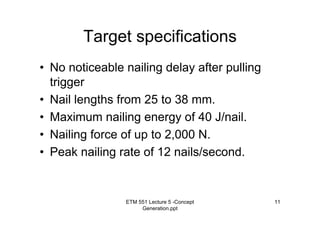
Target specifications
• No noticeable nailing delay after pulling
trigger
• Nail lengths from 25 to 38 mm.
• Maximum nailing energy of 40 J/nail.
• Nailing force of up to 2,000 N.
• Peak nailing rate of 12 nails/second.
ETM 551 Lecture 5 -Concept
Generation.ppt
12
Target specifications (cont)
• Average nailing rate of 4 nails/min.
• Maximum trigger delay of 0.25 second.
• Tool mass less than 4 kg
• Maximum trigger delay of 0.25 sec.
ETM 551 Lecture 5 -Concept
Generation.ppt
13
Problem decomposition
• Decompose complex problem into
simpler sub-problems. Many design
challenges are too complex to solve as
a single problem.
• Split a complex problem into simpler sub-
problems.(Problem decomposition)
ETM 551 Lecture 5 -Concept
Generation.ppt
14
Problem decomposition
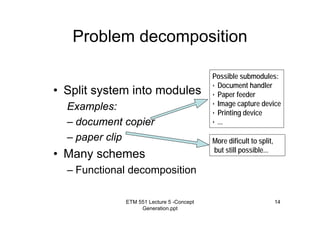
• Split system into modules
Examples:
– document copier
– paper clip
• Many schemes
– Functional decomposition
Possible submodules:
• Document handler
• Paper feeder
• Image capture device
• Printing device
• ...
More dificult to split,
but still possible...
ETM 551 Lecture 5 -Concept
Generation.ppt
15
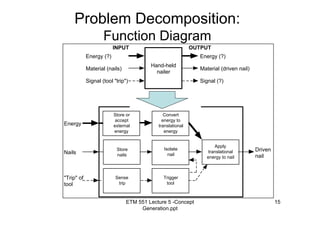
Problem Decomposition:
Function Diagram
Store
nails
Store or
accept
external
energy
Isolate
nail
Convert
energy to
translational
energy
Apply
translational
energy to nail
Sense
trip
Trigger
tool
Energy
Nails
"Trip" of
tool
Driven
nail
Hand-held
nailer
Energy (?)
Signal (?)
Material (nails)
Energy (?)
Signal (tool "trip")
INPUT OUTPUT
Material (driven nail)
ETM 551 Lecture 5 -Concept
Generation.ppt
16
Some useful tips to get started
• Create a function diagram of an existing
product.
• Create function diagram based on an
arbitrary product concept already
generated by the team or on a known
subfunction technology. Be sure to
generalize the diagram to the appropriate
level of abstraction.
ETM 551 Lecture 5 -Concept
Generation.ppt
17
Tips to get started
• Follow one of the flows (e.g., materials)
and determine what operations are
required.
The details of the other flows can be
derived by thinking about their
connections to the initial flow.
ETM 551 Lecture 5 -Concept
Generation.ppt
18
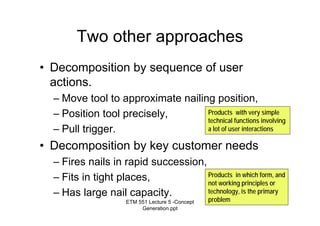
Two other approaches
• Decomposition by sequence of user
actions.
– Move tool to approximate nailing position,
– Position tool precisely,
– Pull trigger.
• Decomposition by key customer needs
– Fires nails in rapid succession,
– Fits in tight places,
– Has large nail capacity.
Products with very simple
technical functions involving
a lot of user interactions
Products in which form, and
not working principles or
technology, is the primary
problem
ETM 551 Lecture 5 -Concept
Generation.ppt
19
Focus on critical sub-problems
• The aim of decomposition techniques is to
split a complex problem into simpler sub-
problems, then tackle each in a focused
way.
ETM 551 Lecture 5 -Concept
Generation.ppt
20
The Nailer:
Step 2 - Search externally
• Conduct external searches to find existing
solutions to either the overall problem or a
sub-problem identified during the
decomposition step.
• Use search engines (in advanced mode)
to find existing solutions discussed on
Internet sites.
ETM 551 Lecture 5 -Concept
Generation.ppt
21
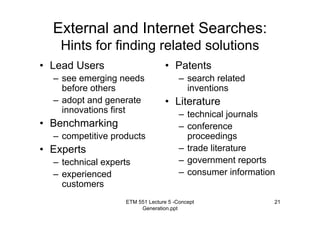
External and Internet Searches:
Hints for finding related solutions
• Lead Users
– see emerging needs
before others
– adopt and generate
innovations first
• Benchmarking
– competitive products
• Experts
– technical experts
– experienced
customers
• Patents
– search related
inventions
• Literature
– technical journals
– conference
proceedings
– trade literature
– government reports
– consumer information
ETM 551 Lecture 5 -Concept
Generation.ppt
22
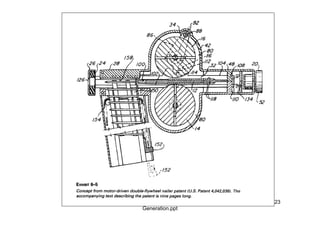
Patents
• Try the European patent office
• http://ep.espacenet.com
• US patent office
• http://patft.uspto.gov
ETM 551 Lecture 5 -Concept
Generation.ppt
23
ETM 551 Lecture 5 -Concept
Generation.ppt
24
Step 3 - Search internally
• Suspend judgment
– Suspend evaluation for the days or weeks
required to generate a large set of alternatives
is critical to success.
• Generate a lot of ideas
– Most experts believe that the more ideas a
team generates, the more likely the team is to
explore fully the ‘solution space’.
ETM 551 Lecture 5 -Concept
Generation.ppt
25
Step 3 - Search internally (cont)
• Welcome ideas, even if they do not seem
very feasible
– Ideas which initially appear infeasible can
often be improved, “debugged” or “repaired”
by other members of the team.
• Use graphical and physical media.
– Reasoning about physical and geometric
information with words is difficult.
ETM 551 Lecture 5 -Concept
Generation.ppt
26
Hints for Generating Solution
Concepts
• Make analogies
– Experienced designers always ask
themselves what other devices solve a related
problem.
• Wish and wonder
– Beginning a thought or comment with “I wish
we could.....” or “I wonder what would happen
if ....” helps to stimulate oneself or the group
to consider new possibilities.
ETM 551 Lecture 5 -Concept
Generation.ppt
27
Hints (cont)
• Use related stimuli
– Most individuals can think of a new idea when
presented with a new stimulus.
• Use unrelated stimuli
– Occasionally, random or unrelated stimuli can
be effective in encouraging new ideas.
• Set quantitative goals
– Set a goal of 10 or 20 concepts.
ETM 551 Lecture 5 -Concept
Generation.ppt
28
Hints (cont)
• Use the gallery method
– Use the gallery method to display a large
number of concepts simultaneously for
discussion.
ETM 551 Lecture 5 -Concept
Generation.ppt
29
TRIZ
• In the 1990’s, a Russian problem solving
methodology called TRIZ (a Russian
acronym for theory of inventive problem
solving) began to disseminate in Europe
and USA.
• Useful in identifying physical working
principles.
• The key idea is to identify a contradiction
that is implicit in a problem.
ETM 551 Lecture 5 -Concept
Generation.ppt
30
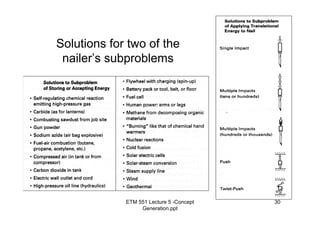
Solutions for two of the
nailer’s subproblems
ETM 551 Lecture 5 -Concept
Generation.ppt
31
The nailer:
Step 4 - Explore systematically
• After external and internal search there
are probably tens or hundreds of solutions
to subproblems, or concept fragments
• Navigate the space of possibilities…
– With the concept classification tree
– With the concept combination table
ETM 551 Lecture 5 -Concept
Generation.ppt
32
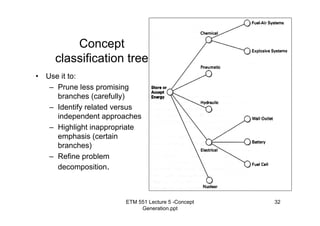
Concept
classification tree
• Use it to:
– Prune less promising
branches (carefully)
– Identify related versus
independent approaches
– Highlight inappropriate
emphasis (certain
branches)
– Refine problem
decomposition.
ETM 551 Lecture 5 -Concept
Generation.ppt
33
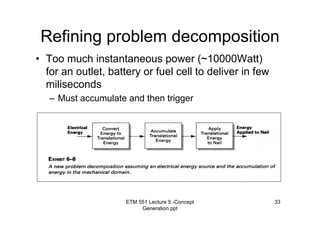
Refining problem decomposition
• Too much instantaneous power (~10000Watt)
for an outlet, battery or fuel cell to deliver in few
miliseconds
– Must accumulate and then trigger
ETM 551 Lecture 5 -Concept
Generation.ppt
34
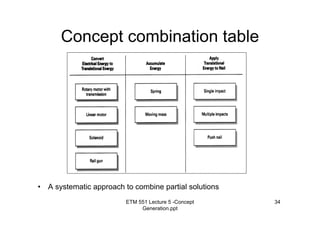
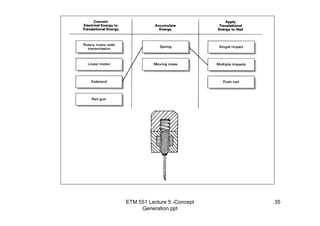
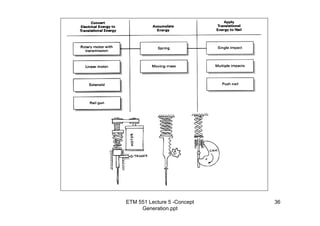
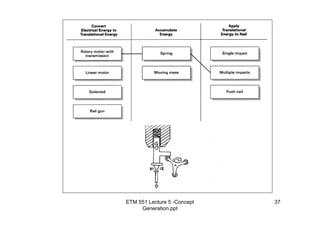
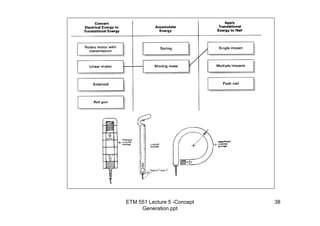
Concept combination table
• A systematic approach to combine partial solutions
ETM 551 Lecture 5 -Concept
Generation.ppt
35
ETM 551 Lecture 5 -Concept
Generation.ppt
36
ETM 551 Lecture 5 -Concept
Generation.ppt
37
ETM 551 Lecture 5 -Concept
Generation.ppt
38
ETM 551 Lecture 5 -Concept
Generation.ppt
39
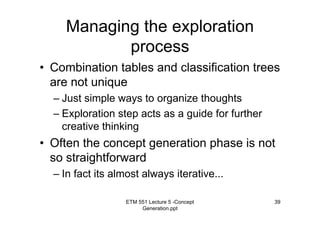
Managing the exploration
process
• Combination tables and classification trees
are not unique
– Just simple ways to organize thoughts
– Exploration step acts as a guide for further
creative thinking
• Often the concept generation phase is not
so straightforward
– In fact its almost always iterative...
ETM 551 Lecture 5 -Concept
Generation.ppt
40
Step 5: Reflect on the Results and
the Process
• Is the team developing confidence that the
solution space has been fully explored?
• Are there alternative function diagrams?
• Are there alternative ways to decompose
the problem?
• Have external sources been thoroughly
pursued?
• Have ideas from everyone been accepted
and integrated into process?
ETM 551 Lecture 5 -Concept
Generation.ppt
41
Summary
• A product concept is an approximate
description of the technology, working
principles, and form of the product.
• The concept generation begins with a set
of customer needs and target
specifications.
• In most cases an effective team will
generate hundreds of concepts, of which 5
to 20 will merit serious consideration.
ETM 551 Lecture 5 -Concept
Generation.ppt
42
Summary
• The concept generation consists of 5
steps
– Clarify the problem
– Search externally
– Search internally
– Explore systematically
– Reflect on the solutions and the process

Etm551 lecture05

  • 1.
    ETM 551 Lecture5 -Concept Generation.ppt 1 Product Design & Development Concept Generation
  • 2.
    ETM 551 Lecture5 -Concept Generation.ppt 2 Concept Generation Example: Power Nailer • What existing solution concepts, if any, could be successfully adapted for this application? • What new concepts might satisfy the established needs and specifications? • What methods can be used to facilitate the concept generation process?
  • 3.
    ETM 551 Lecture5 -Concept Generation.ppt 3 Concept Development Process Perform Economic Analysis Benchmark Competitive Products Build and Test Models and Prototypes Identify Customer Needs Establish Target Specifications Generate Product Concepts Select Product Concept(s) Set Final Specifications Plan Downstream Development Mission Statement Test Product Concept(s) Development Plan
  • 4.
    4 The Activity ofConcept Generation • A good concept is sometimes poorly implemented in subsequent development phases, but a poor concept can rarely be manipulated to achieve commercial success. • Concept generation typically consumes less than 5% budget and 15% of the development time • Because the concept genaration activity is not costly, there is no excuse for lack of diligence and care in executing asound concept generation method.
  • 5.
    ETM 551 Lecture5 -Concept Generation.ppt 5 Preliminary questions After identifying customer needs and establishing target product specifications, the team should ask: • What existing solutions could be adapted for this application? • What new concepts might satisfy these needs and specifications? • What methods can be used to facilitate concept generation process?
  • 6.
    ETM 551 Lecture5 -Concept Generation.ppt 6 Concept generation activity • Structured approaches reduce the likelihood of costly problems – Common dysfunctions during concept generation: – Consideration of only one or two alternatives, often proposed by the most assertive members of the team. – Failure to consider carefully the usefulness of concepts employed by other firms in related and unrelated products. – Involvement of only one or two people in the process, resulting in lack of confidence and commitment by other team members. – Ineffective integration of promising partial solutions. – Failure to consider entire categories of solutions.
  • 7.
    ETM 551 Lecture5 -Concept Generation.ppt 7 A Five-Step Method • Step 1: Clarify the Problem • Step 2: Search Externally • Step 3: Search Internally • Step 4: Explore Systematically • Step 5: Reflect on the Results and the Process
  • 8.
    8 Concept Generation Process 1. Clarifythe problem • Understanding • Problem decomposition • Focus on critical subproblems 3. Search internally • Individual • Group 2. Search externally • Lead users • Experts • Patents • Literature • Benchmarking 4. Explore systematically • Classification tree • Combination table 5. Reflect on solution and process • Constructive feedback SUBPROBLEMS NEW CONCEPTS EXISTING CONCEPTS INTEGRATED SOLUTIONS
  • 9.
    ETM 551 Lecture5 -Concept Generation.ppt 9 The nailer: Step 1 Review assumptions underlying mission statement The nailer will: – use nails (as opposed to adhesives, screws etc.). – be compatible with nail magazines on existing tools. – nail into wood. – be hand-held.
  • 10.
    ETM 551 Lecture5 -Concept Generation.ppt 10 Customer needs • Customer needs (for a hand-held nailer): – The nailer inserts nails in rapid succession. – The nailer works into tight spaces – The nailer is lightweight. – The nailer has no noticeable nailing delay after tripping tool.
  • 11.
    ETM 551 Lecture5 -Concept Generation.ppt 11 Target specifications • No noticeable nailing delay after pulling trigger • Nail lengths from 25 to 38 mm. • Maximum nailing energy of 40 J/nail. • Nailing force of up to 2,000 N. • Peak nailing rate of 12 nails/second.
  • 12.
    ETM 551 Lecture5 -Concept Generation.ppt 12 Target specifications (cont) • Average nailing rate of 4 nails/min. • Maximum trigger delay of 0.25 second. • Tool mass less than 4 kg • Maximum trigger delay of 0.25 sec.
  • 13.
    ETM 551 Lecture5 -Concept Generation.ppt 13 Problem decomposition • Decompose complex problem into simpler sub-problems. Many design challenges are too complex to solve as a single problem. • Split a complex problem into simpler sub- problems.(Problem decomposition)
  • 14.
    ETM 551 Lecture5 -Concept Generation.ppt 14 Problem decomposition • Split system into modules Examples: – document copier – paper clip • Many schemes – Functional decomposition Possible submodules: • Document handler • Paper feeder • Image capture device • Printing device • ... More dificult to split, but still possible...
  • 15.
    ETM 551 Lecture5 -Concept Generation.ppt 15 Problem Decomposition: Function Diagram Store nails Store or accept external energy Isolate nail Convert energy to translational energy Apply translational energy to nail Sense trip Trigger tool Energy Nails "Trip" of tool Driven nail Hand-held nailer Energy (?) Signal (?) Material (nails) Energy (?) Signal (tool "trip") INPUT OUTPUT Material (driven nail)
  • 16.
    ETM 551 Lecture5 -Concept Generation.ppt 16 Some useful tips to get started • Create a function diagram of an existing product. • Create function diagram based on an arbitrary product concept already generated by the team or on a known subfunction technology. Be sure to generalize the diagram to the appropriate level of abstraction.
  • 17.
    ETM 551 Lecture5 -Concept Generation.ppt 17 Tips to get started • Follow one of the flows (e.g., materials) and determine what operations are required. The details of the other flows can be derived by thinking about their connections to the initial flow.
  • 18.
    ETM 551 Lecture5 -Concept Generation.ppt 18 Two other approaches • Decomposition by sequence of user actions. – Move tool to approximate nailing position, – Position tool precisely, – Pull trigger. • Decomposition by key customer needs – Fires nails in rapid succession, – Fits in tight places, – Has large nail capacity. Products with very simple technical functions involving a lot of user interactions Products in which form, and not working principles or technology, is the primary problem
  • 19.
    ETM 551 Lecture5 -Concept Generation.ppt 19 Focus on critical sub-problems • The aim of decomposition techniques is to split a complex problem into simpler sub- problems, then tackle each in a focused way.
  • 20.
    ETM 551 Lecture5 -Concept Generation.ppt 20 The Nailer: Step 2 - Search externally • Conduct external searches to find existing solutions to either the overall problem or a sub-problem identified during the decomposition step. • Use search engines (in advanced mode) to find existing solutions discussed on Internet sites.
  • 21.
    ETM 551 Lecture5 -Concept Generation.ppt 21 External and Internet Searches: Hints for finding related solutions • Lead Users – see emerging needs before others – adopt and generate innovations first • Benchmarking – competitive products • Experts – technical experts – experienced customers • Patents – search related inventions • Literature – technical journals – conference proceedings – trade literature – government reports – consumer information
  • 22.
    ETM 551 Lecture5 -Concept Generation.ppt 22 Patents • Try the European patent office • http://ep.espacenet.com • US patent office • http://patft.uspto.gov
  • 23.
    ETM 551 Lecture5 -Concept Generation.ppt 23
  • 24.
    ETM 551 Lecture5 -Concept Generation.ppt 24 Step 3 - Search internally • Suspend judgment – Suspend evaluation for the days or weeks required to generate a large set of alternatives is critical to success. • Generate a lot of ideas – Most experts believe that the more ideas a team generates, the more likely the team is to explore fully the ‘solution space’.
  • 25.
    ETM 551 Lecture5 -Concept Generation.ppt 25 Step 3 - Search internally (cont) • Welcome ideas, even if they do not seem very feasible – Ideas which initially appear infeasible can often be improved, “debugged” or “repaired” by other members of the team. • Use graphical and physical media. – Reasoning about physical and geometric information with words is difficult.
  • 26.
    ETM 551 Lecture5 -Concept Generation.ppt 26 Hints for Generating Solution Concepts • Make analogies – Experienced designers always ask themselves what other devices solve a related problem. • Wish and wonder – Beginning a thought or comment with “I wish we could.....” or “I wonder what would happen if ....” helps to stimulate oneself or the group to consider new possibilities.
  • 27.
    ETM 551 Lecture5 -Concept Generation.ppt 27 Hints (cont) • Use related stimuli – Most individuals can think of a new idea when presented with a new stimulus. • Use unrelated stimuli – Occasionally, random or unrelated stimuli can be effective in encouraging new ideas. • Set quantitative goals – Set a goal of 10 or 20 concepts.
  • 28.
    ETM 551 Lecture5 -Concept Generation.ppt 28 Hints (cont) • Use the gallery method – Use the gallery method to display a large number of concepts simultaneously for discussion.
  • 29.
    ETM 551 Lecture5 -Concept Generation.ppt 29 TRIZ • In the 1990’s, a Russian problem solving methodology called TRIZ (a Russian acronym for theory of inventive problem solving) began to disseminate in Europe and USA. • Useful in identifying physical working principles. • The key idea is to identify a contradiction that is implicit in a problem.
  • 30.
    ETM 551 Lecture5 -Concept Generation.ppt 30 Solutions for two of the nailer’s subproblems
  • 31.
    ETM 551 Lecture5 -Concept Generation.ppt 31 The nailer: Step 4 - Explore systematically • After external and internal search there are probably tens or hundreds of solutions to subproblems, or concept fragments • Navigate the space of possibilities… – With the concept classification tree – With the concept combination table
  • 32.
    ETM 551 Lecture5 -Concept Generation.ppt 32 Concept classification tree • Use it to: – Prune less promising branches (carefully) – Identify related versus independent approaches – Highlight inappropriate emphasis (certain branches) – Refine problem decomposition.
  • 33.
    ETM 551 Lecture5 -Concept Generation.ppt 33 Refining problem decomposition • Too much instantaneous power (~10000Watt) for an outlet, battery or fuel cell to deliver in few miliseconds – Must accumulate and then trigger
  • 34.
    ETM 551 Lecture5 -Concept Generation.ppt 34 Concept combination table • A systematic approach to combine partial solutions
  • 35.
    ETM 551 Lecture5 -Concept Generation.ppt 35
  • 36.
    ETM 551 Lecture5 -Concept Generation.ppt 36
  • 37.
    ETM 551 Lecture5 -Concept Generation.ppt 37
  • 38.
    ETM 551 Lecture5 -Concept Generation.ppt 38
  • 39.
    ETM 551 Lecture5 -Concept Generation.ppt 39 Managing the exploration process • Combination tables and classification trees are not unique – Just simple ways to organize thoughts – Exploration step acts as a guide for further creative thinking • Often the concept generation phase is not so straightforward – In fact its almost always iterative...
  • 40.
    ETM 551 Lecture5 -Concept Generation.ppt 40 Step 5: Reflect on the Results and the Process • Is the team developing confidence that the solution space has been fully explored? • Are there alternative function diagrams? • Are there alternative ways to decompose the problem? • Have external sources been thoroughly pursued? • Have ideas from everyone been accepted and integrated into process?
  • 41.
    ETM 551 Lecture5 -Concept Generation.ppt 41 Summary • A product concept is an approximate description of the technology, working principles, and form of the product. • The concept generation begins with a set of customer needs and target specifications. • In most cases an effective team will generate hundreds of concepts, of which 5 to 20 will merit serious consideration.
  • 42.
    ETM 551 Lecture5 -Concept Generation.ppt 42 Summary • The concept generation consists of 5 steps – Clarify the problem – Search externally – Search internally – Explore systematically – Reflect on the solutions and the process