CONCEPT
GENERATIO
N
Fatima Rahman | Md Yusuf Ansari | Rehan Kumar | Md
Zaffar | Shamim Ahmad
1
Practical Example of Concept
Generation
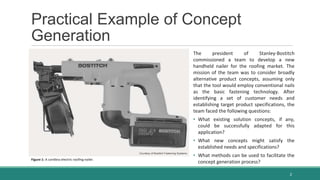
The president of Stanley-Bostitch
commissioned a team to develop a new
handheld nailer for the roofing market. The
mission of the team was to consider broadly
alternative product concepts, assuming only
that the tool would employ conventional nails
as the basic fastening technology. After
identifying a set of customer needs and
establishing target product specifications, the
team faced the following questions:
• What existing solution concepts, if any,
could be successfully adapted for this
application?
• What new concepts might satisfy the
established needs and specifications?
• What methods can be used to facilitate the
concept generation process?
Courtesy of Bostitch Fastening Systems
Figure 1: A cordless electric roofing nailer.
2
The Activity of Concept Generation
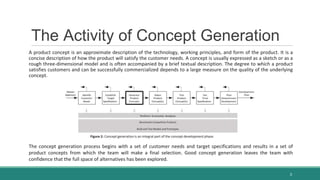
A product concept is an approximate description of the technology, working principles, and form of the product. It is a
concise description of how the product will satisfy the customer needs. A concept is usually expressed as a sketch or as a
rough three-dimensional model and is often accompanied by a brief textual description. The degree to which a product
satisfies customers and can be successfully commercialized depends to a large measure on the quality of the underlying
concept.
The concept generation process begins with a set of customer needs and target specifications and results in a set of
product concepts from which the team will make a final selection. Good concept generation leaves the team with
confidence that the full space of alternatives has been explored.
Figure 2: Concept generation is an integral part of the concept development phase.
3
Structured Approaches Reduce the Likelihood of
Costly Problems
Common dysfunctions exhibited by development teams during concept generation include:
• Consideration of only one or two alternatives, often proposed by the most assertive members of the team.
• Failure to consider carefully the usefulness of concepts employed by other firms in related and unrelated products.
• Involvement of only one or two people in the process, resulting in lack of confidence and commitment by the rest
of the team.
• Ineffective integration of promising partial solutions.
• Failure to consider entire categories of solutions.
A structured approach to concept generation reduces the incidence of these problems by encouraging the gathering of
information from many disparate information sources, by guiding the team in the thorough exploration of alternatives,
and by providing a mechanism for integrating partial solutions.
4
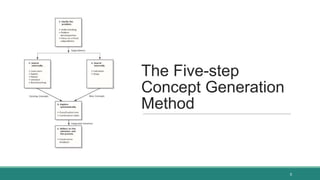
The Five-step
Concept Generation
Method
5
Step 1: Clarify the Problem
• Clarifying the problem consists of developing a general understanding and then breaking the problem down into
subproblems if necessary.
• The mission statement for the project, the customer needs list, and the preliminary product specification are the
ideal inputs to the concept generation process, although often these pieces of information are still being refined as
the concept generation phase begins.
• Ideally the team has been involved both in the identification of the customer needs and in the setting of the target
product specifications.
6
1-A: Decompose a Complex Problem into Simpler
Sub-problems
• Many design challenges are too complex to solve as a single problem and can be usefully divided into several simpler
subproblems.
• As a general rule, we feel that teams should attempt to decompose design problems, but should be aware that such a
decomposition may not be very useful for products with extremely simple functions.
• Dividing a problem into simpler subproblems is called problem decomposition. There are many schemes by which a
problem can be decomposed. Here we demonstrate a functional decomposition and also list several other
approaches that are frequently useful.
7
1-A: Decompose a Complex Problem into Simpler
Sub-problems
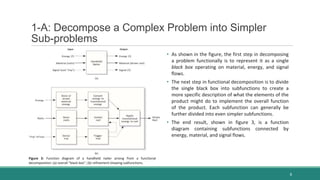
Figure 3: Function diagram of a handheld nailer arising from a functional
decomposition: (a) overall “black box”; (b) refinement showing subfunctions.
• As shown in the figure, the first step in decomposing
a problem functionally is to represent it as a single
black box operating on material, energy, and signal
flows.
• The next step in functional decomposition is to divide
the single black box into subfunctions to create a
more specific description of what the elements of the
product might do to implement the overall function
of the product. Each subfunction can generally be
further divided into even simpler subfunctions.
• The end result, shown in figure 3, is a function
diagram containing subfunctions connected by
energy, material, and signal flows.
8
1-A: Decompose a Complex Problem into Simpler
Sub-problems
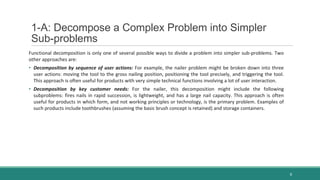
Functional decomposition is only one of several possible ways to divide a problem into simpler sub-problems. Two
other approaches are:
• Decomposition by sequence of user actions: For example, the nailer problem might be broken down into three
user actions: moving the tool to the gross nailing position, positioning the tool precisely, and triggering the tool.
This approach is often useful for products with very simple technical functions involving a lot of user interaction.
• Decomposition by key customer needs: For the nailer, this decomposition might include the following
subproblems: fires nails in rapid succession, is lightweight, and has a large nail capacity. This approach is often
useful for products in which form, and not working principles or technology, is the primary problem. Examples of
such products include toothbrushes (assuming the basic brush concept is retained) and storage containers.
9
1-B: Focus Initial Efforts on the Critical Sub-problems
• The goal of all of these decomposition techniques is to divide a complex problem into simpler problems such that
these simpler problems can be tackled in a focused way.
• Once problem decomposition is complete, the team chooses the subproblems that are most critical to the success
of the product and that are most likely to benefit from novel or creative solutions.
• This approach involves a conscious decision to defer the solution of some of the subproblems.
• Teams can usually agree after a few minutes of discussion on which subproblems should be addressed first and
which should be deferred for later consideration.
10
Step 2: Search Externally
• External search is aimed at finding existing solutions to both the overall problem and the subproblems
identified during the problem clarification step.
• Implementing an existing solution is usually quicker and cheaper than developing a new solution. Liberal use
of existing solutions allows the team to focus its creative energy on the critical subproblems for which there are
no satisfactory prior solutions.
• Conventional solution to one subproblem can frequently be combined with a novel solution to another
subproblem to yield a superior overall design.
• The external search for solutions is essentially an information-gathering process. Available time and resources
can be optimized by using an expand-and-focus strategy: first expand the scope of the search by broadly
gathering information that might be related to the problem and then focus the scope of the search by exploring
the promising directions in more detail.
11
There are five ways to gather information from
external sources:
1.Interview Lead Users
•Lead users are those users of a product who experience needs months or years before
the majority of the market and stand to benefit substantially from a product innovation
(von Hippel, 1988). Frequently these lead users will have already invented solutions to
meet their needs.
•In the handheld nailer case, the nailer team consulted with the building contractors from
the PBS television series This Old House to solicit new concepts. These lead users, who
are exposed to tools from many manufacturers, made many interesting. Observations
about the weaknesses in existing tools, but in this case did not provide many new
product concepts.
12
2.Consult Experts
•Experts with knowledge of one or more of the subproblems not only can provide solution
concepts directly but also can redirect the search in a more fruitful area. These people
can be found by calling universities, by calling companies, and by looking up authors of
articles.
•In general, consultants will expect to be paid for time they spend on a problem beyond
an initial meeting or telephone conversation. Suppliers are usually willing to provide
several days of effort without direct compensation if they anticipate that someone will
use their product as a component in a design.
13
3.Search patent
•Patents are a rich and readily available source of technical information containing
detailed drawings and explanations of how many products work. The main disadvantage
of patent searches is that concepts found in recent patents are protected (generally for 20
years from the date of the patent application), so there may be a royalty involved in using
them.
•The formal indexing scheme for patents is difficult for novices to navigate. Fortunately,
several databases contain the actual text of all patents. These text databases can be
searched electronically by key words. Key word searches can be conducted efficiently
with only modest practice and are remarkably effective in finding patents relevant to
a particular product.
14
4.Search Published Literature
•Published literature includes journals; conference proceedings; trade magazines;
government reports; market, consumer, and product information; and new product
announcements. Literature searches are therefore very fertile sources of existing solutions.
•Electronic searches are frequently the most efficient way to gather information
from published literature. Searching the Internet is often a good first step, although the
quality of the results can be hard to assess. More structured databases are available from
online sources.
•Handbooks cataloging technical information can also be very useful references for
external search. Examples of such engineering references are Marks’ Standard Handbook
of Mechanical Engineering, Perry’s Chemical Engineers’ Handbook, and Mechanisms and
Mechanical Devices Sourcebook.
15
5.Benchmark Related Products
•In the context of concept generation, benchmarking is the study of existing products with
functionality similar to that of the product under development or to the subproblems on
which the team is focused. Benchmarking can reveal existing concepts that have been
implemented to solve a particular problem, as well as information on the strengths
and weaknesses of the competition.
•At this point the team will likely already be familiar with the competitive and closely
related products. Products in other markets, but with related functionality, are more difficult
to find. One of the most useful sources of this information is the Thomas Register, a
directory of manufacturers of industrial products organized by product type. Often the
hardest part of using the Thomas Register is finding out what related products are actually
called and how they are cataloged. The Thomas Register database can be accessed via
the Internet.
16
Step 3: Search Internally
• Internal Search relies on innovative techniques. Osborn developed it in the 1940s. Also known as
brainstorming. The generation of solution concepts involves the utilisation of individual and group
creativity and knowledge.
• Every concept that resulted from this step was developed using knowledge that the team already
possessed.
• Internal Search is useful to think as a process of retrieving a potentially useful piece
of information from one's memory and then adapting that information to the problem at hand.
• This process can be carried out by individuals working in isolation or by group of people working
together.
17
Guidelines for Internal Search
Five guidelines are useful for improving both individual and group internal search:
18
1. Suspend
judgment
2. Generate a lot of
ideas
3. Welcome ideas
that may seem
infeasible
4. Make plenty of
sketches
5. Build sketch
models
1. Suspend judgment
•If choosing what to dress in the morning or what to eat for breakfast. We are used to making judgements quickly
and moving on because the majorities of the decisions we make in our daily lives only have impact for a few minutes
or hours.
•Decisions made about product concepts have long-term effects on us. Therefore, it is essential to success
that evaluation is put on hold for the days or weeks needed to produce a significant number of choices. The
requirement to postpone judgement is usually translated into the rule that no concept judgement is permitted during
group concept creation sessions.
2. Generate a lot of ideas.
•Most experts believe that the more ideas a team generates, the more likely the team is to explore fully the
solution space.
•Trying to share more ideas may inspire people to share those they may otherwise consider unworthy of
notice because doing so lowers the standards of excellence for any given thought. A high number of ideas has the
ability to generate even more ideas because each thought serves as a trigger for more ideas.
19
3. Welcome ideas that may seem infeasible.
Ideas that originally seem impossible can frequently be "debugged," "repaired," or enhanced by other
team members. The more infeasible an idea, the more it stretches the boundaries of the solution space and
encourages the team to think of the limits of possibility.
4. Make plenty of sketches.
The ability to reason spatially about actual items might be difficult. The use of text and spoken
language to describe physical objects is fundamentally ineffective. Many drawing materials should be
accessible, whether working in a group or alone. The quality of the sketch is not as important in this case; what counts
is how the concept is expressed (Yang and Cham, 2007). Additionally, it has been demonstrated that
good concept development is correlated with adding important dimensions to concept sketches (Yang, 2009).
5. Build sketch models.
Simple, physical models can quickly be created to express concepts using foam, clay, cardboard, 3-
D printing, and other media. Three-dimensional sketch models are particularly helpful for problems requiring
a deep understanding of form, user interface, and spatial relationships.
20
Both Individual and Group Sessions Can Be Useful
• studies of group and individual problem solving suggest that a set of people working alone for a
period of time will generate more and better concepts than the same people working together for
the same time period (McGrath, 1984).
• we believe that team members should spend at least some of
their concept generation time working alone. This is because each person in the group may excel at a
different dimension of creativity. That is, some members may be more fluid, while others are more flexible,
and others can be more novel.
• Practical reason for holding group concept generation sessions: In very intense and demanding
work environments, without scheduling a meeting, few people will allocate several hours for concentrated
individual effort on generating new concepts. The phone rings, people interrupt, urgent problems and e-mails
demand attention. In certain environments, scheduled group sessions may be the only way to guarantee that
enough attention is paid to the concept generation activity.
• The nailer team used both individual effort and group sessions for internal search. For example, during
one particular week each member was assigned one or two subproblems and was expected to develop at
least 10 solution concepts. This divided the concept generation work among all members. The group then
met to discuss and expand on the individually generated concepts. The more promising concepts were
investigated further.
21
Hints for Generating Solution Concepts
Experienced individuals and groups may frequently sit down and start coming up with solid ideas for a
subproblem. These people frequently have a range of thinking-stimulating approaches that have integrated
naturally into their approach to problem-solving. Unskilled product development professionals may benefit from
a set of hints that spark new ideas or create connections between concepts.
Numerous recommendations are provided by VanGundy (1988), von Oech (1998), and McKim (1980) few of
them are:
• Wish and wonder
Beginning a thought or comment with “I wish we could . . .” or “I wonder what would happen if . . .” helps to
stimulate oneself or the group to consider new possibilities. These questions cause reflection on the
boundaries of the problem. For ex, A member of the nailer team commented, "I wish the tool could be 1 metre
long," when faced with the length of a rail gun, an electromagnetic device for speeding a projectile. In response
to this remark, it was suggested that possibly a long tool, similar to a cane, could be used to nail decking while
a person is still standing.
22
• Use related stimuli
When given a novel stimulus, the majority of people can come up with a fresh thought. The stimuli that are
produced in the context of the current issue are related stimuli. For instance, one strategy for using related
stimuli in a group session is for each person to independently come up with a list of ideas before passing the
list to a neighbour. Most people are able to come up with new ideas after reflecting on someone else's ideas.
Statements about client wants and images of the product's surroundings of use are additional relevant stimuli.
• Set quantitative goals
Generating new ideas can be exhausting. Near the end of a session, individuals and groups may find
quantitative goals useful as a motivating force. The nailer team frequently issued individual concept generation
assignments with quantitative targets of 10 to 20 concepts.
23
Step 4 : Explore Systematically
Explore Systematically aimed at navigating the space of possibilities by organizing and
synthesizing these solution fragments.
There are two specific tools for managing this complexity and organizing the
thinking of the team:
1. Concept classification tree
2. Concept combination table
24
Concept Classification Tree
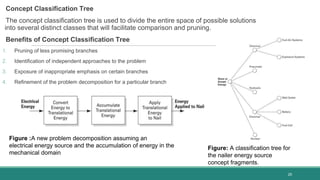
The concept classification tree is used to divide the entire space of possible solutions
into several distinct classes that will facilitate comparison and pruning.
Benefits of Concept Classification Tree
1. Pruning of less promising branches
2. Identification of independent approaches to the problem
3. Exposure of inappropriate emphasis on certain branches
4. Refinement of the problem decomposition for a particular branch
Figure: A classification tree for
the nailer energy source
concept fragments.
25
Figure :A new problem decomposition assuming an
electrical energy source and the accumulation of energy in the
mechanical domain
Concept Combination Table
The concept combination table provides a way to consider combinations of solution
fragments systematically.
• Columns correspond to identified subproblems
• Entries in each column correspond to solution fragments for each of the subproblems derived from the external and internal
searches
• Potential solutions to the overall problem are formed by combining one fragment from each column
• Combination of fragments must usually be developed and refined before an integrated solution emerges
• Involves additional creative thought
• If a fragment can be eliminated as being infeasible before combining it with other fragments, then the number of combinations the
team needs to consider is reduced
• The table should be concentrated on subproblems that are coupled
Figure: Concept combination table for the handheld nailer
26
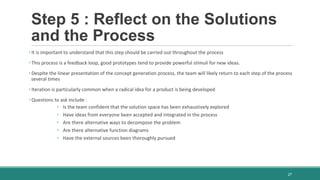
Step 5 : Reflect on the Solutions
and the Process
• It is important to understand that this step should be carried out throughout the process
• This process is a feedback loop, good prototypes tend to provide powerful stimuli for new ideas.
• Despite the linear presentation of the concept generation process, the team will likely return to each step of the process
several times
• Iteration is particularly common when a radical idea for a product is being developed
• Questions to ask include :
• Is the team confident that the solution space has been exhaustively explored
• Have ideas from everyone been accepted and integrated in the process
• Are there alternative ways to decompose the problem
• Are there alternative function diagrams
• Have the external sources been thoroughly pursued
27
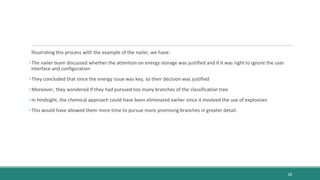
Illustrating this process with the example of the nailer, we have:
• The nailer team discussed whether the attention on energy storage was justified and if it was right to ignore the user
interface and configuration
• They concluded that since the energy issue was key, so their decision was justified
• Moreover, they wondered if they had pursued too many branches of the classification tree
• In hindsight, the chemical approach could have been eliminated earlier since it involved the use of explosives
• This would have allowed them more time to pursue more promising branches in greater detail.
28
References
• Product Design and Development (Sixth Edition), Karl T. Ulrich and Steven D. Eppinger
• Creative Design, Prototyping, and Testing (Coursera), University of Maryland
• Product Concept Generation article by Mical Nobel, Tufts Univerity Electrical and Computer Engineering Design
Handbook 2013
29

CONCEPT GENERATION.pptx

  • 1.
    CONCEPT GENERATIO N Fatima Rahman |Md Yusuf Ansari | Rehan Kumar | Md Zaffar | Shamim Ahmad 1
  • 2.
    Practical Example ofConcept Generation The president of Stanley-Bostitch commissioned a team to develop a new handheld nailer for the roofing market. The mission of the team was to consider broadly alternative product concepts, assuming only that the tool would employ conventional nails as the basic fastening technology. After identifying a set of customer needs and establishing target product specifications, the team faced the following questions: • What existing solution concepts, if any, could be successfully adapted for this application? • What new concepts might satisfy the established needs and specifications? • What methods can be used to facilitate the concept generation process? Courtesy of Bostitch Fastening Systems Figure 1: A cordless electric roofing nailer. 2
  • 3.
    The Activity ofConcept Generation A product concept is an approximate description of the technology, working principles, and form of the product. It is a concise description of how the product will satisfy the customer needs. A concept is usually expressed as a sketch or as a rough three-dimensional model and is often accompanied by a brief textual description. The degree to which a product satisfies customers and can be successfully commercialized depends to a large measure on the quality of the underlying concept. The concept generation process begins with a set of customer needs and target specifications and results in a set of product concepts from which the team will make a final selection. Good concept generation leaves the team with confidence that the full space of alternatives has been explored. Figure 2: Concept generation is an integral part of the concept development phase. 3
  • 4.
    Structured Approaches Reducethe Likelihood of Costly Problems Common dysfunctions exhibited by development teams during concept generation include: • Consideration of only one or two alternatives, often proposed by the most assertive members of the team. • Failure to consider carefully the usefulness of concepts employed by other firms in related and unrelated products. • Involvement of only one or two people in the process, resulting in lack of confidence and commitment by the rest of the team. • Ineffective integration of promising partial solutions. • Failure to consider entire categories of solutions. A structured approach to concept generation reduces the incidence of these problems by encouraging the gathering of information from many disparate information sources, by guiding the team in the thorough exploration of alternatives, and by providing a mechanism for integrating partial solutions. 4
  • 5.
  • 6.
    Step 1: Clarifythe Problem • Clarifying the problem consists of developing a general understanding and then breaking the problem down into subproblems if necessary. • The mission statement for the project, the customer needs list, and the preliminary product specification are the ideal inputs to the concept generation process, although often these pieces of information are still being refined as the concept generation phase begins. • Ideally the team has been involved both in the identification of the customer needs and in the setting of the target product specifications. 6
  • 7.
    1-A: Decompose aComplex Problem into Simpler Sub-problems • Many design challenges are too complex to solve as a single problem and can be usefully divided into several simpler subproblems. • As a general rule, we feel that teams should attempt to decompose design problems, but should be aware that such a decomposition may not be very useful for products with extremely simple functions. • Dividing a problem into simpler subproblems is called problem decomposition. There are many schemes by which a problem can be decomposed. Here we demonstrate a functional decomposition and also list several other approaches that are frequently useful. 7
  • 8.
    1-A: Decompose aComplex Problem into Simpler Sub-problems Figure 3: Function diagram of a handheld nailer arising from a functional decomposition: (a) overall “black box”; (b) refinement showing subfunctions. • As shown in the figure, the first step in decomposing a problem functionally is to represent it as a single black box operating on material, energy, and signal flows. • The next step in functional decomposition is to divide the single black box into subfunctions to create a more specific description of what the elements of the product might do to implement the overall function of the product. Each subfunction can generally be further divided into even simpler subfunctions. • The end result, shown in figure 3, is a function diagram containing subfunctions connected by energy, material, and signal flows. 8
  • 9.
    1-A: Decompose aComplex Problem into Simpler Sub-problems Functional decomposition is only one of several possible ways to divide a problem into simpler sub-problems. Two other approaches are: • Decomposition by sequence of user actions: For example, the nailer problem might be broken down into three user actions: moving the tool to the gross nailing position, positioning the tool precisely, and triggering the tool. This approach is often useful for products with very simple technical functions involving a lot of user interaction. • Decomposition by key customer needs: For the nailer, this decomposition might include the following subproblems: fires nails in rapid succession, is lightweight, and has a large nail capacity. This approach is often useful for products in which form, and not working principles or technology, is the primary problem. Examples of such products include toothbrushes (assuming the basic brush concept is retained) and storage containers. 9
  • 10.
    1-B: Focus InitialEfforts on the Critical Sub-problems • The goal of all of these decomposition techniques is to divide a complex problem into simpler problems such that these simpler problems can be tackled in a focused way. • Once problem decomposition is complete, the team chooses the subproblems that are most critical to the success of the product and that are most likely to benefit from novel or creative solutions. • This approach involves a conscious decision to defer the solution of some of the subproblems. • Teams can usually agree after a few minutes of discussion on which subproblems should be addressed first and which should be deferred for later consideration. 10
  • 11.
    Step 2: SearchExternally • External search is aimed at finding existing solutions to both the overall problem and the subproblems identified during the problem clarification step. • Implementing an existing solution is usually quicker and cheaper than developing a new solution. Liberal use of existing solutions allows the team to focus its creative energy on the critical subproblems for which there are no satisfactory prior solutions. • Conventional solution to one subproblem can frequently be combined with a novel solution to another subproblem to yield a superior overall design. • The external search for solutions is essentially an information-gathering process. Available time and resources can be optimized by using an expand-and-focus strategy: first expand the scope of the search by broadly gathering information that might be related to the problem and then focus the scope of the search by exploring the promising directions in more detail. 11
  • 12.
    There are fiveways to gather information from external sources: 1.Interview Lead Users •Lead users are those users of a product who experience needs months or years before the majority of the market and stand to benefit substantially from a product innovation (von Hippel, 1988). Frequently these lead users will have already invented solutions to meet their needs. •In the handheld nailer case, the nailer team consulted with the building contractors from the PBS television series This Old House to solicit new concepts. These lead users, who are exposed to tools from many manufacturers, made many interesting. Observations about the weaknesses in existing tools, but in this case did not provide many new product concepts. 12
  • 13.
    2.Consult Experts •Experts withknowledge of one or more of the subproblems not only can provide solution concepts directly but also can redirect the search in a more fruitful area. These people can be found by calling universities, by calling companies, and by looking up authors of articles. •In general, consultants will expect to be paid for time they spend on a problem beyond an initial meeting or telephone conversation. Suppliers are usually willing to provide several days of effort without direct compensation if they anticipate that someone will use their product as a component in a design. 13
  • 14.
    3.Search patent •Patents area rich and readily available source of technical information containing detailed drawings and explanations of how many products work. The main disadvantage of patent searches is that concepts found in recent patents are protected (generally for 20 years from the date of the patent application), so there may be a royalty involved in using them. •The formal indexing scheme for patents is difficult for novices to navigate. Fortunately, several databases contain the actual text of all patents. These text databases can be searched electronically by key words. Key word searches can be conducted efficiently with only modest practice and are remarkably effective in finding patents relevant to a particular product. 14
  • 15.
    4.Search Published Literature •Publishedliterature includes journals; conference proceedings; trade magazines; government reports; market, consumer, and product information; and new product announcements. Literature searches are therefore very fertile sources of existing solutions. •Electronic searches are frequently the most efficient way to gather information from published literature. Searching the Internet is often a good first step, although the quality of the results can be hard to assess. More structured databases are available from online sources. •Handbooks cataloging technical information can also be very useful references for external search. Examples of such engineering references are Marks’ Standard Handbook of Mechanical Engineering, Perry’s Chemical Engineers’ Handbook, and Mechanisms and Mechanical Devices Sourcebook. 15
  • 16.
    5.Benchmark Related Products •Inthe context of concept generation, benchmarking is the study of existing products with functionality similar to that of the product under development or to the subproblems on which the team is focused. Benchmarking can reveal existing concepts that have been implemented to solve a particular problem, as well as information on the strengths and weaknesses of the competition. •At this point the team will likely already be familiar with the competitive and closely related products. Products in other markets, but with related functionality, are more difficult to find. One of the most useful sources of this information is the Thomas Register, a directory of manufacturers of industrial products organized by product type. Often the hardest part of using the Thomas Register is finding out what related products are actually called and how they are cataloged. The Thomas Register database can be accessed via the Internet. 16
  • 17.
    Step 3: SearchInternally • Internal Search relies on innovative techniques. Osborn developed it in the 1940s. Also known as brainstorming. The generation of solution concepts involves the utilisation of individual and group creativity and knowledge. • Every concept that resulted from this step was developed using knowledge that the team already possessed. • Internal Search is useful to think as a process of retrieving a potentially useful piece of information from one's memory and then adapting that information to the problem at hand. • This process can be carried out by individuals working in isolation or by group of people working together. 17
  • 18.
    Guidelines for InternalSearch Five guidelines are useful for improving both individual and group internal search: 18 1. Suspend judgment 2. Generate a lot of ideas 3. Welcome ideas that may seem infeasible 4. Make plenty of sketches 5. Build sketch models
  • 19.
    1. Suspend judgment •Ifchoosing what to dress in the morning or what to eat for breakfast. We are used to making judgements quickly and moving on because the majorities of the decisions we make in our daily lives only have impact for a few minutes or hours. •Decisions made about product concepts have long-term effects on us. Therefore, it is essential to success that evaluation is put on hold for the days or weeks needed to produce a significant number of choices. The requirement to postpone judgement is usually translated into the rule that no concept judgement is permitted during group concept creation sessions. 2. Generate a lot of ideas. •Most experts believe that the more ideas a team generates, the more likely the team is to explore fully the solution space. •Trying to share more ideas may inspire people to share those they may otherwise consider unworthy of notice because doing so lowers the standards of excellence for any given thought. A high number of ideas has the ability to generate even more ideas because each thought serves as a trigger for more ideas. 19
  • 20.
    3. Welcome ideasthat may seem infeasible. Ideas that originally seem impossible can frequently be "debugged," "repaired," or enhanced by other team members. The more infeasible an idea, the more it stretches the boundaries of the solution space and encourages the team to think of the limits of possibility. 4. Make plenty of sketches. The ability to reason spatially about actual items might be difficult. The use of text and spoken language to describe physical objects is fundamentally ineffective. Many drawing materials should be accessible, whether working in a group or alone. The quality of the sketch is not as important in this case; what counts is how the concept is expressed (Yang and Cham, 2007). Additionally, it has been demonstrated that good concept development is correlated with adding important dimensions to concept sketches (Yang, 2009). 5. Build sketch models. Simple, physical models can quickly be created to express concepts using foam, clay, cardboard, 3- D printing, and other media. Three-dimensional sketch models are particularly helpful for problems requiring a deep understanding of form, user interface, and spatial relationships. 20
  • 21.
    Both Individual andGroup Sessions Can Be Useful • studies of group and individual problem solving suggest that a set of people working alone for a period of time will generate more and better concepts than the same people working together for the same time period (McGrath, 1984). • we believe that team members should spend at least some of their concept generation time working alone. This is because each person in the group may excel at a different dimension of creativity. That is, some members may be more fluid, while others are more flexible, and others can be more novel. • Practical reason for holding group concept generation sessions: In very intense and demanding work environments, without scheduling a meeting, few people will allocate several hours for concentrated individual effort on generating new concepts. The phone rings, people interrupt, urgent problems and e-mails demand attention. In certain environments, scheduled group sessions may be the only way to guarantee that enough attention is paid to the concept generation activity. • The nailer team used both individual effort and group sessions for internal search. For example, during one particular week each member was assigned one or two subproblems and was expected to develop at least 10 solution concepts. This divided the concept generation work among all members. The group then met to discuss and expand on the individually generated concepts. The more promising concepts were investigated further. 21
  • 22.
    Hints for GeneratingSolution Concepts Experienced individuals and groups may frequently sit down and start coming up with solid ideas for a subproblem. These people frequently have a range of thinking-stimulating approaches that have integrated naturally into their approach to problem-solving. Unskilled product development professionals may benefit from a set of hints that spark new ideas or create connections between concepts. Numerous recommendations are provided by VanGundy (1988), von Oech (1998), and McKim (1980) few of them are: • Wish and wonder Beginning a thought or comment with “I wish we could . . .” or “I wonder what would happen if . . .” helps to stimulate oneself or the group to consider new possibilities. These questions cause reflection on the boundaries of the problem. For ex, A member of the nailer team commented, "I wish the tool could be 1 metre long," when faced with the length of a rail gun, an electromagnetic device for speeding a projectile. In response to this remark, it was suggested that possibly a long tool, similar to a cane, could be used to nail decking while a person is still standing. 22
  • 23.
    • Use relatedstimuli When given a novel stimulus, the majority of people can come up with a fresh thought. The stimuli that are produced in the context of the current issue are related stimuli. For instance, one strategy for using related stimuli in a group session is for each person to independently come up with a list of ideas before passing the list to a neighbour. Most people are able to come up with new ideas after reflecting on someone else's ideas. Statements about client wants and images of the product's surroundings of use are additional relevant stimuli. • Set quantitative goals Generating new ideas can be exhausting. Near the end of a session, individuals and groups may find quantitative goals useful as a motivating force. The nailer team frequently issued individual concept generation assignments with quantitative targets of 10 to 20 concepts. 23
  • 24.
    Step 4 :Explore Systematically Explore Systematically aimed at navigating the space of possibilities by organizing and synthesizing these solution fragments. There are two specific tools for managing this complexity and organizing the thinking of the team: 1. Concept classification tree 2. Concept combination table 24
  • 25.
    Concept Classification Tree Theconcept classification tree is used to divide the entire space of possible solutions into several distinct classes that will facilitate comparison and pruning. Benefits of Concept Classification Tree 1. Pruning of less promising branches 2. Identification of independent approaches to the problem 3. Exposure of inappropriate emphasis on certain branches 4. Refinement of the problem decomposition for a particular branch Figure: A classification tree for the nailer energy source concept fragments. 25 Figure :A new problem decomposition assuming an electrical energy source and the accumulation of energy in the mechanical domain
  • 26.
    Concept Combination Table Theconcept combination table provides a way to consider combinations of solution fragments systematically. • Columns correspond to identified subproblems • Entries in each column correspond to solution fragments for each of the subproblems derived from the external and internal searches • Potential solutions to the overall problem are formed by combining one fragment from each column • Combination of fragments must usually be developed and refined before an integrated solution emerges • Involves additional creative thought • If a fragment can be eliminated as being infeasible before combining it with other fragments, then the number of combinations the team needs to consider is reduced • The table should be concentrated on subproblems that are coupled Figure: Concept combination table for the handheld nailer 26
  • 27.
    Step 5 :Reflect on the Solutions and the Process • It is important to understand that this step should be carried out throughout the process • This process is a feedback loop, good prototypes tend to provide powerful stimuli for new ideas. • Despite the linear presentation of the concept generation process, the team will likely return to each step of the process several times • Iteration is particularly common when a radical idea for a product is being developed • Questions to ask include : • Is the team confident that the solution space has been exhaustively explored • Have ideas from everyone been accepted and integrated in the process • Are there alternative ways to decompose the problem • Are there alternative function diagrams • Have the external sources been thoroughly pursued 27
  • 28.
    Illustrating this processwith the example of the nailer, we have: • The nailer team discussed whether the attention on energy storage was justified and if it was right to ignore the user interface and configuration • They concluded that since the energy issue was key, so their decision was justified • Moreover, they wondered if they had pursued too many branches of the classification tree • In hindsight, the chemical approach could have been eliminated earlier since it involved the use of explosives • This would have allowed them more time to pursue more promising branches in greater detail. 28
  • 29.
    References • Product Designand Development (Sixth Edition), Karl T. Ulrich and Steven D. Eppinger • Creative Design, Prototyping, and Testing (Coursera), University of Maryland • Product Concept Generation article by Mical Nobel, Tufts Univerity Electrical and Computer Engineering Design Handbook 2013 29