Ethics in Research
Chapter 1
Waseem Fayyaz
Quantiative Research
Preston
Outline:
1. Introduction to ethics in research
2. Ethical issues and human participants in
research
3. Ethical issues and nonhuman subjects in
research
4. Ethical issues and scientific integrity
1. Introduction to ethics in research
 you must accept the responsibility to behave
ethically toward those who will be affected
by your research
 ethics is the study of proper action
 research ethics concerns the responsibility
of researchers to be honest and respectful
to all individuals who may be affected by
their research studies or their reports of the
studies’ results
2. Ethical issues and human
participants in research
 Historical highlights of treatment of human
participants
– World War II – brutal experiments performed on
prisoners in Nazi concentration camps
– 1947 Nuremberg trial with experimenters who
conducted those experiments
– as a result of that trial – Nuremberg Code has been
established
2. Ethical issues and human
participants in research
 Historical highlights of treatment of human
participants (cont.)
– Milgram obedience study (Milgram, 1963)
 subjects instructed to use electric shock to punish
other individuals when they made errors in a learning
task
 participants were administering what appeared to be
dangerously strong and painful shocks
 no real shocks were used in the study
 although the participants in this study sustained no
physical harm, they suffered shame and
embarrassment for having behaved inhumanely
toward their fellow human beings
2. Ethical issues and human
participants in research
 American psychological association (APA)
Guidelines
– www.apa.org/ethics/code.html
– APA Ethics Code contains ten ethical
standards, and you should be completely
familiar with all of them before beginning any
research with human participants
2. Ethical issues and human
participants in research
 American psychological association (APA)
Guidelines (major ethical issues)
– No harm
 the researcher is obligated to protect participants
from physical or psychological harm
– Psychological harm – participants may feel increased
anxiety, anger, lower self-esteem especially in situations
where they feel that they have been cheated or insulted
 any risk of harm must be justified
 participants must be informed of any potential risks
2. Ethical issues and human
participants in research
 American psychological association (APA)
Guidelines (major ethical issues)
– Informed consent
 human participants should be given complete information
about the research and their role in it
 they should understand the information and then voluntarily
decide whether or not to participate
– information – if not possible to provide the subject with
information about the purpose of the study we can explain
to him at least exactly what will be done
– understanding – some participants may not be competent to
understand the research (e.g. children), therefore, it is
necessary to provide the information to a parent or a guardian
– voluntary participation – participants decide to participate of
their own free will (no obligation because of a teacher or a
professor asked them to do so)
2. Ethical issues and human
participants in research
 American psychological association (APA)
Guidelines (major ethical issues)
– deception – informed consent can not be obtain before
the study
 to obtain unbiased results researchers must sometimes use
deception because participants may adjust their own levels of
performance in an attempt to satisfy the experimenter
 Passive deception (or omission) is the withholding or omitting of
information (researcher intentionally does not tell participants
some information about the study)
 Active deception (or commission) is the presenting of
misinformation about the study to participants (misleading
participants about the specific purpose of the study)
2. Ethical issues and human
participants in research
 American psychological association (APA)
Guidelines (major ethical issues)
– guidelines for a study involving deception:
 the deception must be justified in terms of some benefit that
outweighs the risk to the participants
 the researcher can not conceal from the participants any
significant aspects of the study that is expected to cause
physical pain or severe emotional stress
 the researcher must provide the participant with debriefing that
explains the true nature of the experiment, including the use
and purpose of deception after the study is completed
2. Ethical issues and human
participants in research
 American psychological association (APA)
Guidelines (major ethical issues)
– Confidentiality
 is the practice of keeping strictly secret and private
the information or measurements obtained from an
individual during a research study
– Anonymity
 is the practice of ensuring that an individual’s name
is not directly associated with the information or
measurements obtained from that individuals (e.g.
using codes)
The Institutional Review board (IRB)
– most human-participant research must be reviewed and
approved by a group of individuals (scientists and non-
scientists) not directly affiliated with the specific
research study
– the U.S. Department of Health and Human Services
(HHS) requires review of all human-participant research
conducted by government agencies and institutions
receiving government funds
– IRB typically requires that researchers submit a written
research proposal that addresses each of the seven
criteria of IRB (minimization of risk to participants,
reasonable risk in relation to benefits, equitable
selection, informed consent, documentation of informed
consent, data monitoring, privacy and confidentiality)
 Category I (exempt review) – anonymous survey on innocuous
topic
 Category II (expedited review) – minimal risk to participants
 Category III (full review) – special populations, deception,
intervention, invasive measurement
3. Ethical issues and nonhuman
subjects in research
 the first ethical question is whether nonhuman subjects
should be used at all in behavioral research
 APA guidelines for the use and treatment of nonhuman
subjects in research
– animals must be treated humanely, qualified individuals must
conduct research, the research must be justified and the
researcher has a responsibility to minimize discomfort or harm
 institutions that conduct research with animals have an
animal research review board called the Institutional
Animal Care and Use Committee (IACUC)
– Committee consists of a veterinarian, at least one scientist
experience in animal research and a one member of public with
no affiliation with the institution
4. Ethical issues and scientific
integrity
 two ethical issues relevant to the written
reports of the research study
– fraud
 is an explicit effort of a researcher to deceive and
misrepresent the data
 fraud needs to be distinguished from an error
– error is an honest mistake that occurs in the research
process
 safeguards against fraud
– replication of studies by different scientists
– peer review when a researcher submits a research article for
publication (editor of the journal and a few experts in the field
critically review the paper in extreme detail)
4. Ethical issues and scientific
integrity
 two ethical issues relevant to the written reports of
the research study (cont.)
– plagiarism
 is the representation of someone else’s ideas or words as
one’s own, it is unethical!!!
 reference citations must be included in your paper whenever
someone else’s ideas or work has influenced your thinking and
writing
 whenever you use direct quotations or even paraphrase
someone else’s work, you need to give them credit
 include a complete list of references at the end of the paper
Writing an APA-Style Research
Report
Outline:
1. The goal of a research report
2. General APA guidelines for writing style
and format
3. The elements of an APA-style research
report
4. Submitting a manuscript for publication
5. Writing a research proposal
1. The goal of a research report
 basic purpose of a good research report is
to provide three kinds of information about
the research study:
– what was done (detailed description of your
research project)
– what was found (objective description of the
outcome)
– how your research study is related to other
knowledge in the area
1. The goal of a research report
 a research report is a very structured
document subdivided into separate, well-
defined segments, and each segment has
a specified content
 formal style and structure is determined by
the guidelines presented in the Publication
Manual of the American Psychological
Association (5th edition, 2001)
2. General APA guidelines for writing
style and format
 the goal is to provide simple, straightforward
description and explanation of your research
study
– impersonal style (don’t say ‘I believe..’, ‘I
think’)
– verb tense (past for the description of the
research and results, present tense in
discussion section)
– avoid biased language (age, gender, ethnicity)
– citations (e.g. Jones, 1998)
2. General APA guidelines for writing
style and format
 guidelines for typing and word-processing
– double spaced
– no more than 27 lines of text per page
– at least 1’’ margin on all sides
– typeface – 12-point Times Roman or 12-point
Courier
– each page of the manuscript, except for the
figures, is numbered and identified with a page
header
3. The elements of an APA-style
research report
 title page
– title page is the first page of a research report
manuscript and contains the title of the paper, the
author names and affiliations, and the running head
– a running head is an abbreviated title for a research
report, containing a maximum of 50 characters, it
appears on the title page of the manuscript and at the
top of the pages in a published article
 abstract
– abstract is a brief summary of the research study,
totaling no more than 120 words, the abstract focuses
on what was done and what was found in the study
3. The elements of an APA-style
research report
 Introduction
– is the first major section of text in a research report, it
presents a logical development of the research
question, including a review of the relevant background
literature, a statement of the research question and
hypothesis, and a brief description of the methods used
to answer the question or test the hypothesis
 method
– the method section of a research report describes how
the study was conducted, including the subjects or
participants, the apparatus or materials, and the
procedures used
3. The elements of an APA-style
research report
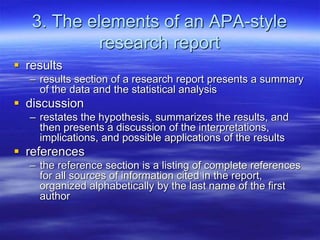
 results
– results section of a research report presents a summary
of the data and the statistical analysis
 discussion
– restates the hypothesis, summarizes the results, and
then presents a discussion of the interpretations,
implications, and possible applications of the results
 references
– the reference section is a listing of complete references
for all sources of information cited in the report,
organized alphabetically by the last name of the first
author
3. The elements of an APA-style
research report
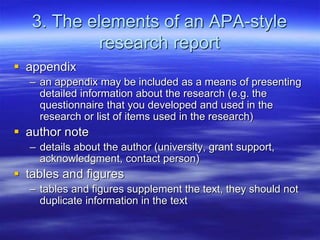
 appendix
– an appendix may be included as a means of presenting
detailed information about the research (e.g. the
questionnaire that you developed and used in the
research or list of items used in the research)
 author note
– details about the author (university, grant support,
acknowledgment, contact person)
 tables and figures
– tables and figures supplement the text, they should not
duplicate information in the text
4. Submitting a manuscript for
publication
 three steps to follow:
– select a journal that is appropriate for the topic
of your research report
– consult the journal’s instructions to authors for
specific submission requirements
– enclose a cover letter along with the manuscript
to the journal editor
5. Writing a research proposal
 a research proposal is a written report presenting
the plan and underlying rationale of a future
research study
 a proposal includes a review of the relevant
background literature, an explanation of how the
proposed study is related to other knowledge in
the area, a description of how the planned
research will be conducted, and a description of
the possible results
 writing a research proposal is very much like
writing a research report (you have to follow the
general APA style guidelines discussed earlier)

Ethics in Research, APA report

  • 1.
    Ethics in Research Chapter1 Waseem Fayyaz Quantiative Research Preston
  • 2.
    Outline: 1. Introduction toethics in research 2. Ethical issues and human participants in research 3. Ethical issues and nonhuman subjects in research 4. Ethical issues and scientific integrity
  • 3.
    1. Introduction toethics in research  you must accept the responsibility to behave ethically toward those who will be affected by your research  ethics is the study of proper action  research ethics concerns the responsibility of researchers to be honest and respectful to all individuals who may be affected by their research studies or their reports of the studies’ results
  • 4.
    2. Ethical issuesand human participants in research  Historical highlights of treatment of human participants – World War II – brutal experiments performed on prisoners in Nazi concentration camps – 1947 Nuremberg trial with experimenters who conducted those experiments – as a result of that trial – Nuremberg Code has been established
  • 5.
    2. Ethical issuesand human participants in research  Historical highlights of treatment of human participants (cont.) – Milgram obedience study (Milgram, 1963)  subjects instructed to use electric shock to punish other individuals when they made errors in a learning task  participants were administering what appeared to be dangerously strong and painful shocks  no real shocks were used in the study  although the participants in this study sustained no physical harm, they suffered shame and embarrassment for having behaved inhumanely toward their fellow human beings
  • 6.
    2. Ethical issuesand human participants in research  American psychological association (APA) Guidelines – www.apa.org/ethics/code.html – APA Ethics Code contains ten ethical standards, and you should be completely familiar with all of them before beginning any research with human participants
  • 7.
    2. Ethical issuesand human participants in research  American psychological association (APA) Guidelines (major ethical issues) – No harm  the researcher is obligated to protect participants from physical or psychological harm – Psychological harm – participants may feel increased anxiety, anger, lower self-esteem especially in situations where they feel that they have been cheated or insulted  any risk of harm must be justified  participants must be informed of any potential risks
  • 8.
    2. Ethical issuesand human participants in research  American psychological association (APA) Guidelines (major ethical issues) – Informed consent  human participants should be given complete information about the research and their role in it  they should understand the information and then voluntarily decide whether or not to participate – information – if not possible to provide the subject with information about the purpose of the study we can explain to him at least exactly what will be done – understanding – some participants may not be competent to understand the research (e.g. children), therefore, it is necessary to provide the information to a parent or a guardian – voluntary participation – participants decide to participate of their own free will (no obligation because of a teacher or a professor asked them to do so)
  • 9.
    2. Ethical issuesand human participants in research  American psychological association (APA) Guidelines (major ethical issues) – deception – informed consent can not be obtain before the study  to obtain unbiased results researchers must sometimes use deception because participants may adjust their own levels of performance in an attempt to satisfy the experimenter  Passive deception (or omission) is the withholding or omitting of information (researcher intentionally does not tell participants some information about the study)  Active deception (or commission) is the presenting of misinformation about the study to participants (misleading participants about the specific purpose of the study)
  • 10.
    2. Ethical issuesand human participants in research  American psychological association (APA) Guidelines (major ethical issues) – guidelines for a study involving deception:  the deception must be justified in terms of some benefit that outweighs the risk to the participants  the researcher can not conceal from the participants any significant aspects of the study that is expected to cause physical pain or severe emotional stress  the researcher must provide the participant with debriefing that explains the true nature of the experiment, including the use and purpose of deception after the study is completed
  • 11.
    2. Ethical issuesand human participants in research  American psychological association (APA) Guidelines (major ethical issues) – Confidentiality  is the practice of keeping strictly secret and private the information or measurements obtained from an individual during a research study – Anonymity  is the practice of ensuring that an individual’s name is not directly associated with the information or measurements obtained from that individuals (e.g. using codes)
  • 12.
    The Institutional Reviewboard (IRB) – most human-participant research must be reviewed and approved by a group of individuals (scientists and non- scientists) not directly affiliated with the specific research study – the U.S. Department of Health and Human Services (HHS) requires review of all human-participant research conducted by government agencies and institutions receiving government funds – IRB typically requires that researchers submit a written research proposal that addresses each of the seven criteria of IRB (minimization of risk to participants, reasonable risk in relation to benefits, equitable selection, informed consent, documentation of informed consent, data monitoring, privacy and confidentiality)  Category I (exempt review) – anonymous survey on innocuous topic  Category II (expedited review) – minimal risk to participants  Category III (full review) – special populations, deception, intervention, invasive measurement
  • 13.
    3. Ethical issuesand nonhuman subjects in research  the first ethical question is whether nonhuman subjects should be used at all in behavioral research  APA guidelines for the use and treatment of nonhuman subjects in research – animals must be treated humanely, qualified individuals must conduct research, the research must be justified and the researcher has a responsibility to minimize discomfort or harm  institutions that conduct research with animals have an animal research review board called the Institutional Animal Care and Use Committee (IACUC) – Committee consists of a veterinarian, at least one scientist experience in animal research and a one member of public with no affiliation with the institution
  • 14.
    4. Ethical issuesand scientific integrity  two ethical issues relevant to the written reports of the research study – fraud  is an explicit effort of a researcher to deceive and misrepresent the data  fraud needs to be distinguished from an error – error is an honest mistake that occurs in the research process  safeguards against fraud – replication of studies by different scientists – peer review when a researcher submits a research article for publication (editor of the journal and a few experts in the field critically review the paper in extreme detail)
  • 15.
    4. Ethical issuesand scientific integrity  two ethical issues relevant to the written reports of the research study (cont.) – plagiarism  is the representation of someone else’s ideas or words as one’s own, it is unethical!!!  reference citations must be included in your paper whenever someone else’s ideas or work has influenced your thinking and writing  whenever you use direct quotations or even paraphrase someone else’s work, you need to give them credit  include a complete list of references at the end of the paper
  • 16.
    Writing an APA-StyleResearch Report
  • 17.
    Outline: 1. The goalof a research report 2. General APA guidelines for writing style and format 3. The elements of an APA-style research report 4. Submitting a manuscript for publication 5. Writing a research proposal
  • 18.
    1. The goalof a research report  basic purpose of a good research report is to provide three kinds of information about the research study: – what was done (detailed description of your research project) – what was found (objective description of the outcome) – how your research study is related to other knowledge in the area
  • 19.
    1. The goalof a research report  a research report is a very structured document subdivided into separate, well- defined segments, and each segment has a specified content  formal style and structure is determined by the guidelines presented in the Publication Manual of the American Psychological Association (5th edition, 2001)
  • 20.
    2. General APAguidelines for writing style and format  the goal is to provide simple, straightforward description and explanation of your research study – impersonal style (don’t say ‘I believe..’, ‘I think’) – verb tense (past for the description of the research and results, present tense in discussion section) – avoid biased language (age, gender, ethnicity) – citations (e.g. Jones, 1998)
  • 21.
    2. General APAguidelines for writing style and format  guidelines for typing and word-processing – double spaced – no more than 27 lines of text per page – at least 1’’ margin on all sides – typeface – 12-point Times Roman or 12-point Courier – each page of the manuscript, except for the figures, is numbered and identified with a page header
  • 22.
    3. The elementsof an APA-style research report  title page – title page is the first page of a research report manuscript and contains the title of the paper, the author names and affiliations, and the running head – a running head is an abbreviated title for a research report, containing a maximum of 50 characters, it appears on the title page of the manuscript and at the top of the pages in a published article  abstract – abstract is a brief summary of the research study, totaling no more than 120 words, the abstract focuses on what was done and what was found in the study
  • 23.
    3. The elementsof an APA-style research report  Introduction – is the first major section of text in a research report, it presents a logical development of the research question, including a review of the relevant background literature, a statement of the research question and hypothesis, and a brief description of the methods used to answer the question or test the hypothesis  method – the method section of a research report describes how the study was conducted, including the subjects or participants, the apparatus or materials, and the procedures used
  • 24.
    3. The elementsof an APA-style research report  results – results section of a research report presents a summary of the data and the statistical analysis  discussion – restates the hypothesis, summarizes the results, and then presents a discussion of the interpretations, implications, and possible applications of the results  references – the reference section is a listing of complete references for all sources of information cited in the report, organized alphabetically by the last name of the first author
  • 25.
    3. The elementsof an APA-style research report  appendix – an appendix may be included as a means of presenting detailed information about the research (e.g. the questionnaire that you developed and used in the research or list of items used in the research)  author note – details about the author (university, grant support, acknowledgment, contact person)  tables and figures – tables and figures supplement the text, they should not duplicate information in the text
  • 26.
    4. Submitting amanuscript for publication  three steps to follow: – select a journal that is appropriate for the topic of your research report – consult the journal’s instructions to authors for specific submission requirements – enclose a cover letter along with the manuscript to the journal editor
  • 27.
    5. Writing aresearch proposal  a research proposal is a written report presenting the plan and underlying rationale of a future research study  a proposal includes a review of the relevant background literature, an explanation of how the proposed study is related to other knowledge in the area, a description of how the planned research will be conducted, and a description of the possible results  writing a research proposal is very much like writing a research report (you have to follow the general APA style guidelines discussed earlier)