THE
MORAL AGENT
N
E
S
W
MORAL AGENT
 A moral agent is a person who has the ability to discern right
from wrong and to be held accountable for his or her own
actions. Moral agents have a moral responsibility not to cause
unjustified harm. Traditionally, moral agency is assigned only to
those who can be held responsible for their actions.
CULTURE
 Culture (/ˈkʌltʃər/) is an umbrella term which encompasses
the social behavior and norms found in human societies, as well
as the knowledge, beliefs, arts, laws, customs, capabilities and
habits of the individuals in these groups.[1]
 Humans acquire culture through the learning processes
of enculturation and socialization, which is shown by the diversity
of cultures across societies.
CULTURE IN MORAL BEHAVIOR
Ethics are the set of moral principles that guide a person's behavior. These morals are shaped by social
norms, cultural practices, and religious influences. Ethics reflect beliefs about what is right, what is wrong, what is just, what is
unjust, what is good, and what is bad in terms of human behavior.
CULTURAL
RELATIVISM
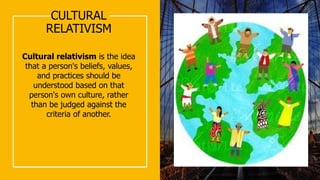
Cultural relativism is the idea
that a person's beliefs, values,
and practices should be
understood based on that
person's own culture, rather
than be judged against the
criteria of another.
CULTURE IN MORAL BEHAVIOR
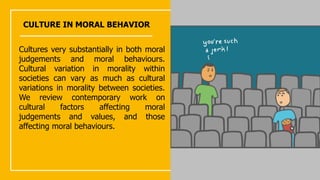
Cultures very substantially in both moral
judgements and moral behaviours.
Cultural variation in morality within
societies can vary as much as cultural
variations in morality between societies.
We review contemporary work on
cultural factors affecting moral
judgements and values, and those
affecting moral behaviours.
CULTURE IN MORAL BEHAVIOR
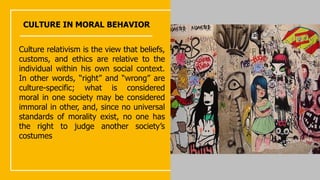
Culture relativism is the view that beliefs,
customs, and ethics are relative to the
individual within his own social context.
In other words, “right” and “wrong” are
culture-specific; what is considered
moral in one society may be considered
immoral in other, and, since no universal
standards of morality exist, no one has
the right to judge another society’s
costumes
CULTURE IN MORAL BEHAVIOR
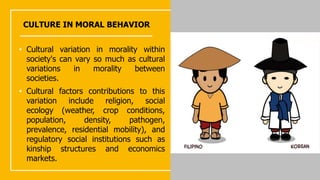
• Cultural variation in morality within
society's can vary so much as cultural
variations in morality between
societies.
• Cultural factors contributions to this
variation include religion, social
ecology (weather, crop conditions,
population, density, pathogen,
prevalence, residential mobility), and
regulatory social institutions such as
kinship structures and economics
markets.
CULTURE IN MORAL BEHAVIOR
Whether between or within nations and societies,
cultures vary substantially in their promotion and
transmission of a multitude of moral judgments
and behavior. Cultural factors contributing to this
variation include religion, social ecology(weather,
crop conditions, population density, pathogen
prevalence, residential mobility), and regulatory
social institutions such as kinship structures and
economic markets. This variability raises
questions for normative theories of morality, but
also holds promise for future descriptive work on
moral thought and behavior.
FILIPINO
CULTURE
FILIPINO CULTURE
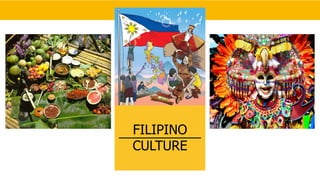
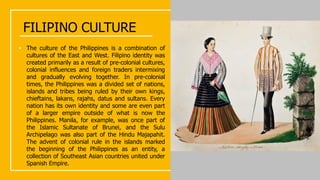
• The culture of the Philippines is a combination of
cultures of the East and West. Filipino identity was
created primarily as a result of pre-colonial cultures,
colonial influences and foreign traders intermixing
and gradually evolving together. In pre-colonial
times, the Philippines was a divided set of nations,
islands and tribes being ruled by their own kings,
chieftains, lakans, rajahs, datus and sultans. Every
nation has its own identity and some are even part
of a larger empire outside of what is now the
Philippines. Manila, for example, was once part of
the Islamic Sultanate of Brunei, and the Sulu
Archipelago was also part of the Hindu Majapahit.
The advent of colonial rule in the islands marked
the beginning of the Philippines as an entity, a
collection of Southeast Asian countries united under
Spanish Empire.
Pakikipagkapwa-tao
Opening yourself to
others and feel one
with other with dignity
and respect deal with
them as fellow human
beings.
• sense of fairness and justice
• concern of others
• ability to empathize with others
• helpfulness and generosity
• practice of hospitality
• sensitive to other feelings and trust
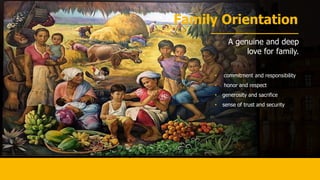
Family Orientation
A genuine and deep
love for family.
• commitment and responsibility
• honor and respect
• generosity and sacrifice
• sense of trust and security
Joy and Humor
Filipinos have a cheerful
and fun loving approach
to life and its up and
down, pleasant
disposition, a sense of
humor and propensity for
happiness that contribute
not only to the Filipino
charm but also to the
Filipino spirit.
• emotional balance and optimism
• healthy disrespect for power
and office
Flexibility, adaptability
and Creativity
Hard work and industry
Capacity for hard work
given to raise ones
standard living of a
decent life for ones
family.
Faith and Religiosity
Faith in god –
accepting reality to
comprehend as a
human created by god.
“Pampalakas-loob”
Extreme Personalism
• always trying to give
personal interpretation to
actions
• thank you with “but”
(compliment-criticism-
complement)
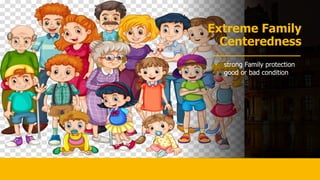
Extreme Family
Centeredness
• strong Family protection
good or bad condition
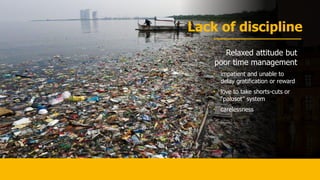
Lack of discipline
Relaxed attitude but
poor time management
• impatient and unable to
delay gratification or reward
• love to take shorts-cuts or
“palusot” system
• carelessness
Passivity and Lack
of initiative
strong reliance to
others fate
• yeah proud pinoy. Its all
because of the
race(nationality/blood) not by
persons attitude, hard work,
dream and perseverance etc.
• very complacent (relax) but
their rarely is a sense of
urgency (its ok we have 1 day
left to finished, just relax)
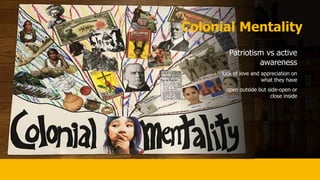
Colonial Mentality
Patriotism vs active
awareness
• luck of love and appreciation on
what they have
• open outside but side-open or
close inside
Colonial Mentality
Patriotism vs active
awareness
• luck of love and appreciation on
what they have
• open outside but side-open or
close inside
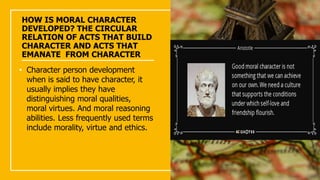
HOW IS MORAL CHARACTER
DEVELOPED? THE CIRCULAR
RELATION OF ACTS THAT BUILD
CHARACTER AND ACTS THAT
EMANATE FROM CHARACTER
• Character person development
when is said to have character, it
usually implies they have
distinguishing moral qualities,
moral virtues. And moral reasoning
abilities. Less frequently used terms
include morality, virtue and ethics.
HOW IS MORAL CHARACTER
DEVELOPED? THE CIRCULAR
RELATION OF ACTS THAT BUILD
CHARACTER AND ACTS THAT
EMANATE FROM CHARACTER
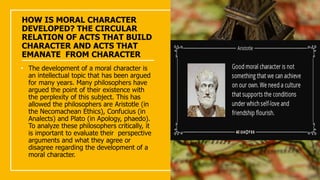
• The development of a moral character is
an intellectual topic that has been argued
for many years. Many philosophers have
argued the point of their existence with
the perplexity of this subject. This has
allowed the philosophers are Aristotle (in
the Necomachean Ethics), Confucius (in
Analects) and Plato (in Apology, phaedo).
To analyze these philosophers critically, it
is important to evaluate their perspective
arguments and what they agree or
disagree regarding the development of a
moral character.
MORAL
CHARACTER
A Moral character is defined as a
idea in which one is unique and
can be distinguished from others
perhaps it can assemble qualities
and traits that are different from
various individuals.
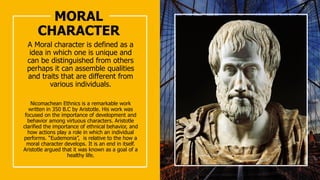
Nicomachean Ethnics is a remarkable work
written in 350 B.C by Aristotle. His work was
focused on the importance of development and
behavior among virtuous characters. Aristotle
clarified the importance of ethnical behavior, and
how actions play a role in which an individual
performs. “Eudemonia”, is relative to the how a
moral character develops. It is an end in itself.
Aristotle argued that it was known as a goal of a
healthy life.
Nelson Mandela
Adolf Hitler
THANK YOU

Moral agent

  • 1.
  • 2.
    MORAL AGENT  Amoral agent is a person who has the ability to discern right from wrong and to be held accountable for his or her own actions. Moral agents have a moral responsibility not to cause unjustified harm. Traditionally, moral agency is assigned only to those who can be held responsible for their actions.
  • 3.
    CULTURE  Culture (/ˈkʌltʃər/)is an umbrella term which encompasses the social behavior and norms found in human societies, as well as the knowledge, beliefs, arts, laws, customs, capabilities and habits of the individuals in these groups.[1]  Humans acquire culture through the learning processes of enculturation and socialization, which is shown by the diversity of cultures across societies.
  • 4.
    CULTURE IN MORALBEHAVIOR Ethics are the set of moral principles that guide a person's behavior. These morals are shaped by social norms, cultural practices, and religious influences. Ethics reflect beliefs about what is right, what is wrong, what is just, what is unjust, what is good, and what is bad in terms of human behavior.
  • 5.
    CULTURAL RELATIVISM Cultural relativism isthe idea that a person's beliefs, values, and practices should be understood based on that person's own culture, rather than be judged against the criteria of another.
  • 6.
    CULTURE IN MORALBEHAVIOR Cultures very substantially in both moral judgements and moral behaviours. Cultural variation in morality within societies can vary as much as cultural variations in morality between societies. We review contemporary work on cultural factors affecting moral judgements and values, and those affecting moral behaviours.
  • 7.
    CULTURE IN MORALBEHAVIOR Culture relativism is the view that beliefs, customs, and ethics are relative to the individual within his own social context. In other words, “right” and “wrong” are culture-specific; what is considered moral in one society may be considered immoral in other, and, since no universal standards of morality exist, no one has the right to judge another society’s costumes
  • 8.
    CULTURE IN MORALBEHAVIOR • Cultural variation in morality within society's can vary so much as cultural variations in morality between societies. • Cultural factors contributions to this variation include religion, social ecology (weather, crop conditions, population, density, pathogen, prevalence, residential mobility), and regulatory social institutions such as kinship structures and economics markets.
  • 9.
    CULTURE IN MORALBEHAVIOR Whether between or within nations and societies, cultures vary substantially in their promotion and transmission of a multitude of moral judgments and behavior. Cultural factors contributing to this variation include religion, social ecology(weather, crop conditions, population density, pathogen prevalence, residential mobility), and regulatory social institutions such as kinship structures and economic markets. This variability raises questions for normative theories of morality, but also holds promise for future descriptive work on moral thought and behavior.
  • 10.
  • 11.
    FILIPINO CULTURE • Theculture of the Philippines is a combination of cultures of the East and West. Filipino identity was created primarily as a result of pre-colonial cultures, colonial influences and foreign traders intermixing and gradually evolving together. In pre-colonial times, the Philippines was a divided set of nations, islands and tribes being ruled by their own kings, chieftains, lakans, rajahs, datus and sultans. Every nation has its own identity and some are even part of a larger empire outside of what is now the Philippines. Manila, for example, was once part of the Islamic Sultanate of Brunei, and the Sulu Archipelago was also part of the Hindu Majapahit. The advent of colonial rule in the islands marked the beginning of the Philippines as an entity, a collection of Southeast Asian countries united under Spanish Empire.
  • 12.
    Pakikipagkapwa-tao Opening yourself to othersand feel one with other with dignity and respect deal with them as fellow human beings. • sense of fairness and justice • concern of others • ability to empathize with others • helpfulness and generosity • practice of hospitality • sensitive to other feelings and trust
  • 13.
    Family Orientation A genuineand deep love for family. • commitment and responsibility • honor and respect • generosity and sacrifice • sense of trust and security
  • 14.
    Joy and Humor Filipinoshave a cheerful and fun loving approach to life and its up and down, pleasant disposition, a sense of humor and propensity for happiness that contribute not only to the Filipino charm but also to the Filipino spirit. • emotional balance and optimism • healthy disrespect for power and office
  • 15.
  • 16.
    Hard work andindustry Capacity for hard work given to raise ones standard living of a decent life for ones family.
  • 17.
    Faith and Religiosity Faithin god – accepting reality to comprehend as a human created by god. “Pampalakas-loob”
  • 18.
    Extreme Personalism • alwaystrying to give personal interpretation to actions • thank you with “but” (compliment-criticism- complement)
  • 19.
    Extreme Family Centeredness • strongFamily protection good or bad condition
  • 20.
    Lack of discipline Relaxedattitude but poor time management • impatient and unable to delay gratification or reward • love to take shorts-cuts or “palusot” system • carelessness
  • 21.
    Passivity and Lack ofinitiative strong reliance to others fate • yeah proud pinoy. Its all because of the race(nationality/blood) not by persons attitude, hard work, dream and perseverance etc. • very complacent (relax) but their rarely is a sense of urgency (its ok we have 1 day left to finished, just relax)
  • 22.
    Colonial Mentality Patriotism vsactive awareness • luck of love and appreciation on what they have • open outside but side-open or close inside
  • 23.
    Colonial Mentality Patriotism vsactive awareness • luck of love and appreciation on what they have • open outside but side-open or close inside
  • 24.
    HOW IS MORALCHARACTER DEVELOPED? THE CIRCULAR RELATION OF ACTS THAT BUILD CHARACTER AND ACTS THAT EMANATE FROM CHARACTER • Character person development when is said to have character, it usually implies they have distinguishing moral qualities, moral virtues. And moral reasoning abilities. Less frequently used terms include morality, virtue and ethics.
  • 25.
    HOW IS MORALCHARACTER DEVELOPED? THE CIRCULAR RELATION OF ACTS THAT BUILD CHARACTER AND ACTS THAT EMANATE FROM CHARACTER • The development of a moral character is an intellectual topic that has been argued for many years. Many philosophers have argued the point of their existence with the perplexity of this subject. This has allowed the philosophers are Aristotle (in the Necomachean Ethics), Confucius (in Analects) and Plato (in Apology, phaedo). To analyze these philosophers critically, it is important to evaluate their perspective arguments and what they agree or disagree regarding the development of a moral character.
  • 26.
    MORAL CHARACTER A Moral characteris defined as a idea in which one is unique and can be distinguished from others perhaps it can assemble qualities and traits that are different from various individuals. Nicomachean Ethnics is a remarkable work written in 350 B.C by Aristotle. His work was focused on the importance of development and behavior among virtuous characters. Aristotle clarified the importance of ethnical behavior, and how actions play a role in which an individual performs. “Eudemonia”, is relative to the how a moral character develops. It is an end in itself. Aristotle argued that it was known as a goal of a healthy life.
  • 27.
  • 28.
  • 29.